Your card was declined at the airport, so you search for your bank’s name and tap the first phone number on the screen. Someone picks up, says the bank’s name and asks for your card number to “look into it.” That number may have been placed there by a scammer who paid for an ad or planted a fake listing.
The fix is not complicated, but it has to happen before you dial. You need to know which sources a company actually controls, which ones anyone can fill, and how to check a number that someone else handed to you.
Search results are the first place fake numbers hide
People look up customer service numbers in a hurry, usually when something has already gone wrong. That is exactly when nobody stops to ask where a number came from.
The FTC’s advice on search results is blunt: “Don’t assume the phone number that comes up in search is legit.” Paid ads can sit above the real company’s website and look almost identical to it. Planted numbers also turn up in map listings, forum posts and copycat “helpline” sites, and AI-generated summaries can repeat them with confidence.
The losses are large. According to the FTC, people reported losing nearly $1 billion to business impersonators in 2025, up from $866 million in 2024, and bank impersonators caused the highest losses of any business type. Many of those scams turn on a phone number. Either the scammer calls you, or you call a number the scammer put in your path.
The number on your card beats any search result
The safest rule: take the number from something the company gave you, not from something you found or something that found you.
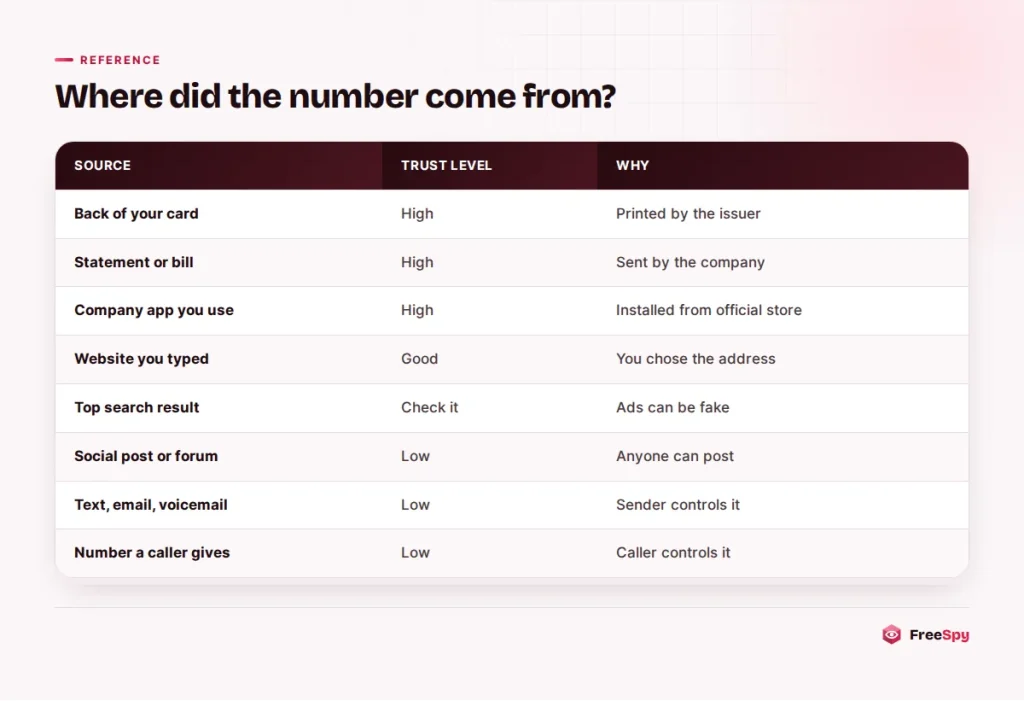
For a bank or card issuer, the number on the back of the physical card is the gold standard. The issuer printed it, and it reaches the people who can freeze or replace that card.
Next comes your statement or bill. The FTC suggests that if you are paying a bill, you “call the number from your bill directly.” A paper statement that came in the mail, or a PDF you downloaded after logging in, both count.
The company’s own app is reliable too, as long as you installed it from the official app store and have been using it for a while. If you only just downloaded it, check that the developer name matches the company before you trust its “Contact us” page.
Product boxes and paperwork are underrated. The FTC notes that “the packaging, manual, or other print material for your product is a good source of real customer service information.” Welcome letters, contracts and receipts work the same way.
Finally, a website address you type yourself, or a bookmark you saved earlier, is far safer than a link from a search page or an email.
What’s missing from that list matters as much: the top search result, and any number that arrives inside a text, a voicemail or a caller’s script. Someone other than the company can control all of those.
Ads, look-alike addresses and “all brands” helplines
Sometimes you have to search, for instance when you need a company you have never dealt with. The FTC suggests looking past the top results, which may be paid ads, and double-checking the web address before you trust it.
A “Sponsored” label is not proof of fraud, since plenty of ads are legitimate, but it is the easiest way for a scammer to reach the top of the page. Look hard at the address itself. Extra words like “help”, “support” or “official”, a brand name with one letter swapped, or an odd ending after the dot should all slow you down.
Real company sites have logins, product pages and a contact page buried in the menu. Fake ones are often a large “Call now” button with little behind it. Pages that list “customer service numbers for every airline” or “printer support for all brands” are not run by any of those brands. And if a number shows up only on forums or social media, and never on the company’s own site, treat it as unverified.
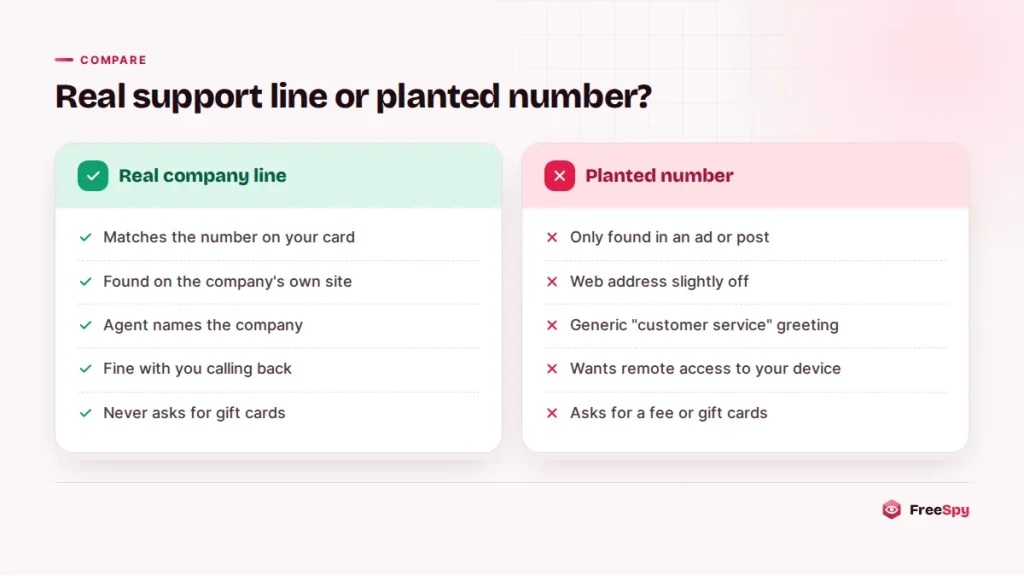
The call itself gives a fake line away quickly. It may answer “Customer service, how can I help?” without naming the company, then move on to remote access, a fee or gift cards. The FTC’s line here is firm: never wire money, send gift cards or give your account password in exchange for customer service help.
Checking a number before you dial it
Sometimes the number comes to you: a caller says “call us back at this number,” or it is in a voicemail, a text or a letter you are not sure about. Before you dial, run it through a reverse lookup. On FreeSpy you can paste it into the search box, or go straight to an address like freespy.app/2025550147, with no sign-up.
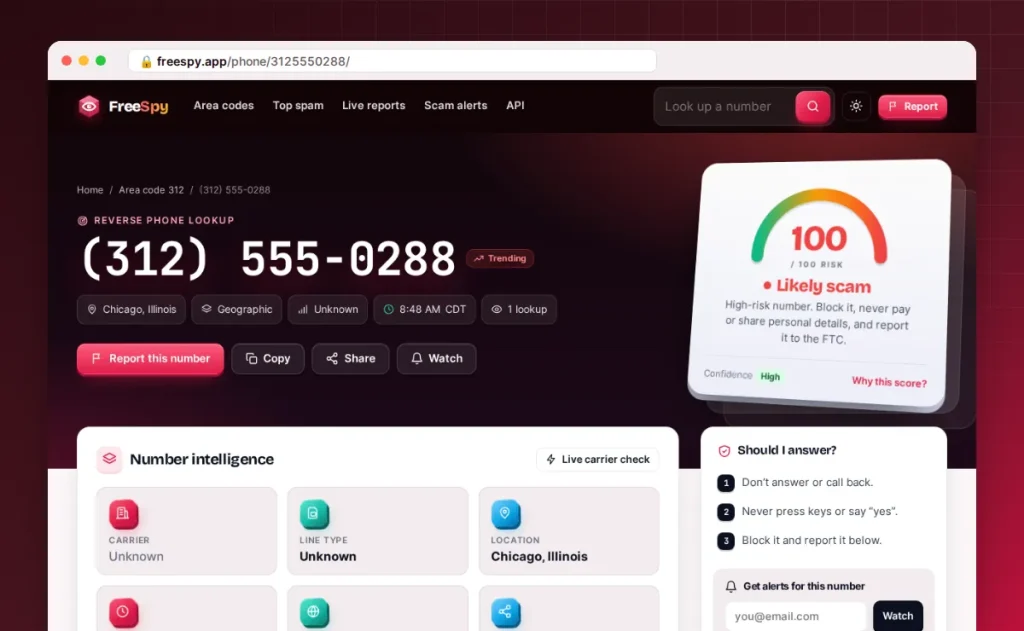
Start with validity. The page checks every number against North American Numbering Plan rules, and a number that cannot exist is a strong sign of spoofing.
Then look at the type: toll-free, geographic, premium 900 or Caribbean +1 international. Large companies usually publish toll-free or main office numbers. A Caribbean code on a supposed US bank line should stop you cold, and a “local branch” whose area code is on the other side of the continent deserves a second look. If a code is unfamiliar, the area code list shows its region or country.
Line type helps when carrier data is available. A fraud department calling from someone’s personal mobile line would be unusual. VoIP on its own is not a warning sign, though, because many real call centers run on it.
Reports are often the most useful part. Community reports and FTC Do Not Call complaints show whether other people have flagged the number and what the caller claimed to be. A comment like “said they were my bank” tells you more than any score.
The page also shows a 0–100 risk score with each factor and its points listed. A verified business is capped at 15 points. “No reports yet” only means nobody has flagged the number so far; a scammer may have started using it yesterday. Read a clean result as “no warnings found,” and still compare the number with the one on your card or statement.
When the “company” is the one calling
Incoming calls are where most impersonation scams begin. The caller says they are from your bank’s fraud team, your phone carrier or a delivery company, and they often know your name and part of your card number. You can end it politely:
“Thanks for letting me know. I’m going to hang up and call the number on the back of my card. Is there a reference number I should give them?”
A real company accepts that, and its staff can see a genuine alert on your account when you call the official line. A scammer pushes back. There is no time, the case will “restart,” the account will be “frozen.” Pressure to stay on the line is the clearest sign you should leave it.
Don’t let the screen talk you out of it. The Canadian Anti-Fraud Centre warns, “Do not assume that phone numbers appearing on your call display are accurate,” because the number shown is whatever the calling system sends, and that can be your bank’s real number. If you want the technical side, this explainer on how spoofing works covers it. The CAFC also suggests calling your bank from a different phone, or waiting 10 minutes before you call out, since some scams try to hold the line open after you hang up.
Verified caller ID is starting to appear. Apple announced in October 2024 that businesses would be able to register for Business Caller ID, which shows a verified company’s name, logo and department on the incoming call screen. Google says its own legitimate calls identify Google, give a reason for calling, and never ask for payment information over the phone. Useful, but these features don’t cover every company or every phone yet.
Bank calls are the most expensive version of this, and they follow a script of their own. The tells of fake fraud-team calls are worth knowing before one reaches you.
Toll-free twins, agencies and airline lines
A toll-free number one digit off
Scammers sometimes register a toll-free number that differs from a real one by a single digit, or uses a different prefix such as 888 instead of 800. Dial from memory and you can land on the wrong line. Copy toll-free numbers from your card or statement instead.
Government agencies
Use the agency’s own .gov site, or canada.ca in Canada. The Social Security Administration’s national number is 1-800-772-1213 and the IRS’s main individual line is 1-800-829-1040. If someone claiming to be from an agency calls first and gives you a different number to ring back, it’s a scam.
Airlines and hotels
Fake airline and hotel lines are common because people search for them under stress, at a gate or a check-in desk. Use the number in the airline’s app, on its own website, or in the confirmation email you got when you booked directly.
Pop-up “support” numbers
A warning that takes over your browser and tells you to call a support number is almost always a scam. Close the tab; if it won’t close, restart the device.
Ten minutes now saves a panicked search later
The best time to find a real number is before you need it. While nothing is wrong, save these in your contacts:
- Your bank and card issuers, copied from the back of each card, with clear labels such as “Bank fraud line (from card)”
- Your mobile carrier, internet provider, and power and gas utility, copied from a recent bill
- Your insurer and pharmacy, from your insurance card or a prescription label
- Any airline or loyalty program you use often, from its app
Do it for parents or relatives as well. “Call the number saved as Bank fraud line” is a much easier instruction to follow in a stressful moment than “search for it.”
Already called a planted number?
Fake support lines are built to sound exactly like the real thing, so there is nothing to be embarrassed about. What matters now is what you shared.
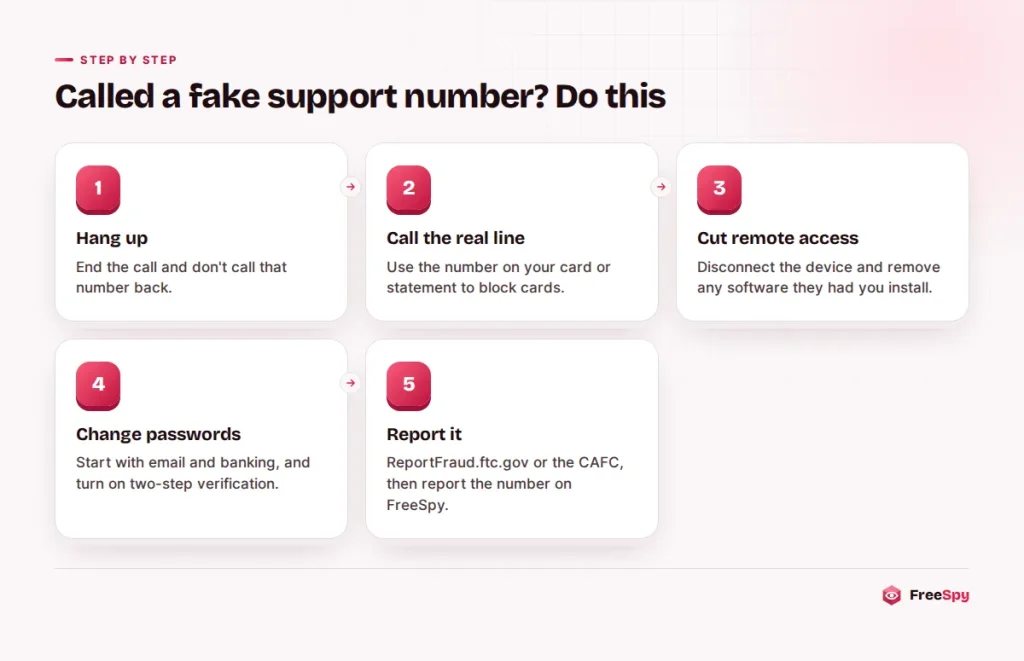
- Hang up and don’t call that number again.
- If you gave card or bank details, call the real number on your card or statement, ask them to block the card and review recent transactions.
- If you allowed remote access to a computer or phone, disconnect it from the internet, remove the software, and have the device checked before you log in to anything.
- Change passwords for every account you mentioned, starting with email and banking, and turn on two-step verification.
- Report it. In the US, report to the FTC at ReportFraud.ftc.gov. In Canada, report to the Canadian Anti-Fraud Centre at 1-888-495-8501 or online.
It also helps to add a report for the number you called, so the next person who looks it up sees what happened to you.
Quick answers
Is the number in a map listing reliable?
Often, but not always. Listings can be wrong, out of date or deliberately faked. For any company that holds your money or personal data, use the number from your card, statement, app or a website address you typed yourself.
What about a number in an email from the company?
Emails can be forged to look like they came from a company you use. Instead of calling a number in the email, log in to your account through the app or a typed address and use the contact details there.
Sources
- FTC: Online search results: the good, the bad, and the scammy
- FTC: Scammers and “customer service”, another imposter scam
- FTC: Imposter scam losses in 2025
- Canadian Anti-Fraud Centre: Bank investigator
- Apple Newsroom, October 2024
- Google Business Profile Help: Fraudulent calls and texts