Is FreeSpy really free?
Yes. Every lookup is free and needs no sign-up. That covers the verdict, carrier, line type, location, community reports and FTC complaints. Businesses that need high-volume API access can choose a paid plan.
Where does the data come from?
From four sources: the North American Numbering Plan (area codes, exchanges, rate centers), live carrier databases (carrier, line type, porting), the FTC’s Do-Not-Call complaint data, and reports from people who got the calls.
How is the risk score calculated?
Every number starts low. Points are added or taken away for each signal: community reports (recent ones count more), how serious the reported calls are, sudden spikes in reports, FTC complaint volume, the share of robocalls, line type, and numbering-plan red flags. Each number page lists every factor and its points.
Can you tell me the name of the person who called?
We focus on whether a call is safe. We don’t build profiles of people. If licensed caller-ID (CNAM) data is turned on, you may see the registered caller name. If it isn’t, you’ll see the names callers gave, as reported by the community.
Why does my own number show up?
Scammers can fake any caller ID, including yours or a neighbour’s. If someone is misusing your number, add a report marked “Safe” so callers know, or ask us to remove the reports about it.
How do I remove my number?
Use the Remove My Number page. After a quick check, we hide the community reports for your number and tell search engines not to index its page.
Does it work for Canadian numbers?
Yes. Every Canadian area code is covered, with local time, province and overlays. We also flag Caribbean +1 numbers, because calls to them are billed as international.
The short answers above cover the questions people ask most. The ones below go further, grouped by topic: how accurate lookups are, how reports turn into a score, what happens to your data, what to do about a scam call, and how the bulk tool and API work.
Key takeaways
- A lookup describes the number, not necessarily the person who called. Caller ID can be faked.
- Every point in a risk score is listed on the number page, so you can check the reasoning yourself.
- Recent reports count more than old ones, and “Safe” reports pull a score down.
- FreeSpy is a warning system, not a people-search site and not a Do Not Call compliance tool.
Lookups and accuracy
Why is the carrier on the page different from the one I know the caller uses?
A number page can show two carriers. The original carrier is the company that first received the exchange (the middle three digits) from the numbering administrator. That record never changes. Since wireless number portability began in the US in November 2003, people can move a number to another provider, so the original carrier is often not the current one. When a carrier-data provider is connected, the page also shows the current carrier, the line type and whether the number was ported. If you only see the original carrier, treat it as history, not as the number’s present home.
The page says “No reports yet”. Does that mean the number is safe?
No. It means nobody has reported it and it has no FTC complaints on record, so there’s nothing to score. Scammers often use a number for a few hours and then move on, so new scam numbers look clean at first. Judge the call by what happened: did the caller ask for money, a code, or personal details? If you don’t recognize the number, let it go to voicemail. If the call turns out to be unwanted, your report gives the next person something to go on.
Why is a number marked as invalid or spoofed?
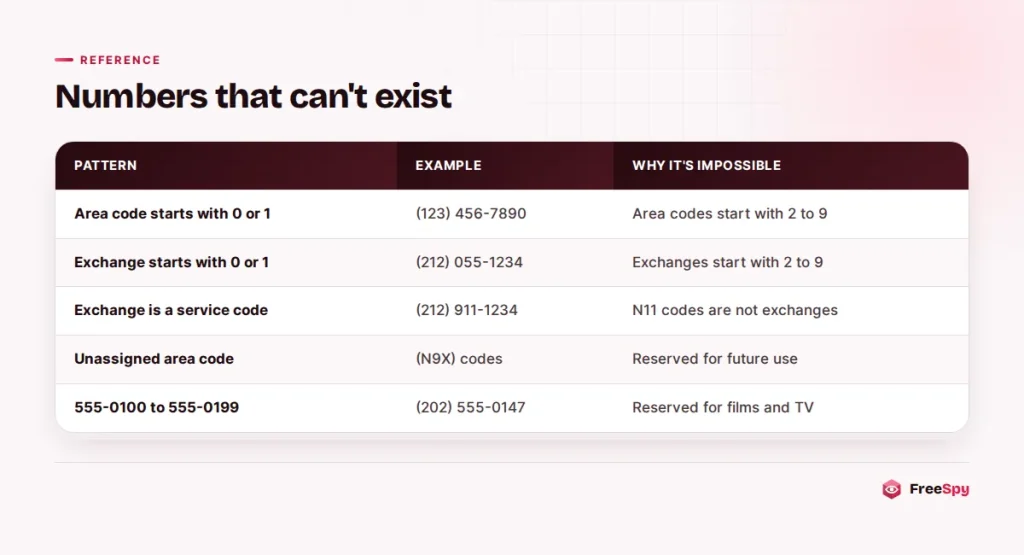
Some digit combinations can’t exist under North American Numbering Plan rules. An area code or exchange can’t start with 0 or 1, an exchange can’t be a service code like 911, and some area codes aren’t assigned to anyone. If a call shows one of these numbers, the caller ID was almost certainly faked, because no real line could have it, and the page gives it a high score. Numbers from 555-0100 to 555-0199 are a special case: they’re reserved for films and TV, never ring a real phone, and are labelled as fictional.
Why is a number that looks local marked as international?
The +1 country code is shared by the US, Canada, US territories and many Caribbean countries. Area codes such as 809, 876, 473 or 284 look like any US code, but they belong to the Dominican Republic, Jamaica, Grenada and the British Virgin Islands. Calling them is billed at international rates. FreeSpy labels these as Caribbean +1 numbers and adds points to the score, because they’re the basis of the one-ring callback scam. Our area code directory shows which codes are which.
How up to date is the information?
It depends on the source. Community reports appear as soon as they’re submitted, unless a moderator holds them. FTC complaint data is synced each weekday from the FTC’s public Do Not Call reported-calls feed, which the FTC updates each business day. Carrier and line-type data is fetched when the lookup runs, where a provider is connected. Area-code and exchange facts come from numbering-plan records and change rarely.
Reports and the score
How much does one report change a score?
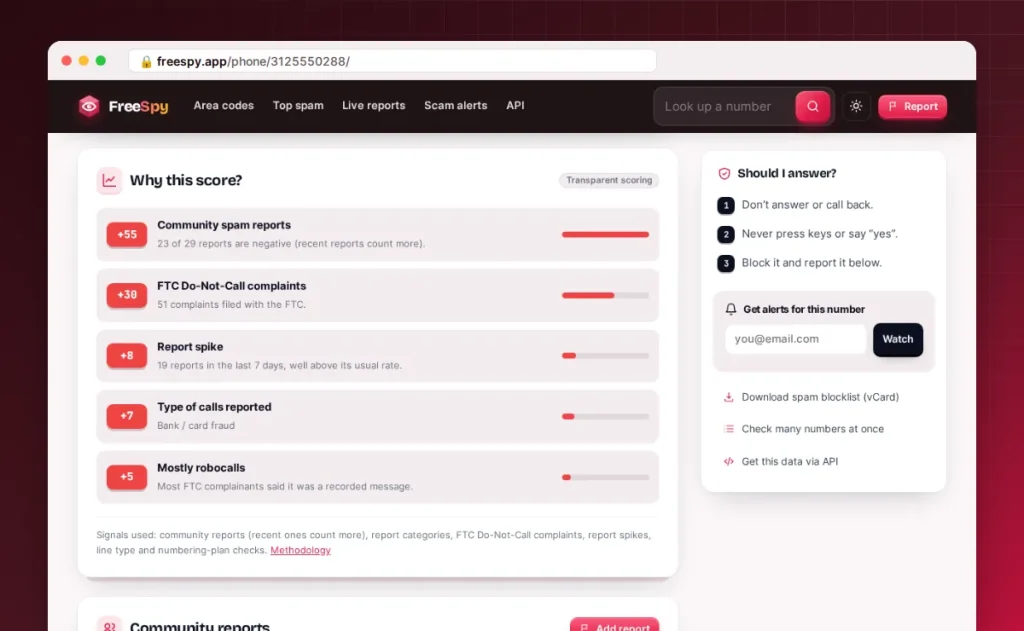
Less than you might expect, by design. Every number starts with a small baseline. Negative community reports add points, up to 55 in total, but each extra report adds a little less than the one before, so one angry person can’t push a number to “Likely scam” alone. A report’s weight also halves every 60 days, so a number that was spammy last year and quiet since will drift back down. “Safe” ratings subtract points. The page lists each factor and its points, so you can see exactly what moved the score.
What do the verdict labels mean?
Scores run from 0 to 100. Likely safe is 0–24, Use caution is 25–49, Suspicious is 50–74 and Likely scam is 75–100. “No reports yet” replaces the label when a number has no reports and no complaints, so a quiet number isn’t presented as safe. The label is a summary. Two numbers with the same score can get there differently, one from FTC complaints and another from a cluster of recent reports, so read the factor list before deciding what to do.
Why did a score jump overnight?
Usually one of two things. A spike factor adds 8 points when a number gets three or more reports in seven days and at least double the week before, which catches fresh campaigns quickly. Or new FTC complaints arrived in the weekday sync. Complaints add points on a log scale up to 30, plus 5 more if most complainants said it was a robocall. The severity of what people report also counts: government impersonation and bank fraud weigh more than a telemarketer.
Can someone flood a number with fake reports?
We make it hard. Each visitor can report a given number once per 24 hours, write actions are rate-limited, and the form has a hidden spam trap and an optional CAPTCHA. IP addresses are stored only as salted one-way hashes, which is enough to spot repeats without keeping the address itself. Because each extra report adds fewer points, piling on has limited effect. Anyone can flag a report, and a report with several flags is hidden until a moderator reviews it under our community guidelines.
What is a verified business number?
Legitimate businesses sometimes collect reports simply because they make a lot of calls, or because scammers spoof their main line. If a business proves it owns a number, we can mark it as verified. The page then shows the business label, and the score is capped at 15. Reports stay visible, so callers can still read what people experienced. To start verification, use the contact page and choose “Verify my business number”.
Privacy and your number
Do you keep a record of the numbers I look up?
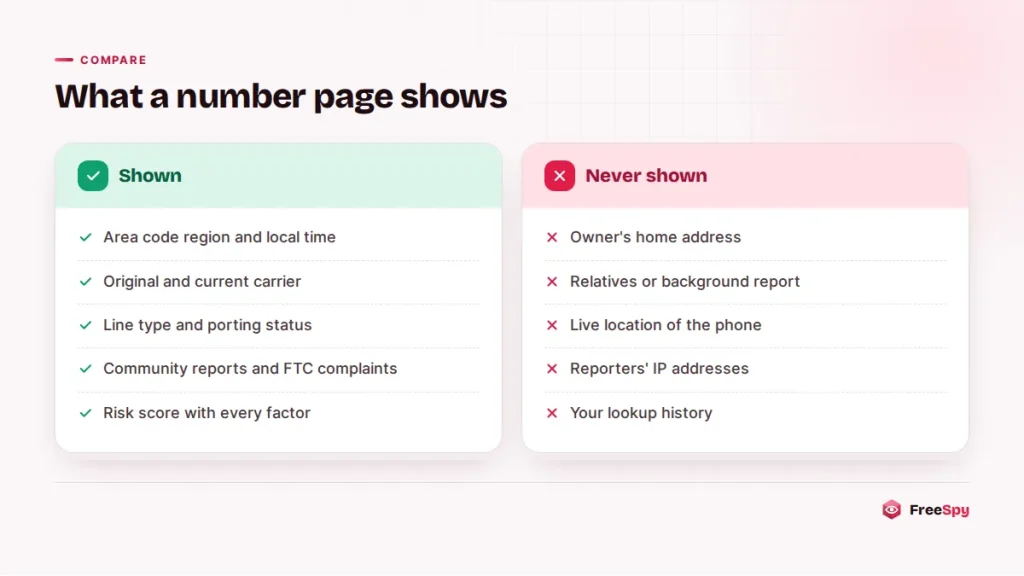
We log lookups to count how often a number is viewed and to improve results. Those logs aren’t linked to your identity, and you don’t need an account to search. FreeSpy doesn’t sell personal data and doesn’t build profiles of the people who own numbers. The privacy policy lists what’s collected and why. If you sign up for “watch this number” alerts, we keep your email address for that purpose only.
What do you store when I submit a report?
The number, your rating, the category, the call type and your comment. If you choose to add them, the name the caller gave and your own area code, which lets the page show roughly where reports come from. Your IP address is turned into a salted hash used only for rate limits and abuse checks, and the raw address isn’t stored with the report. Links and email addresses in comments are removed automatically. Please don’t type your own name, address or account details into a comment.
Can I get an alert when someone reports my number?
Yes. Every number page has a “watch this number” option. Enter your email and you’ll get a message when new reports arrive. It’s useful if you suspect your number is being spoofed: you’ll know quickly when strangers start reporting calls you never made. You can then add a “Safe” report explaining the situation, tell your carrier, or ask for the reports to be hidden through Remove my number.
Can I use a lookup to screen a tenant or a job applicant?
No. FreeSpy isn’t a consumer reporting agency, and its data isn’t meant for decisions about employment, housing, credit or insurance. In the US, those decisions are covered by the Fair Credit Reporting Act, which requires a compliant background-check provider, the person’s consent and a way to dispute errors. Canada has its own privacy rules for screening. This is general information, not legal advice. Check the official sources or a lawyer for your situation.
Scams and what to do
Should I call a number back to find out who it was?
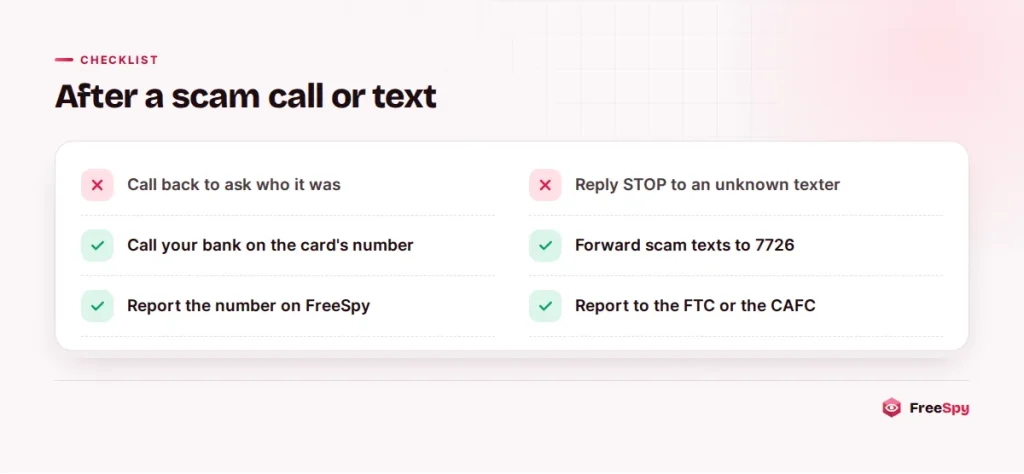
Not if you don’t recognize it. A single ring, a voicemail with no company name, or a message telling you to “call back urgently” are all designed to get you to dial. Calling back can confirm your line is active, connect you to a scammer who now has your attention, or, for Caribbean and premium-rate numbers, add charges to your bill. Look the number up first. If the caller claimed to be a company or agency, call the number you find on your card, statement or the official website.
I already gave the caller money or my card details. What now?
Act quickly. Call your bank or card issuer using the number on the back of your card and ask them to stop or reverse the payment and replace the card. If you paid with a gift card, contact the company that issued it. Change any passwords you shared and turn on two-step verification. Then report it: in the US at ReportFraud.ftc.gov (and IdentityTheft.gov if your identity was used), in Canada to the Canadian Anti-Fraud Centre at 1-888-495-8501. File a police report too, since banks often ask for one.
Is a report on FreeSpy enough, or should I also tell the authorities?
Do both. A FreeSpy report warns the next person who looks the number up. A report to a regulator feeds investigations and enforcement. In the US, use ReportFraud.ftc.gov for scams, donotcall.gov for unwanted sales calls (if you’ve been registered at least 31 days), and fcc.gov/complaints for spoofing and one-ring calls. In Canada, report fraud to the CAFC and telemarketing complaints to the National DNCL at lnnte-dncl.gc.ca. The report page links to each of them.
What should I do with a scam text?
Don’t tap the link and don’t reply, not even “STOP”, unless you know the sender. Forward the message to 7726 (SPAM) so your carrier can act on it, and use the “report junk” option in Apple Messages or Google Messages. Then report the sender’s number on FreeSpy with the call type set to “Text message”. The FTC’s list of top text scams for 2024 was led by fake package delivery problems, phony job offers and fake bank fraud alerts.
API and bulk lookup
How many numbers can I check at once?
Bulk lookup checks up to 50 numbers per run. Paste them one per line or separated by commas, or import a CSV or text file and the tool will pick out the phone numbers. Results show location, line type, report count, FTC complaints and the risk score for each number, and you can export the table as a CSV. For larger lists, run several batches or use the API, which accepts 50 numbers per request and can be called repeatedly within your plan’s limits.
What does the API return, and how do I get access?
The API returns JSON. The main endpoint, /lookup/{number}, gives validation, location, time zone, carrier and line type, community reports, FTC complaints and the risk score with every factor. Other endpoints cover bulk checks, report lists, report submission, trending numbers, recent reports, the heatmap and area codes. Requests use an API key and are rate-limited. Light use is free, and paid plans for higher volume are on the pricing page.
Can I use FreeSpy to make my calling list Do Not Call compliant?
No. A risk score tells you whether a number has been reported for spam. It says nothing about whether the person behind it registered on the National Do Not Call Registry or gave you consent to call. If you make telemarketing calls, you must scrub your list against the official National Do Not Call Registry in the US and the National DNCL in Canada and follow TCPA consent rules. Check the official sources or a lawyer for your obligations.
Sources
Still stuck? Contact us.