| Number | Location | Type | Reports | FTC | Risk |
|---|
Need more than 50 at a time or automated checks? Use the API.
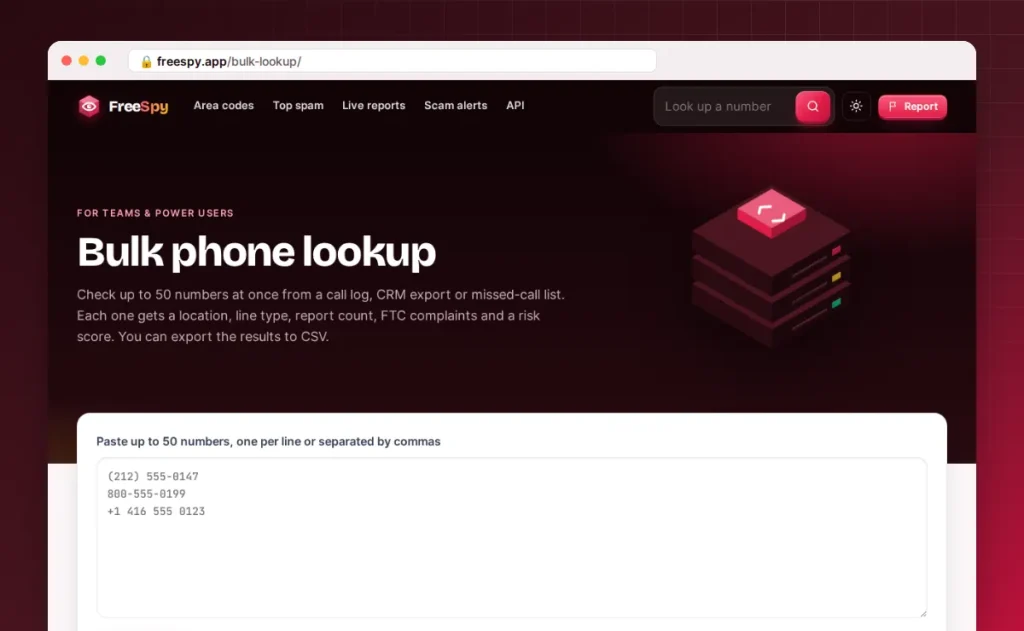
Bulk lookup runs the same checks as a single FreeSpy search on up to 50 numbers at once and puts the results in one table. It’s built for call logs, missed-call lists and CRM exports, where checking numbers one by one would take an afternoon. This guide covers the input formats it accepts, what each output column means, and how to clean a list before and after you run it.
Key takeaways
- Paste up to 50 numbers in almost any format, or import a CSV or text file. The tool picks out the phone numbers for you.
- Each row shows location, line type, community reports, FTC complaints and a 0–100 risk score with a verdict.
- Export the results as CSV, with the carrier and a link to each number’s full page included.
- A risk score is not Do Not Call compliance. If you telemarket, scrub your list against the official registry.
- For more than 50 numbers, or automated checks, use the API.
Who uses bulk lookup
Most people who use it have a pile of numbers and a simple question: which of these should we worry about?
- Small offices and clinics reviewing a week of missed calls to decide which ones deserve a callback and which were robocalls.
- Customer support and fraud teams checking callback requests or numbers that customers say called them pretending to be the company.
- IT and security staff looking at numbers from a phishing or smishing campaign that hit employees, to see if they’re already known.
- Sales and operations teams cleaning a CRM export: finding impossible numbers, toll-free lines and international numbers mixed into a domestic list.
- Individuals who exported their phone’s call history and want to see which unknown callers were spam.
Bulk lookup is not for screening people. FreeSpy doesn’t return names or addresses, and its data must not be used for decisions about employment, housing, credit or insurance, which in the US fall under the Fair Credit Reporting Act.
Accepted formats
Put one number per line, or separate them with commas or semicolons. The tool strips spaces, dashes, dots and brackets, and accepts an optional leading 1 or +1. All of these are read as the same number:
(212) 555-0147212-555-0147or212.555.01472125550147+1 212 555 0147or1-212-555-0147
A few extra rules help with messy data. Extensions at the end, such as x204 or ext. 12, are dropped. Vanity numbers typed in letters, like 1-800-FLOWERS, are converted to digits. Numbers dialed with the international prefix 011 are rejected, because they’re outside the North American Numbering Plan and FreeSpy covers +1 numbers only. If you paste more than 50 numbers, only the first 50 are checked.
Importing a file
Click Import CSV and choose a .csv or .txt file. The tool scans the whole file for anything shaped like a 10-digit North American number, so it doesn’t matter which column the numbers are in or whether there’s a header row. The first 50 matches are placed in the box, where you can review or edit them before running the check. Vanity numbers written in letters aren’t picked up from files, so convert those first or paste them in by hand.
What each output column means
Results appear in a table, one row per number, in the order you entered them. Click any number to open its full page with reports, the map and the complete score breakdown.
- Number. The number in standard (NPA) NXX-XXXX form, linked to its FreeSpy page.
- Location. The main city and state or province of the area code. This is where the number was assigned, not where the phone is now, and it says nothing about where a spoofed call came from. Toll-free numbers have no location.
- Type. The line type when it’s known: mobile, landline, fixed VoIP, non-fixed VoIP, toll-free or premium-rate. When line type isn’t available, it shows the number type instead, such as geographic or “International (NANP Caribbean)”. In bulk mode, line type comes from stored carrier data where FreeSpy has it, or is estimated from the exchange’s original assignment. Since numbers can be ported, open the number page for a fresh check when it matters.
- Reports. The total number of community reports for the number, including Safe ones. Open the page to read them.
- FTC. How many Do Not Call complaints consumers filed with the FTC about calls from this number, from the FTC’s public data, synced each weekday.
- Risk. The 0–100 risk score and its verdict: Likely safe (0–24), Use caution (25–49), Suspicious (50–74), Likely scam (75–100), or “No reports yet” when there are no reports or complaints.
Rows that fail validation are shown in a different style with the reason, for example “Area codes never start with 0 or 1” or “This area code is not assigned anywhere in North America.” These rows tell you which entries in your list are typos, junk data or spoofed caller IDs.
Exporting to CSV
Click Export results to download freespy-bulk.csv. The export includes a few columns that don’t fit on screen:
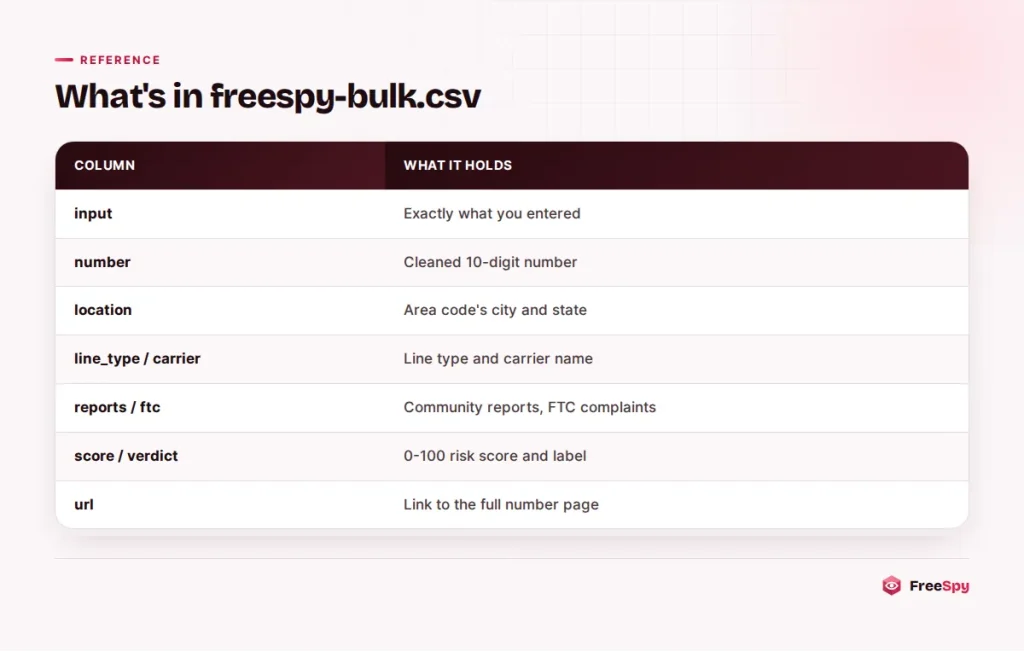
input: exactly what you entered, so you can match rows back to your original list.number: the cleaned 10-digit number, blank if the input was invalid.location,line_type,reports,ftc,score,verdict: as described above.carrier: the carrier name from stored carrier data, or the exchange’s original carrier when that’s all that’s known.url: the link to the number’s FreeSpy page.
Every value is quoted, so the file opens cleanly in any spreadsheet app. If your spreadsheet shows the number column in scientific notation, set that column’s format to Text or Plain text and re-import.
Tip: Sort the exported file by score, highest first. The numbers at the top are the ones to block or warn staff about; the “No reports yet” rows at the bottom need judging case by case.
Cleaning a list
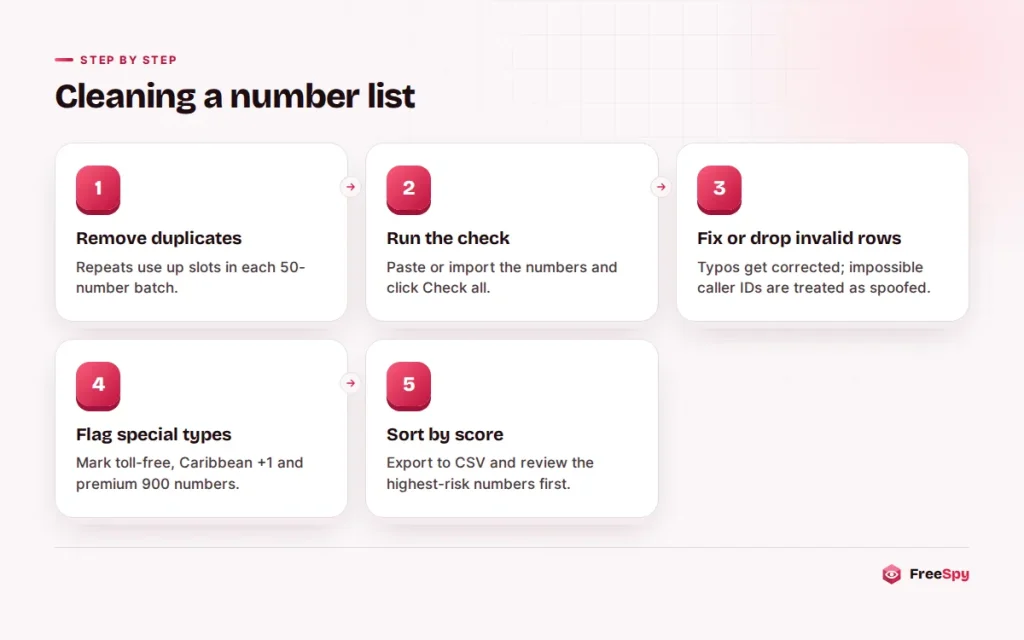
Most lists contain more than plain domestic numbers. Here’s what to look for and what to do with it.
Invalid numbers
Numbers that fail validation can’t ring a real phone. In a list someone typed in, they’re usually typos: a missing digit, a transposed area code. In a call log, they’re a strong sign of spoofing, because the caller ID showed a number that can’t exist. Fix typos at the source. Treat impossible caller IDs as scam calls.
Fictional and test numbers
Numbers from 555-0100 to 555-0199 are reserved for films, TV and examples. They often show up in CRM data as placeholders or test entries, such as 555-0123 after a real area code. They’re marked as fictional and should be deleted.
Toll-free numbers
Numbers in 800, 888, 877, 866, 855, 844 and 833 are toll-free: the receiving business pays for the call. They have no geographic location, and they belong to businesses rather than individuals, so a customer list full of them may contain company switchboards instead of personal contacts. Scammers also use toll-free numbers, so check reports as you would for any other number. Our guide to toll-free numbers explains how they’re assigned.
Caribbean +1 numbers
Area codes such as 809, 829, 849, 876, 473, 284, 649, 664, 767 and 268 look like US codes but belong to Caribbean countries, and calls to them are billed as international. FreeSpy labels them “International (NANP Caribbean)” and adds points to the score. In a domestic list, flag them before anyone calls back. In a missed-call log, they’re often one-ring scam calls. The area code directory shows where each code belongs, and every code has its own page, such as the one for area code 212.
Premium-rate numbers
The 900 area code is premium-rate: the caller pays extra charges. These rarely belong in a contact list, and FreeSpy scores them higher for that reason.
Duplicates
The tool checks every line you give it, including repeats. Remove duplicates first so your 50 slots go to different numbers.
A note on compliance
A risk score tells you whether a number has been reported for unwanted calls. It doesn’t tell you whether the person behind it registered on a Do Not Call list or agreed to hear from you. Those are separate checks with separate rules.
In the US, telemarketers must remove numbers on the National Do Not Call Registry from their calling lists, using the FTC’s official access for sellers and telemarketers. The registry had about 258.5 million active registrations as of September 30, 2025, according to the FTC’s Do Not Call Data Book. The TCPA also restricts autodialed and prerecorded calls and texts to mobile numbers without prior express consent, and limits telemarketing calls to 8 a.m. to 9 p.m. in the recipient’s local time. In Canada, telemarketers must register with the National DNCL and remove registered numbers before calling.
Bulk lookup can help with hygiene, such as removing invalid, toll-free and Caribbean numbers, but it is not a substitute for scrubbing against the official registries. This is general information, not legal advice. Check the official sources or consult a lawyer about your obligations. Our guide to robocall laws and Do Not Call rules covers the basics.
When to use the API instead
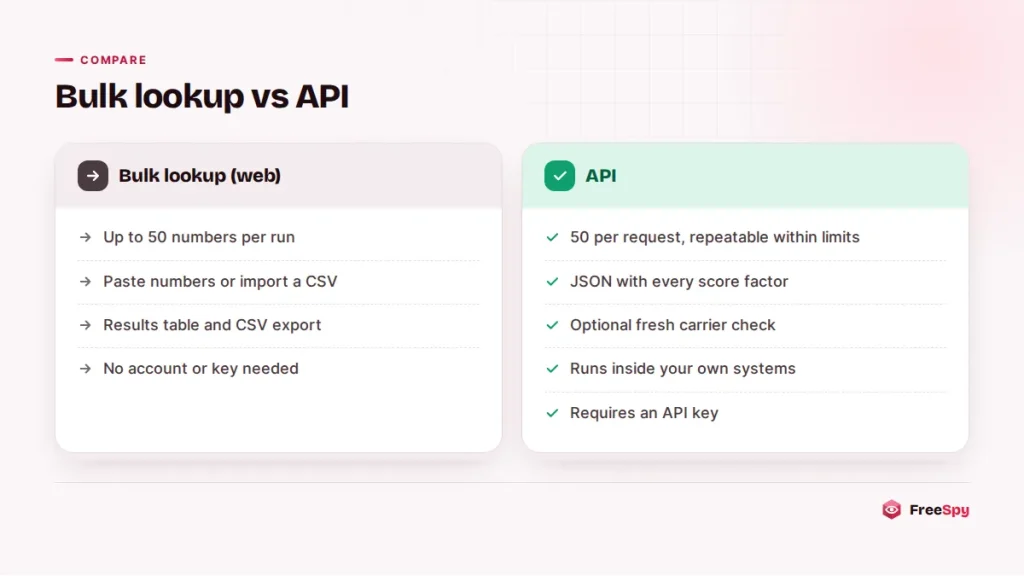
The web tool is meant for occasional lists. Switch to the FreeSpy API when:
- You have more than 50 numbers. The API’s
/bulkendpoint also takes 50 numbers per request, but you can send requests in a loop within your plan’s rate limits. - You want checks to run automatically, for example scoring every inbound call in your phone system, or every new lead before it enters your CRM.
- You need the full detail. The
/lookup/{number}endpoint returns everything on the number page as JSON: validation, location, time zone, carrier and line type, reports, FTC complaints, and each score factor with its points. Adding?live=1requests a fresh carrier check, which counts against a separate live quota. - You want to feed reports back, using the
/reportsendpoint to submit what your team learned about a number.
API access uses a key and is rate-limited. Light use is free, and higher-volume plans are listed on the pricing page.
Common questions
Is bulk lookup free?
Yes. The web tool is free and needs no account. Requests are rate-limited to prevent abuse, so very frequent runs may be slowed down.
Do you keep the lists I upload?
The file is read in your browser, and only the numbers are sent for checking. Lookups are logged to count views, without linking them to your identity.
Can I check international numbers outside +1?
No. FreeSpy covers the North American Numbering Plan only: the US, Canada, US territories and the Caribbean countries that share +1.