A recorded voice offering to lower your credit card rate, on a cell phone you registered on the Do Not Call list years ago, is probably breaking more than one rule. The US and Canada both have rules about who may call you, when, with what technology, and what happens when they ignore your wishes.
Below are those rules in plain terms, so you can tell which calls cross the line and where to report them.
Not legal advice: this is a general summary. Rules change and details matter. For a specific situation, check the official FTC, FCC or CRTC source or speak with a lawyer.
Two US rulebooks that overlap
Two sets of rules govern telemarketing and robocalls in the US. Knowing which is which helps you file the right complaint.
The TCPA, enforced by the FCC
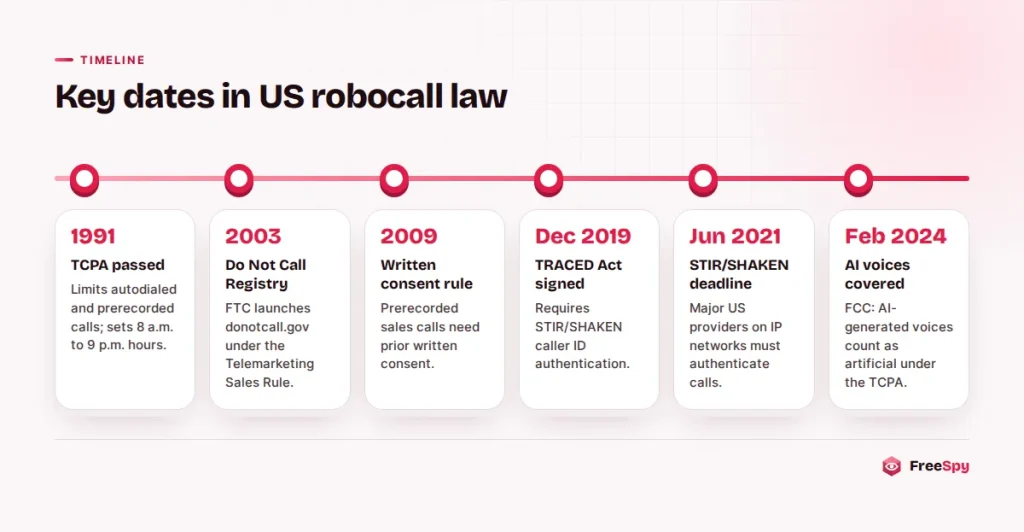
The Telephone Consumer Protection Act of 1991 is about the technology used to reach you. Calls and texts to a mobile phone made with an autodialer, or with a prerecorded or artificial voice, need your prior express consent, with narrow exceptions such as emergencies. The law also limits telemarketing calls to between 8 a.m. and 9 p.m. in your local time zone.
The Telemarketing Sales Rule, enforced by the FTC
The Telemarketing Sales Rule (TSR) covers how sales calls are conducted. It created the National Do Not Call Registry in 2003 and bans misrepresentations during sales calls. Since 2009 it has required prior written consent before a company can send you prerecorded sales messages, so a “press 1 to speak to a representative” robocall pitching a product generally needs that written permission.
Signing up for the national registry
The registry is a list of numbers that telemarketers must check and skip. Registering is free and takes a couple of minutes.
- Go to donotcall.gov, or call 1-888-382-1222 from the phone you want to register.
- Online, enter your number or numbers plus an email address for confirmation.
- Click the link in the confirmation email within the time it gives you. If you register online and skip this step, the registration doesn’t go through.
- Use the same site later to check that a number is registered.
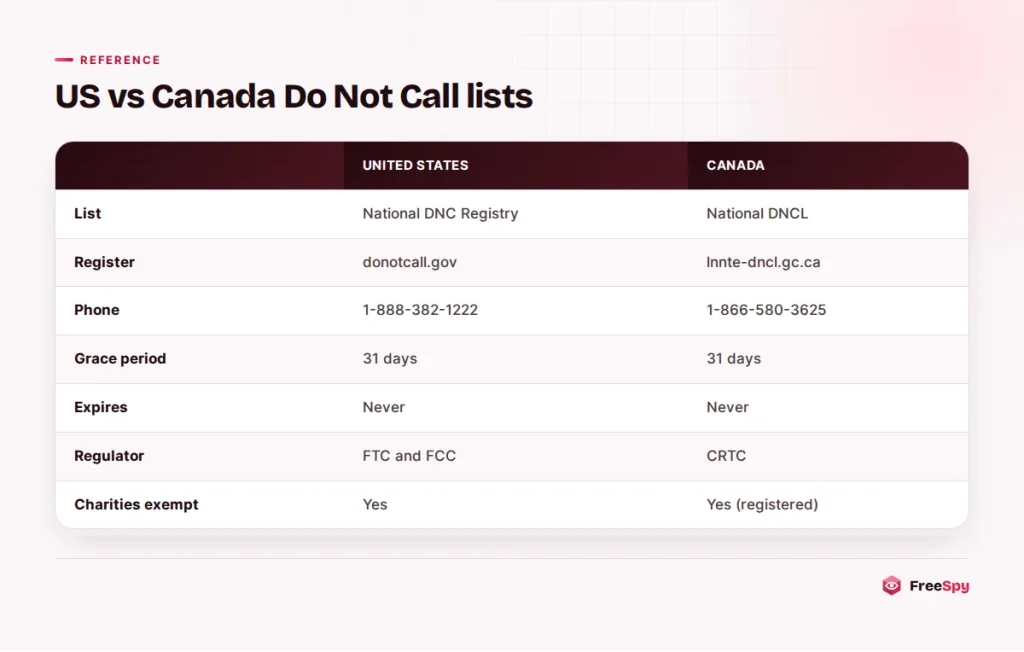
Registration never expires, and you can add mobile numbers as well as landlines. You don’t need to re-register, although a number can drop off the list if it’s disconnected and reassigned to someone else.
Telemarketers get up to 31 days after you register to stop calling, because they download the list periodically. Sales calls that continue after that are likely violations.
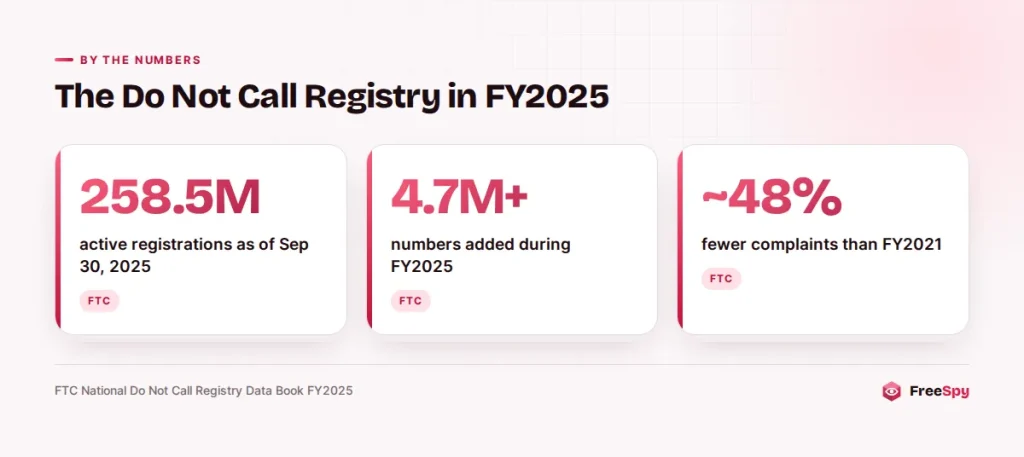
According to the FTC’s National Do Not Call Registry Data Book for fiscal year 2025, the registry had about 258.5 million active registrations as of September 30, 2025, up 1.9%, with more than 4.7 million numbers added during the year. New Hampshire had the most registrations per capita.
Callers the registry doesn’t cover
The registry applies to sales calls. Political calls and campaign messages are exempt, as are charities calling on their own behalf and surveys or polls that don’t sell anything. Debt collectors fall under separate debt collection rules. Informational calls, such as a flight delay, a pharmacy refill reminder or a fraud alert from your bank, aren’t sales calls at all.
Companies you have an established business relationship with can also call, but only for a while: up to 18 months after your last purchase, payment or delivery, or up to 3 months after you made an inquiry or submitted an application. After that, your registration applies again.
Exempt doesn’t mean unlimited. You can tell any company “put me on your internal do-not-call list”, and it has to honour that request even if it relied on an exemption. Use those words, note the date, and keep the record. Exempt callers still have to follow the TCPA’s consent rules for autodialed and prerecorded calls to mobile phones.
Consent decides most robocall disputes
There are two levels. Informational autodialed or prerecorded calls to a mobile need prior express consent, which can be as simple as giving your number for that purpose. Telemarketing robocalls need prior written consent: a signed agreement, and electronic signatures count, that clearly authorizes that seller to call you that way.
Consent is specific. Giving your number to a store at checkout doesn’t automatically authorize marketing robocalls from its partners.
It also can’t be a condition of purchase for telemarketing robocalls. A company can’t make you agree to sales robocalls in order to buy something.
And you can take it back. Tell the company clearly, by phone, by text reply or in writing, that you no longer want the calls, and keep a copy or a note of the date.
Cloned and synthetic voices
In February 2024, the FCC ruled that calls using AI-generated or cloned voices count as calls using an “artificial” voice under the TCPA. A robocall with a synthetic voice, whether it imitates a celebrity, a politician or a relative, falls under the same consent rules as any prerecorded message. Without the required consent it’s illegal, and state attorneys general gained a clear tool for going after voice-cloning operations.
$500 a call: suing under the TCPA
The TCPA is unusual because it lets individuals sue. You can claim $500 per violation, and a court can raise that to $1,500 per violation if the violation was willful or knowing. People often bring these cases in small claims court.
The law is rarely the hard part. The evidence and the defendant are. You need to identify who’s really behind the call, which is difficult when the number is spoofed. Keep call logs, screenshots, voicemails and any names or websites mentioned. Calls that end in a pitch for a real product are the easiest to trace, since the seller has to get paid somehow.
Many states have also passed their own telemarketing laws, often called “mini-TCPAs”, with stricter consent rules, calling hours or penalties. Your state attorney general’s website will say what applies where you live.
Filing a Do Not Call complaint
If a sales call reaches you more than 31 days after you registered, or a robocall arrives without your consent, report it at donotcall.gov or by calling 1-888-382-1222. The form asks for the number that called you and the number that was called, the date and time, whether it was a prerecorded message, the subject (debt reduction, an imposter, a medical product and so on), and the company name if the caller gave one. There’s room for a description too.
If you lost money or shared personal information, also report it at ReportFraud.ftc.gov. In Canada, contact the Canadian Anti-Fraud Centre at 1-888-495-8501. The full list of places to report differs a little depending on whether the call was a sales pitch, a scam or a text.
Where your complaint goes
The FTC doesn’t resolve individual complaints or call you back. It pools them. Complaints go into a database that law enforcement uses to spot patterns and build cases, and the numbers feed industry efforts to trace and block illegal calls.
The FTC also publishes the reported-call data through its Do Not Call reported-calls API at api.ftc.gov, updated each business day. Each record includes the number that called, the date, whether it was a robocall, the subject, and the consumer’s state and area code. Consumer names are not included.
FreeSpy syncs that data each weekday, so a number’s page shows its FTC complaint count, the share that were robocalls, the topics and the dates, labelled “FTC complaint” to keep them apart from community reports. Complaint volume is one of the inputs to the number’s risk score, as the scoring explainer shows.
What the complaints show
According to the FTC’s FY2025 Data Book, complaints rose during fiscal 2025 but were still about 48% lower than in FY2021, when there were close to 5 million. Robocalls made up most complaints, and the top topics were reducing debt, imposters, and medical and prescriptions.
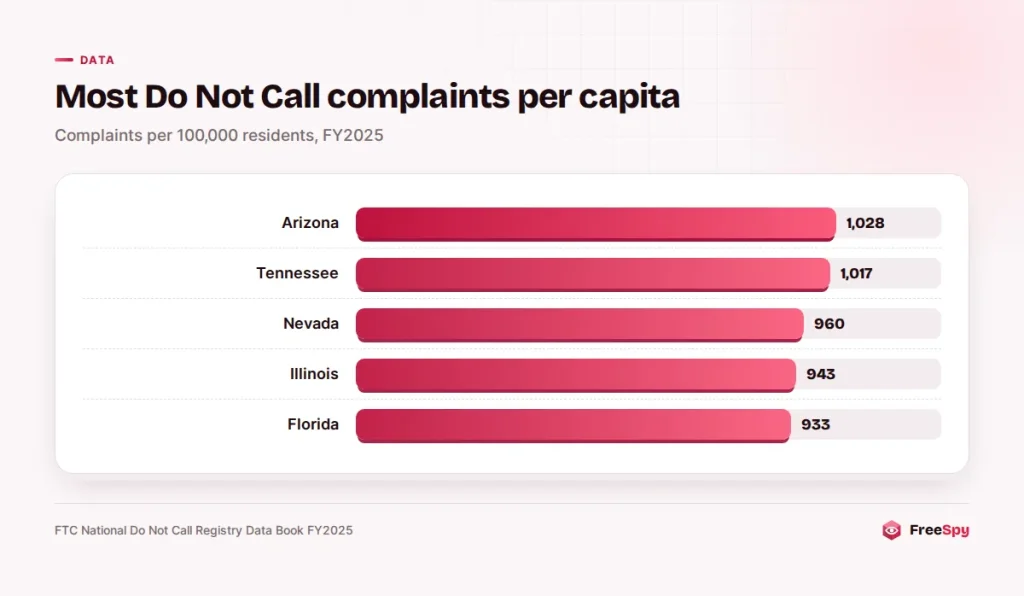
Complaints per 100,000 residents were highest in Arizona (1,028), Tennessee (1,017), Nevada (960), Illinois (943) and Florida (933). Higher rates can reflect more calls, or simply more people willing to report them.
Canada: the National DNCL and the CRTC’s rules
In Canada, the CRTC regulates telemarketing through the Unsolicited Telecommunications Rules. They include the National Do Not Call List rules, telemarketing rules (identifying who’s calling and on whose behalf, respecting calling hours), and rules on automatic dialing-announcing devices, the Canadian term for robocall systems, which generally may not be used to sell to you without your consent.
To register, go to lnnte-dncl.gc.ca or call 1-866-580-3625 from the phone you want to add. Registration is permanent. As in the US, telemarketers have 31 days after you register to stop calling.
Canadian exemptions
The DNCL doesn’t apply to every caller. Registered charities are exempt, along with political parties, riding associations and candidates, newspapers calling about subscriptions, and businesses with an existing business relationship with you.
Exempt organizations still have to keep their own internal do-not-call lists. If you tell one to stop calling, it must add you to that list.
Complaining in Canada
File a complaint about a telemarketing call through the DNCL website or at 1-866-580-3625. Have the caller’s number, the date and time, and the company name if you know it. The CRTC uses complaints to investigate and can impose administrative monetary penalties on telemarketers that break the rules. If the call was a scam, report it to the Canadian Anti-Fraud Centre as well.
Scammers don’t read the rules
All of these laws assume the caller wants to stay in business legally. Fraudsters don’t. They spoof caller ID, call from overseas and rotate numbers, so a DNC registration does almost nothing against them. Carriers fight that side with call authentication, and the STIR/SHAKEN system is where most of that effort goes.
So the legal tools work best alongside practical ones. Register your numbers, turn on the call filtering built into your phone, and report what still gets through.
Things people want to know
I registered but still get sales calls. Why?
If it’s been less than 31 days, the caller may not have downloaded the updated list yet. After that, the caller is either exempt, has your consent from an earlier sign-up, or is ignoring the law. Many persistent callers are scammers who never check the registry.
Are texts covered?
Under the TCPA, autodialed marketing texts to mobile phones need consent in the same way as robocalls. Forward spam texts to 7726 (SPAM) and report them in your messaging app.
Can I sue a company in Canada the way people do under the TCPA?
Canada’s system relies mainly on complaints and CRTC enforcement rather than individual lawsuits for each call. A lawyer can tell you whether other remedies apply to your situation.
Sources
- FTC: National Do Not Call Registry Data Book, Fiscal Year 2025
- National Do Not Call Registry (donotcall.gov)
- FTC API portal (Do Not Call reported calls)
- ReportFraud.ftc.gov
- FCC Consumer Complaint Center
- Canada’s National Do Not Call List
- Canadian Radio-television and Telecommunications Commission (CRTC)
- Canadian Anti-Fraud Centre