We use independent data sources, publish how much each signal counts, and guard against abuse.
Layer 1 · Numbering plan
Every lookup starts with the North American Numbering Plan. We reject numbers that can’t exist: area codes starting with 0 or 1, reserved N9X codes and the 555-01XX numbers used in fiction. We pick out toll-free, premium and Caribbean codes, and match the area code to its region, cities and time zone. Once NANPA/CNAC exchange data is imported, we also know the original carrier and rate center of every NPA-NXX block.
Layer 2 · Carrier data
Live lookups through licensed providers such as Twilio and Telnyx return the current carrier, the line type (mobile, landline, fixed or non-fixed VoIP) and porting status. We cache results so the service stays fast and free.
Layer 3 · Government complaints
Every weekday we sync the FTC’s Do Not Call “Reported Calls” data. Complaints are grouped by the number that placed the call, along with the robocall share and complaint topics.
Layer 4 · Community
People report what happened. Each report has a rating (unwanted, unsure or safe), a category with a severity weight, and optional details. Votes push helpful reports up, and flags hide abusive ones.
Score factors
Signal
Effect
Notes
Community reports
+0 … +55
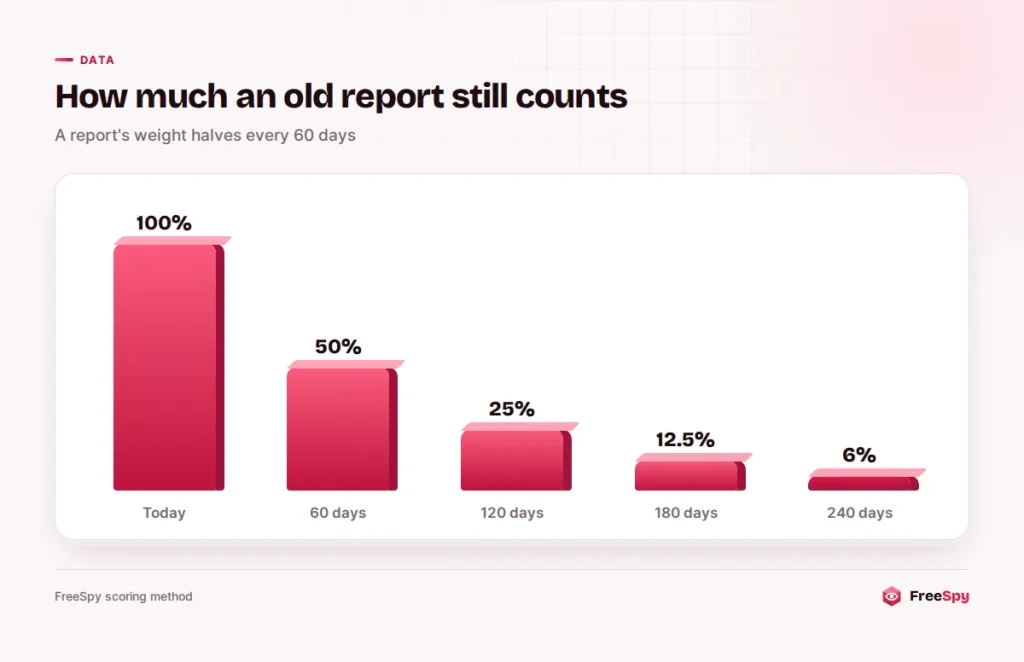
A report’s weight halves every 60 days. Safe ratings lower the score.
Report severity
−12 … +12
Impersonation and bank fraud count more than surveys.
Report spike
+8
3 or more reports in 7 days, and at least double the week before.
FTC complaints
+0 … +30
Logarithmic scale. Adds 5 more if most were robocalls.
Caribbean / premium code
+15 / +20
Risk of one-ring scams and callback charges.
Line type
−3 … +8
Non-fixed VoIP numbers are cheap and easy to throw away. Landlines are rarely used for mass dialing.
Impossible number
= 88
A number that can’t exist on the network must have been spoofed.
Verified business
cap 15
Ownership confirmed by our team.
Verdicts: 0–24 likely safe, 25–49 use caution, 50–74 suspicious, 75–100 likely scam. A number with no signals at all shows “No reports yet”.
The four layers and the score table above are the short version. This page is the long one: what FreeSpy checks when you look up a number, where each piece of data comes from, how the points add up to a verdict, and where the data runs out. If you want to judge whether to trust a result, this is the page to read.
Key takeaways
A lookup runs in a fixed order: clean up the input, test it against numbering-plan rules, add location and carrier data, then community reports and FTC complaints, then the score.
Location means where the number was issued, not where the caller is sitting. Caller ID can be faked, and numbers move between carriers and cities.
Every number starts at 8 points. Each signal adds or removes a set amount, and the number page lists every one of them.
Community reports lose half their weight every 60 days, so a number that stopped calling people slowly drifts back toward a low score.
The score measures what people and the FTC have reported about the number. It cannot see who is holding the phone right now.
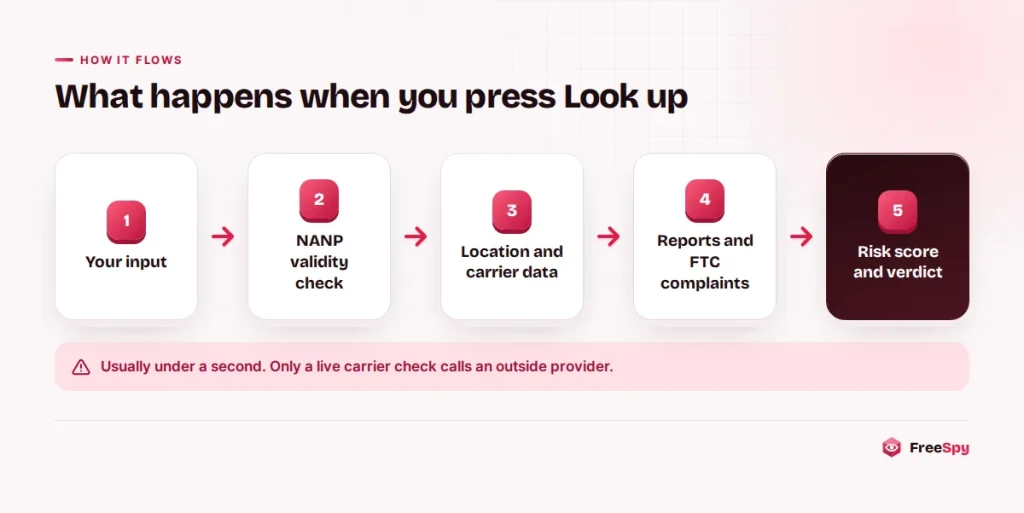
What happens in the second after you press Look up
Most lookups finish in well under a second, because nearly all the data is already stored on FreeSpy’s servers. Only a live carrier check goes out to an outside provider. The order of work is the same for every number.
Clean up the input. Spaces, dots, dashes and brackets are stripped. A leading 1 or +1 is dropped. Extensions such as “x204” or “ext. 12” are cut off. Letters on a vanity number (1-800-FLOWERS style) are turned into keypad digits. Anything that starts with 011, the US and Canadian prefix for dialing overseas, is rejected because it isn’t a +1 number.
Check the shape. What’s left must be exactly 10 digits. If it isn’t, you get a “We couldn’t read that number” page instead of a guess.
Test it against the numbering plan. The area code and the exchange are checked against the rules described below. A number that breaks them is flagged as impossible, and the lookup stops scoring there.
Add location and carrier facts. The area code gives region, cities and time zone. The first six digits give the original carrier and rate center. Cached live carrier data, if any, adds the current carrier and line type.
Pull the evidence. Approved community reports are totaled and weighted by age. FTC complaints come from FreeSpy’s local copy of the FTC feed.
Score it and build the page. Each signal becomes points, the total becomes a verdict, and the page also lists other recently reported numbers in the same exchange block.
The same steps run from the search box on the home page, the bulk lookup page and the API, so the score matches everywhere.
Every lookup runs through the same steps, whether it starts on the website, in bulk lookup or through the API.
Step one: could this number exist at all?
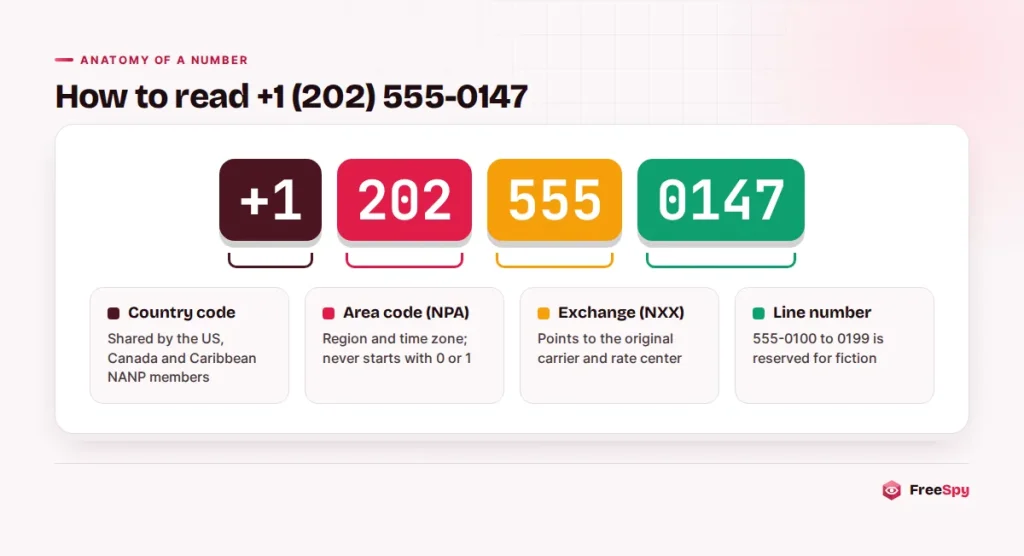
Every US and Canadian number follows the North American Numbering Plan (NANP), which AT&T and the Bell System set up in 1947. The format is +1, then a three-digit area code (the NPA), a three-digit exchange (the NXX), and a four-digit line number. The rules are strict, and that makes a fake number easy to catch.
The four parts of a North American number, and what FreeSpy reads from each.
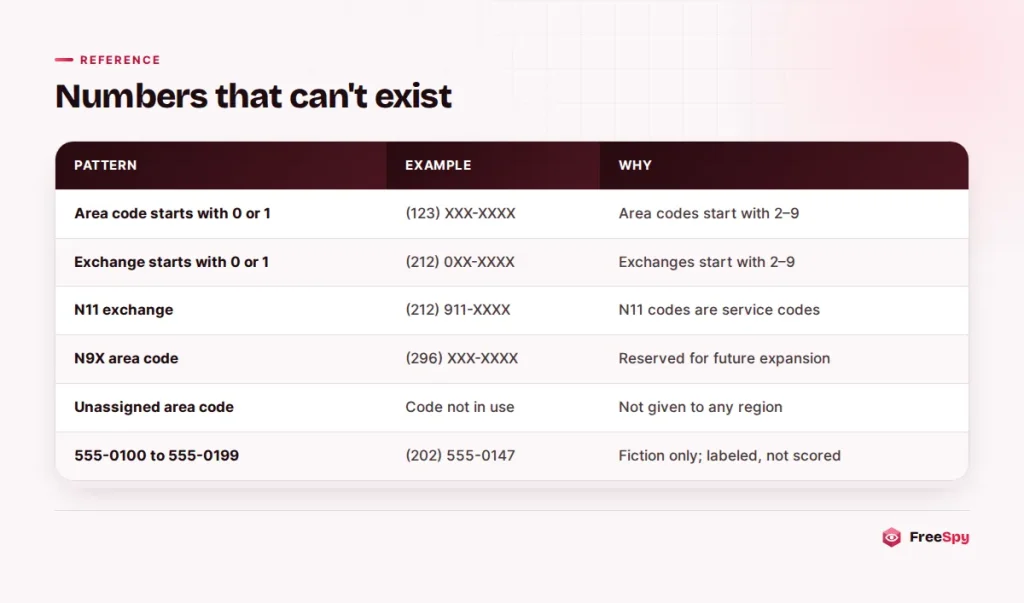
Neither the area code nor the exchange can begin with 0 or 1. Exchanges ending in 11, such as 411 or 911, are service codes and can’t be used for ordinary lines. Area codes with 9 as the middle digit (the N9X codes) are held back for a future expansion of the plan, and the 37X and 96X ranges are reserved as well. Many other three-digit combinations simply have not been handed out to any region yet.
A call can’t come from a line that doesn’t exist. When caller ID shows an impossible number, someone typed it into the caller ID field by hand. That’s why an impossible number gets a fixed score of 88, which is in the “Likely scam” band, no matter what else is known. Canada’s regulator took the same view: a 2018 CRTC decision required carriers to block calls with blatantly illegitimate caller ID, such as numbers that can’t exist.
A caller ID showing any of these patterns was typed in by hand, so FreeSpy treats it as spoofed.
One range gets special treatment. Numbers from 555-0100 to 555-0199, in any area code, are set aside for films, TV and printed examples. They never ring a real phone. FreeSpy marks them as fictional instead of scoring them as scams, because people mostly look them up after seeing them on screen. It’s also why every example on this site, including (202) 555-0147, uses that range. Other 555 numbers are reserved for directory assistance and special services and are labeled that way.
Area code, location and time zone
Once a number passes, the area code is matched against FreeSpy’s area-code directory, which covers more than 400 codes in the US, Canada and the Caribbean, including non-geographic codes like toll-free. That match gives you the region, the state or province, the main cities, the time zone and the current local time there.
Keep in mind what this location means. It’s where the number was issued, not where the caller is. People keep their numbers when they move across the country. Internet phone services hand out numbers from area codes the customer has never visited. And caller ID can be spoofed, so a call showing a Chicago number may come from a call center on another continent. The guide to caller ID spoofing explains why the network lets that happen.
Big cities also have overlays, several area codes covering the same ground. Manhattan uses 212, 646, 332 and 917, and a number page lists these sibling codes. Each code has its own page, such as area code 212.
The local-time tile shows the time in the number’s home area and whether it falls inside the 8 a.m. to 9 p.m. window. Under the TCPA, telemarketing calls are limited to those hours in the recipient’s local time, so the tile is most useful when you’re the one about to call. A few area codes cross a time-zone line, and FreeSpy shows the main zone for the code in those cases.
Original carrier versus current carrier
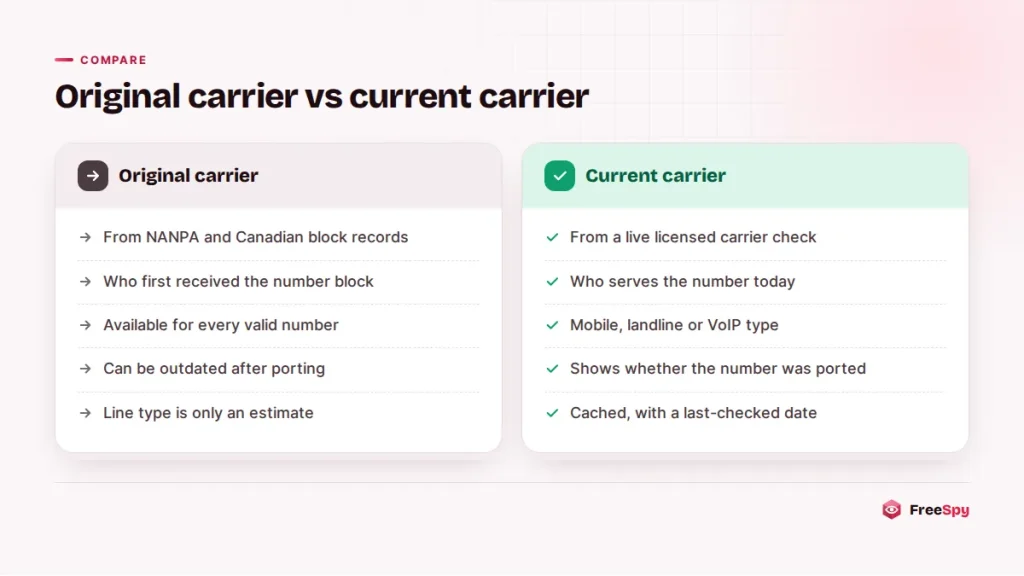
Phone numbers are handed to carriers in blocks. Exchange data from the US numbering administrator (NANPA) and Canada’s numbering administration records which company received each NPA-NXX block and which rate center it belongs to. Carriers also get numbers in smaller pools of 1,000 to save numbers, so one exchange can be split between several companies.
That record tells you the original carrier. It doesn’t tell you who serves the number today. Since November 24, 2003, people in the US have been able to take their wireless numbers with them when they switch carriers, and numbers move between mobile, landline and internet services all the time. A number first issued to a local phone company may now sit on a mobile plan or an internet calling app.
So FreeSpy keeps the two apart. Without live data, the page says “Original carrier” and marks the line type as estimated, with a note that the number may have been ported. When a live check has been run through a licensed provider such as Twilio or Telnyx, the tile switches to “Carrier” and shows the current carrier, the line type and whether the number was ported. Live results are cached for a while, and the page shows when the data was last checked. You can request a fresh check with the “Live carrier check” button, within a daily limit.
Since 2003 numbers can move between carriers, so FreeSpy labels block-record data as the original carrier.
Line types and what they mean for risk
The kind of line behind a number says something about how easy it is to get, how easy it is to throw away, and what it costs to call back. Here is how each type is treated.
Mobile (−2 points). Tied to a carrier account with payment on file. Scammers use mobiles, but they’re slower to replace than internet numbers.
Landline (−3 points). Rarely used to place calls in bulk. Spoofed calls often display landline numbers, though, so this is a small nudge, not a clean bill of health.
Fixed VoIP (no points). An internet line tied to a service address, like a business phone system. Treated much like a landline.
Non-fixed VoIP (+8 points). Internet numbers that can be created online in minutes, in bulk, and dropped just as fast. Plenty of honest apps use them, but so do spam campaigns. A VoIP line of unspecified kind gets +5.
Toll-free (no line-type points). Numbers like 800, 888 and 833, where the receiver pays. Banks use them, and so do scammers who want to look official.
Premium-rate 900 (+20 points). The caller pays extra. There is rarely a good reason for one to call you.
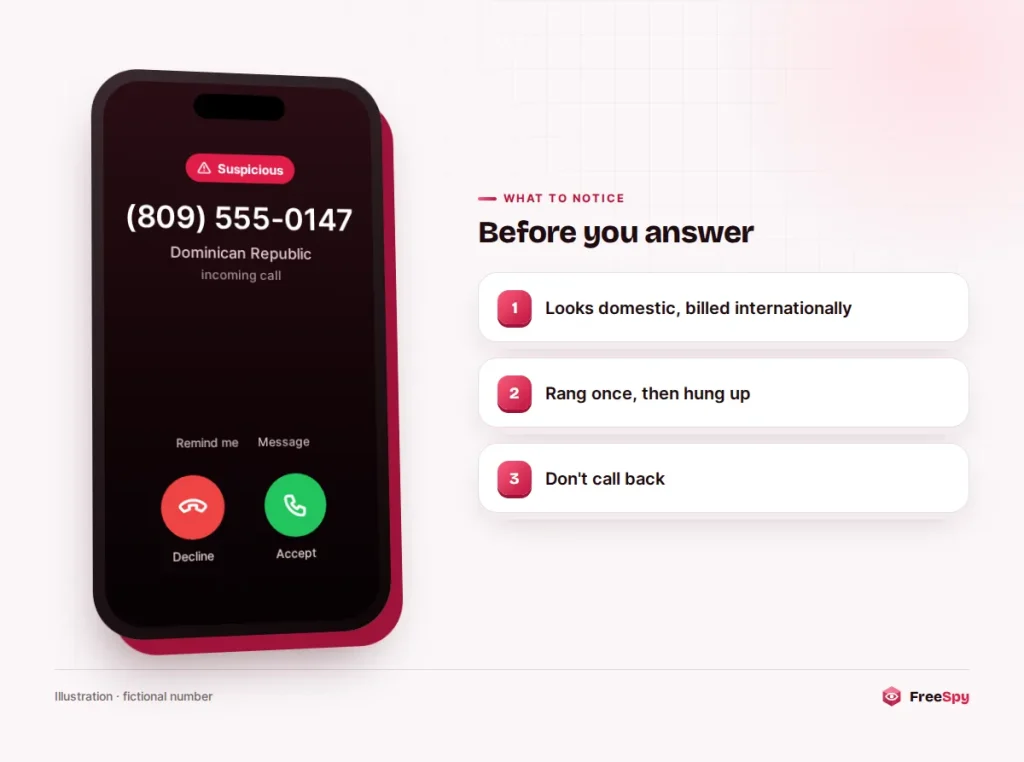
Caribbean +1 (+15 points). Area codes such as 809, 876 and 473 look domestic but belong to other countries, and calls to them cost international rates. They’re the home of the one-ring callback scam.
The line-type points only apply when real carrier data exists. An estimate from the block record doesn’t move the score, because a ported number could be anything by now. Premium and Caribbean points come from the area code alone, so they always apply.
FTC Do Not Call complaint data
The second independent source is the US government. When someone files a Do Not Call complaint with the Federal Trade Commission, the FTC publishes the basic facts through its public “reported calls” API at api.ftc.gov, updated each business day. Each record includes the number the call came from, the date, whether the consumer said it was a robocall or recorded message, a subject chosen from a list (such as “Imposters” or “Reducing your debt”), and the consumer’s state and area code. Names and the consumer’s own phone number are not part of it.
FreeSpy pulls that feed every weekday and groups the records by the calling number. A number page then shows the complaint count, the share that were robocalls, the dates of the first and latest complaint, and the topics people chose, under an “FTC complaint” label so you can tell it apart from community reports. The FTC usually publishes a weekday’s complaints around midday Eastern time, and weekend complaints arrive on Monday, so the newest records are always a day or more old.
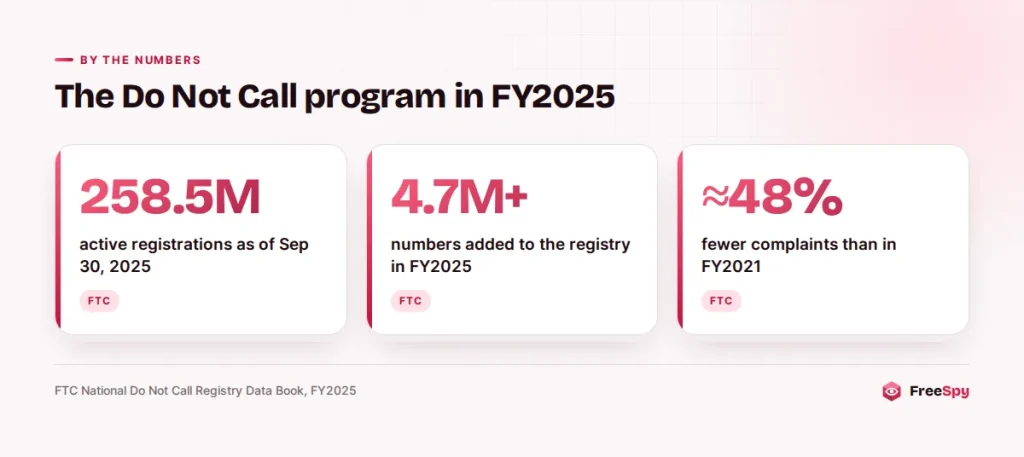
The FTC's Do Not Call program is the source of the complaint counts shown on number pages.
Read this data with its limits in mind:
Complaints describe the number on the caller ID screen. If the caller spoofed it, the complaints land on an innocent number.
They aren’t verified. The FTC says so itself, and the number page repeats it. A complaint is one person’s account of a call.
FreeSpy’s counts start from when it began importing. The figures show complaints FreeSpy has collected, not every complaint ever filed about the number.
It’s US-only. Canadians report to the National Do Not Call List and the Canadian Anti-Fraud Centre, which don’t publish per-number data this way.
The topics in the data match what the FTC sees nationally. According to the FTC’s National Do Not Call Registry Data Book for fiscal 2025, robocalls make up most complaints, and the top topics are reducing debt, imposters, and medical and prescriptions.
Community reports
The third source is people. Anyone can report a number without an account. A report has a rating (unwanted, unsure or safe), a category, the type of contact (call, text, voicemail, robocall or a one-ring missed call), the name the caller gave if any, and a free-text comment.
Categories carry a severity weight. Government impersonation, bank and card fraud, tech-support scams, smishing and crypto or investment pitches sit at the top. Fake deliveries, fake jobs, auto warranty and Medicare or health insurance calls are in the middle. Telemarketers, debt collectors, silent hang-ups and surveys or political calls are at the low end. There is also a “legitimate / safe caller” category, which counts in the number’s favor.
Three things keep reports honest:
Votes. Readers can mark a report helpful or not. Helpful reports can be sorted to the top of a number page. One vote per report per visitor.
Flags. A report that names a private person, includes abuse or is plainly false can be flagged. When a report collects several flags, it is taken out of public view automatically until a moderator checks it.
Moderation. Moderators can approve, hide or delete reports. Only approved reports count toward the score. The rules are on the community guidelines page.
Age matters too. A report’s weight halves every 60 days. A report from today counts fully, one from two months ago counts half, and one from eight months ago counts about a sixteenth. Numbers get reassigned, and without the decay a new owner could carry a stranger’s history for years.
Older reports fade, so a number that stops causing problems slowly recovers on its own.
The risk score, worked through
Every valid number starts at 8 points. From there:
Community reports add up to 55 points along a curve. Each unwanted report adds 1 to a running weight, each “unsure” adds 0.2, and each “safe” subtracts 1.2, all multiplied by the age decay. A weight of 1 is worth about 12 points, 2 is about 22, 4 is about 35, and the curve flattens toward 55 after that. If safe ratings win, the number can lose up to 25 points instead.
Report severity takes the average severity of the reported categories and turns it into −12 to +12. Mostly government impersonation adds about 11. Mostly survey calls takes off about 5.
A spike adds 8 when a number gets 3 or more reports in 7 days, and at least twice as many as the week before.
FTC complaints add points on a log scale: 1 complaint adds 9, 3 add 18, 7 add 27, and from about 9 complaints up it hits the 30-point ceiling. If more than half were robocalls, 5 more.
Number type and line type add the amounts in the section above.
The total is capped at 0 to 100 and mapped to a verdict: 0–24 likely safe, 25–49 use caution, 50–74 suspicious, 75–100 likely scam. If there are no reports and no complaints at all, the page says “No reports yet” instead of calling the number safe. The page also shows a confidence level: low with fewer than 2 signals, medium with 2 to 7, high with 8 or more.
Three fictional examples show how it plays out. They use 555-01XX numbers, so imagine them as real ones.
Example 1: (312) 555-0199, a fake bank alert
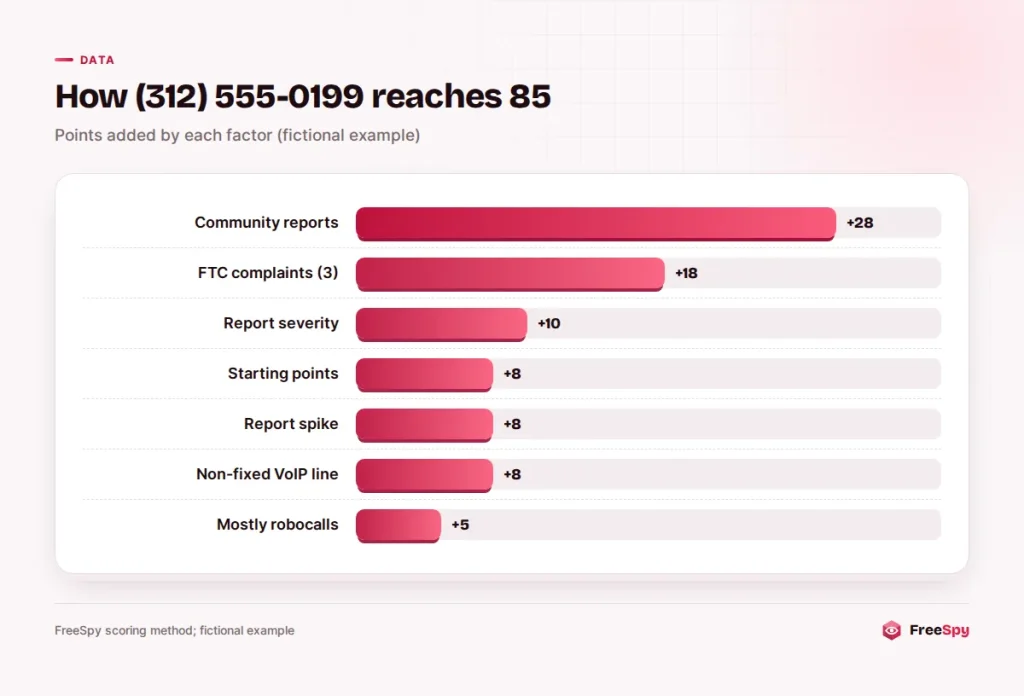
Three people report the number in five days. Two pick “Bank / card fraud”, one picks “Scam / fraud”. The FTC feed has 3 complaints about it, all marked as robocalls. A live check shows a non-fixed VoIP line.
Fictional example: three fresh bank-fraud reports, three FTC robocall complaints and a non-fixed VoIP line.
Start at 8. The three fresh reports give a weight of nearly 3, worth 28 points. Their average severity is high, adding 10. Three reports in a week with none the week before is a spike, adding 8. Three FTC complaints add 18, and the robocall share adds 5. The non-fixed VoIP line adds 8. Total: 85, “Likely scam”, with medium confidence because there are six signals.
Example 2: (614) 555-0123, a pushy sales line
Two reports: a telemarketer five days ago and a robocall twenty days ago. Three FTC complaints, all robocalls. The line is a landline.
Start at 8. The two reports, slightly discounted for age, add 19. The low-severity categories average out near the middle, adding 1. The FTC complaints add 18 and the robocall share 5. The landline takes off 3. Total: 48, “Use caution”. Probably an annoying sales operation rather than fraud, and worth letting go to voicemail.
Example 3: (809) 555-0147, the one-ring call
Two people report a single ring and a hang-up, two and five days ago, both under “One-ring / callback scam”. No FTC complaints, no carrier data.
Fictional example: a Caribbean area code adds 15 points on its own because callbacks cost international rates.
Start at 8. The two reports add 21, the high-severity category adds 8, and the Caribbean area code adds 15. Total: 52, “Suspicious”. There’s no spike bonus, because two reports in a week is below the threshold of three. If a third person reports it this week, the extra report and the spike bonus together lift it to about 68, near the top of “Suspicious”.
Now take six “Scam / fraud” reports that all arrive this week. That alone lands the number around 68. Leave those same six reports untouched for eight months and the score falls to about 23. Nobody has to delete anything for an old number to recover.
Two rules override the rest. An impossible number is fixed at 88, as described above. A number whose business owner FreeSpy has verified is capped at 15, because a known pharmacy can collect angry reports from people who didn’t want the reminder call.
What the score can’t tell you
A score summarizes evidence, and evidence has gaps.
Who is calling right now. The score describes the number’s history. If a scammer spoofs your pharmacy’s number, the pharmacy’s clean record shows up on your screen. A low score is never proof that the person on the line is who they say.
Brand-new campaigns. Scammers often rotate through fresh numbers every few days. The first people to get those calls see “No reports yet” because nobody has reported them yet. Treat “No reports yet” as unknown, not as safe.
Whether a legitimate caller is welcome. Debt collectors, political campaigns and survey firms make legal calls that many people report as unwanted. The score can tell you a call is unpopular, not that it’s illegal.
Who owns the number. FreeSpy does not do people searches. It doesn’t show owners’ names or addresses. A caller name appears only if licensed caller ID name data is turned on, or as “Caller claimed to be” when people report the name a caller used.
The safest habit doesn’t depend on any score. If a caller asks for money, codes, passwords or remote access to your computer, hang up and call the organization back on a number you find yourself.
Privacy and abuse protection
An open reporting site could be turned against the people who own the numbers on it. These protections cover both number owners and reporters.
No raw IP addresses. Reports, votes and flags store a salted hash of your IP address, enough to spot repeat submissions without keeping where you connected from.
Rate limits and bot traps. Each visitor can report a given number once per 24 hours, and lookups, votes and flags have per-visitor limits too. Forms carry a hidden honeypot field, and a CAPTCHA can be switched on when spam picks up.
Comment cleaning. Links become “[link removed]” and email addresses are masked, so reports can’t spread phishing links or contact details.
General reporter location. If you give your own area code, the report shows only the city and state that code covers.
Removal requests. If your number was spoofed or the reports about it are unfair, you can ask to have them hidden on the remove my number page. Requests are reviewed within 72 hours. Once a request is approved, reports, comments and caller names for the number are hidden and search engines are told not to index the page. Area-code facts stay, because they describe the area code, not you.
How to read a number page, section by section
Number pages are laid out so the answer comes first and the evidence follows. Working from top to bottom:
The verdict panel. Verdict, score and confidence, with “Verified” or “Trending” badges where they apply, and buttons to report, share or watch the number.
Warning banners. Only when relevant: “This number can’t exist”, “International number” for Caribbean codes, or “Owner opted out”.
Number intelligence and map. Carrier or original carrier, line type, location and rate center, local time, porting status, and a map of the area code with its overlays. The footer says where carrier data came from and when.
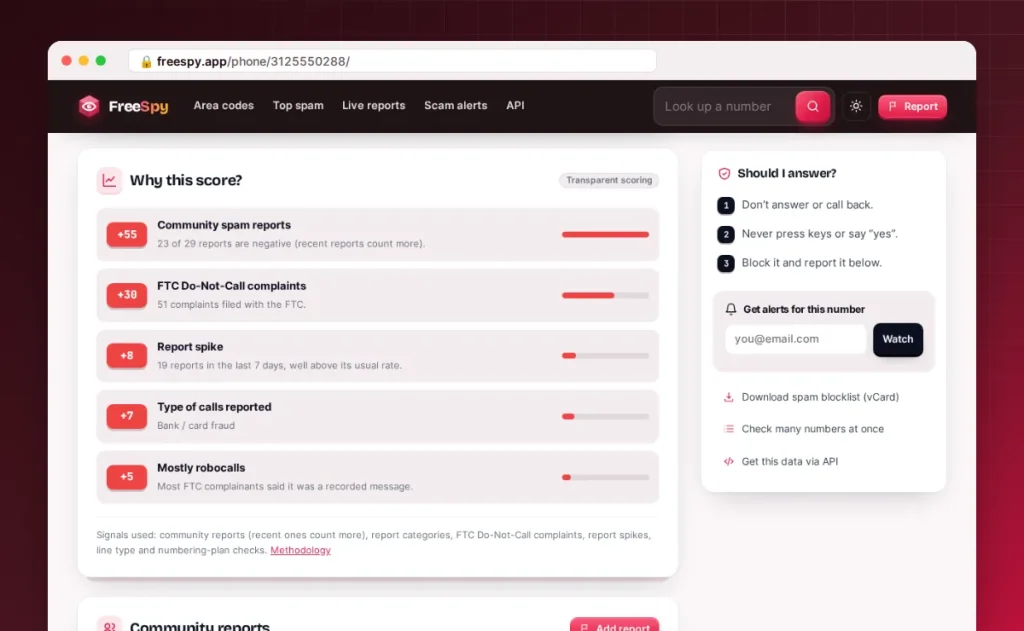
Why this score? Every factor with its points and a one-line explanation, sorted by impact. If one factor is doing most of the work, you’ll see it here.
Community reports. Totals, the share rated unwanted, reports in the last 7 days, a 90-day timeline, the categories people chose, the names callers gave, and the reports themselves, sortable by newest or most helpful.
FTC Do-Not-Call complaints. Complaint count, robocall share, first and latest complaint dates and the topics consumers picked. Shown only when complaints exist.
Campaign radar. Other numbers in the same NPA-NXX block that got unwanted reports in the last 30 days. Several hits in one block often means a dialer is working through a range or spoofing numbers that look like yours.
Questions about this number and the sidebar, which has advice matched to the verdict, a sign-up for email alerts, and links to a spam blocklist download and the top spam numbers list.
Example number page with demo data: the score panel lists every factor and how many points it adds.
A good order for a quick check: read the verdict, open “Why this score?”, then skim the three newest reports. If the reports describe the same script you heard, you have your answer.
Frequently asked questions
Why does a number with no reports show “No reports yet” instead of “Likely safe”?
Because silence isn’t evidence. A number with no reports and no FTC complaints could be your dentist or a scam line that went live this morning. FreeSpy only calls a number “Likely safe” when there is something to base that on, such as safe ratings from people who know the caller.
Can a business pay to improve its score?
Points can’t be bought, and reports aren’t removed for money. A business can have its ownership of a number verified, which caps the score at 15 and adds a “Verified” badge, but its reports stay visible. Anyone can ask for unfair reports to be reviewed for free.
My number was spoofed and now it has a bad score. What can I do?
Use the remove my number form. After a request is approved, reports and comments are hidden and the page is set to noindex. Also tell your carrier, since many offer spoofing help, and consider filing a complaint with the FCC or, in Canada, the CRTC.
Does the score work for Canadian numbers?
Yes. Canadian numbers get the same numbering-plan checks, location data, community reports and scoring. FTC complaints apply when people in the US complained about the number. For Canadian fraud reporting, contact the Canadian Anti-Fraud Centre at 1-888-495-8501.