Your phone rings once and stops. The number looks ordinary: a three-digit area code and seven digits. So you call back, which is exactly what the caller wanted.
This is the one-ring scam, also known by its Japanese name, Wangiri (“one ring and cut”). It needs no conversation and no stolen passwords. It runs on curiosity, and on a phone bill that charges international rates for a number that doesn’t look international.
The short version: missed calls from area codes such as 876, 809 or 473 are often Caribbean numbers billed as international calls, and the person who placed them earns money when you dial back. If you don’t know anyone there, don’t return the call.
Thousands of calls that never connect
The scammer uses an autodialer to place huge numbers of very short calls. Each one rings just long enough to register as a missed call, often a single ring, then hangs up before you can answer. A call that never connects is barely billed, so this costs the scammer almost nothing.
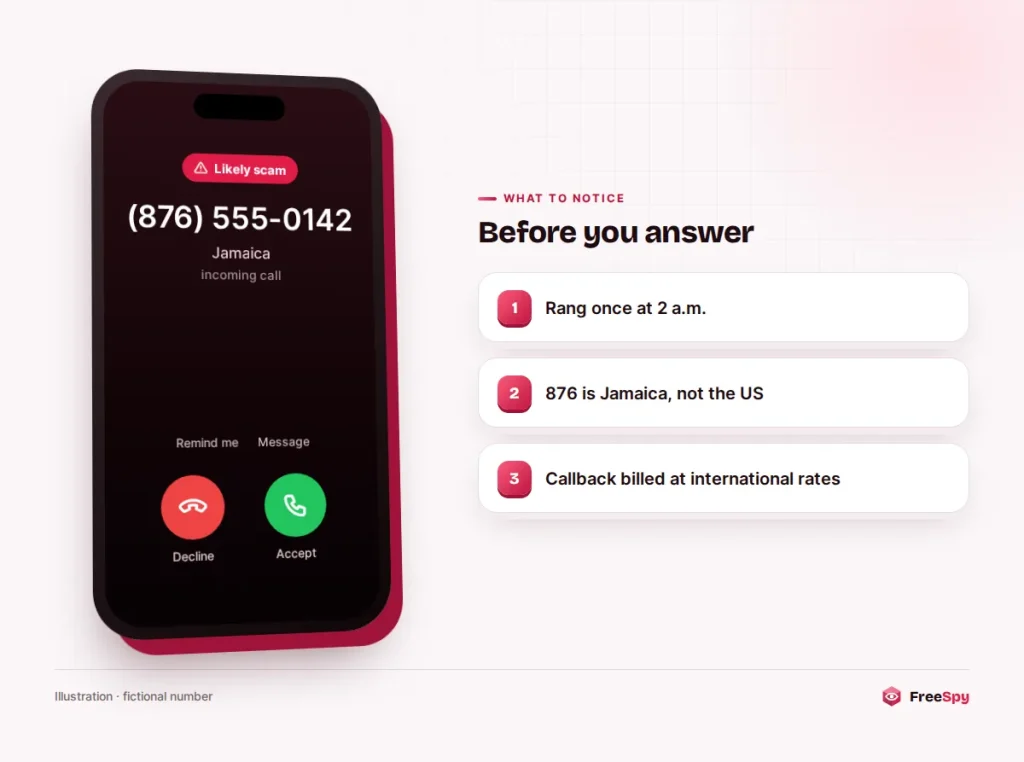
The timing is chosen to make you curious or worried. Calls tend to arrive late at night or early in the morning, and some numbers ring two or three times in a row so the missed calls look urgent. A missed call at 2 a.m. makes a lot of people think of a family emergency.
There are variations. Some leave a voicemail asking you to call back about a delivery, a prize or a relative. Others send a text along the lines of “Please call me back, it’s important.” The goal stays the same: get you to dial the number yourself.
Your phone bill is the payment channel
When you place an international call, your carrier pays the network in the other country a fee for completing it. Some countries’ networks charge high fees. Scammers lease numbers in those places, sometimes premium-rate numbers, through arrangements the industry calls international revenue share. Each minute you spend on the line generates charges, and part of that money flows back to whoever holds the number.
That’s why the scammer wants you to stay on as long as possible. You might hear hold music, a recording that sounds like a switchboard, a ringing tone that never connects, or a vague message about a prize. Each extra minute of waiting adds to the scammer’s share.
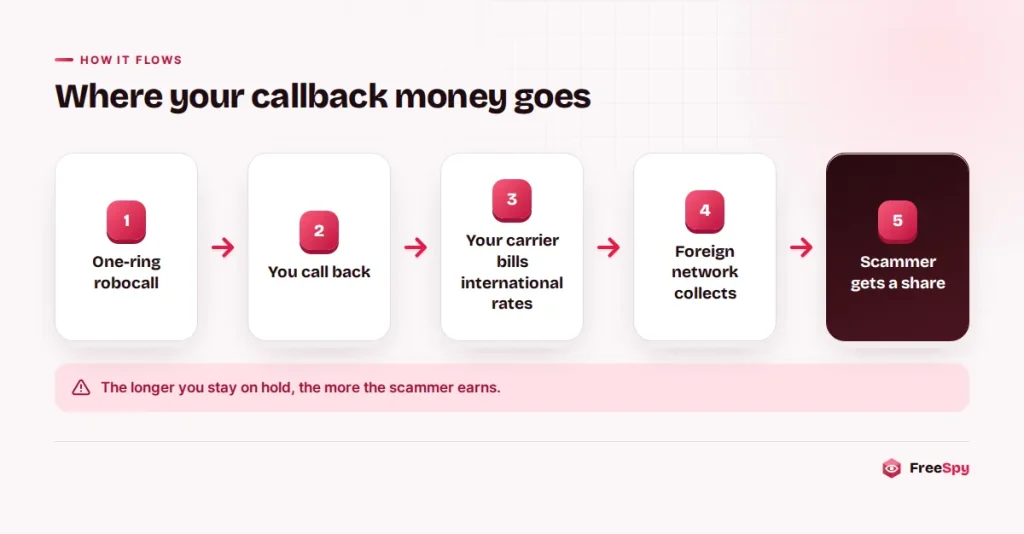
It’s a volume business. Most people ignore the missed call. Across millions of calls, though, even a small share of callbacks produces steady income, and the people paying for it are the ones who called back.
Caribbean countries share the +1 code
The North American Numbering Plan (NANP) covers more than the US and Canada. Bermuda and many Caribbean nations use the same +1 country code and the same number format: a three-digit area code followed by seven digits. A call from Jamaica looks exactly like a call from Ohio until you know what the area code means.
Calls to these Caribbean codes are billed as international, not as long distance. The FCC’s advisory on one-ring scams lists area codes that look domestic but aren’t, including these:
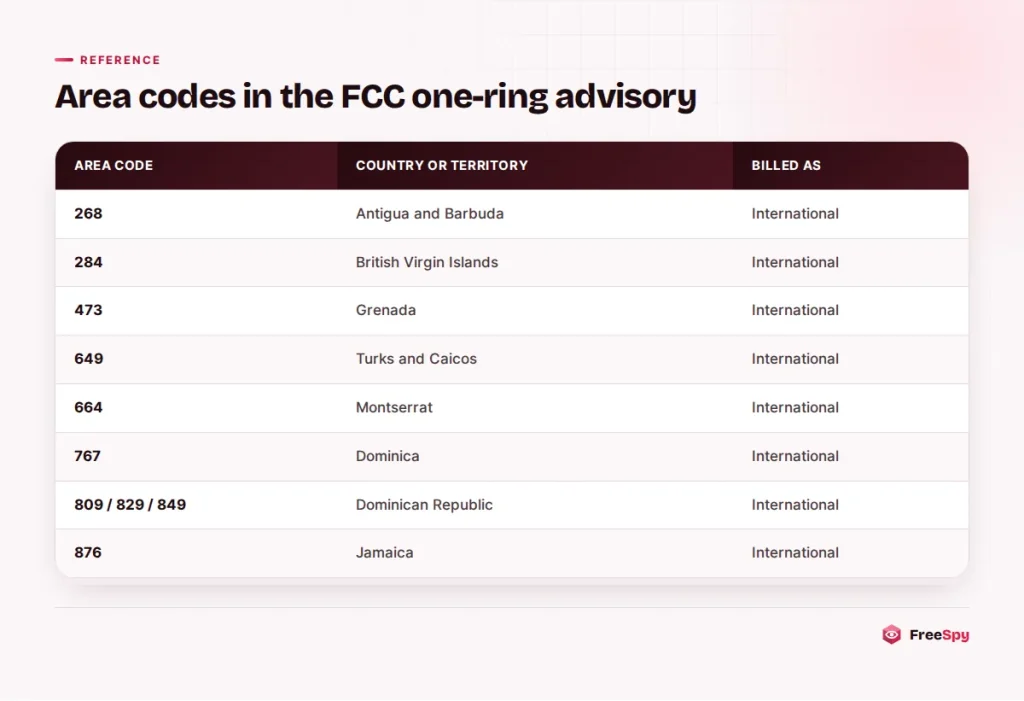
The same advisory mentions 222 (Mauritania) and 232 (Sierra Leone). Those aren’t +1 area codes at all. They’re country codes you would dial with 011 from the US. Shown without the plus sign and the usual formatting, though, they can pass for an area code at a glance, which is the point.
Tip: The area code directory lists every NANP code, Caribbean ones included, with its country or region. If a code isn’t familiar, check it before you dial.
Spotting a Caribbean number before you dial
The format won’t tell you. Caribbean numbers follow the same rules as US and Canadian ones: the area code starts with a digit from 2 to 9, and so does the exchange. You have to check the area code itself.
A handful of codes come up again and again in warnings: 876, 809, 829, 849 and 473. If you see one of them and don’t know anyone in Jamaica, the Dominican Republic or Grenada, assume the call wasn’t meant for you.
Some phones and carriers show the country, or simply “International”, under the number. Many show nothing, so a blank location line proves nothing either way.
Nobody memorizes every area code. The US and Canada alone have hundreds. An unfamiliar code is a reason to look it up before you call, not a reason to call and find out. A lookup labels a Caribbean number as “Caribbean +1 international” and names the country instead of a US state.
The rule cuts the other way too. A number showing a US area code isn’t guaranteed to be a domestic call, because callers can display numbers they don’t own. That’s a separate problem from one-ring billing, but it’s the reason no caller ID should be taken at face value.
When the bait is a voicemail or a text
Some versions skip the missed call and go straight for the callback. A voicemail says a parcel is being held, a relative was hurt, or a prize is waiting, and reads out a number to call. A text does the same in two lines.
The number in the message is the one that matters, not the one that sent it. Check its area code the same way you would a missed call. If the message claims to come from a courier, a bank or a hospital, find that organization’s number on its official website or on a bill and call that instead. A real delivery company or hospital won’t mind, and a scam number never gets dialled.
Be wary of messages that give no name at all. “Call me back, it’s urgent” from an unknown sender is designed to make you fill in the blanks yourself, usually with the worst possibility.
What a callback costs
According to the FCC, calling back may cost you an international connection fee plus per-minute charges. The amount depends on your plan and the destination. Some plans include certain Caribbean destinations at low rates, while others bill them at full international or premium rates. Prepaid users may just see their balance drop.
The charges often appear weeks later, labelled as international calls, which is why many people never connect them to a missed call. The longer you stayed on the line, the larger the charge.
A callback has a second cost that doesn’t show up on any bill. It tells the scammer your number is active and answered by a person. Numbers that respond tend to get more scam calls afterward, not fewer.
Called back already? Start with your usage page
Don’t panic. A single short callback is usually a modest charge, and carriers handle these disputes all the time.
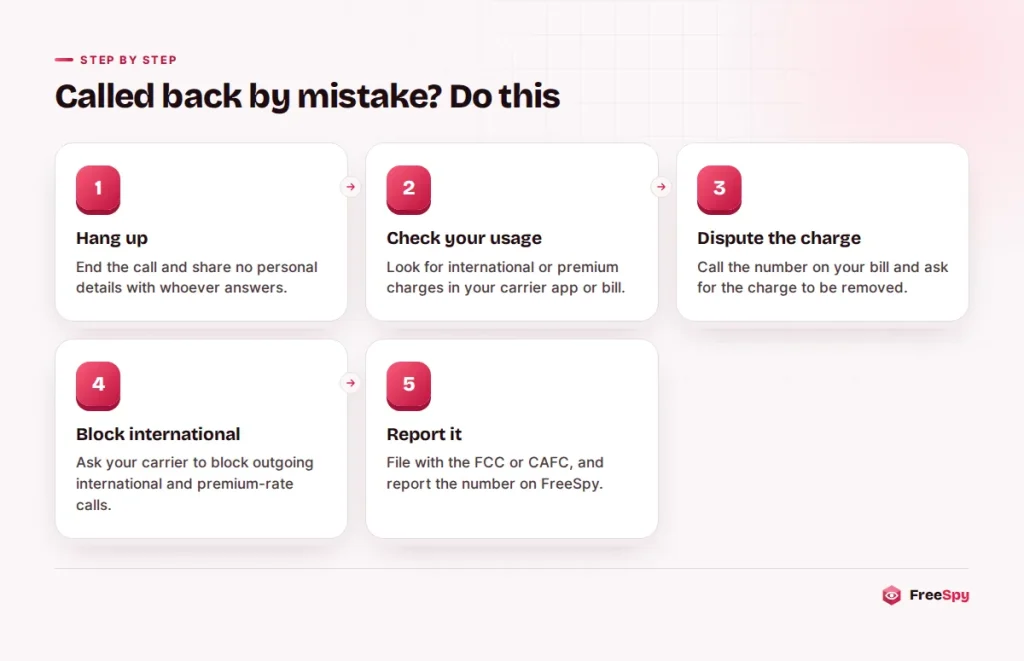
If you’re still on the line, hang up, and don’t give any personal details to whoever answers.
Then check your usage. Most carrier apps and online accounts show recent calls and charges well before the bill arrives. Look for anything marked international or premium, and note the date, time and number.
Call your carrier on the number printed on your bill. Explain that you returned a one-ring scam call and ask them to remove the charge. Many will credit it, especially the first time. While you have them, ask about blocking international and premium-rate calls on the line (more on that below).
File a complaint as well. In the US, report it to the FCC at fcc.gov/complaints. In Canada, report it to the Canadian Anti-Fraud Centre online or at 1-888-495-8501, and if your carrier won’t resolve a billing dispute, the Commission for Complaints for Telecom-television Services (CCTS) handles telecom complaints.
Last, warn the next person. A report on the number with the category “one-ring” and the call type “one-ring missed call” shows up for anyone who looks it up later.
Block the outgoing side
Blocking incoming scam calls helps, but the real fix is on the outgoing side. If your line can’t dial expensive international numbers, a callback can’t cost you anything.
Most carriers can turn off outgoing international calls on a line. Ask customer service, or look in your account settings or app. Because Caribbean +1 codes are international, the block covers them too.
Ask whether your carrier can also block premium numbers, such as US 900 numbers where the caller pays. The way toll-free and premium numbers are billed is quite different, even though they look alike on screen.
If you manage a plan for a child or an older parent who never calls abroad, a block on their line is a cheap safety net. And on the incoming side, Silence Unknown Callers on iPhone and spam filtering on Android cut the number of missed calls in the first place; the phone settings walkthrough has the menus.
If you have family or business contacts in the Caribbean, a full block may be too much. Leave it off and save the numbers you actually call in your contacts. Anything from that region that isn’t in your contacts can wait until you’ve checked it.
The +15 points a Caribbean code adds
Each FreeSpy number page checks the area code against NANP data and shows the number type. When a number belongs to a Caribbean +1 code, the page labels it “Caribbean +1 international” with the country, and the risk score adds 15 points for that alone. Premium 900 numbers add 20.
The Caribbean flag doesn’t mark a number as a scam by itself, because plenty of legitimate calls come from the Caribbean. It raises the starting point. When the same number also has community reports tagged “one-ring”, FTC Do Not Call complaints or a sudden spike in reports, those factors stack, and the number moves into “Suspicious” or “Likely scam”. Each factor and its points are listed on the page, so you can see why a number scored the way it did.
When a Caribbean call is real
Not every call from 876 or 809 is a scam. Families, resorts, cruise operators, banks and call centres all use Caribbean numbers.
Context is the difference. A real caller usually stays on the line when you pick up, leaves a clear message with a name, and is someone you had reason to hear from. A single ring at an odd hour with no message, from a country where you know nobody, is not a call to return.
A few more questions
Can I be charged just for answering a one-ring call?
The charges come from calling the number back. Answering an incoming call on a US or Canadian plan while you’re at home is not how this scam makes money. If you travel abroad, your plan’s roaming rules may differ, so check with your carrier.
Should I block the number?
You can, but scammers rotate through many numbers, so blocking one rarely stops the next. An international calling block on your line and a habit of not returning unknown missed calls work better.
Does calling back give the scammer my personal details?
A callback by itself only reveals that your number works and that a person uses it. Your details are at risk only if someone answers and you give them information, so if a person does pick up, say nothing about yourself and hang up.
Sources
- FCC consumer guide: “One Ring” (Wangiri) scam
- FCC Consumer Complaint Center
- Canadian Anti-Fraud Centre