A report takes less than a minute, and it’s the most useful thing you can do after an unwanted call. The next person who looks the number up will read what you wrote before deciding whether to answer. This page explains each field in the form above, shows what makes a report helpful, and covers where else to report the call.
Key takeaways
- The most useful detail is who the caller claimed to be and what they asked for.
- Report the number exactly as it appeared on your caller ID, even if you suspect it was spoofed.
- Leave out personal information, yours or anyone else’s. Links and email addresses are removed automatically.
- A FreeSpy report warns other people. A report to the FTC, FCC or Canadian Anti-Fraud Centre helps enforcement. Do both.
What each field means
Only the number and the rating are needed. Everything else is optional, but each extra field makes your report more useful to the person who reads it next.
Phone number that contacted you
Type the number the way it showed on your phone. Any format works: (202) 555-0147, 202-555-0147 or +1 202 555 0147. If you came here from a number page, it’s filled in already. For texts from short codes (five- or six-digit senders), the form won’t accept the number, because short codes aren’t part of the 10-digit numbering plan. Forward those texts to 7726 instead.
Rating: Unwanted, Not sure, or Safe
Pick Unwanted for scams, spam, robocalls and any call you didn’t want. Pick Not sure if you missed the call or the caller hung up before saying anything. Pick Safe if the caller turned out to be legitimate, such as your dentist’s reminder line or a delivery driver. Safe reports matter. They lower a number’s score, and they protect real businesses and people whose numbers get spoofed.
Type of call
This is the category: government impersonation, bank or card fraud, tech-support scam, text phishing, crypto or investment scam, one-ring callback, fake delivery, fake job offer, auto warranty, Medicare or health insurance, robocall, harassment, telemarketer, debt collector, silent call, survey or political, other, or legitimate caller. Choose the one that matches what the caller claimed. A recorded voice saying it’s from the IRS is government impersonation, not just a robocall. The category affects the score, because a fake Social Security call is more dangerous than a survey.
How did they reach you?
Phone call, text message, voicemail, recorded robocall, or a missed call after one ring. This helps readers recognize the pattern. A number that only ever rings once is a different threat from one that leaves long voicemails.
Name they claimed
Write the name the caller used, exactly as they said it: “Medicare Benefits Dept.”, “Amazon Fraud Team”, “Officer Daniels, county sheriff”. Scam campaigns reuse the same names across many numbers, so this field helps people connect the dots. Don’t guess at a name, and don’t enter the real name of the person you think owns the number.
Your area code
Optional. If you add it, the page can show roughly where reports come from, such as “reported from Arizona”. It never shows your number. It helps reveal campaigns that target one region, and it feeds the spam radar map of reports by area code. You can watch new reports arrive on recent reports.
What happened?
Your description, up to 1,200 characters. Two or three sentences is usually enough. Say what the caller wanted, how they asked for it, and anything distinctive: a callback number, a payment method, a website name, a reference number they read out. Links and email addresses are replaced with “[link removed]” and “[email removed]”, so describe a website by name instead of pasting it.
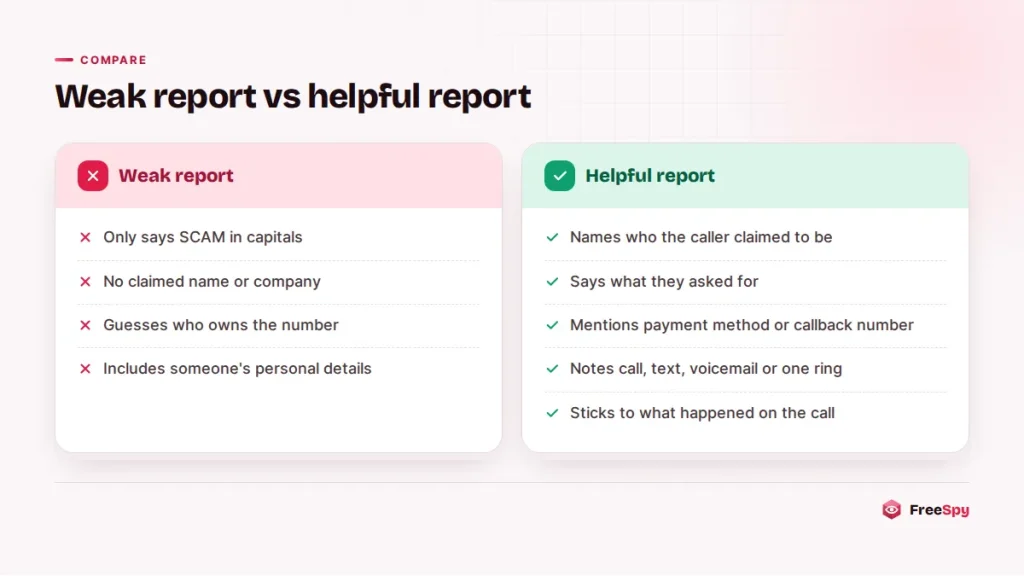
Good reports and weak reports
The difference is detail. A weak report tells readers you were annoyed. A good one tells them what to expect and how to spot it. These examples are fictional.
Weak:
SCAM DO NOT ANSWER
Good:
Recorded message said my Social Security number was “suspended due to suspicious activity” and to press 1 to speak to an officer. The man who answered asked me to confirm my SSN and date of birth. I hung up. Called around 2 p.m. on a weekday.
Weak:
Called 5 times, the owner of this number is a creep.
Good:
Five calls in two days, no voicemail. When I finally answered there was silence for a few seconds, then a click. Possibly a dialer checking if the line is active.
Weak:
Fine.
Good:
Automated refill reminder from my pharmacy. Gave the store location and said my order was ready. Didn’t ask for any payment or details. I checked with the pharmacy and it’s their number.
The good reports share three things: the claimed identity, the request, and how the call went. They describe behaviour, not a person, and they’d still be accurate if the caller ID turned out to be spoofed.
What not to post
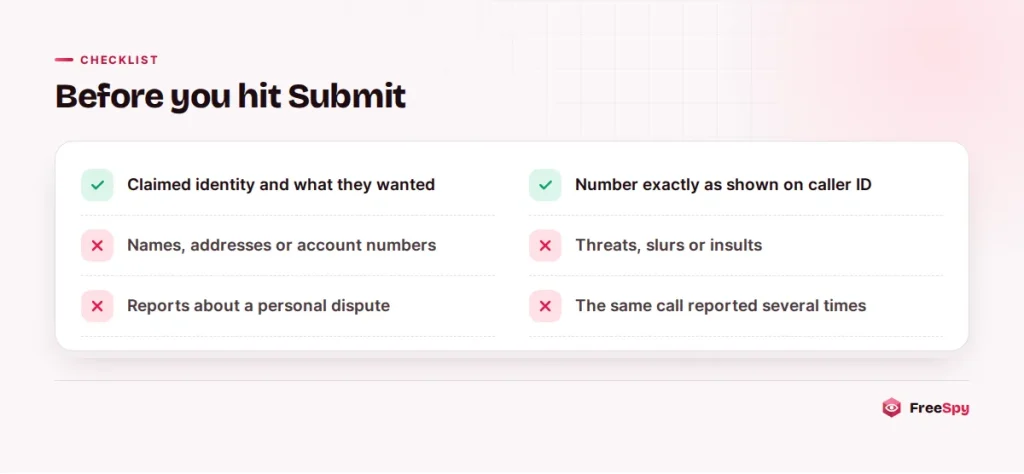
Reports are public, indexed by search engines, and readable by the person whose number it is. Our community guidelines set out the rules. The short version:
- No personal information. No names, home addresses, email addresses or account numbers, including your own. If a scammer read out your account number, write “they knew the last four digits of my card”, not the digits.
- No threats, slurs or harassment. Even if the caller was abusive, keep your report factual.
- No accusations you can’t support. “This number belongs to John Smith on Elm Street and he’s a fraudster” is unfair if the number was spoofed, and it may be defamatory. Describe what happened on the call and leave identity out of it.
- No personal disputes. Don’t report an ex, a neighbour, a landlord or a business you’re arguing with. That’s not what the site is for, and those reports are removed.
- No duplicate reports. One report per call is enough. Submitting the same call several times doesn’t help readers and is blocked within a 24-hour window.
- No ads or links. Self-promotion is removed, and links are stripped automatically.
Remember that caller ID can be faked. If comments on a number say “this is my number and I didn’t call anyone”, the number is probably being spoofed. Report the call content, and say that the number may be spoofed.
What happens after you submit
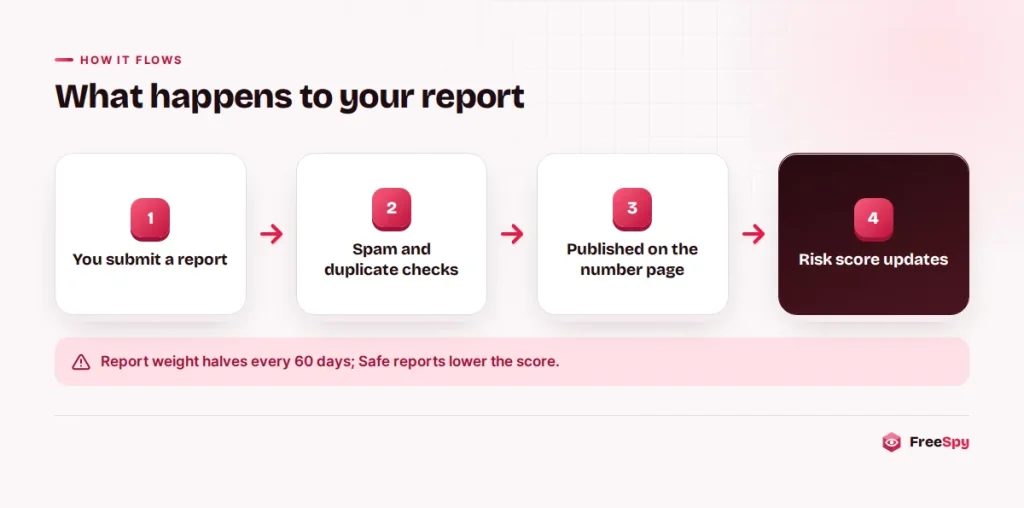
Most reports appear on the number page within seconds. A few things happen along the way.
Spam checks
Each visitor can report a given number once per 24 hours, and all write actions are rate-limited. The form includes a hidden field that only bots fill in, and a CAPTCHA can be switched on when abuse picks up. Your IP address is turned into a salted one-way hash, which lets us spot repeat submissions without storing the address itself. You don’t need an account, and we don’t ask for your email.
Moderation
Reports are published straight away in most cases, though some may be held for review before they appear. After publication, anyone can vote a report helpful or not helpful, or flag it. A report that collects several flags is hidden until a moderator looks at it. Moderators may edit out personal details or remove reports that break the guidelines.
Effect on the score
An Unwanted report adds to the number’s community score. Each extra report adds a little less than the one before, so a single report can’t push a number into “Likely scam” on its own. The category counts too: serious categories such as government impersonation and bank fraud add more than a telemarketer or survey. A report’s weight halves every 60 days, so the score reflects what the number is doing now. A Safe report subtracts points. If a number gets three or more reports in a week, and at least double the week before, a spike factor kicks in and the number can appear on top spam numbers. Every factor and its points are listed on the number page. How it works explains the full method.
Report it to the authorities too
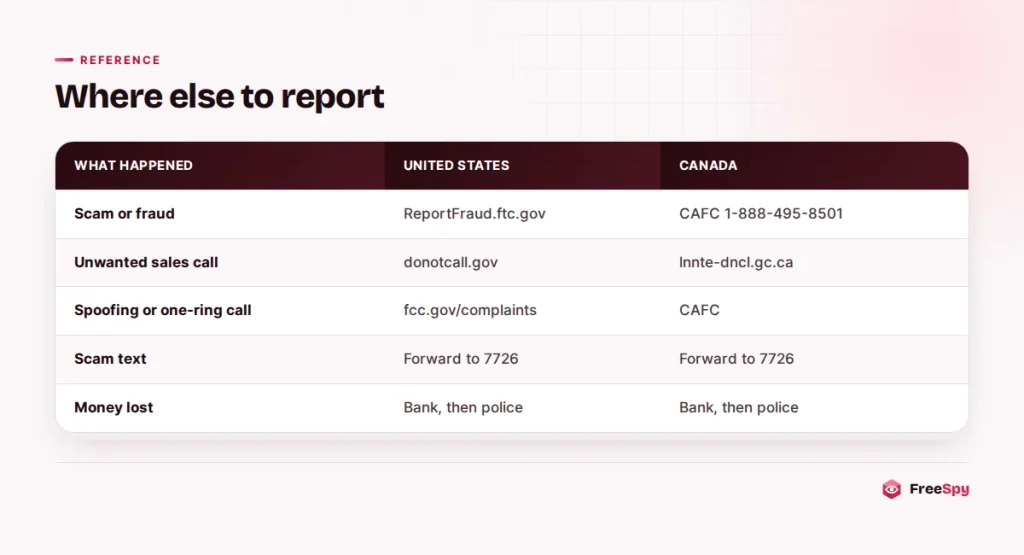
FreeSpy reports warn other people. Government reports feed investigations, trend data and enforcement. They take a few more minutes, and they’re worth it, especially if you lost money or shared personal information.
In the US
- Scams and fraud: ReportFraud.ftc.gov. Include the number, the date, what the caller claimed, and any payment details. The FTC shares reports with law enforcement through its Consumer Sentinel network.
- Unwanted sales calls: donotcall.gov or 1-888-382-1222, if your number has been on the National Do Not Call Registry for at least 31 days. These complaints are published in the FTC data that FreeSpy shows on number pages.
- Spoofing, one-ring calls and robocalls: the FCC’s complaint center at fcc.gov/complaints.
- Scam texts: forward the message to 7726 (SPAM) and use “report junk” in your messaging app.
- Government impersonation: Social Security scams to the SSA Inspector General at oig.ssa.gov; IRS impersonation to TIGTA at tigta.gov.
In Canada
- Fraud and scams: the Canadian Anti-Fraud Centre, online or at 1-888-495-8501. The CAFC received more than 112,000 fraud reports in 2025, with over $704 million in reported losses.
- Telemarketing: the National Do Not Call List at lnnte-dncl.gc.ca or 1-866-580-3625, if you’ve been registered for at least 31 days and the caller isn’t exempt.
- Lost money: also report to your local police and your bank.
Tip: Write your FreeSpy report first, while the call is fresh. Then copy the same description into your FTC or CAFC report. It saves you remembering the details twice.
Common questions about reporting
Can I edit or delete my report?
Reports are anonymous, so we can’t confirm who wrote one. If you made a mistake, add a new report with the correct rating, or use the contact page to ask us to remove it.
What if the number was spoofed?
Report it anyway, as it appeared on your caller ID, and say in the comment that it may be spoofed. That helps the real owner too, because readers will see the pattern.
Should I report a call I missed?
Yes, if you have something to add. Choose “Not sure” or “One-ring / callback scam” if it rang once, and leave a short note. Avoid guessing what the call was about.
Someone reported my number unfairly. What can I do?
Add a Safe report explaining the situation, or ask us to hide the reports through Remove my number. We review requests within 72 hours.