Transparent
Every score lists its factors. There are no hidden formulas and no paid “premium reports”.
Privacy-first
We hash IP addresses, never sell data, and give number owners an opt-out that works.
Community-powered
Each report helps the next person who gets that call. Moderation keeps reports fair.
FreeSpy is a free reverse phone lookup for numbers in the US, Canada and the rest of the +1 calling area. You type in a number that called or texted you, and you get a plain verdict with the evidence behind it: where the number comes from, what kind of line it is, what other people reported, and what the FTC has on file. This page explains what the site is for, what it deliberately doesn’t do, and the rules it runs on.
Key takeaways
- FreeSpy answers one question: should you trust this call or text? It is not a people-search or background-check site.
- Lookups are free with no sign-up. The site is paid for by ads and by paid API plans for businesses with high volume.
- Every risk score lists its factors and points, and the method is published on the How it works page.
- Number owners can ask to have reports hidden, and reporters are protected by hashed IP addresses and cleaned comments.
- Guides cite official sources, and readers can send corrections through the contact page.
Why FreeSpy exists
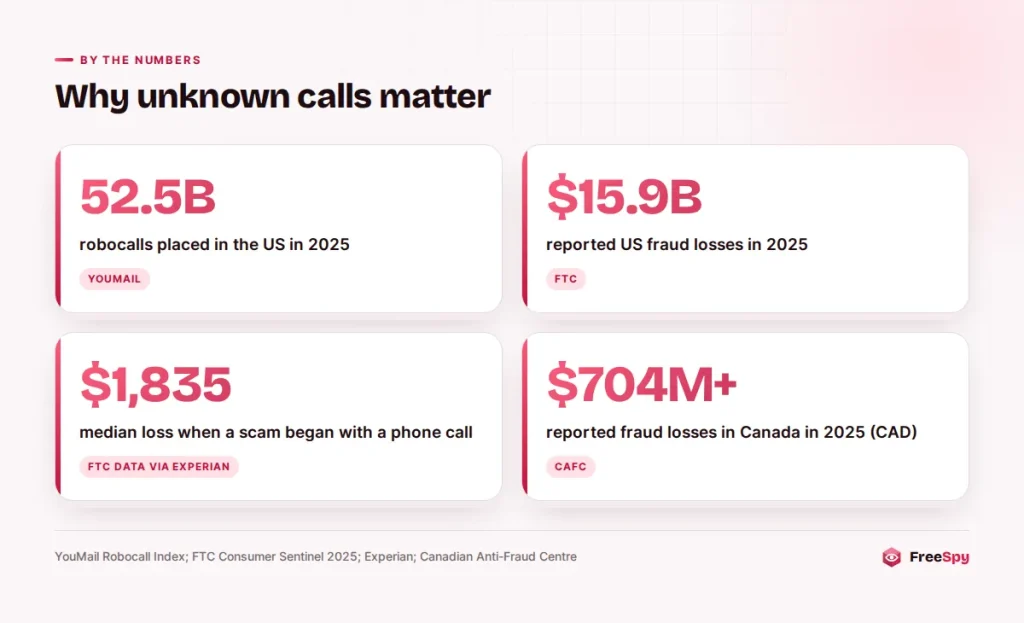
Unknown calls have stopped being a minor nuisance. YouMail’s Robocall Index estimates that about 52.5 billion robocalls were placed in the US in 2025. The FTC’s Consumer Sentinel data for the same year shows about 3 million fraud reports and a record $15.9 billion in reported losses. In Canada, the Canadian Anti-Fraud Centre logged more than 112,000 fraud reports and more than $704 million in losses in 2025.
Phone scams also hurt more per victim than most. According to an Experian summary of the FTC’s 2025 data, the median loss when a scam started with a phone call was $1,835, the highest of the main contact methods. The person on the other end has your full attention, and they use it to build urgency.
Most people deal with this by not answering. That works until the unknown number is the pharmacy, a new doctor or a school. FreeSpy is meant for that moment of doubt: a quick, free way to see whether other people have had trouble with a number before you decide whether to answer, call back or block it.
What FreeSpy is, and what it is not
Many sites that call themselves “reverse phone lookups” are front doors for paid people-search reports. You type in a number, watch a progress bar, and get asked for a subscription to see a name, an address and a list of relatives. FreeSpy works differently on purpose.
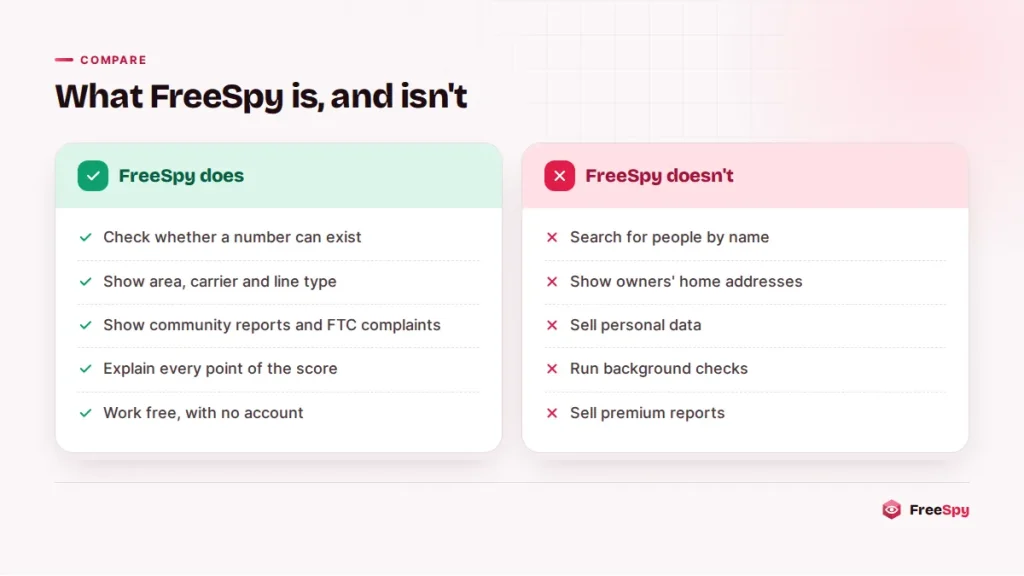
FreeSpy looks at the number: whether it can exist, where it was issued, which carrier it started with, what type of line it is, and how people and the FTC have described calls from it. It does not build profiles of people. It doesn’t sell personal data, doesn’t run background checks, and doesn’t show owners’ names, home addresses, relatives or social media accounts.
The only names that appear on a number page come from two places. One is licensed caller ID name (CNAM) data, the same short label a phone network can show on your screen, where that data source is enabled. The other is “Caller claimed to be”, which lists names that callers gave according to people who reported them. A scammer who says he’s from “Medicare Benefits” ends up listed that way, which is useful, but it’s a claim and not an identity.
If you need to know who a person is for legal reasons, such as serving papers or a court case, FreeSpy isn’t the right tool. Your carrier, the police and the courts have ways to get subscriber records that a public website doesn’t and shouldn’t have.
The principles behind the site
Free for the person holding the phone
Every lookup on the website is free and needs no account. That covers the verdict, location, carrier and line type where available, community reports, FTC complaint data and the full score breakdown. There is no locked “premium report” waiting behind a payment screen. Reporting a number is free too.
A score you can check
A risk score is only useful if you can see how it was made. Each number page lists every factor that moved the score and how many points it added or removed: community reports, how serious the reported calls were, sudden spikes in reports, FTC complaints, the share of robocalls, line type and numbering-plan red flags. The How it works page publishes the full method with worked examples. If you think a score is wrong, you can see exactly which factor to question.
Privacy for reporters
People who report scam calls shouldn’t become targets themselves. FreeSpy doesn’t need an account to report, stores IP addresses only as salted hashes, and shows a reporter’s location only as the city and state of an area code they choose to give. Comments are cleaned so they can’t carry links or email addresses. The privacy policy has the details.
Fairness to number owners
Caller ID is easy to fake. When scammers spoof a real number, the person who owns it can end up with a page full of angry reports for calls they never made. FreeSpy treats that as a real risk, not an edge case. Reports lose half their weight every 60 days, so old trouble fades. Abusive or false reports can be flagged and hidden. And anyone can use the remove my number form. Requests are reviewed within 72 hours, and approved ones hide all reports, comments and caller names for the number and tell search engines to drop the page.
Where the data comes from
A FreeSpy result combines four independent kinds of data. Each one is labeled on the number page so you always know which is which.
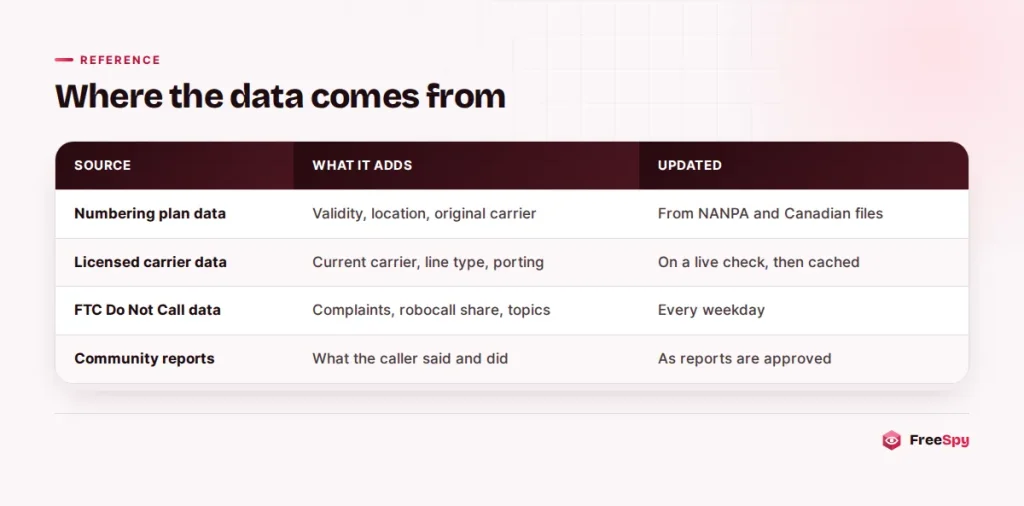
- Numbering plan data. Area-code and exchange records from the North American Numbering Plan, including the original carrier and rate center for each block of numbers, from NANPA and Canadian numbering administration data.
- Carrier data. When a live check is run, licensed carrier-data providers return the current carrier, line type and porting status. Results are cached for a while to keep the site fast and free.
- FTC complaints. The Federal Trade Commission publishes basic Do Not Call complaint data each business day. FreeSpy imports it every weekday and shows complaint counts, robocall share and topics per number, marked as FTC data.
- Community reports. What people say happened when the number called or texted them, with a rating, a category and a comment.
None of these sources is perfect alone. Carrier data says nothing about behavior. Reports and complaints can land on a spoofed number. That is why the score combines them and shows its work instead of picking one.
How the site is funded
FreeSpy pays for servers, carrier-data lookups and moderation in two ways.
- Advertising. Pages carry ads. Advertisers don’t get any say over scores, reports, or what the guides say, and an ad on a page is not an endorsement.
- Paid API plans. Businesses that need to check numbers in volume, such as call centers screening inbound calls or apps checking phone numbers at sign-up, can use the FreeSpy API. Light use is free. Plans for higher volume are listed on the pricing page.
Some business plans include a verified-business badge. Verification confirms that a company owns a number, and it caps that number’s score at 15 so a known pharmacy or clinic isn’t labeled a scam because people disliked a reminder call. It doesn’t remove or hide any reports, and nobody can pay to change a score directly or to have reports deleted.
How the guides are written
Alongside the lookup tool, FreeSpy publishes guides on phone scams, caller ID spoofing, blocking spam, and the laws on robocalls and telemarketing. They follow a few rules:
- Official sources first. Statistics come from primary sources such as the FTC, the FCC, the CRTC and the Canadian Anti-Fraud Centre, or from clearly named industry trackers. Each figure is attributed in the text and linked in a Sources list at the end.
- No made-up examples. Example phone numbers come from the 555-0100 to 555-0199 range, which is reserved for fiction, so no real person gets calls because of a guide. There are no invented testimonials or quotes.
- US and Canada both. Where the rules differ, guides cover both countries, for example the US National Do Not Call Registry and Canada’s National DNCL.
- Not legal advice. Guides explain how laws such as the TCPA work in general terms. For your own situation, check the official source or talk to a lawyer.
- Corrections. If you find an error, an outdated figure or a broken source link, send it through the contact page. Confirmed errors are fixed in the article.
How moderation works
Community reports are the part of FreeSpy most open to misuse, so they get the most rules. The community guidelines set out what a report may and may not contain. In short: describe the call, not the person. No names of private individuals, no home addresses, no threats, no guesses presented as facts.
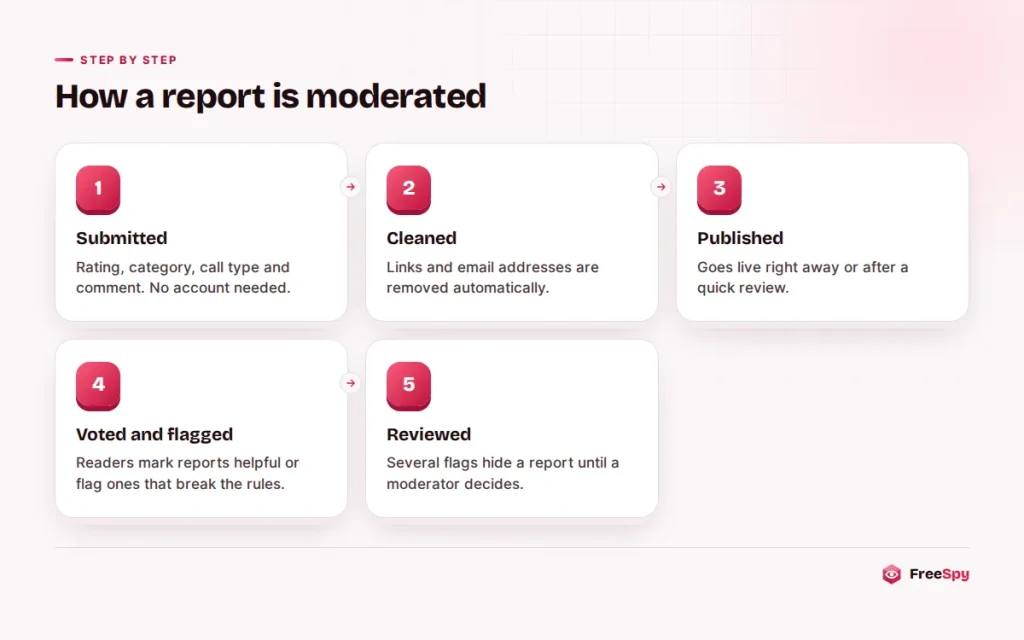
Several layers keep that in place. Each visitor can report a given number only once per 24 hours, and forms are protected against bots. Links and email addresses are stripped from comments automatically. Readers can vote reports helpful and flag ones that break the rules; when a report collects several flags, it is hidden until a moderator reviews it. Moderators can approve, hide or delete reports, and only approved reports count toward a score.
Moderation is about keeping reports fair and lawful, not about agreeing with them. A report that says “they claimed to be from my bank and asked for my card number” stays up even if the number belongs to a company that disputes it. The company can ask for a review, and if the number was spoofed, the removal process exists for exactly that.
How to reach FreeSpy
The contact page is the way in for corrections to guides, questions about a score, API keys and business plans, and press questions. To get reports about your own number hidden, use the remove my number form instead, since it goes straight to the removal queue. For common questions about how lookups work, the FAQ may already have the answer.
If a call has already cost you money, don’t wait on a website. Call your bank first, then report the scam to the FTC at ReportFraud.ftc.gov or, in Canada, to the Canadian Anti-Fraud Centre at 1-888-495-8501.
Frequently asked questions
Is FreeSpy a people-search site?
No. It looks up phone numbers, not people. It doesn’t show owners’ names, addresses or relatives, and it doesn’t sell personal data or background reports.
Do I need an account to look up or report a number?
No. Lookups and reports both work without signing up. An email address is needed only if you want alerts when a number gets new reports.
Can a company pay to remove bad reports?
No. Reports are hidden only through moderation for breaking the guidelines, or through an approved removal request, which is free.
How do I report a mistake in a guide?
Use the contact page and include the article, the error and a source if you have one. Confirmed errors are corrected in the article.