Zelle, Venmo and Cash App move money in seconds. That speed is what makes them useful, and it is exactly what a scammer needs. Many of the costliest losses on these apps don’t begin in the app at all. They begin with a phone call from someone who sounds like your bank, your utility, a buyer or a grandchild, and they end with you tapping “Send.”
Once that happens, getting the money back is hard, and sometimes impossible. So the useful knowledge is mostly about the minutes before you send: which scripts lead there, and what a pause can catch.
Instant, final and familiar: what the scammer is buying
For a scammer, a payment app solves three problems at once. The money arrives almost instantly, before you’ve had time to talk to anyone. It’s hard to reverse. And it feels routine, because sending money from your own banking app doesn’t feel like wiring cash to a stranger.
The FTC compares it to “sending cash” and warns that “it’s very hard to get it back.” The Consumer Financial Protection Bureau makes the same point from a technical angle: mobile payment services “generally don’t have a recall or retrieval feature.” Zelle itself calls the service “a great way to send money to friends, family or others you trust,” and says it does not offer purchase protection.
The phone is often how they get you there. According to FTC data for 2025, scams that began with a phone call had a median loss of $1,835, the highest of the main contact methods. A live voice can answer your doubts and walk you through each tap in real time, which a text can’t.
“Send it to yourself”: the bank call built for careful people
This is the best-known phone-based Zelle scam, and it is designed for people who think they’re being cautious. Zelle describes the sequence:
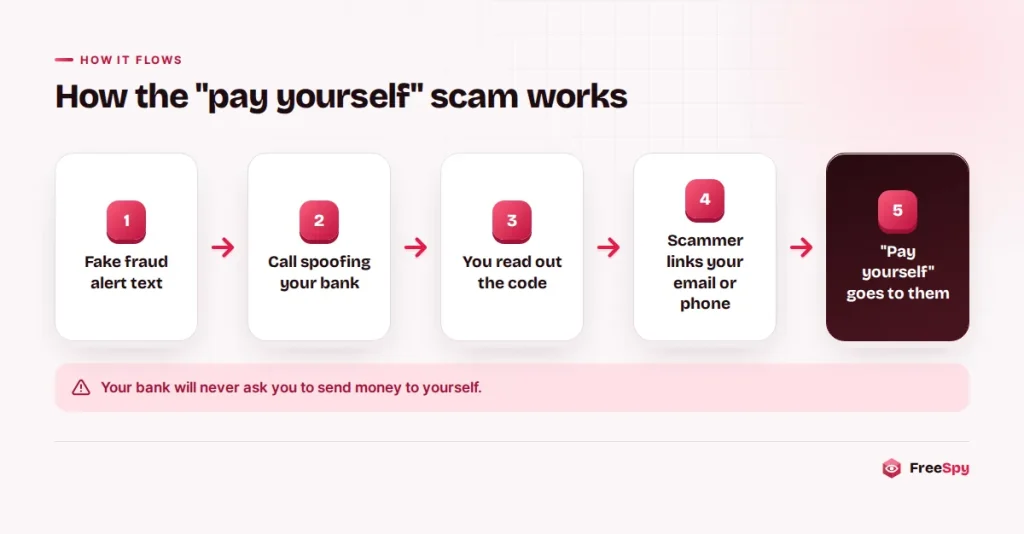
- You get a text that looks like a fraud alert from your bank, asking whether you made a purchase.
- Soon after, someone calls from a number that appears to be your bank and offers to stop the fraud.
- The caller says you need to “send money to yourself” to move it out of the thief’s reach, and asks for the one-time passcode your bank just texted you to authorize it.
- With that code, the scammer registers their own account to your email address or phone number. When you pay “yourself,” the money goes to them.
Zelle’s answer is short: “your bank will never ask you to send money to yourself.” It also warns about versions where you’re told to send money to an email address containing your own name, or words like “Zelle Dispute,” so the recipient looks official.
The incoming call often displays your bank’s real name or number, because the number shown on screen can be spoofed. The same callers have other moves too, and the rest of that call follows a recognizable pattern.
Five other stories that lead to the Send button
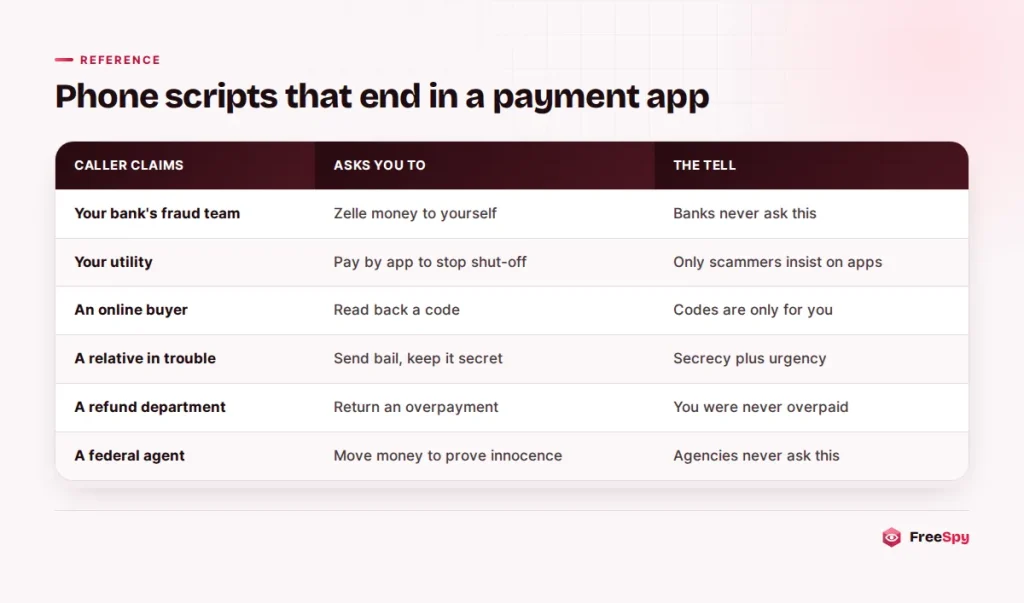
The “pay yourself” script gets the attention, but plenty of others steer you to the same place. All examples here are fictional.
“Your power will be cut off in an hour”
“This is the disconnection department. Your account is past due and a technician is on the way. To stop the shut-off, send $486 by Zelle to our billing coordinator.”
A shut-off threat with a one-hour deadline, settled by a personal app transfer, is a scam pattern. The FTC warns that only scammers insist you pay with a payment app, gift cards, cryptocurrency or a wire transfer.
“We need to verify you’re a real seller”
List something for sale online and a “buyer” may call or text asking you to read back a code to prove you’re real, or say their payment is “on hold” until you upgrade your account by sending money. A code you didn’t request is never meant for the other person; the code-sharing trick behind it is one of the oldest on marketplaces.
“Grandma, it’s me. I need help”
A frightened voice says there’s been an accident or an arrest and asks for bail or a lawyer’s fee by Zelle, and begs you not to tell anyone. With AI cloning, the voice may sound familiar. Families who agree on a family code word ahead of time can end that call in seconds.
“You’re owed a refund”
A caller says you were overcharged for a subscription or a security service and offers a refund. They have you log in to your bank while they “process” it, then claim they refunded too much and ask you to send the difference back by app. The “overpayment” is usually your own money shuffled between your accounts, or nothing at all.
“Your account is part of a federal investigation”
Once you’re scared, some scams pass the call to a fake FTC, FBI or police agent who says the money has to move to prove you’re innocent. The FTC says it will never demand money or tell you to transfer money.
Tricked into approving it, or taken without permission?
Banks and payment services treat two situations differently, and the difference affects whether you get your money back.
Fraud is money leaving your account without your permission. Someone took over your account and sent a payment you never approved.
A scam is when you were persuaded to approve the payment yourself. Zelle explains that if you “gave the ‘ok’ to authorize a payment,” it’s typically treated as a scam, and “because you authorized the payment, you may not be able to get your money back.”
In the US, the Electronic Fund Transfer Act and its Regulation E limit your liability for unauthorized electronic transfers, and how much depends on how fast you report. When a lost or stolen card, code or other means of access is involved, telling your bank within two business days of learning about it generally caps your liability at $50; wait longer and the cap can rise to $500. Unauthorized transfers that show up on a statement must be reported within 60 days of the statement being sent to avoid liability for later transfers.
The “pay yourself” scam sits in a gray zone. You pressed Send, but the scammer used your code to change where the money went. Tell your bank exactly what happened, including that you gave a code to someone posing as the bank, and ask them to investigate it as an unauthorized transfer. Rules change and the details matter, so check the CFPB’s guidance or speak with a lawyer about a specific case. This is general information, not legal advice.
Thirty seconds before you tap Send
Most of these scams fall apart if you stop and ask a few questions first.
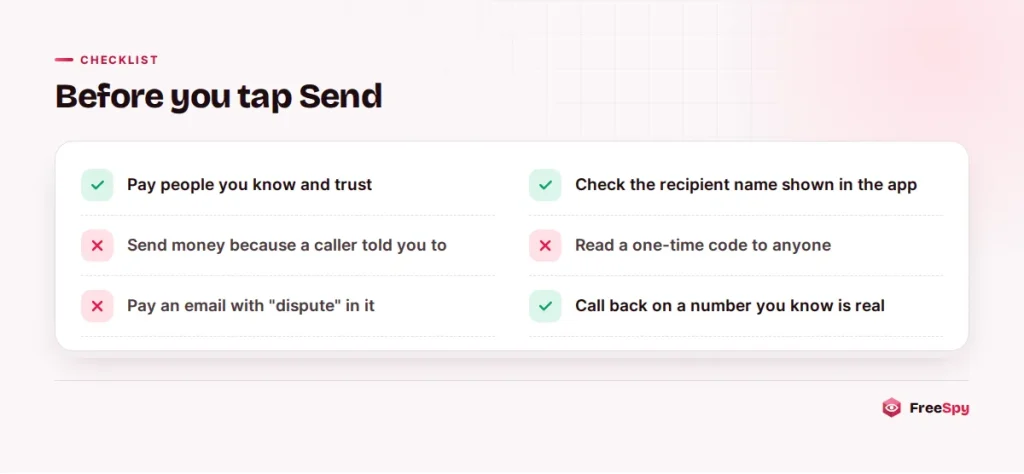
Did a phone call lead to this payment? If someone on the line is telling you to send money, stop there. Banks, utilities and agencies don’t ask for app transfers during a call.
Do you know the person? Zelle recommends against using it with people you don’t know, or for purchases you aren’t sure you’ll receive.
Is the recipient who you think? Read the name the app shows before you confirm. An email address with your own name or “dispute” in it is not your bank.
Is anyone asking for a code? A one-time passcode is for you to type into your own app, and nobody else.
Can you check another way? The FTC’s advice is to “contact the person, bank, or business at a phone number you know to be real.” While you’re at it, look up the number that called. A FreeSpy lookup shows whether the number is valid, its type and region, and any community reports or FTC complaints; a report reading “said they were my bank, asked me to Zelle myself” settles the question. A clean result doesn’t clear the caller, though, since a spoofed call can carry a real bank’s number.
Already sent it? The first hour
Move fast. Nothing else matters as much as the first hour.
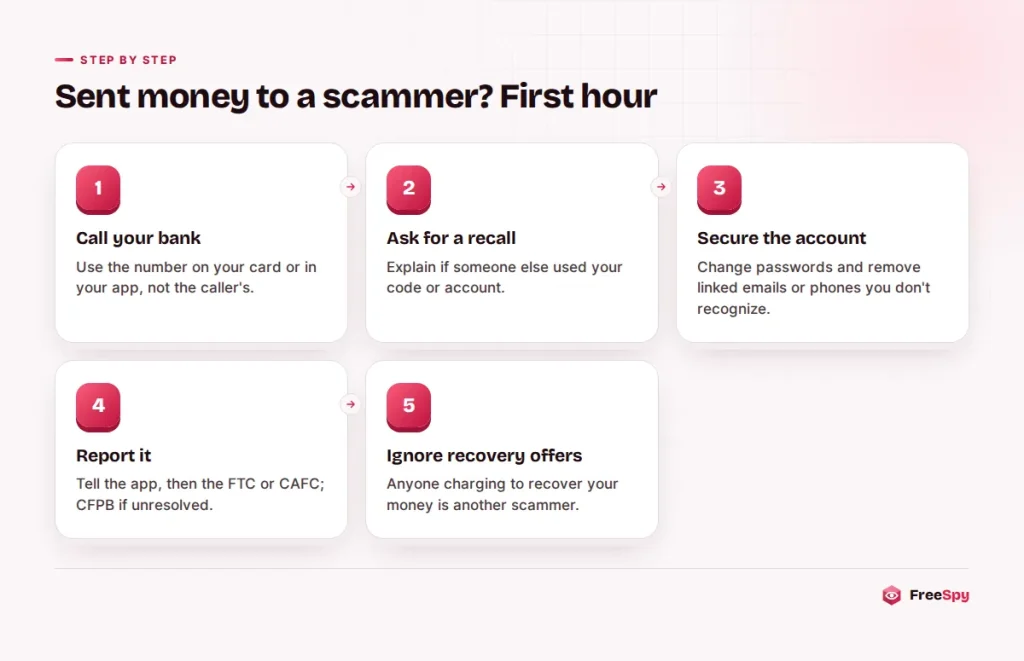
- Call your bank or credit union on the number from your card or your app, never the one that called you. Zelle tells users to contact their bank or credit union’s customer support team. For Venmo or Cash App, use the support option inside the app.
- Ask them to stop or recall the payment, and to treat it as fraud if anyone else used your code or your account. The CFPB advises notifying your financial institution right away about an erroneous transaction.
- Lock the account down. Change your online banking password, check which email addresses and phone numbers are linked to your payment apps, and remove anything you don’t recognize.
- Report it. In the US, report to the FTC at ReportFraud.ftc.gov after reporting to the app, and file a complaint with the CFPB at consumerfinance.gov if your bank or the service doesn’t resolve it. In Canada, report to the Canadian Anti-Fraud Centre at 1-888-495-8501 or online.
- Warn the next person with a report on the caller’s number, choosing a category such as bank/card fraud and describing the script.
- Ignore recovery offers. People who lost money often hear from “recovery services” that charge a fee to get it back. That’s another scam.
Interac e-Transfer gets the same scripts in Canada
Canada doesn’t have Zelle, but Interac e-Transfer fills the same role and attracts the same calls. The Canadian Anti-Fraud Centre describes “bank investigator” scams where fraudsters add you as a payee using a fake email address and tell you to move funds to “protect” your account. In its 2025 figures, the CAFC recorded 2,167 reports of these fraud investigator scams and $28.3 million in reported losses.
One setting is worth turning on: Interac Autodeposit. With it, Interac says, “your funds are deposited automatically without clicking links or answering security questions,” which removes a common phishing hook. The CAFC recommends it too. And as in the US, no bank will call and ask you to send an e-Transfer to keep your money safe.
Short answers
Can I cancel a Zelle payment?
Only if the recipient hasn’t enrolled with Zelle yet. Zelle says money sent to an enrolled recipient is typically available within minutes and cannot be canceled. Call your bank anyway; the sooner they know, the better.
I shared a code but didn’t send money. Am I safe?
Not necessarily. A code can let a scammer change your login or link their own account to your email or phone. Call your bank, change your passwords and check what’s linked to your payment apps.
Sources
- Zelle: How to spot a pay yourself scam
- Zelle: Understanding fraud and scams
- Zelle: Paying someone you don’t know
- Zelle: Top questions
- FTC: Payment apps like Venmo, Cash App or Zelle
- CFPB: Tips for mobile payment services
- CFPB: Regulation E, 12 CFR 1005.6
- Canadian Anti-Fraud Centre: Bank investigator
- Interac: Fraud protection tips