A missed call from (406) 555-0137 tells you one thing right away: 406 is Montana. That is about as far as the number itself can take you. The caller could be in Billings, in Miami, or in another country using a Montana number over the internet.
A phone number’s location is the place where the number was assigned, not where the person holding it is now. Sometimes those are the same. Often they aren’t, and the type of line makes the biggest difference.
Where the location is stored in the digits
Every number in the US, Canada and the rest of the North American Numbering Plan has the same three parts: a three-digit area code, a three-digit exchange (also called the central office code, or NXX), and a four-digit line number. All of the location data sits in the first six digits.
The area code points to a numbering area. Some cover a whole state or province, others a single metro area. Big cities often have several codes overlaid on the same ground, like 416, 647 and 437 in Toronto.
The exchange is assigned to a carrier at a specific rate center. A rate center is a billing area, usually a town, a cluster of towns or a slice of a large city, and it is the most precise place a phone number can point to.
The last four digits carry no location at all.
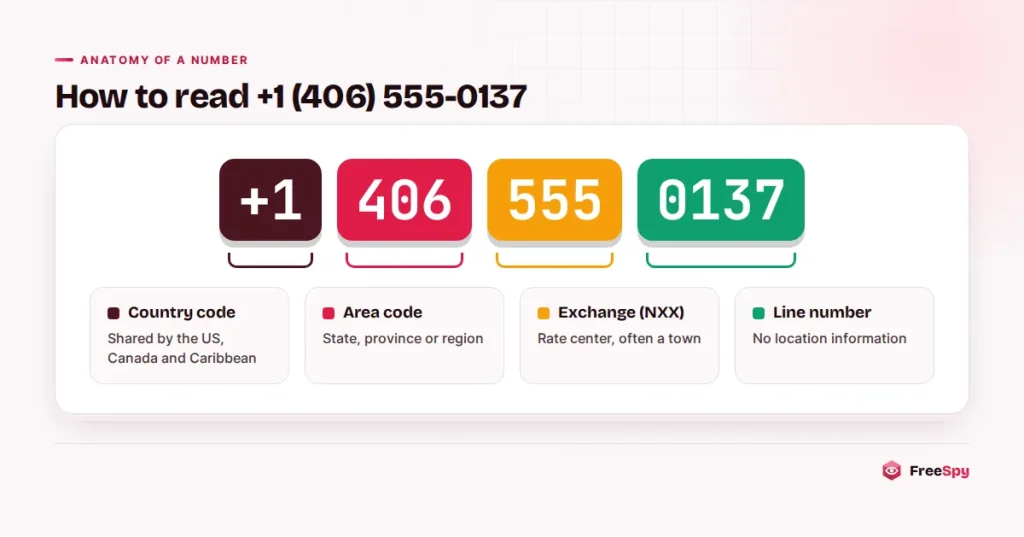
So when a lookup says a number is “from Billings, Montana,” it means the exchange was handed to a carrier for the Billings area. It doesn’t tell you anything about the current owner’s street, or even whether they still live in the state.
Looking it up yourself, for free
You don’t need a paid service to read the location a number carries. Start by writing the number out in full with its area code. A leading +1 is the country code shared by every NANP country, so it isn’t part of the location.
Next, check the area code. An area code directory will give you the state, province or country, and usually the main cities and time zone.
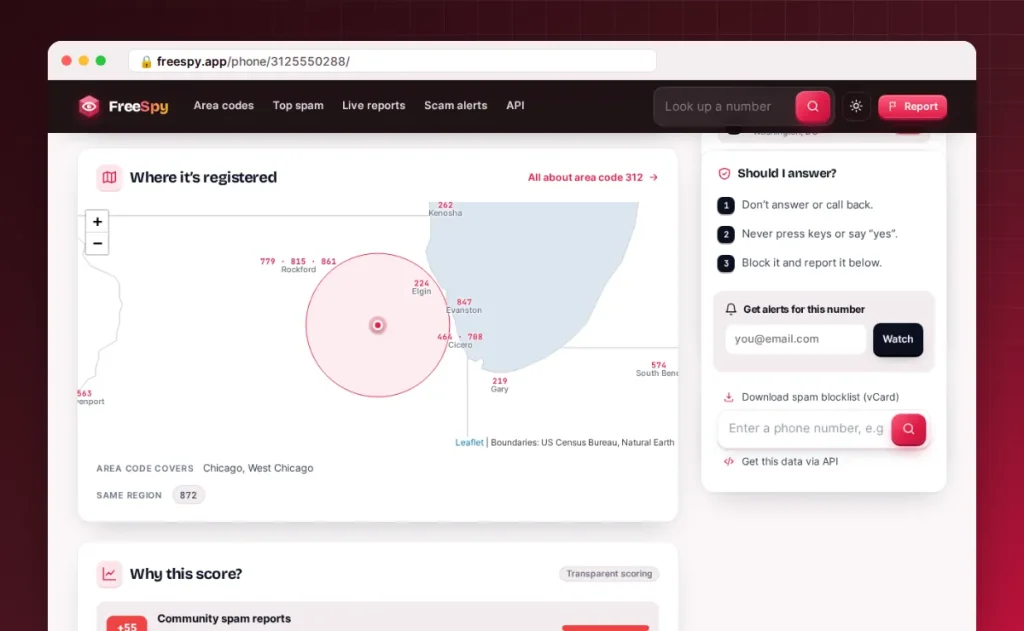
For more detail, run the full number through a reverse lookup. On FreeSpy, typing it into the search box or going to an address like freespy.app/4065550137 brings up the region, cities, time zone and the caller’s current local time. The page also shows the original carrier and rate center of the exchange, taken from NANPA or Canadian numbering data.
The same page labels the number type: geographic, toll-free, premium-rate 900, or a Caribbean number that uses +1 but is billed as international. Where a carrier-data provider is connected, it adds the current carrier and whether the line is mobile, landline or VoIP. Community reports and FTC complaint counts sit underneath, and for an unknown caller they often say more than the map.
Reading one result, line by line
Say a number you don’t recognize, (614) 555-0186, has called twice this week. The result comes back with the 614 area code in central Ohio, centered on Columbus, and the Eastern time zone. The exchange’s rate center is in the Columbus area, and the original carrier is a wireless company.
Then the details start to matter. If the current carrier is a different wireless company, the number has been ported at least once, which is normal for a mobile line that has been around a while. If the line type says mobile, the owner may live anywhere now; Columbus is where the number began. If it says non-fixed VoIP, the Ohio label tells you almost nothing about where the caller sits.
Finally, look at what other people saw. Two reports last week describing a pharmacy reminder point one way. A dozen reports in three days about a “final notice” on a car warranty point another. The map answers “where was this number issued?” The reports answer the question you actually had.
How far you can trust it depends on the line
The location attached to a number is fixed when the exchange is assigned. What drifts over time is the link between the number and a real place.
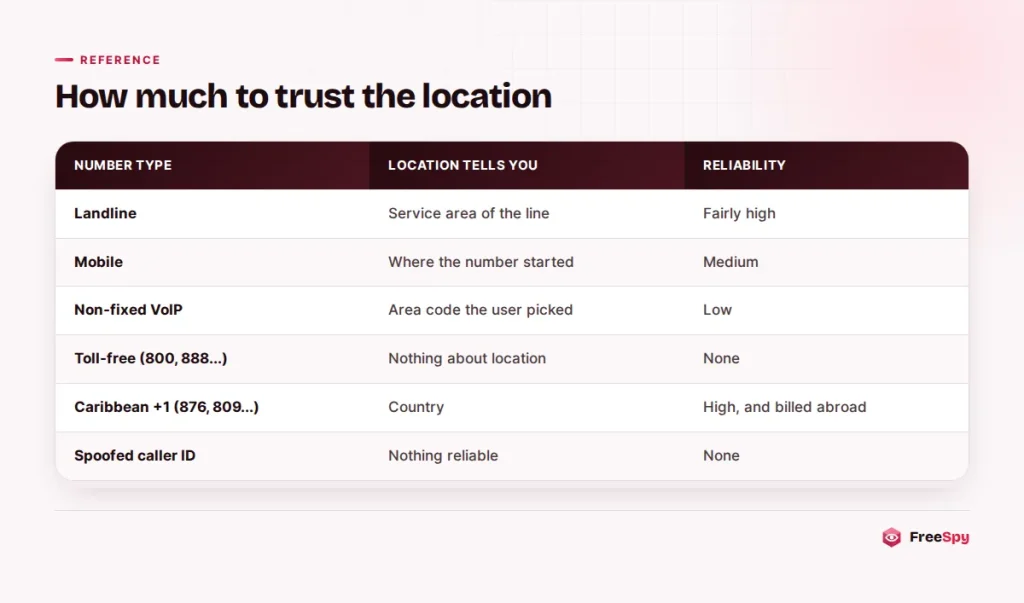
Landlines stay put
A traditional landline is the most reliable case. The number belongs to a service address, and people who move away usually have to give it up. The FCC says you can keep your number when you switch providers if you stay in the same geographic area, but you may not be able to keep it if you move. For a landline, the rate center is usually close to where the phone actually sits.
Mobile numbers travel with their owners
Someone who got a 617 Boston number in college can live in Seattle for twenty years and keep it. Portability added to the drift: wireless number portability began in the US on November 24, 2003, and in most of Canada on March 14, 2007. A mobile number’s area code shows where the number started, which may be where its owner used to live. That’s useful context, not an address.
Internet numbers can be anywhere
A non-fixed VoIP number can be picked from almost any area code and used from anywhere with a data connection, including outside North America. Robocall and scam operations like them for exactly that reason. If a lookup shows VoIP, the area code is little more than a costume. The differences between landline, mobile and VoIP lines matter more than most people expect.
Toll-free and premium numbers have no home
Codes such as 800, 888, 877, 866, 855, 844 and 833 are not tied to a place. A business anywhere can hold one. The same goes for premium 900 numbers, where the caller pays.
Caribbean numbers are a special case
Area codes such as 876 (Jamaica) or 809, 829 and 849 (Dominican Republic) look domestic but belong to other countries. Here the location matters a great deal, because calling back is billed as an international call.
Reasons a “fixed” result can still mislead you
Even a solid-looking answer can be wrong when the call itself isn’t honest.
Spoofing is the big one. Callers can display a number they don’t own, and scammers often show one that matches your own area code and exchange so the call looks local. A “neighbor” call can come from anywhere, and the caller ID authentication carriers now use only partly closes that gap.
Porting moves numbers between carriers. The original carrier shown for an exchange is the company that first received that block of numbers. The line may have moved since, which is why the current carrier is shown separately when that data is available.
Overlays mean two neighbors on the same street can have different area codes, because a new code was added on top of the old one when the region ran short of numbers.
Business phone systems blur things too. Call centers and medical groups often send calls from a central number in another city, or display a local number that forwards somewhere else entirely.
Finding a person is a different matter
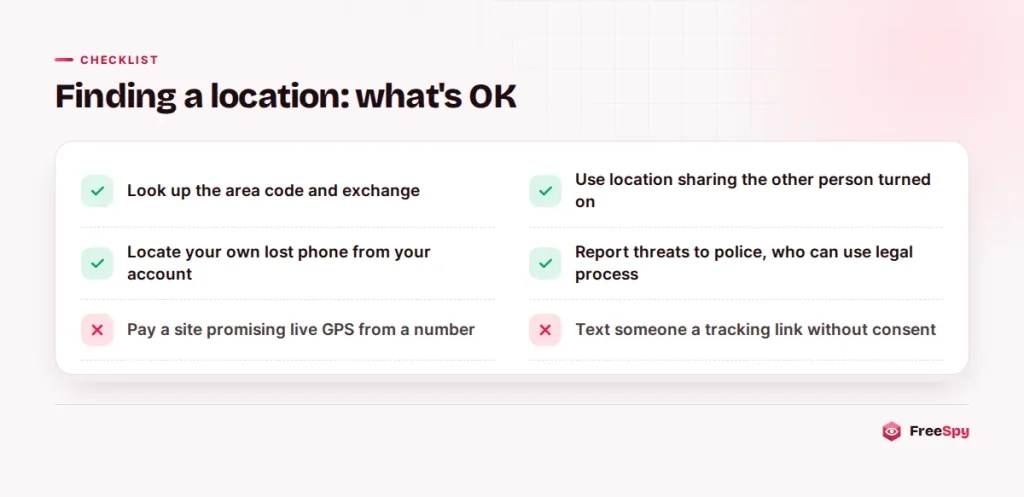
A number lookup cannot locate a person in real time. Live location comes from the carrier’s network or the phone’s own GPS, and it is protected.
The rules are strict for a reason. In April 2024, the FCC fined AT&T, Sprint, T-Mobile and Verizon nearly $200 million for illegally sharing access to customers’ location data, after the carriers sold that access to third parties without customer consent. A site that promises to “track any number” for a fee is either guessing from the area code or relying on data it shouldn’t have.
Location does get shared legitimately, in a handful of ways. Family location-sharing on iPhone and Android works only when the other person agrees to it. Apple and Google both let you find a lost device signed in to your own account. A 911 call sends your location to emergency services. And police can request location records from carriers with the proper legal authority, which is the route to take if someone is threatening or harassing you.
The same limits apply to names and addresses. This site’s lookups show a number’s region, carrier data, line type and reports, never an owner’s name or home address. People-search companies sell records like that, but their data can be stale, and some uses of it are restricted by law.
Watch out: “Locate any phone” services often ask you to text the target a link, or charge a subscription for the same area-code information you can read for free. Tracking someone without consent can also break the law. For a specific situation, check your state or provincial law or speak to a lawyer.
Using the location as a consistency check
For unknown callers, a number’s region is most useful for one question: does it fit the story?
A caller from (480) 555-0162 says they’re with your county sheriff and you missed jury duty. The 480 code is Arizona, which would suit a Phoenix-area sheriff. It still proves nothing. Spoofing a local number is easy, and a demand to pay a “fine” over the phone is a classic scam sign whatever the caller ID says.
A text from (305) 555-0174 says your Ohio credit union has locked your card. A Miami area code doesn’t prove fraud, but it’s a mismatch worth noticing. You’d call the number on the card anyway.
At 3 a.m., your phone shows a missed call from (876) 555-0149. The lookup says Jamaica. Unless you know someone there, leave it.
The part people actually use: time zones
A number’s region also tells you its time zone, which turns out to be the most practical piece of the lookup. Before you return a call to a 907 Alaska number from New York, it helps to know it’s four hours earlier there.
Time zones can also flag rule-breakers. Under the TCPA, telemarketing calls are allowed only between 8 a.m. and 9 p.m. in your local time. A sales call at 10 p.m. means the caller is ignoring the rules, wherever their area code says they are. That’s not legal advice; check the official rules or ask a lawyer about a specific case.
United States
Alaska AK
American Samoa AS
Arizona AZ
Arkansas AR
California CA
- 209Stockton
- 213Los Angeles
- 279Sacramento
- 310Santa Monica
- 323Los Angeles
- 341Oakland
- 350Stockton
- 357Fresno
- 369Santa Rosa
- 408San Jose
- 415San Francisco
- 424Los Angeles
- 442Oceanside
- 510Oakland
- 530Redding
- 559Fresno
- 562Long Beach
- 619San Diego
- 626Pasadena
- 628San Francisco
- 650San Mateo
- 657Anaheim
- 661Bakersfield
- 669San Jose
- 707Santa Rosa
- 714Anaheim
- 738Los Angeles
- 747Los Angeles
- 760Oceanside
- 805Oxnard
- 818Los Angeles
- 820Oxnard
- 831Salinas
- 840San Bernardino
- 858San Diego
- 909San Bernardino
- 916Sacramento
- 925Concord
- 949Irvine
- 951Riverside
Connecticut CT
Delaware DE
District of Columbia DC
Florida FL
- 239Cape Coral
- 305Miami
- 321Orlando
- 352Gainesville
- 386Daytona Beach
- 407Orlando
- 448Tallahassee
- 561West Palm Beach
- 645Miami
- 656Tampa
- 689Orlando
- 727St. Petersburg
- 728West Palm Beach
- 754Fort Lauderdale
- 772Port St. Lucie
- 786Miami
- 813Tampa
- 850Tallahassee
- 863Lakeland
- 904Jacksonville
- 941Sarasota
- 954Fort Lauderdale
Georgia GA
Guam GU
Hawaii HI
Illinois IL
Indiana IN
Kansas KS
Kentucky KY
Louisiana LA
Maine ME
Maryland MD
Massachusetts MA
Michigan MI
Minnesota MN
Mississippi MS
Missouri MO
Montana MT
Nebraska NE
Nevada NV
New Hampshire NH
New Jersey NJ
New Mexico NM
New York NY
North Carolina NC
North Dakota ND
Northern Mariana Islands MP
Ohio OH
Oklahoma OK
Oregon OR
Pennsylvania PA
Puerto Rico PR
Rhode Island RI
South Carolina SC
South Dakota SD
Tennessee TN
Texas TX
- 210San Antonio
- 214Dallas
- 254Killeen
- 281Houston
- 325Abilene
- 346Houston
- 361Corpus Christi
- 409Beaumont
- 432Midland
- 469Dallas
- 512Austin
- 682Fort Worth
- 713Houston
- 726San Antonio
- 737Austin
- 806Lubbock
- 817Fort Worth
- 830New Braunfels
- 832Houston
- 903Tyler
- 915El Paso
- 936Conroe
- 940Denton
- 945Dallas
- 956Laredo
- 972Dallas
- 979College Station
U.S. Virgin Islands VI
Vermont VT
Virginia VA
Washington WA
West Virginia WV
Wisconsin WI
Wyoming WY
Canada
Alberta AB
British Columbia BC
Manitoba MB
New Brunswick NB
Newfoundland and Labrador NL
Northwest Territories NT
Nova Scotia NS
Ontario ON
Quebec QC
Saskatchewan SK
Special & international codes
Toll-free
Caribbean (billed as international)
- 242Bahamas
- 246Barbados
- 264Anguilla
- 268Antigua and Barbuda
- 284British Virgin Islands
- 345Cayman Islands
- 441Bermuda
- 473Grenada
- 649Turks and Caicos
- 658Jamaica
- 664Montserrat
- 721Sint Maarten
- 758Saint Lucia
- 767Dominica
- 784St. Vincent and the Grenadines
- 809Dominican Republic
- 829Dominican Republic
- 849Dominican Republic
- 868Trinidad and Tobago
- 869St. Kitts and Nevis
- 876Jamaica
Premium rate
Personal communications
- 500Personal communications service
- 521Personal communications service
- 522Personal communications service
- 523Personal communications service
- 524Personal communications service
- 525Personal communications service
- 533Personal communications service
- 544Personal communications service
- 566Personal communications service
- 577Personal communications service
- 588Personal communications service
Sources
- FCC: Keeping your phone number when you change providers
- Government of Canada: Wireless number portability begins (2007)
- FCC: Location data fines against four carriers (April 2024)
- FCC: “One Ring” scam and Caribbean area codes
- FCC: Caller ID spoofing