
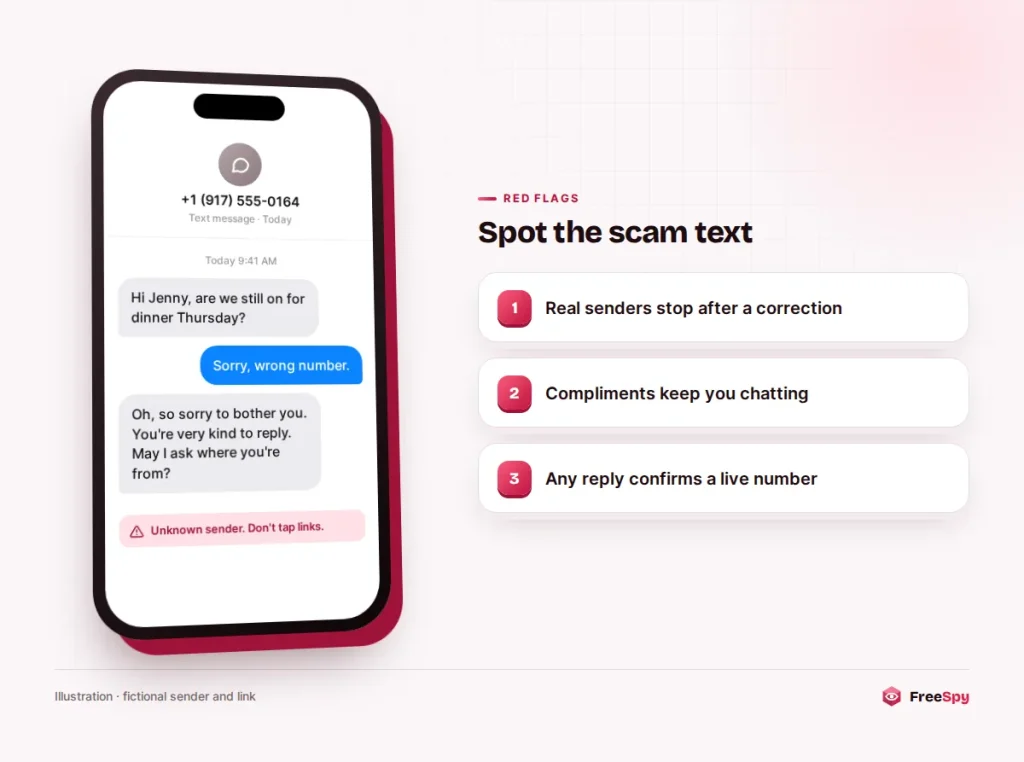
“Hi Jenny, are we still on for dinner Thursday?” You aren’t Jenny, so you text back to say they have the wrong number. The sender apologizes warmly, compliments your kindness and asks where you’re from. A week later you’re chatting every day.
That polite mistake is often the first move in a long con that ends with a fake cryptocurrency investment. It’s nicknamed “pig butchering” because the scammer fattens the victim up with trust before taking everything. The FTC counted these “wrong number” conversations that drift into friendship, romance and then investing among its top five text scams of 2024, and the FBI says cryptocurrency investment fraud caused more reported losses than any other crime it tracked in 2025.
The simplest protection is also the least natural one: don’t reply to texts from numbers you don’t know, not even to say “wrong number.”
A kind reply is what the sender wants
Most people answer a misdirected text out of courtesy, and scammers count on it. The FTC’s advice is blunt: scammers use “hi, how are you?” and wrong-number messages as a conversation starter, so don’t text back.
Even a single reply has value to the sender. As the FTC puts it, you’ve confirmed they reached a working phone number, which could lead to more calls and texts from scammers. If you keep chatting, you’ve stepped into the first stage of the con.
The openers look like ordinary slips:
- “Is this Dr. Patel’s office? I need to move my appointment.”
- “Hey, it’s Mia from the yoga class. Are you free for coffee this week?”
- “Mr. Chen, the documents you asked for are ready.”
- A photo of a dog or a beach with “Look where we are” and nothing else.
Each is built to make you correct the sender. They arrive from ordinary-looking numbers, through messaging apps, or on social media. The FTC has warned about the social media version too: someone contacts you seemingly at random, and before long your new friend is talking money.
Six stages from “sorry” to a frozen account
This scam is slow on purpose. The FBI describes it as a confidence-based scam: the scammer builds a friendship or relationship first, then introduces a fake cryptocurrency investment. The weeks tend to go like this.
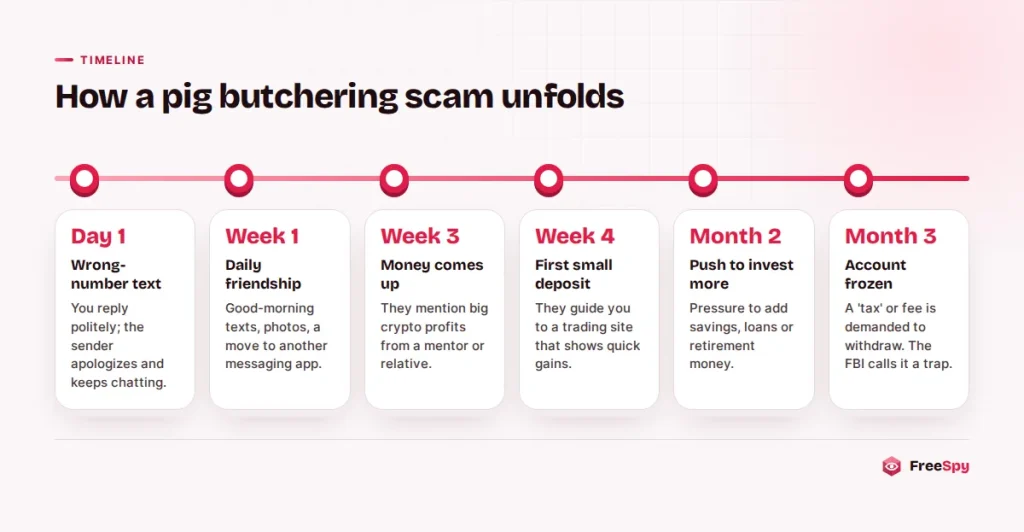
The accidental hello
After your reply, the sender apologizes, thanks you and keeps the conversation going. They’re friendly and well-mannered, and often say they believe in fate. Their profile photos show someone attractive and successful, with luxury travel or nice cars in the background.
Good-morning texts
Messages arrive daily: photos of meals, questions about your family and your job. They often suggest moving to WhatsApp, Telegram or another app. They remember every detail and they’re always available, which feels flattering if you’re lonely, recently divorced or widowed.
The mentor and the profits
Without asking for anything, they mention a great profit from trading crypto, gold or foreign currency, often thanks to an “uncle” or “mentor” with inside knowledge. They don’t push. They wait for you to ask.
A small first deposit
They offer to teach you. A link to a trading website or app arrives, they walk you through opening an account and suggest starting small. The FBI says the returns shown on the platform will appear extremely lucrative, which is meant to reassure you that it’s legitimate.
The big push
Now there’s a “limited-time opportunity.” They encourage you to put in your savings, borrow, refinance your home or cash out a retirement account. The dashboard keeps climbing.
The withdrawal that never comes
When you try to take real money out, something goes wrong. In the FBI’s words, victims find their account frozen and an arbitrary requirement arises: a tax, a fee, a “verification deposit.” The FBI is plain about it: this is a trap. Paying only adds to the loss. Then the friend disappears, or blames you.
Billions lost, and most victims didn’t know
This con produces some of the largest individual losses reported to US and Canadian authorities.
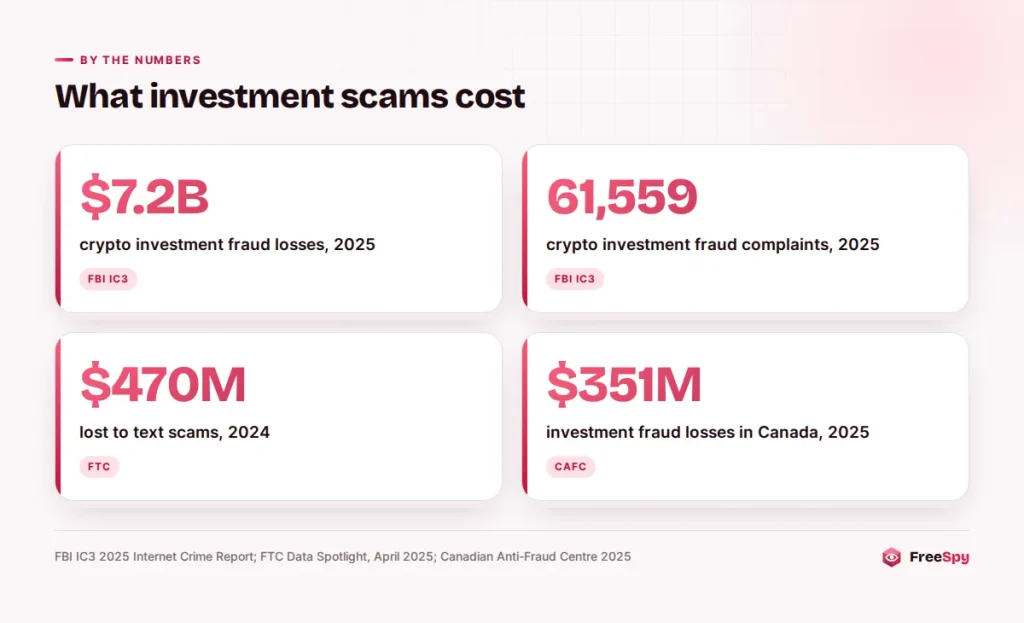
According to the FBI’s IC3 2025 Internet Crime Report, cryptocurrency investment fraud was the highest source of financial losses to Americans, with 61,559 complaints and about $7.2 billion lost. All investment fraud together came to about $8.6 billion. The FTC’s Consumer Sentinel data points the same way: investment scams caused the largest losses of any fraud category in 2025, at $7.9 billion.
Texts are a growing doorway. The FTC says reported losses to text scams reached $470 million in 2024, more than five times the 2020 figure.
In Canada, the Canadian Anti-Fraud Centre recorded 4,409 investment fraud reports with $351 million in losses in 2025, the largest loss of any category, plus 1,093 relationship fraud reports with $63.3 million lost.
Many people are still investing when the money is already gone. Through Operation Level Up, launched in January 2024, the FBI had notified 8,103 crypto investment fraud victims by December 2025. Of those, 77% were unaware they were being scammed.
Signs that show up before any money moves
- A stranger who keeps talking after you’ve corrected them, and wants to switch apps.
- A new friend or love interest who won’t video chat, or always has a reason to cancel.
- Any conversation with someone you’ve never met that turns to investing, especially crypto.
- Guaranteed or risk-free returns. The FTC notes that no one can guarantee profits in any investment, and the CAFC warns about “guaranteed” or “risk-free” offers.
- A trading site you can only reach through their link, often with a name that closely mimics a real platform, which the FBI describes as spoofing.
- Being asked to open and fund new crypto accounts and send coins to wallets they control, a pattern the CAFC flags.
- Pressure to keep the relationship or the investment from your family.
Tip: In Canada, the CAFC advises checking whether an investment firm is registered through your provincial securities regulator or the National Registration Search Tool.
Report it as junk, then delete
Don’t reply. Use the “report junk” option in Apple Messages or Google Messages, or forward the text to 7726 (SPAM); the FTC recommends both. Then block the sender and delete the thread. Reporting takes a few seconds and gives your carrier and phone maker more examples to filter for everyone else.
If you aren’t sure whether it’s someone you actually know, look the number up on FreeSpy, which shows reports from others who got texts from it. The same message often lands on many phones at once, so other people’s reports can settle it quickly.
The fake-friend opener is only one of several common text scams, alongside fake delivery and toll notices.
Sometimes the friendly stranger pivots to a job offer instead of an investment. That version is a close cousin, and task scams run on the same patience: a little early reward, then steady pressure to put in more of your own money.
Money already in? Stop paying the “fees”
This is hard to accept when the dashboard still shows a profit and the friend still sounds caring. These steps give you the best chance of limiting the damage.
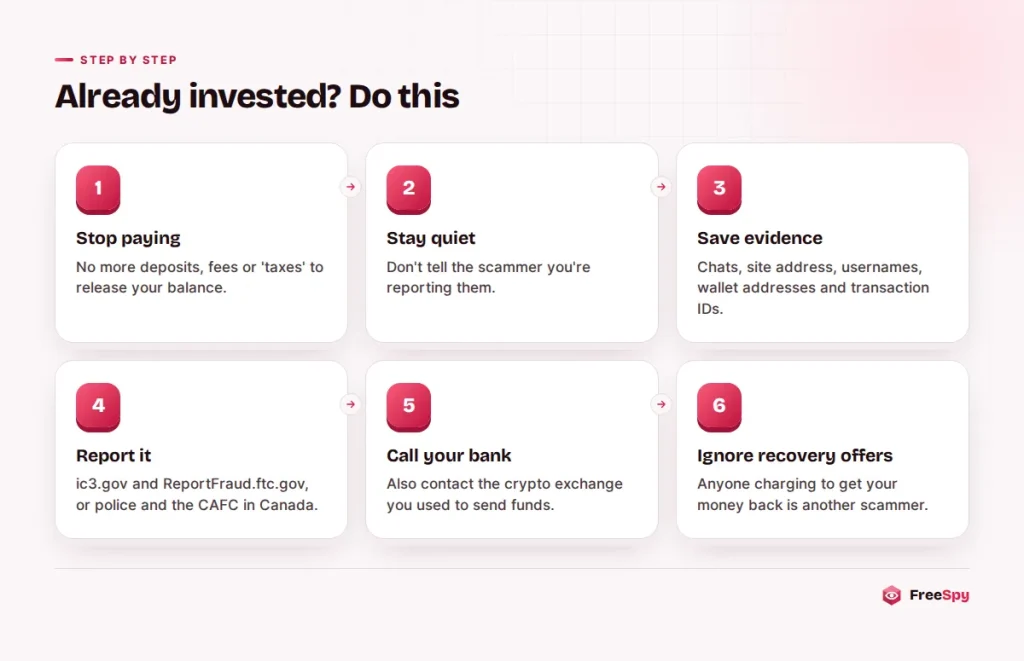
- Stop sending money. No more deposits, fees or “taxes,” whatever the platform claims. The FBI advises victims to stop sending money to the suspected criminals.
- Don’t tell the scammer you’re reporting. The FBI specifically advises not to notify the suspected criminals of its involvement.
- Save everything. Screenshots of chats, the platform’s web address and app name, usernames, phone numbers and email addresses.
- Gather transaction records. The FBI asks for the date, type of payment, amount and account numbers, crypto wallet addresses, and transaction IDs (hashes), which it calls among the most important information you can provide.
- Report it. In the US, file at ic3.gov and with the FTC at ReportFraud.ftc.gov. In Canada, report to local police and the Canadian Anti-Fraud Centre online or at 1-888-495-8501.
- Call your bank and the crypto exchange you used to send funds. Tell them it was fraud and ask what they can freeze.
- Lock down your accounts. If you shared ID documents, passwords or verification codes, work through a recovery checklist for exposed information.
A report on the number under “crypto/investment,” with the call type “text,” also helps the next person who gets that first message.
Warning: After a loss, expect “recovery” offers from people posing as lawyers, investigators or even law enforcement who promise to get your crypto back for an upfront fee. The FBI warns that paying these scammers will not result in recovering your funds.
When it’s your parent or friend who’s invested
Many victims defend the scammer, because the relationship feels real and the platform shows profits. Arguing tends to push them closer to the person on the other end. A calmer approach works better.
Ask questions instead of making accusations. “Have you ever withdrawn the full balance? Have you two ever met on video?”
Suggest a test: try withdrawing the whole balance without paying any fee. A real platform lets you. A fake one invents a new charge.
Show them the FBI’s own description of frozen accounts and fee demands. Seeing their exact story in an official warning often lands harder than a relative’s opinion.
Then offer to file the report with them. Doing it together takes away some of the shame, which is often what keeps people quiet.
Short answers
Is every misdirected text a scam?
No. People do mistype numbers. But a real sender usually stops once you correct them. If the conversation keeps going and turns personal, treat it as a scam. Not replying at all avoids the question.
The platform let me withdraw a little. Doesn’t that prove it’s real?
No. Paying out a small amount costs a scammer little if it convinces you to invest much more. The FBI notes that fake platforms show very lucrative returns to reassure victims. The real test is whether you can withdraw your whole balance without a new fee appearing.
Sources
- FTC Data Spotlight: Top text scams of 2024
- FTC: Why it’s not rude to ignore “hi, how are you?” texts from strangers
- FTC: When an online love interest offers to teach you to invest
- FTC: Testimony on 2025 fraud data
- FBI IC3: 2025 Internet Crime Report
- FBI: Cryptocurrency investment fraud
- FBI: Operation Level Up
- Canadian Anti-Fraud Centre: Investment and crypto investment fraud
- Canadian Anti-Fraud Centre: Top frauds of 2025