“This is the disconnection department. Your power will be shut off in 30 minutes unless you pay the past-due balance now.” Few calls cause panic faster, especially in a heat wave, a cold snap or the middle of a restaurant’s dinner rush. That’s exactly why scammers use it. A utility shut-off scam doesn’t need you to believe much; it only needs you to pay before you’ve had time to check.
Real utilities don’t work this way. The FTC says your utility won’t demand payment by wire transfer, cryptocurrency, payment app or gift card, and won’t threaten to cut you off unless you pay on the spot. If a caller does both, you can hang up without checking anything else.
Thirty minutes, a truck on the way, and a prepaid card
The FTC describes the pattern: scammers reach you by phone, text, email or in person, threaten to shut off your gas, electric or water service, and demand immediate payment. A typical call sounds like this:
“Hi, this is Mark from the billing and disconnection department at your electric company. Our records show your account is two months past due. A technician has already been dispatched to your address and will disconnect service within the hour. To stop the disconnection, you need to make a payment of $486 right now. I can take it over the phone with a prepaid card or transfer you to our payment center.”
Each detail is there to cut your thinking time. Thirty minutes or an hour leaves no room to check your account. A few hundred dollars sounds like a real overdue bill rather than a scam. A technician “already on the way” makes hanging up feel like a gamble.
And then the payment method: prepaid cards, gift cards, crypto or an app transfer. All fast, all very hard to reverse.
A real disconnection comes with paperwork
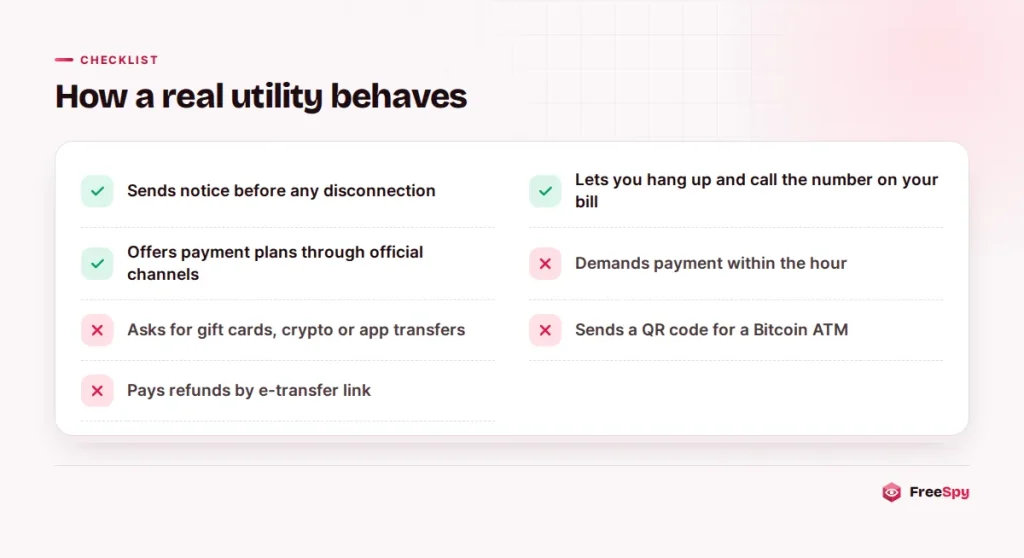
Rules differ by state, province and company, but disconnection for non-payment is a slow, documented process everywhere, not a phone ultimatum. Hydro One in Ontario, for example, says it will never disconnect you without advance notice. Utilities generally send past-due notices on or with your bill well before any shut-off.
Real utilities also don’t ask for unusual payments. Beyond the FTC’s general warning, the utilities themselves spell it out. Hydro One says it will never demand immediate payment by prepaid credit card and doesn’t take credit card or financial information over the phone. BC Hydro says it doesn’t accept cash, gift cards, cryptocurrency or Interac e-Transfer, and doesn’t call customers to ask for card or banking details.
A real utility is also fine with you hanging up and calling back on the number printed on your bill. Only a scammer needs you to stay on the line.
If you really are behind, call your utility on that official number and ask about payment plans or assistance programs. Many utilities offer them, and you’ll be talking to the actual company about your actual account.
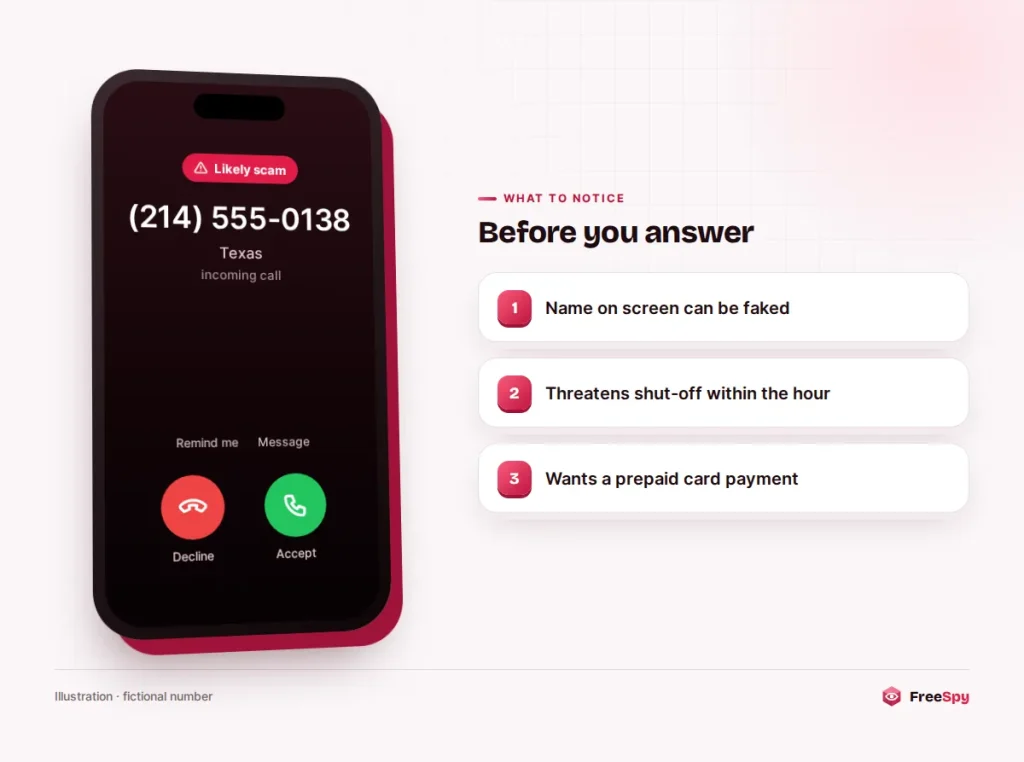
The name on your phone screen won’t settle the question. Hydro One has warned about scammers using phone numbers similar to its own and caller ID names like “Hydro One Meter.” Displayed names and numbers are easy to fake, which is the whole idea behind caller ID spoofing, so the only check that counts is the one you make by calling the utility yourself.
Cash into a Bitcoin ATM, gone in minutes
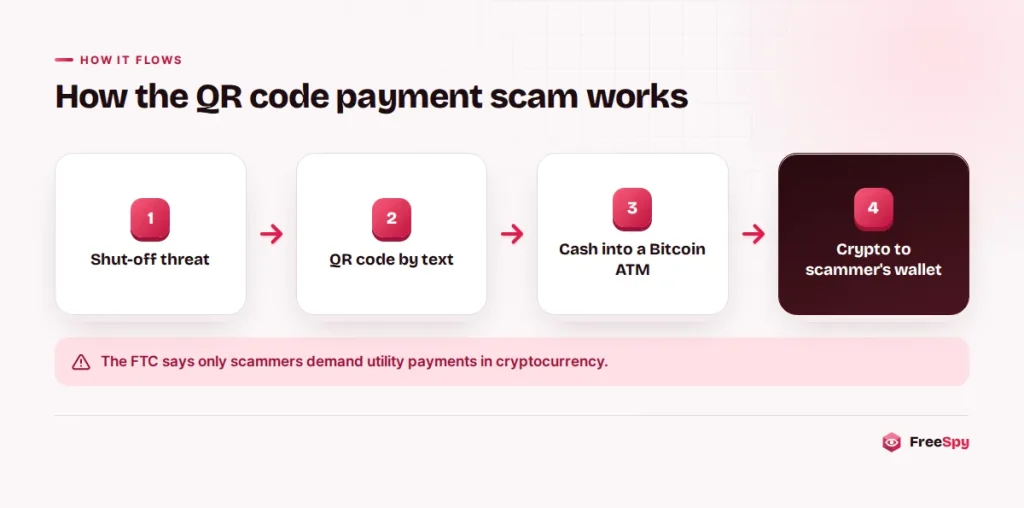
A newer twist moves the payment out of the call entirely. According to the FTC, scammers text a QR code and tell you to scan it at a Bitcoin ATM to make a payment, or your service will be disconnected. You feed cash into the machine, it converts the money to cryptocurrency, and the coins go straight to the scammer’s wallet. Once they’re sent, there’s almost no getting them back.
The FTC’s position on this is unambiguous: only scammers demand payment in cryptocurrency.
Other versions send you to a store to buy gift cards and read the numbers over the phone, or ask for a transfer through a payment app. The FTC’s explanation for these choices is that it’s hard to get your money back once it’s sent, which is also why payment app transfers are so popular with scammers of every kind.
One household rule prevents almost all of this. Nobody pays a utility bill on a call they didn’t start. Bills get paid through the utility’s own app or website, by mail, or by calling the number printed on the bill.
If an older relative lives alone, go over that rule with them before winter. A call threatening to cut the heat in January is hard to ignore when you’re on your own, and they should know they can hang up and phone you first.
Refund texts, fake meter techs and lookalike ads
The shut-off threat is the best-known version. The same groups run several others.
“You were overcharged”
“Power Co: You were overcharged $87.40 on your last bill. Tap to claim your refund before it expires: powerco-refunds.example”
Hydro One has warned about texts asking customers to tap a link to accept a refund. The link leads to a form that collects card or bank details. BC Hydro says it never issues refunds or credits by e-transfer. A real credit simply shows up on your next bill.
The technician at the door
Some scammers come in person, claiming they need to replace your meter, inspect equipment or check a problem on the line. BC Hydro says its employees never enter homes unannounced, and the FTC advises against letting anyone pressure their way into your home. Ask for ID, close the door, and call the utility to confirm the visit before you open it again.
The customer service number you found yourself
Sometimes you’re the one who places the call. You search for your utility’s number, tap the first result and reach someone happy to take your “payment.” The FTC notes that top search results are often paid ads, and BC Hydro reported a paid search ad that closely copied its official website. Your bill and the utility’s own website are safer places to find the real number than a search results page.
Rebates and solar deals in your utility’s name
Ads and calls promise bill credits, rebates or discounted solar panels “through your utility.” BC Hydro and Hydro One have both warned about fake offers using their names, from fake bills shown in ads to discounts on solar and home upgrades. A real program will be listed on the utility’s own website.
The lunch-rush call to a small business
Restaurants, salons and shops can’t afford to lose power during business hours, so they’re a favorite target, often called just before the busiest part of the day. The script is the same with more pressure: “If you don’t pay in the next 20 minutes, we’ll cut power during your lunch service.”
The person who answers the phone at a business is often not the person who pays the bills. Give staff the utility’s real number and the household rule above, and tell them nobody will be blamed for hanging up on a caller who demands payment.
In the ten minutes after the call
Hang up. Don’t argue, and don’t confirm your name, address or account number.
Find your bill, paper or in the utility’s app, and call the number printed on it. Ask whether you owe anything and whether a disconnection is scheduled. Almost always, the answer to both is no.
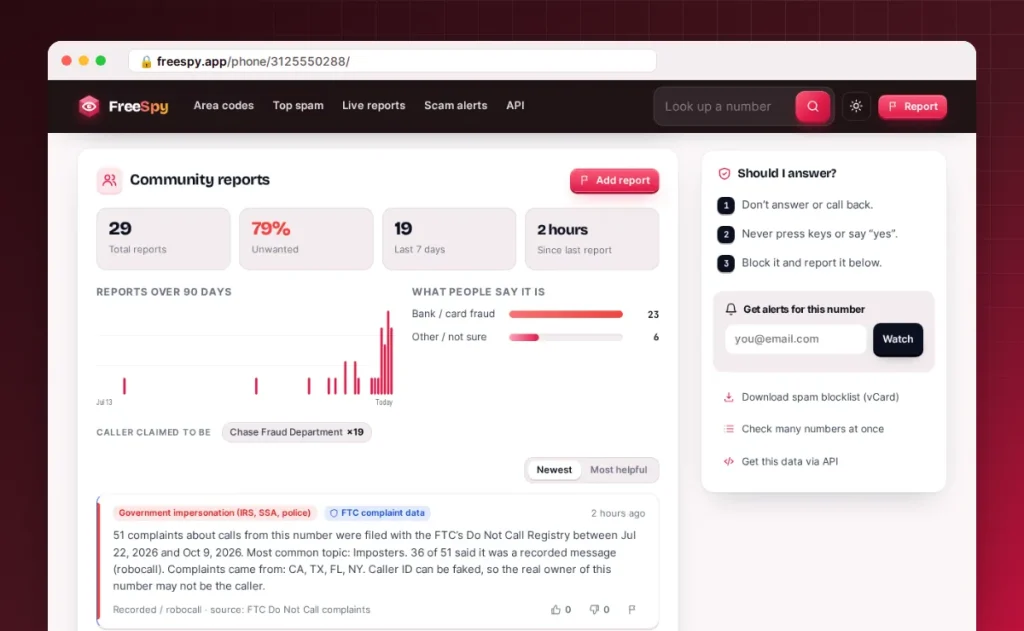
Then look at the number that called. A lookup on FreeSpy shows the line type, the region behind the area code, community reports and any FTC Do Not Call complaints. A “utility” calling from a VoIP number in another state is a strong sign you were right to hang up.
Tell your utility about the call. Utilities often track these campaigns and warn other customers when a new one starts.
Paid with a gift card or crypto? Call the card company or ATM operator first
How much you can recover depends on how you paid, and speed matters more than anything else.
With a gift card, call the company that issued it right away. Tell them it was used in a scam and ask whether the balance can be frozen. Keep the card and the receipt.
For a payment app or bank transfer, report it to the app and your bank immediately and ask whether the payment can be stopped or reversed.
With a credit or debit card, call your card issuer, report fraud and ask for a chargeback. You’ll probably get a new card number.
At a crypto ATM, contact the machine’s operator using the details on the machine or the receipt, and keep that receipt. Recovery is rare, but a fast report is the best chance you have.
If you also gave out a Social Security number, a bank login or other personal details, freeze your credit and set up fraud alerts with your bank the same day.
Expect more calls afterward. People who paid once are often targeted by “recovery” services that promise to get the money back, for a fee. That’s a second scam.
Reports that reach the right people
Utility imposters are part of a bigger problem. According to the FTC’s 2025 data, people reported losing nearly $1 billion to business impersonators and $3.5 billion to imposter scams overall. Reports help regulators and utilities spot new campaigns while they’re still running.
- Your utility, through a number or website you know is real
- ReportFraud.ftc.gov and your state attorney general, as the FTC recommends
- In Canada, the Canadian Anti-Fraud Centre at 1-888-495-8501 or its online reporting system
You can also report the number on the site’s public reports. No account is needed, and the report shows on that number’s page for anyone who looks it up later.
Quick answers
Does my utility ever send texts?
Some utilities send account alerts by text if you signed up for them. Others, like BC Hydro, say they don’t send billing or usage texts to residential customers. Either way, don’t tap a link in a text about a refund or shut-off. Log in through the utility’s official app or website instead.
Should I block the number?
You can, but these callers switch numbers often and sometimes spoof your utility’s real number. Blocking that could stop legitimate calls from your utility. Reporting the number and checking your account directly does more good.
Sources
- FTC: Scammers pretend to be your utility company
- FTC: Only scammers demand utility payments in cryptocurrency
- FTC: Imposter scam losses in 2025
- Hydro One: Fraud alerts
- BC Hydro: Fraud warning (2025)