The text comes from a number you don’t recognize. A recruiter has “reviewed your resume” and has a flexible remote job paying $300 to $800 a day. No interview, no experience, just a few minutes of simple online tasks. A week later, some of the people who answered have deposited thousands of dollars of their own money to release earnings that never existed.
That’s a task scam: a fake job built like a game, where you pay to keep playing. The FTC’s rule for spotting every version of it fits in five words. Never pay anyone to get paid.
Liking videos for money, until the money runs the other way
According to the FTC, these schemes ask you to do simple, repetitive things such as liking videos or rating product images. The work is often assigned in sets of forty, with the promise of “leveling up” once you finish a set. Everything happens inside an app or website the scammers control, so your “earnings” are just numbers they display.
Sooner or later the app says you need to deposit money to continue, or to get at what you’ve earned. The FTC is blunt about that moment: the money isn’t real, and if you deposit money, you won’t get it back.
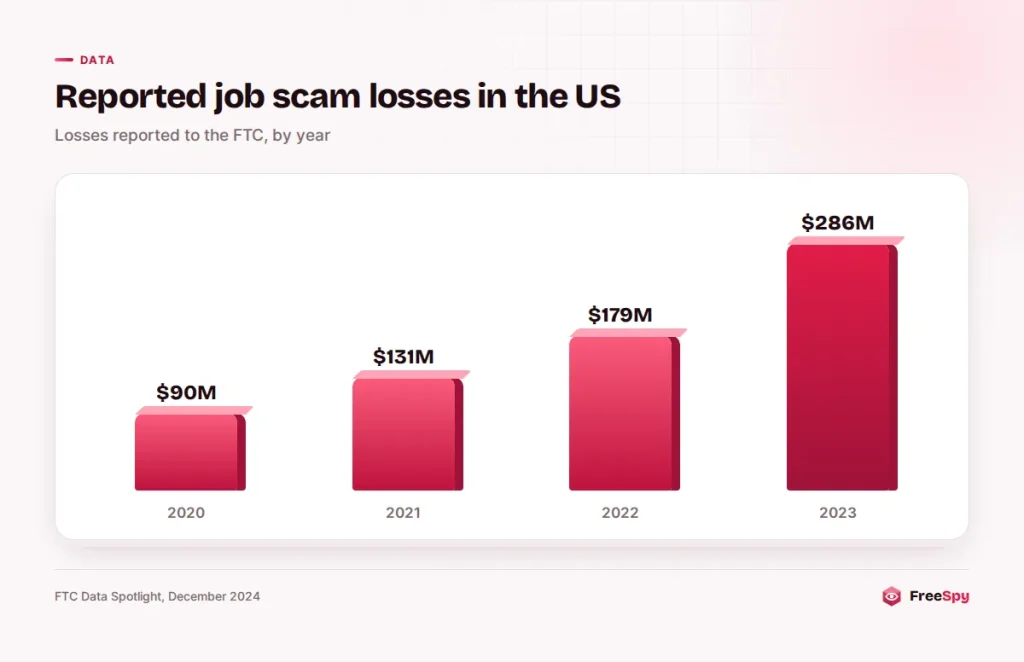
The FTC’s numbers show how fast this has grown. About 20,000 people reported task scams in the first half of 2024, compared with about 5,000 in all of 2023. Reported losses to job scams in general went from $90 million in 2020 to $286 million in 2023, and passed $220 million in just the first six months of 2024. Crypto is the preferred payment: crypto losses to job scams were about $41 million in the first half of 2024, against about $21 million for all of 2023.
Texts are the usual way in. Phony job offers were the second most common text scam the FTC saw in 2024, after fake package delivery problems.
From “Hi, I’m Jessica” to a negative balance in a week
The days below are a made-up but typical example. Each step matches what the FTC has described.
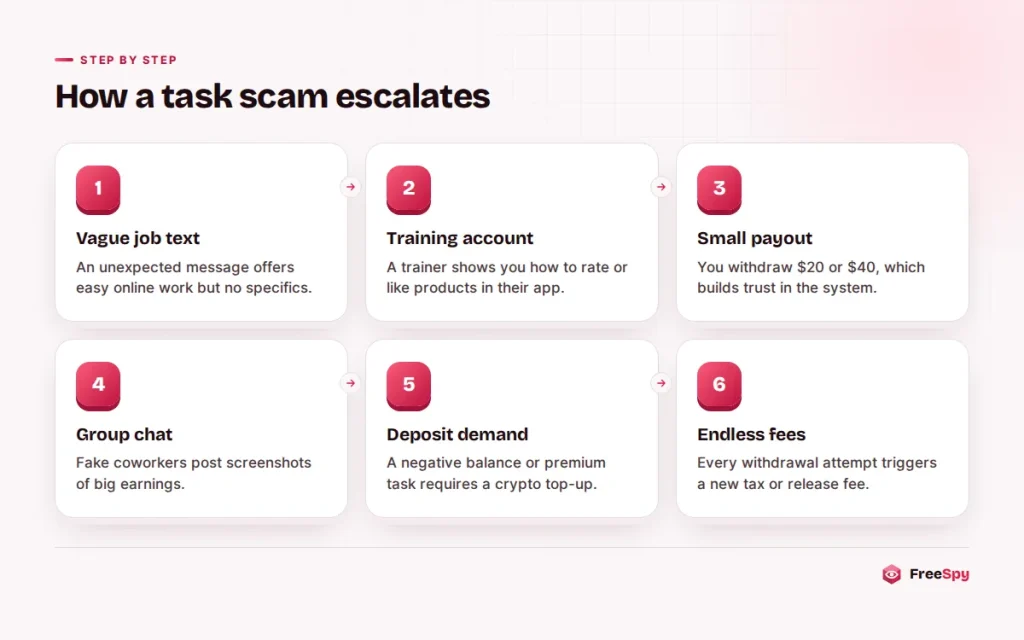
Day 1: a message with a pay range and nothing else
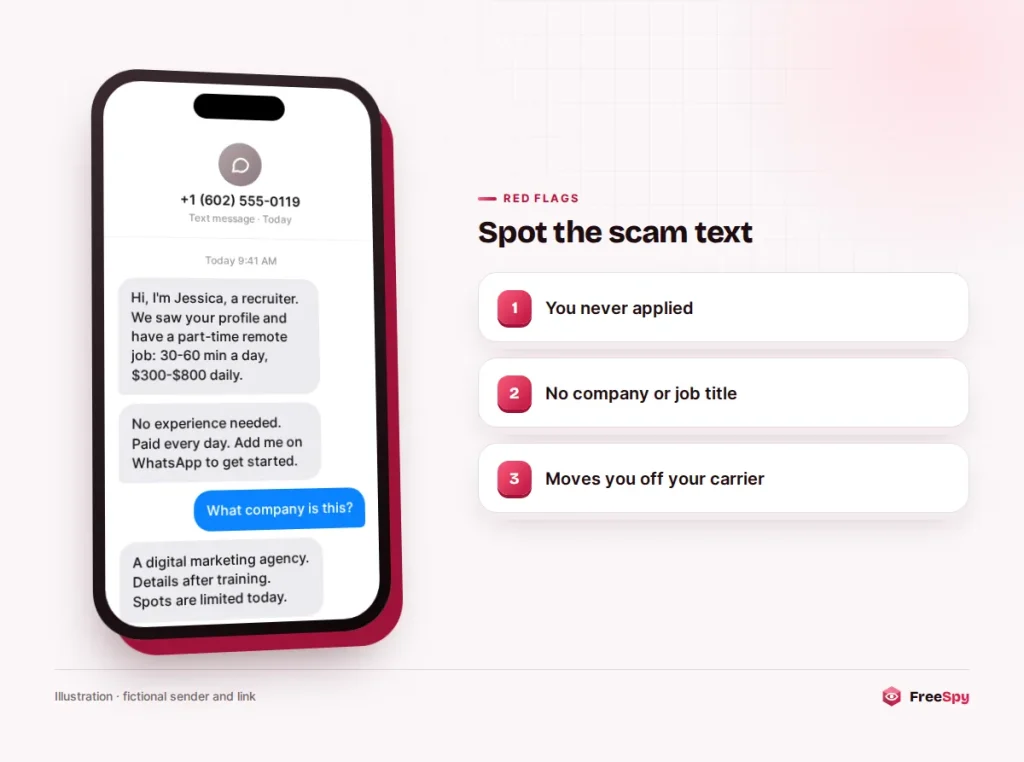
“Hi, I’m Jessica, a recruiter with a digital marketing agency. We saw your profile and have a part-time remote position. 30 to 60 minutes a day, $300 to $800 daily, paid every day. Are you interested? Please add me on WhatsApp to learn more.”
The FTC says these schemes usually start with an unexpected text or WhatsApp message offering online work but no specifics. No company website. No job title you could search. No interview. Moving you to WhatsApp or Telegram also takes the conversation away from your carrier’s spam filtering.
Days 2 and 3: a trainer and a $40 withdrawal
A friendly “trainer” walks you through the platform. You “optimize” products, rate hotels or boost app rankings by tapping buttons. After the first set you’re allowed to withdraw a small amount, maybe $20 or $40.
That payout is the scammer’s marketing budget. The FTC notes that many people get small payouts at first, which makes them trust the system.
Days 3 to 5: the group chat
You’re added to a chat full of “coworkers” posting screenshots of big withdrawals. The FTC says newcomers hear success stories there from supposedly experienced workers who are actually fake. It’s quite possible that everyone in the group except you is part of the operation.
Days 5 to 7: the “lucky combo” order
“Congratulations, you received a lucky combo order. Commission is 5 times higher. Your account balance is now -$1,240. Please top up the balance to complete the set and withdraw your earnings.”
Suddenly your balance is negative, or a “premium” set needs a deposit, nearly always in cryptocurrency. Pay it and the next set needs more. Try to withdraw and there’s a “tax,” a “release fee” or an “account verification” charge.
The game never ends with a payout. It ends when you stop paying.
Fake checks, starter kits and “send me the code”
Gamified tasks are the fastest-growing script, but fake recruiters work from several others.
The fake check is the oldest. You’re “hired,” mailed a check to buy equipment, and told to forward part of the money to a “vendor.” The FTC says no honest employer will send you a check to deposit and then tell you to send on part of the money. The check bounces later, and your bank wants the full amount back from you.
Then there are fees for the job itself: training, a starter kit, a background check, a “certification.” According to the FTC, honest employers, including the federal government, will never ask you to pay to get a job.
Some fake interviews are really identity grabs. After a chat-only “interview,” you’re asked for your Social Security number, bank details and a photo of your ID “for payroll,” which is enough to open accounts in your name.
And some recruiters ask you to read back a code they texted you, “to confirm you’re a real candidate.” That code often sets up a new phone number or hands over an account in your name, the same trick scammers use to set up Google Voice numbers in other people’s names.
A job text can also be the opening line of a different fraud entirely. The friendly message that slowly turns into a fake crypto investment pitch often starts with the same kind of small talk.
What the sender’s number can tell you
A phone number can’t prove a job offer is real. It can often show you one that isn’t.
Start by looking it up. On FreeSpy you’ll see whether the number is valid, which region and number type it belongs to, and, when carrier data is available, whether it’s a mobile, landline or VoIP line. Community reports filed under “fake job” or “smishing” appear on the same page.
Then compare the area code with the story. A recruiter for a New York company texting from somewhere else proves little by itself, since people move and keep their numbers. A mismatch plus a vague offer is another matter. If you don’t recognize a code, the area code list shows where it belongs.
WhatsApp messages often come from numbers with foreign country codes. A US job that only ever talks to you from an overseas number is a warning sign on its own.
Finally, find the company yourself. Look up its official careers page and contact HR through the website, not through anything in the message. If the company exists, ask whether the person who texted you works there. Scammers borrow real company names all the time.
Six things a real recruiter won’t do
One of these is a reason to slow down. Two or more and you can be fairly sure.
- Contact you about a job you never applied for, claiming they “saw your resume”
- Give a daily pay range but no company name, job title or address
- Move the chat to WhatsApp, Telegram or Signal right away
- Skip the interview, or hold it entirely by text
- Pay you to like, rate or “optimize” things online; the FTC says not to trust anyone who offers that
- Ask you to deposit money, buy crypto or pay any fee before you can be paid
Sent money already? Stop at the next deposit request
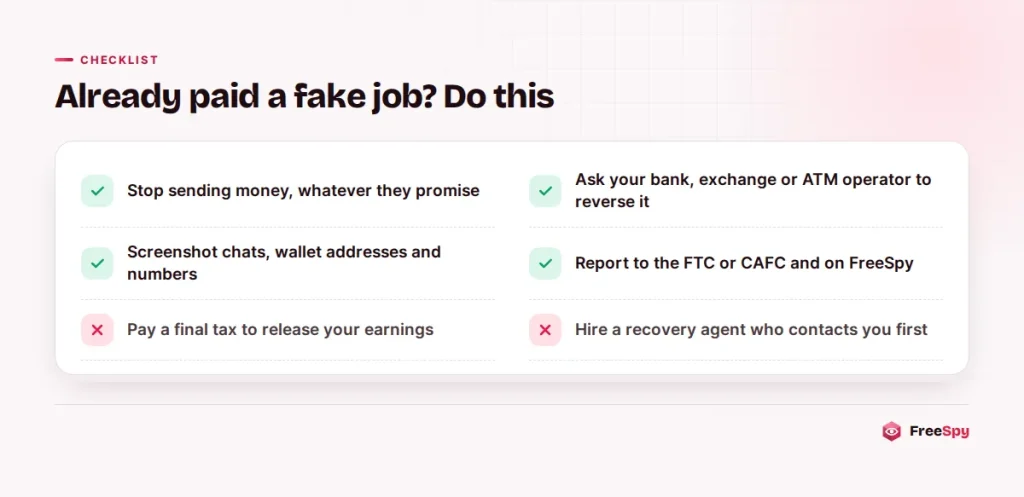
Stop paying now, even if they say one more deposit will release everything. It won’t.
Contact whoever moved the money for you. The FTC’s advice is to report the fraud to that company and ask for the transaction to be reversed if possible. For crypto, that’s the exchange or the crypto ATM operator. For a bank transfer or card payment, it’s your bank.
Save everything before the group disappears: screenshots of the chats, the app or website address, wallet addresses, transaction IDs and every phone number involved.
If you sent a photo of your ID, your Social Security number or a bank login, treat it as identity theft. Freeze your credit, change your passwords and tell your bank.
Report it. In the US, use ReportFraud.ftc.gov; the FTC also points to your state attorney general. Forward the original text to 7726 (SPAM). In Canada, report to the Canadian Anti-Fraud Centre at 1-888-495-8501. You can also file a report on the number with the “fake job” category and call type “text,” so the next person who looks it up sees it.
Then expect a second wave. After you report, “lawyers” or “crypto recovery agents” may contact you promising to get your money back for a fee. That’s another scam aimed at the same people.
Canada’s numbers tell the same story
Canadians get the same texts. In the Canadian Anti-Fraud Centre’s 2025 figures, job fraud was one of the ten most reported categories, with 2,148 reports, 1,726 victims and $50.6 million in reported losses. Measured per victim, that puts job fraud among the costlier categories on the CAFC’s top-ten list. The advice doesn’t change at the border: a real job doesn’t start with an unexpected text, and it never asks you to pay to get paid.
Fewer of these texts in the first place
Report junk in your messaging app. Apple Messages and Google Messages both have a report option, and those reports help filter similar texts for other people.
Turn on the filters. On iPhone you can filter unknown senders into a separate list; on Android, turn on spam protection in Google Messages.
Don’t reply at all, not even “STOP” or “wrong number.” Any reply tells the sender a real person reads that number.
Check what job sites show. Resume and job board profiles can expose your phone number to anyone. Where the site allows it, hide the number and let employers reach you through the platform.
Two more questions
I really did get paid at first. Doesn’t that make it real?
No. The early payouts are part of the setup. They’re small, they come before any deposit, and their whole purpose is to make the bigger requests later feel safe.
Can I get crypto back once it’s sent?
It’s difficult, because crypto transfers are very hard to reverse. Report it quickly to the exchange or ATM operator, to the FTC or CAFC, and to local police. Ignore anyone who contacts you offering to recover it for a fee.
Sources
- FTC Data Spotlight: Gamified job scams (Dec 2024)
- FTC Data Spotlight: Top text scams of 2024
- FTC: Job scams
- Canadian Anti-Fraud Centre: Top frauds of 2025