A man calls from (202) 555-0147 and says he works in your bank’s fraud department. The number looks local and ordinary. A lookup tells a different story: it’s an app-based internet number, ported a few weeks ago, with several reports from people who got the same call. You didn’t need to argue with him to find that out.
Line type and carrier are among the most useful things you can learn about an unfamiliar number, and among the most misread. Some of it is fixed public record, some of it changes whenever a number moves, and none of it identifies a person. Knowing which part is which is what makes the result worth checking.
Situations where the answer changes what you do
Most people never think about line type until something doesn’t add up. A caller claiming to be your bank is one case: banks call from large business phone systems, and a recently created app number with fraud reports is a reason to hang up and ring the number on your card yourself.
Buying from a stranger is another. A seller’s mobile number with no history looks like a private person. An internet number with complaints from other buyers looks like a pattern.
Sometimes it’s purely practical. If the number is a landline, a text probably won’t arrive, so call instead.
And sometimes the number is your own. If a lookup shows your mobile number at a carrier you don’t use, contact your carrier straight away from another phone. That can be a sign someone has moved your number without permission, the kind of port-out fraud criminals use to intercept security codes.
Businesses care for a different reason: knowing which numbers on a list are mobiles matters for texting, and for the consent rules on automated calls and texts.
The first seven digits are public record
Every number in the North American Numbering Plan has the same structure: +1, a three-digit area code, a three-digit exchange, and a four-digit line number.
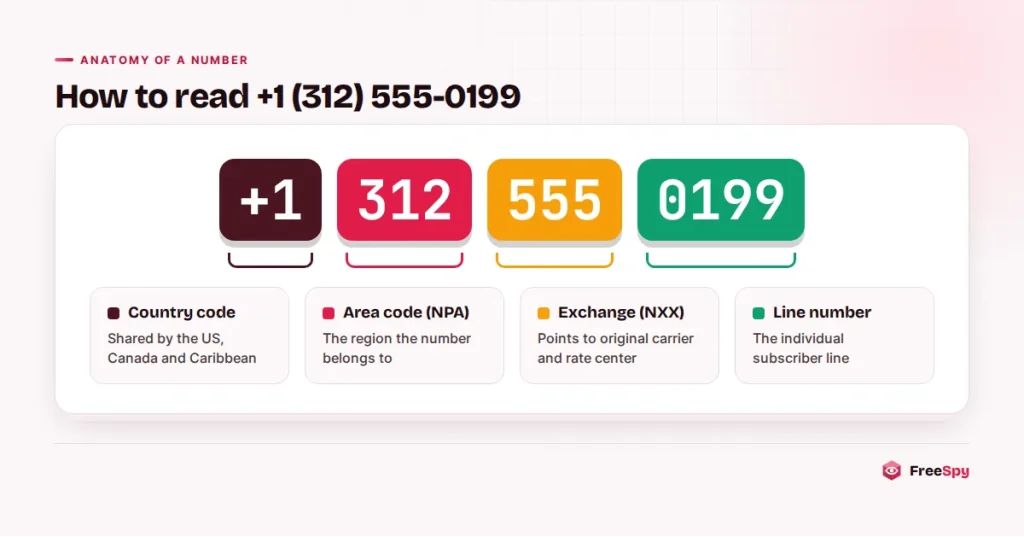
The area code gives you the region. The exchange is where carrier information lives. Numbering administrators assign exchanges, and since number pooling, blocks of 1,000 numbers within them, to specific carriers and to a rate center, the local calling area the number belongs to. In the US those assignments come from NANPA. In Canada they come from the Canadian Numbering Administrator, under the CRTC.
So the first seven digits usually tell you which company first received a number and which town or city it was tied to. That information is public, permanent and reliable. What it can’t tell you is where the number lives today.
Where the number started versus where it is now
US wireless number portability arrived on November 24, 2003. In Canada, people in most of the country could take their numbers between cellphone providers, and between landline and cellphone providers, starting March 14, 2007. The FCC notes that porting “can be done between wireline, IP and wireless providers,” provided you stay in the same geographic area, and that simple ports must be processed in one business day.
A number first assigned to a landline company in Chicago could therefore be on a mobile network now, move to an internet calling provider next year and come back later. Each move leaves the original assignment untouched. To see where a number sits today, a lookup has to query live porting and carrier data, usually through a specialist carrier-data provider.
A FreeSpy number page shows both layers. The original carrier and rate center come from NANPA and Canadian numbering data and are always there. The current carrier, line type and porting status appear when a carrier-data provider is connected. If the page says the number has been ported, the two will differ, and the current one is what tells you the line type.
Mobile, landline, fixed VoIP, non-fixed VoIP
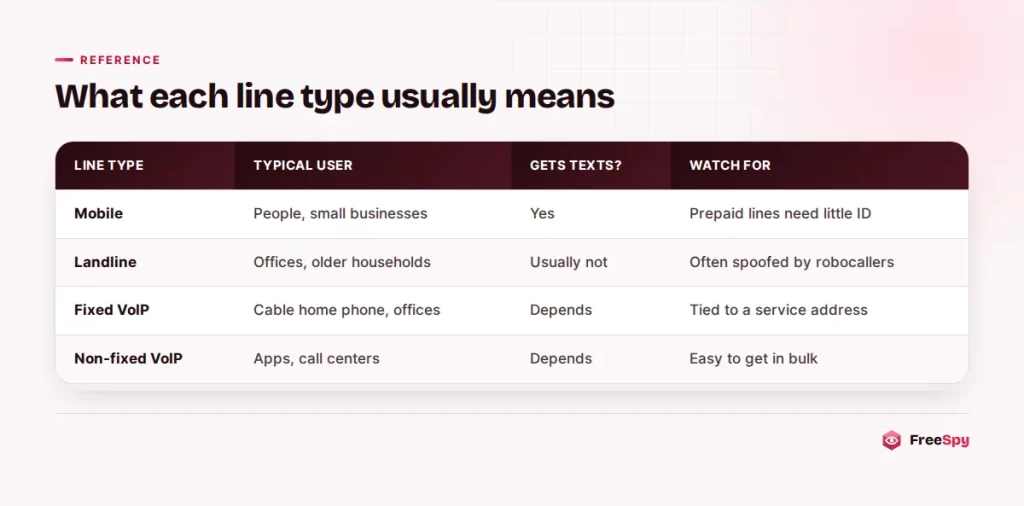
Carrier data usually puts a number into one of four buckets.
A mobile number is a cell line on a wireless carrier’s network. Most people and many small businesses call from one. Prepaid phones are easy to buy, so mobile doesn’t prove identity, but a mobile number with no reports is about as unremarkable as a number gets.
A landline is a traditional wired line from a phone company. Fewer individuals have them each year; they’re more common in older households, businesses, schools and government offices. Most can’t receive ordinary text messages.
Fixed VoIP is internet phone service tied to an address: cable or fiber home phone, or an installed office system. The provider generally knows who the customer is and where.
Non-fixed VoIP works from anywhere with an internet connection: second-number apps, cloud calling tools, platforms that sell numbers in bulk. Lots of honest people and businesses use them. So do many robocall operations, for reasons laid out in the piece on app-based and internet numbers.
Line type sits alongside the number type, which comes from the area code itself. Toll-free numbers such as 800 and 888 are billed to the receiver. Premium 900 numbers charge the caller. Caribbean area codes that share +1, such as 876 and 809, are billed as international even though they look domestic, which is exactly what the one-ring callback scam relies on.
Running the check yourself
There’s no account to create. Type the number into the box below, or put it in the address bar after the domain, like freespy.app/3125550199.
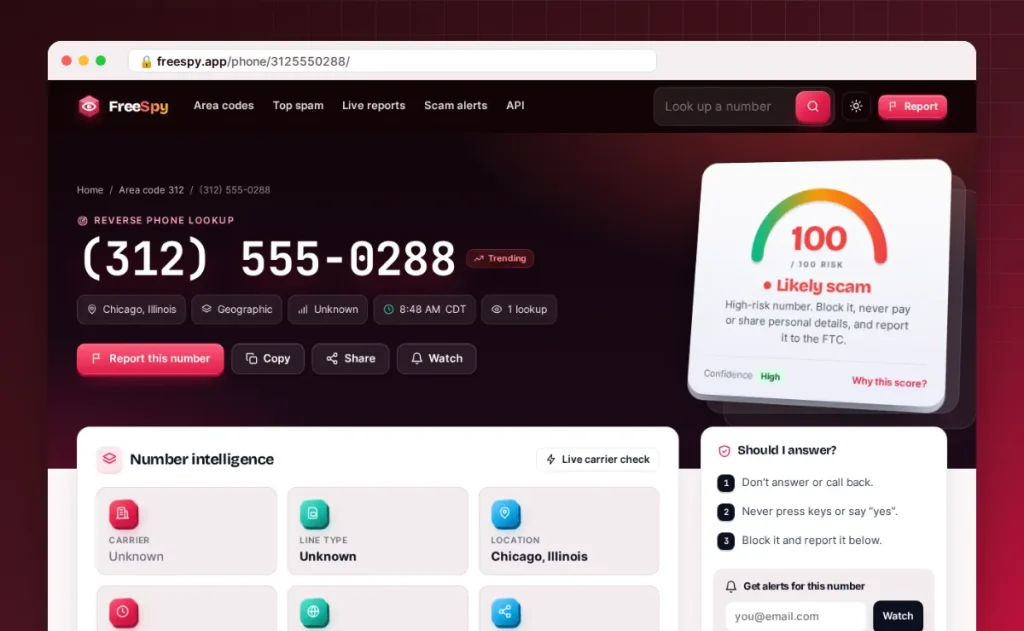
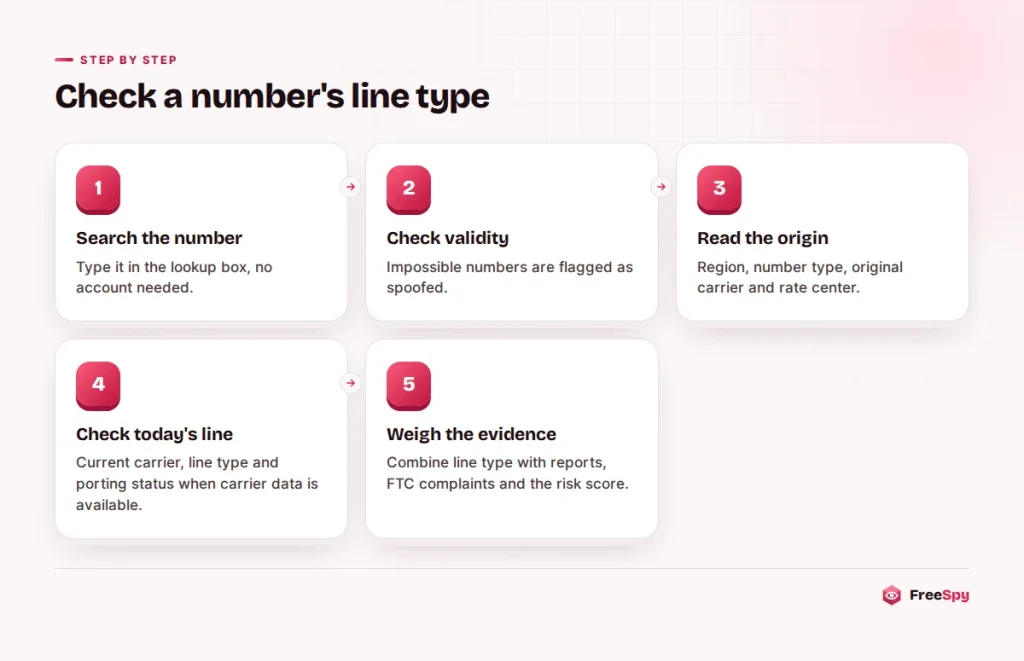
Read the page from the top. First comes a validity check against North American numbering rules: a number that can’t exist, such as one whose area code starts with 0 or 1, is flagged as spoofed and scores 88 out of 100. Then the number type and region, with the state or province, nearby cities and the caller’s local time. Then the original carrier and rate center, and below that the current carrier, line type and porting status when carrier data is available.
Community reports and FTC Do Not Call complaints come next, followed by a 0 to 100 risk score with every factor and its points written out. Line type is one of those factors, worth between −3 and +8 points, which is deliberately small next to reports and complaints.
Four results and how to read them
These numbers are fictional; the situations aren’t.
The “bank” on an app number
Back to the caller from the opening. (202) 555-0147 shows as non-fixed VoIP, recently ported, with several reports tagged “bank/card fraud.” Banks do use internet phone systems, so the line type alone wouldn’t settle it. The reports do. End the call and use the number on the back of your card.
The seller with a bike
You’re arranging to buy a used bike, and the seller texts from (614) 555-0112. Mobile line, same original and current carrier, no reports. That’s what a private seller normally looks like. Meet somewhere public and don’t pay in advance anyway.
The same result from a plumber or a hairdresser would be just as normal. Many small businesses run entirely off the owner’s cell phone, so a mobile line type says nothing against a company that claims to be local and small. It would be odder from a national bank or a government agency.
The landline that sent a robocall
A recorded pitch about your car warranty arrives from (512) 555-0186. The lookup says landline, a small local business, no previous reports. This is what borrowed caller ID looks like: the robocaller spoofed the business’s number. The line type is accurate, but it describes the business, not the person who called you. Report the call and leave the business alone; it is probably a victim too.
Your own number, wrong carrier
You look up your mobile number out of curiosity and it shows a different current carrier from the one you pay. Before you worry, check whether your plan comes from a smaller brand that runs on a bigger network, because data often names the network rather than the brand. If your phone has also lost service without explanation, call your carrier from another phone right away.
Even if it turns out to be a false alarm, it’s a good moment to ask your carrier what protection your account has against unauthorized ports. Most offer an account PIN or a port-out lock, and some turn it on only when you ask. If you rely on text messages for bank or email codes, an authenticator app is harder to steal than a phone number.
What the data can’t see
Carrier data has real blind spots.
It describes the number, not the caller. When caller ID is faked, as with the warranty robocall above, the line type belongs to whoever really holds the number.
It often names the network rather than the brand. Many mobile brands run on a larger carrier’s infrastructure, and lookups tend to report the operator.
It can lag. Ports finish within a business day or less, and data sources don’t always catch up that quickly.
It can’t separate old owners from new ones. Disconnected numbers are reassigned after a waiting period, so the line type may be current while older reports describe someone who gave the number up months ago.
And it doesn’t reveal who is behind a number. Carriers release account holder details only through legal process, such as a request from law enforcement. FreeSpy doesn’t show owners’ names or addresses either; a caller name appears only from licensed caller ID name data, which is capped at 15 characters, or from what callers said about themselves in community reports.
Checking a whole contact list
If you manage numbers in bulk, you can paste a whole list and export the results as CSV, and the API returns the same fields as JSON. Businesses commonly use line type to separate mobiles from landlines before sending texts. In the US, autodialed or prerecorded calls and texts to mobile numbers generally need prior express consent under the Telephone Consumer Protection Act, so the distinction has legal weight. This is general information rather than legal advice; check the FCC’s rules or a lawyer for your own situation.
A rate center, if you’ve been wondering, is simply the local calling area an exchange is tied to, usually named after a town or city. It explains why a number “belongs” somewhere even when the person using it moved across the country years ago.
Sources
- FCC: Porting, keeping your phone number when you change providers
- Government of Canada, March 14, 2007: Wireless number portability begins today
- North American Numbering Plan Administrator
- Canadian Numbering Administrator