Your phone lights up with “No Caller ID.” There’s no area code to check and nothing to block. You can answer and find out, or let it ring and wonder who it was.
Most of the time the person on the other end simply chose to hide their number, which is legal and common. Sometimes the number got lost somewhere between their phone and yours. Either way, you have more options than you might think: both iPhone and Android can screen these calls, many home phone providers can reject them outright, and there are a few things a blank call can and can’t tell you.
Blocked, private, unavailable: what each label is telling you
Phones and carriers word these differently, but they fall into two groups. One group means the caller asked the network to withhold the number. The other means no usable number reached you at all.
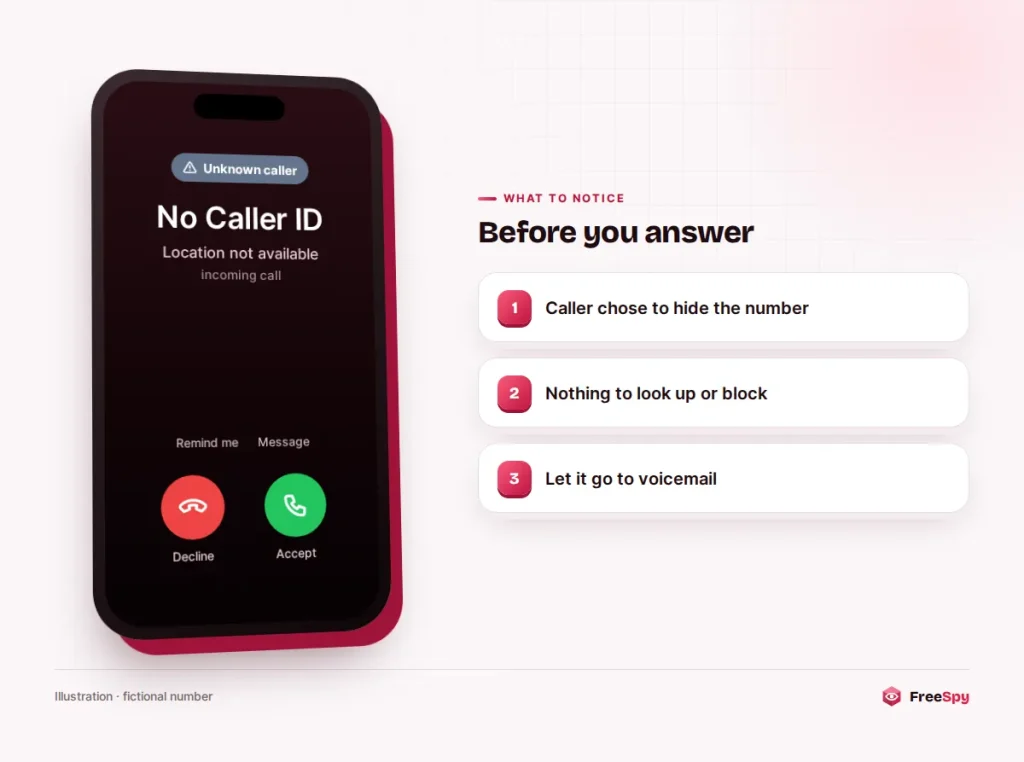
“Private,” “Restricted,” “Blocked” and “No Caller ID” belong to the first group. The caller turned on caller ID blocking, either for one call or for the whole line, and the network carried the call while keeping the number off your screen.
“Unknown,” “Unavailable” and “Out of area” usually belong to the second. Some international calls arrive this way, as do calls that pass through older equipment and business phone systems that were set up badly. Nobody necessarily decided to hide anything.
Then there’s the call that shows a number but no name. That’s a different situation entirely: you have the digits, your phone just doesn’t recognize them, and you can look them up.
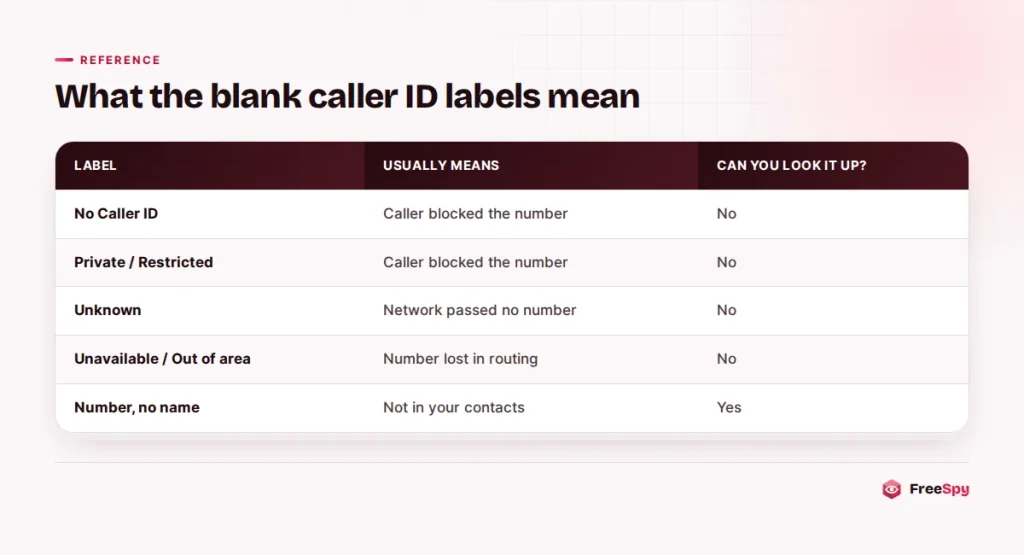
The distinction matters because a blocked number is a choice and an unavailable one is often an accident of routing. Neither label says anything about whether the call is safe.
*67, whole-line blocking and the phone setting
In the US, hiding your number for a single call is built into the network. FCC rules require carriers to recognize *67 dialed before a number as a request not to pass the caller’s number along, and they can’t charge the caller for that per-call blocking. People who have blocking on their entire line dial *82 when they want a particular call to show their number.
Most smartphones also have a “show my caller ID” switch in the call settings, and many internet calling apps let users call anonymously. Whether the phone setting actually works depends on the carrier, which is why plenty of people still reach for *67.
Blocking only hides the number from you. The networks that carried the call still know which line it came from. And it doesn’t apply to emergency lines: a call to 911 delivers the caller’s number whatever the privacy setting says.
The people who hide their number on purpose
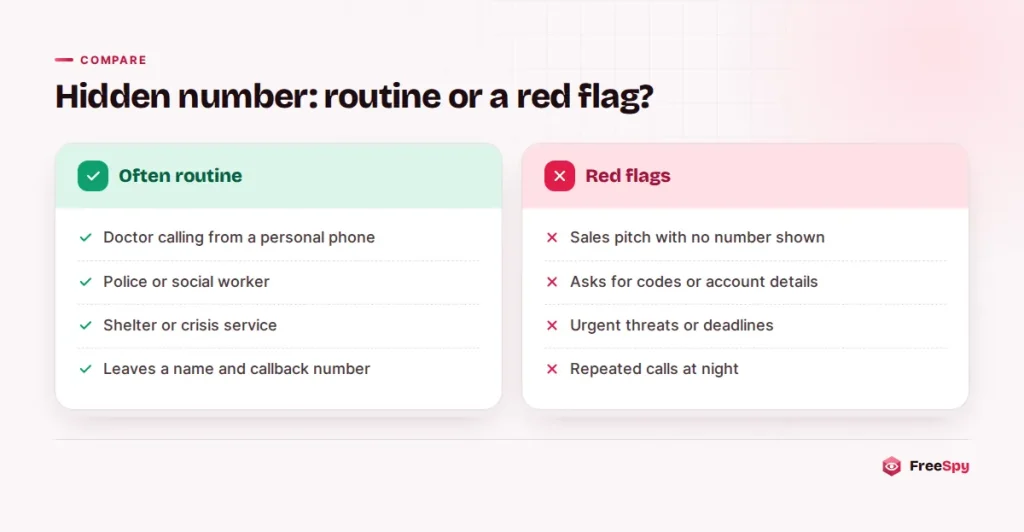
A lot of hidden-number calls are routine once you think about who might want to reach you without handing over a personal cell number. A nurse or therapist calling from their own phone after hours. A police officer, probation officer or social worker, for safety. A shelter or crisis line protecting the people it serves. A relative who set their phone to private years ago and forgot. An office phone system that sends nothing because nobody configured it.
Telemarketers should never be in that list. In the US, the FTC’s Telemarketing Sales Rule and the FCC’s caller ID rules both require telemarketers to transmit caller ID, and the FCC rule specifically prohibits them from blocking it. In Canada, the CRTC’s Unsolicited Telecommunications Rules require telemarketers to display the originating number or another number where they can be reached. A sales pitch from a blank number is breaking the rules before anyone says a word.
Scammers are a mixed picture. Most would rather fake a number than hide one, because people ignore blank calls but often answer something that looks local. That technique, spoofing a caller ID, is a separate problem. Hidden numbers turn up more in harassment, pranks and calls from people you’ve already blocked, who switch to *67 to get through.
There’s no number to search, so wait for one
Every reverse phone lookup starts with a number. When the call arrives blank, your phone never received one, so there is nothing to type into a search box. Be wary of any app that promises to identify every blocked caller; look closely at what it charges and what it does with your data.
What usually happens instead is that the caller gives you a number some other way. People with a real reason to reach you leave a message, and the message almost always includes a callback number. Something like this:
“Hi, this is Jordan calling from Lakeside Family Clinic about your test results. Please call us back at (202) 555-0147. Thanks.”
Now you have something to check. Look up the callback number, then compare it with the number on the clinic’s website or your appointment card. If they match, call back. If the message steers you toward a number you can’t find anywhere official, be suspicious. Anyone can say they’re Jordan from the clinic.
A FreeSpy lookup of a callback number shows its region and line type, any community reports and FTC Do Not Call complaints, and a risk score that lists each factor behind it.
Screening hidden calls on iPhone, Android and landlines
You don’t have to answer these calls to deal with them.
iPhone
Apple’s Phone settings (Settings > Apps > Phone) include Screen Unknown Callers. With Ask Reason for Calling selected, Apple says the caller is asked why they’re calling before your phone even rings, so you can read the answer and decide. Silence Unknown Callers is blunter: calls from numbers that aren’t in your contacts go straight to voicemail. Menu names move around between iOS versions, so check Apple’s support page if yours looks different.
Android
In Google’s Phone app, open Settings, then Blocked numbers, and switch on Unknown. Google says this blocks calls from private or unidentified numbers, while calls from numbers that simply aren’t saved in your contacts still ring. Samsung and other manufacturers have something similar in their own phone apps, usually under call blocking.
This is also the answer to a common frustration. Blocking a specific number does nothing against someone who calls with that number hidden, because there’s no number to match against your block list. The Unknown switch is what catches them.
Landlines and internet home phones
Many landline and VoIP providers offer a feature usually called anonymous call rejection. Callers who hide their number hear a recording telling them to unblock it and try again. The activation code and the price vary, so ask your provider. Carriers also have their own spam apps and network filters, and a rundown of phone and carrier blocking tools walks through them.
Tip: Before you block every hidden call, tell your doctor’s office, pharmacy and your children’s school. Ask them to call from a listed number or leave a voicemail with a callback number, so their calls don’t disappear.
If you pick up anyway
Sometimes you’re expecting a call and answer a blank one. That’s fine. What you want from the conversation is a number you can verify, and you want to give away nothing. A calm version might go like this:
You: “Hello, who’s calling?”
Caller: “This is Mark from your bank’s security team. We’ve noticed a suspicious charge.”
You: “Thanks. I’ll ring the number on the back of my card and ask for the security team.”
Caller: “No need, I can fix it now if you confirm the code we just texted you.”
You: “I don’t share codes.” Then hang up.
Look at what didn’t happen. You didn’t confirm your name, birth date or address, you didn’t read out a code, and you chose the callback number yourself. That last habit defeats most phone scams, whether the call came in blank, spoofed or from a perfectly ordinary-looking number.
A real caller won’t object. A clinic will tell you to use the main line. A courier will give you a tracking reference you can check on its website. Pressure to stay on the line, act immediately or keep the call secret is the tell.
When the hidden calls keep coming
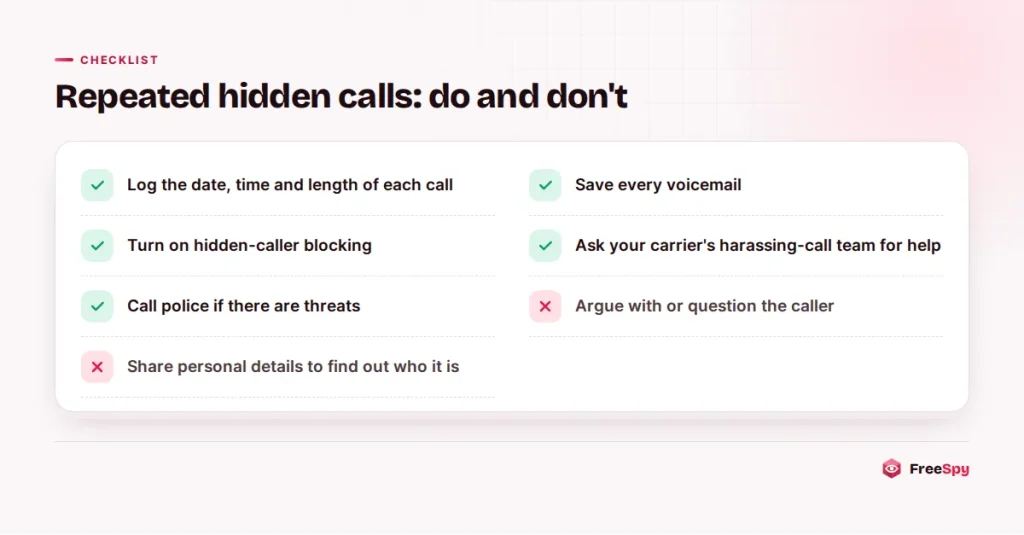
One or two blank calls are an annoyance. Calls at night, calls with only breathing or silence, threats, or calls that started after you blocked someone are something else, and you don’t have to put up with them.
Don’t engage. Answering, arguing or demanding to know who it is gives the caller the reaction they’re after.
Start a log: the date, time and length of each call and anything that was said. Screenshots of your call history help, and so do voicemails, so keep them even if they upset you.
Turn on the hidden-caller blocking described above so the calls stop reaching you while you deal with the rest. Then contact your carrier and ask for the team that handles harassing or annoyance calls. Carriers can see where a blocked call really came from and can work with police, who can request records you can’t. If there are threats, or the calls are part of a wider pattern of someone following or watching you, go to the police with your log.
Long silences on the line have their own, usually mechanical, explanations; the piece on dead-air calls and hang-ups goes through them.
Hiding a number is legal; faking one isn’t
Hiding your own number is allowed in both countries. The law goes after deception. In the US, the Truth in Caller ID Act of 2009 makes it illegal to spoof caller ID with intent to defraud, cause harm or wrongfully obtain anything of value, and the FCC can fine violators up to $10,000 per violation. Telemarketers face the stricter rule already mentioned: they must send caller ID at all. Canada’s telemarketing rules, enforced by the CRTC, take the same line.
If a blank sales call gets through, you can still describe it in a complaint to the FTC in the US or to the National Do Not Call List in Canada. This is general information, not legal advice; check the official source or talk to a lawyer about a specific situation.
A blank screen isn’t a spam warning
“No Caller ID” and labels like “Scam Likely” come from different places. The first reflects the caller’s privacy setting. The second comes from your carrier’s analytics, which judge a number they can see by its calling patterns. Since those carrier warning labels attach to a number, a hidden call rarely earns one. A missing warning on a blank call tells you nothing either way.
Quick answers
Does *67 hide my number when I send a text?
No. The code is a calling feature, and text messages carry your number regardless. Some messaging apps use their own accounts or separate numbers, which is a different thing from blocking caller ID.
I blocked a number and the same person still gets through. How?
They are probably calling with their number hidden. A block list needs a number to match, so a hidden call slips past it. Use the setting that blocks private or unknown callers, and contact your carrier if the calls are harassing.
Are hidden-number calls more likely to be scams?
Not necessarily. Many come from medical staff, police and shelters. Scammers more often use a fake local-looking number, because blank calls get ignored. Judge the call by what the caller asks you to do.
Sources
- FCC caller ID rules, 47 CFR 64.1601
- FTC Telemarketing Sales Rule, 16 CFR 310.4
- CRTC Unsolicited Telecommunications Rules
- Apple Support: Manage unknown callers on iPhone
- Google Phone app Help: Block or unblock a phone number
- FCC: Caller ID spoofing