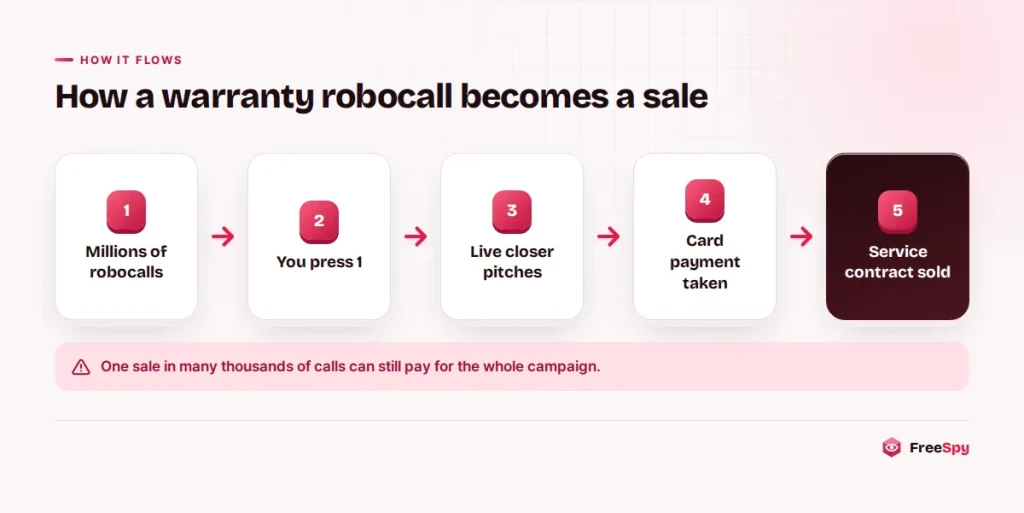
“We’ve been trying to reach you about your car’s extended warranty.” The line became a national joke years ago, and car warranty robocalls still come, sometimes about a car you sold in 2015 or never owned at all. They aren’t random. Each one is the top of a sales funnel, built to find the small number of people who will press 1, stay on the line and pay for a contract.
The FTC’s description is blunt: these are illegal robocalls and likely scams, and the callers are not your dealer or your car’s manufacturer. The right response takes about three seconds. Hang up without pressing anything.
The recording, line by line
Most of these calls begin with a recording. A typical one goes like this:
“This is the vehicle services department calling about your car’s extended warranty. Our records show we’ve sent you several notices in the mail and haven’t heard back. You haven’t extended your warranty past the factory cutoff, and we’re about to close your file. Press 1 to speak with a warranty specialist now.”
The FTC has flagged this exact pattern: the caller claims to have mailed you notices already, and says you haven’t extended coverage past the factory cutoff. Both lines are there to make the call sound like a follow-up from a company you already deal with, and to make you feel something is about to expire.
“Vehicle services department” names nobody. “Your car” names no car. A dealer who actually had your file would say which vehicle and which dealership.
Some versions use live callers from the start. Others come as texts or as mailers with urgent headings like “Final Warranty Notice” or “Motor Vehicle Notification,” wording the FTC lists as a warning sign.
Three reasons the calls keep coming
One sale pays for a lot of dialing
A robocall costs almost nothing to place. A vehicle service contract, according to the FTC, often sells for hundreds or thousands of dollars. If one call in many thousands ends in a sale, the campaign still makes money. The robocall itself is just a filter, sorting out people who worry about repair bills and are willing to press 1.
The pitch fits nearly every adult
Most phone scams need a particular target: someone on Medicare, someone with student loans, a customer of a certain bank. A car pitch works on almost anyone who drives. The script doesn’t need to know your car, and many never mention a make or model. When one does, the information usually comes from old registration or marketing data. That’s why you hear about a car you got rid of years ago, or one that belonged to the person who had your number before you.
When one operation falls, another starts dialing
Few robocall categories have drawn as much enforcement. Each time a network is cut off, other sellers and lead generators step in with fresh numbers, different phone companies and slightly reworded scripts. Spoofing helps them, because the number on your screen often isn’t where the call really came from, which is why blocking a spoofed number rarely stops the next call.
Five billion calls in three months: the FCC case
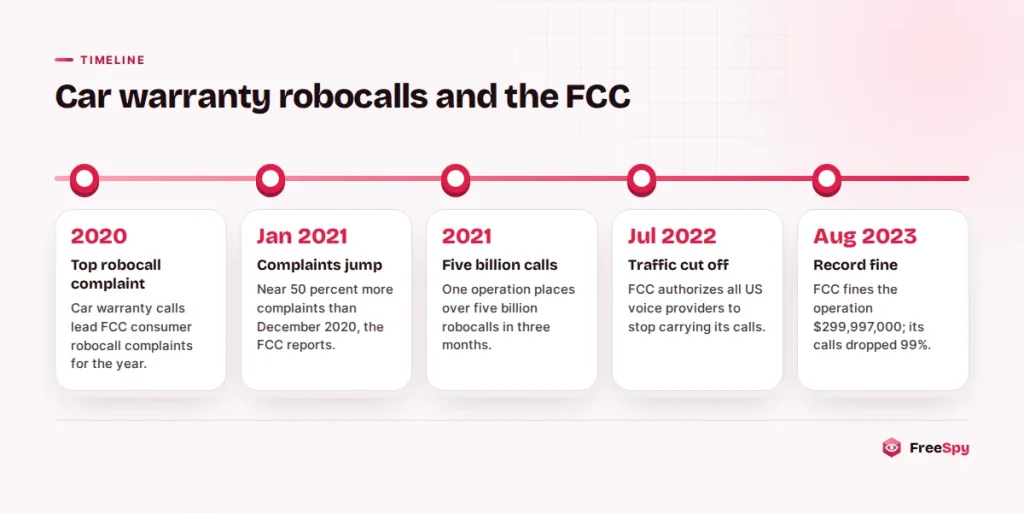
In 2020 these calls were the top robocall complaint consumers filed with the FCC, ahead of Social Security scam calls. They kept climbing. The FCC reported a near 50 percent increase in complaints in January 2021 compared with December 2020.
In July 2022 the FCC went after one international operation, estimated to have generated upwards of eight billion robocalls. Its Enforcement Bureau authorized all US voice providers to stop carrying the operation’s traffic and sent cease-and-desist letters to eight carriers.
A year later, in August 2023, the FCC fined the same operation $299,997,000, a record. By the FCC’s count, it had placed more than five billion robocalls to more than 500 million phone numbers during a three-month span in 2021. After the traffic was cut off, the FCC said, those illegal calls dropped by 99%.
That case removed one very large source. It didn’t remove the business model. Robocall volume overall is still enormous: YouMail’s Robocall Index estimates 52.5 billion robocalls in the US in 2025, roughly 30 billion of them unwanted telemarketing and scam calls a year. Car warranty pitches remain a steady slice of that.
What they’re selling is a service contract, not a warranty
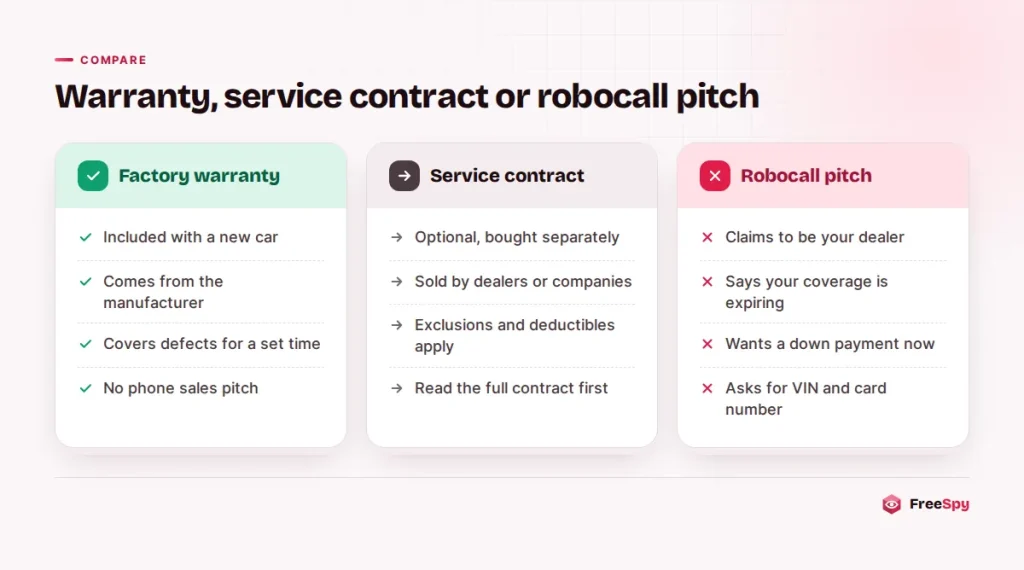
A warranty comes with a new car. It’s the manufacturer’s promise to fix certain defects for a set time. What these callers sell is a vehicle service contract: a separate, optional product from a third party that promises to pay for some repairs.
The FTC is precise on this point. A service contract, even when it’s marketed as an “extended warranty,” is not a warranty under federal law, because you buy it separately. Service contracts are legal when sold fairly, and dealers and manufacturers sell them too. The trouble is how robocall sellers sell them, and what you find out later about the coverage.
The FTC’s checklist for any service contract is worth reading before you sign one from anyone. Service contracts typically don’t cover accident damage or normal wear and tear, and few cover all repairs and maintenance. You may owe a deductible each time the car goes in. Check when coverage starts and ends, and whether it simply overlaps the factory warranty you already have. The contract should also say how to make a claim and how you get reimbursed.
A salesperson on a cold call won’t walk you through any of that. They’ll want a down payment before you’ve seen a page.
Hang up first, then decide what else to do
The aim is to give the dialer nothing it can use.
If you can, let unknown numbers go to voicemail. A real business that needs you will leave a message with its name. These operations often leave nothing, or leave the same recording.
If you pick up and hear a recording, hang up. Don’t press 1 to reach an agent, and don’t press 2 or 9 to “be removed.” Any key press tells the system the line is live and a person answered, which is part of what answering a spam call sets off.
If a live person comes on, keep your details to yourself. Your VIN, mileage, name, address and card number all have value to the seller. “I’m not interested, put me on your do-not-call list” is enough. Then hang up.
Arguing, or trying to waste the caller’s time, doesn’t help. It keeps your number on “answered” lists, and those lists get resold.
If you want to see who else has had calls from the same number, a lookup on FreeSpy shows the line type and region along with community reports tagged “auto warranty” and any FTC Do Not Call complaints about it. You can report the call at DoNotCall.gov or 1-888-382-1222, and add your own report so the next person sees it.
Your carrier’s free spam filter and your phone’s silence-unknown-callers setting will stop a lot of these before they ever ring.
Most of these calls break US telemarketing law
In the US, a prerecorded sales call needs your prior written consent, and telemarketers must honor the National Do Not Call Registry. The Telephone Consumer Protection Act also restricts autodialed and prerecorded calls to cell phones without prior express consent, and lets consumers sue for $500 per violation, or up to $1,500 if the violation was willful.
The gray area is consent. If you once filled out an online quote form, a seller may claim you agreed to be called, with that agreement buried in fine print and shared with dozens of “marketing partners.” The rules on consent and exemptions are more detailed than most people expect. This is general information, not legal advice; for a specific case, check the official sources or talk to a lawyer.
For Canadians
The same pitch arrives in Canada as “vehicle protection” or extended warranty calls. If your number is on the National Do Not Call List (1-866-580-3625), telemarketers have 31 days after registration to stop calling, and you can complain if they don’t. Registration doesn’t expire. Calls that try to take money or personal information under false pretenses go to the Canadian Anti-Fraud Centre at 1-888-495-8501.
Bought a contract on one of these calls?
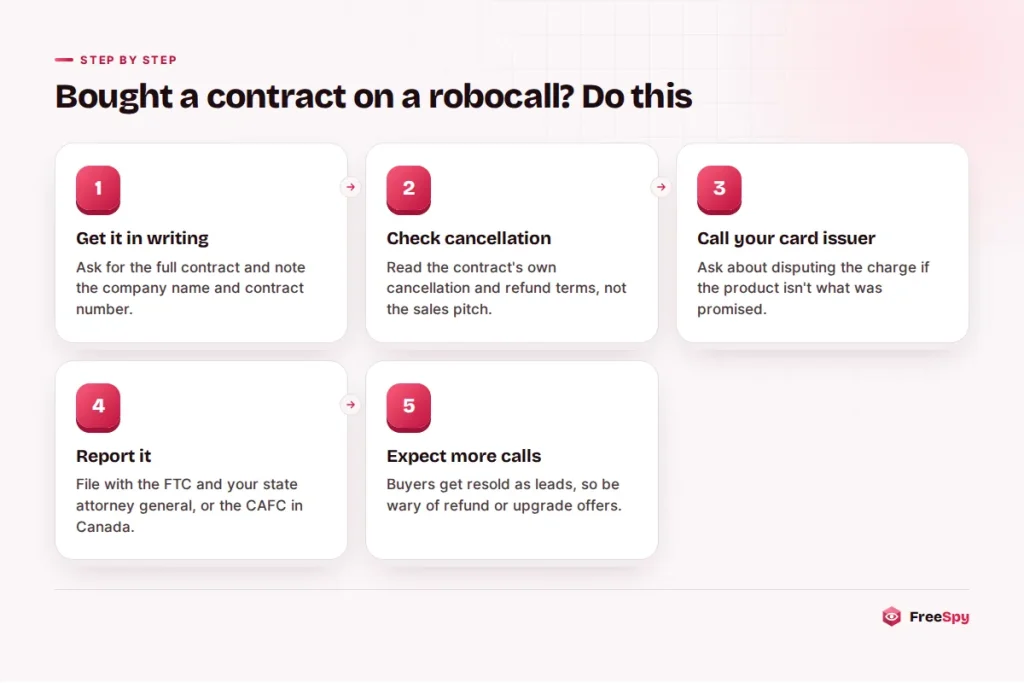
The money isn’t necessarily gone. Start by getting the paperwork. If you never received a written contract, ask for one in writing, and note the company name, the contract number and the date you agreed.
Then read the cancellation terms in the contract itself. Many service contracts allow cancellation within a set window or give a prorated refund, but what counts is the document, not what the salesperson promised.
If you paid by credit card and the product isn’t what you were told, call your card issuer about a dispute. Dispute windows are limited, so don’t wait for the seller to call back.
Report the sale at ReportFraud.ftc.gov and to your state attorney general. In Canada, contact the CAFC and your provincial consumer protection office.
Expect more calls afterward. A person who bought once may be resold as a “buyer” lead, so be especially wary of anyone offering a refund, an upgrade or help canceling for a fee. If you gave a card number or other personal details, treat it the way you would any exposed account and watch your statements closely.
How a real dealer or manufacturer gets in touch
Not every call about your car is a scam. Your dealer may call about a service appointment, and manufacturers do contact owners about safety recalls. The differences are easy to spot once you know them.
A real dealer or manufacturer knows your car. They won’t need you to confirm the VIN or mileage before they’ll tell you why they’re calling.
Recalls come by mail. According to NHTSA, manufacturers notify registered owners by first class mail, and the dealer fixes the recalled part for free. No recall comes with a sales pitch.
And a legitimate business won’t mind if you hang up and call back on a number you looked up yourself.
If you do want extra coverage, compare offers from your manufacturer or dealer, read the whole contract before you sign, and buy it on a call you started.
Sources
- FTC: Hang up on auto warranty robocalls
- FTC: Auto warranties and auto service contracts
- FCC: Top five unwanted call complaints
- FCC news release, July 7, 2022
- FCC news release, August 3, 2023
- NHTSA: Safety recalls
- YouMail Robocall Index