Look up enough unwanted calls and one word keeps turning up in the line type field: VoIP. The number looks like any other, a local area code and seven digits, but it doesn’t belong to a cell phone or a copper landline. It runs over the internet.
That doesn’t make it a scam number. A huge share of honest calling now runs the same way, from cable home phones to the system your dentist uses. But the features that make internet calling cheap and flexible are the same ones robocall operations depend on, and once you understand how these numbers are handed out and used, a lookup result starts to mean something.
A normal phone number with an internet connection behind it
VoIP stands for Voice over Internet Protocol. In the FCC’s words, it “converts the voice signal from your telephone into a digital signal that can travel over the Internet.” Instead of a dedicated line or a cell tower, the call travels as data.
The kind that matters for caller ID is what the FCC calls interconnected VoIP: services that let you call ordinary phone numbers and receive calls from them. To make that work, the provider gives you a regular North American number, +1, a three-digit area code, a three-digit exchange and four digits. Nothing in those digits says “internet phone.”
You’ve almost certainly used one. Home phone service bundled with cable or fiber internet is VoIP. So are most office phone systems, cloud calling inside tools such as Microsoft Teams or Zoom, second-number apps like Google Voice, and the platforms call centers use so agents can work from anywhere.
Fixed and non-fixed: the split that tells you more
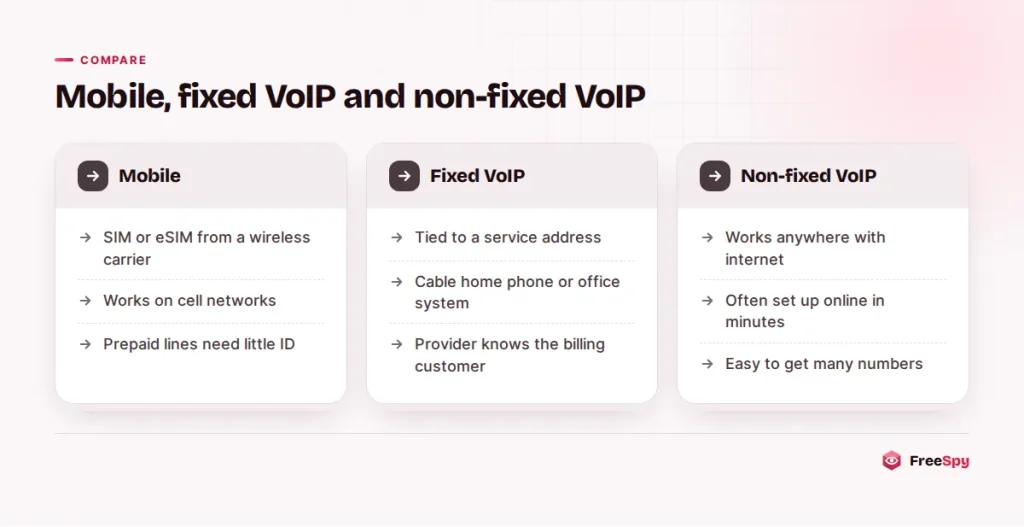
Carrier data, the kind a lookup returns, usually sorts these lines into two groups, and the difference is more useful than the word VoIP on its own.
Fixed VoIP is tied to a physical service address. A cable company’s home phone, or a phone system installed in an office, falls here. The provider normally knows the customer’s name and address because it installed the service or bills for it there.
Non-fixed VoIP works anywhere with an internet connection. These numbers live in apps and web dashboards. Many can be set up online in minutes, and some providers sell them in large batches to businesses that make a lot of calls. That flexibility suits remote workers and small firms. It also suits high-volume scam operations very well.
Neither group is good or bad by nature. A non-fixed number could belong to your child’s school counselor using a work app, and a mobile number could belong to a scammer with a prepaid phone. Line type narrows down what kind of service is behind a number. It doesn’t tell you who is holding it.
What scam operations get out of internet calling
The FTC’s explanation of why robocalls became so common fits in one sentence: “It’s cheap and easy for them to make robocalls over the internet from anywhere in the world.” Internet calling is why that sentence is true.
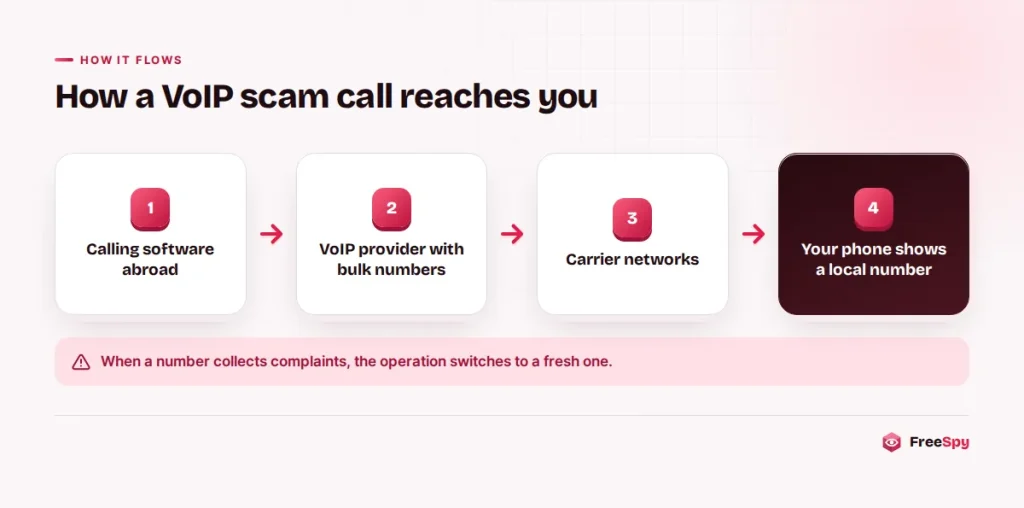
Cost comes first. Calling software can place enormous numbers of calls for very little money, so a scheme that fools one person in several thousand still pays.
Supply comes second. Some providers hand out numbers in bulk, and the FCC noted in December 2025 that bad actors “obtain large quantities of numbers to avoid robocall mitigation measures.” When one number collects complaints or a carrier spam label, the operation drops it and moves to the next.
Then there’s location. A caller overseas can choose numbers in your area code, because local-looking calls get answered more often, and the people running the calls can sit far from the area code they display, which makes them harder to find and prosecute.
Many internet calling systems also let the user type in whatever caller ID they like. That’s a different problem from holding a real VoIP number: with faked caller ID, the scammer isn’t using a number they control at all, and the line type on a lookup describes whoever really owns it.
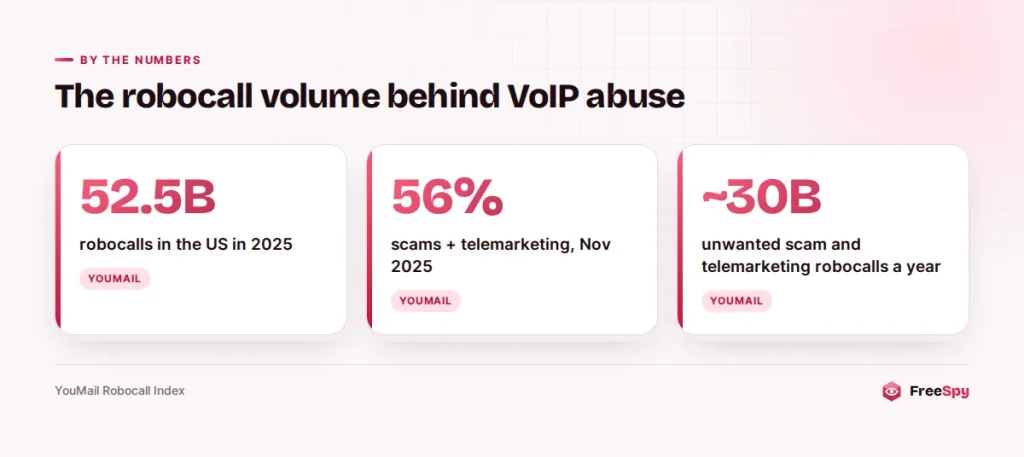
The volume is hard to picture. YouMail’s Robocall Index estimates 52.5 billion robocalls in the US in 2025, and in November 2025 scams and telemarketing together made up 56% of them. Most of that traffic travels over internet-based networks.
Rules that have closed some of the gaps
Regulators have spent years tightening the conditions that made internet numbers attractive to scammers.
In 2015 the FCC began allowing interconnected VoIP providers to obtain numbers directly, rather than only through a phone company partner. That made the service easier to offer, and later rules attached obligations to it. In December 2025 the FCC applied its robocall, public safety and national security certification requirements to providers that hold this direct access, with the risk of losing it if they don’t comply.
Caller ID authentication came in between. The TRACED Act, signed in December 2019, required STIR/SHAKEN, and major US voice providers on IP networks had to use it by June 30, 2021. Because the system works on IP networks, internet-based calls are exactly where it applies. Each call gets an attestation level: A when the provider knows the customer and their right to use the number, B when it knows the customer but not the number, C when the call arrived from somewhere else, such as abroad. Providers must also file in the FCC’s Robocall Mitigation Database, and others must block traffic from providers that aren’t listed.
In Canada, the CRTC has required STIR/SHAKEN for IP-based voice calls since November 30, 2021.
None of this sorts wanted calls from unwanted ones. STIR/SHAKEN checks whether the caller had the right to use the number, not whether you want to hear from them. This is a plain summary for general information; the FCC and CRTC publish the current rules.
The dentist and the fraud ring use the same technology
Dental offices, pharmacies, schools, couriers, recruiters, contractors and your own employer may all call from internet lines. Plenty of households have a VoIP home phone without knowing it. Blocking every such caller would cut you off from a lot of ordinary life.
That’s why FreeSpy treats line type as a small factor in its risk score, between −3 and +8 points out of 100. Community reports can add up to 55 points and FTC Do Not Call complaints up to 30, so line type nudges a score without deciding it. The full scoring method lists every factor and its weight.
Two fictional numbers show why context outweighs line type.
(312) 555-0199 is non-fixed VoIP with no reports and no FTC complaints. It called once and left a voicemail from a dental office confirming your appointment, and the office’s website lists the same number. Nothing to worry about.
(312) 555-0123 is also non-fixed VoIP, but it has a dozen recent community reports tagged “bank/card fraud,” a jump in reports this week, and FTC complaints marked as robocalls. Its voicemail says your card is locked and asks you to press 1. Same line type, very different story.
You can’t tell from the digits
Internet numbers use the same area codes and exchanges as everything else, and porting lets numbers move between mobile, landline and VoIP providers. So the only practical way to know is to check the data.
When carrier data is available, a lookup shows the current carrier, the line type (mobile, landline, fixed or non-fixed VoIP) and whether the number has been ported. It also shows which company the exchange was first assigned to, from NANPA and Canadian numbering records. If that company is an internet calling provider, the number started life as VoIP, though it may have moved since. Some VoIP calls also arrive showing only a city and state as the caller name, because nobody set one. That fits the pattern without proving anything.
The details of reading carrier and porting fields, including where that data goes wrong, deserve their own walk-through.
An unknown internet number is calling: a routine that works
Whatever the line type, a scam call only succeeds if you act on what the caller says. So the routine is the same for all of them.
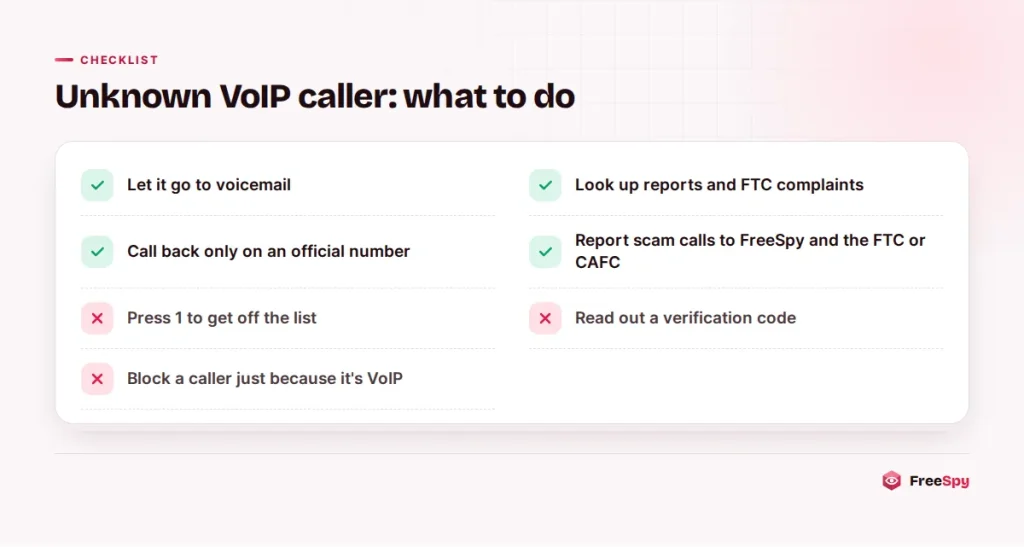
- Let it go to voicemail. Real callers leave messages; robocalls often don’t, or leave a recording asking you to press a key.
- Look the number up and read the reports, FTC complaints and score.
- If the caller claims to be your bank, a utility or a government office, call the number printed on your card, bill or the official website, never the one the caller gives you.
- Don’t read out a verification code to anyone. One common trick uses your code to attach a Google Voice number to your phone, and the code-sharing scam is worth understanding before someone tries it on you.
- Don’t press buttons on robocalls. The FTC warns that pressing numbers to talk to someone or get off the list “will probably only lead to more robocalls.”
- Report scam calls to the FTC at ReportFraud.ftc.gov or, in Canada, to the Canadian Anti-Fraud Centre at 1-888-495-8501, and add a community report so the next person who looks the number up sees it.
Blocking one internet number rarely helps for long, because operations rotate through so many of them. Your carrier’s spam filtering and your phone’s unknown-caller screening will do more of the work.
Using an internet number yourself
A second number from an app is handy for marketplace listings, a side business or anything you’d rather not tie to your main phone. It comes with a few trade-offs.
Emergency calls can behave differently. The FCC warns that “Some VoIP service providers may have limitations to their 911 service,” so keep your registered address current with your provider and find out how its 911 service works before you need it.
Some banks and apps won’t send security codes to non-fixed numbers, or treat them as higher risk. If a service rejects your number at sign-up, that’s the most likely reason.
And a number from an app has often belonged to someone else before you. If it arrives with old spam reports attached, those reports describe the previous user, and you can ask for them to be reviewed.
Questions people ask
Can a VoIP number be traced?
The provider that assigned it has account records, and law enforcement can request them. You can’t get those records yourself. A lookup shows the provider and line type, not the person behind the account.
Why does my friend’s number show as non-fixed VoIP?
They may use a second-number app, a work calling app or a carrier that delivers service over the internet. Some numbers have also been ported from a mobile carrier to an internet provider.
Sources
- FCC: Voice over Internet Protocol (VoIP)
- FTC: Robocalls
- FCC news release, December 18, 2025, on VoIP providers and numbering
- FCC fact sheet: Numbering Policies for Modern Communications
- FCC: TRACED Act implementation
- YouMail Robocall Index