You answer an unknown call and a cheerful voice asks, “Can you hear me?” Almost everyone says “Yes” without thinking. Then you remember the warning a friend shared online: scammers record your “yes” and use it to sign you up for things you never agreed to.
That warning is partly true. The FCC really did alert consumers about these calls in 2017. But a recorded “yes” is a weak tool on its own, because it doesn’t give anyone your card or account number, and charges you didn’t authorize can be disputed. The more certain cost of answering is plainer: it tells the caller that your number reaches a live person.
Below is what the official alerts actually said, where the online version went further, and what to do if you already answered.
The 2017 alerts that started it
In March 2017, the FCC issued a consumer alert about calls that open with this question. It described callers who often pretend to be from a familiar organization, such as a mortgage lender or utility, and try to get you to say “yes.” In the FCC’s words, “The caller then records the consumer’s ‘Yes’ response and thus obtains a voice signature.” The alert said that signature could then be used to authorize unwanted charges by phone.
The FTC posted its own short warning the same month. Its advice was practical: don’t respond, just hang up, ask your phone provider about call blocking, put your number on the Do Not Call Registry and file a complaint.
After that, the story spread on its own. Shared posts claimed one “yes” could empty a bank account or lock you into a contract. That’s where the record and the rumor part ways.
Four claims, checked
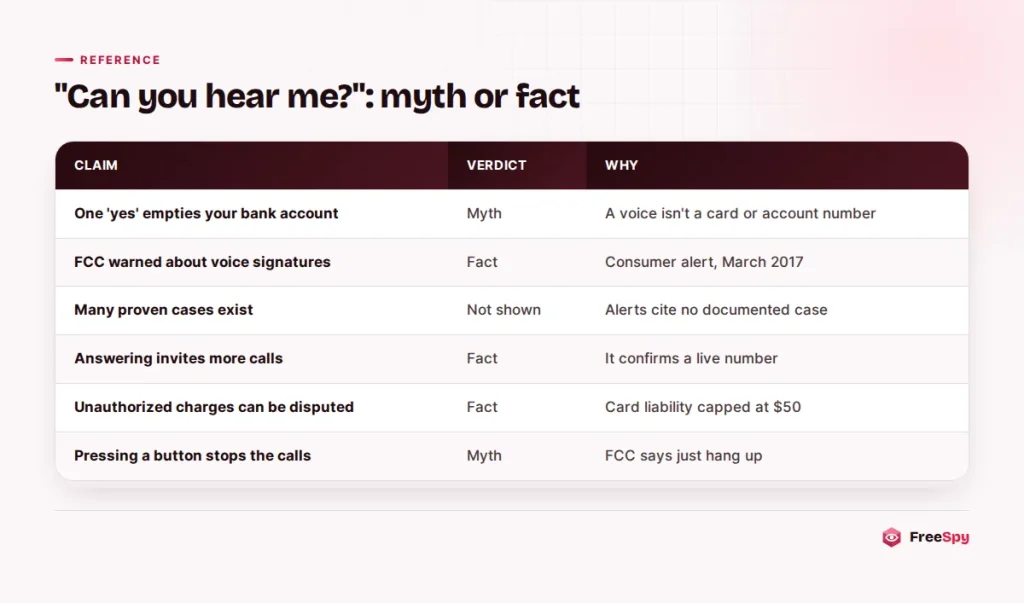
The table below sums it up. The details matter, though, because they tell you what to actually watch for.
Myth: one “yes” lets a scammer take money from your account
To charge you, a company needs a way to bill you: a card number, a bank account, or a phone number it can bill through your carrier. A recording of you saying “yes” contains none of those. If a scammer already has your card number, they don’t need your voice to misuse it. If they don’t have it, your voice won’t get it for them.
Fact: the FCC described a voice-signature risk
The FCC’s concern was that a recorded “yes” could be presented as consent for a charge. The alert tied this to “cramming,” the practice of placing unauthorized charges on bills. It told people who had answered such calls to check their bank, credit card and phone statements, and said that if you notice unauthorized charges, “you have likely been a victim of ‘cramming’.”
Myth: there are many proven cases
Neither the FCC alert nor the FTC’s 2017 post describes a specific documented case in which a recorded “yes” by itself was used to approve a charge, and we didn’t find one in other official sources. That doesn’t make it impossible. It means the dramatic version shared online goes further than the evidence.
Fact: answering has a cost
Any engagement with a robocall or scam call tells the caller your number is active and a person picks up. The FTC makes this point about “wrong number” texts: even one reply confirms a working number, which could lead to more calls and texts from scammers. A spoken “yes” does the same, which is the main reason picking up spam calls tends to bring more of them.
What the opening question is really for
Whatever the caller has planned, the line does useful work for them that has nothing to do with voice signatures.
It gets you talking. Answering a simple question feels polite, and once you’ve spoken you’re more likely to stay for the pitch.
It confirms a human. Automated dialers place enormous numbers of calls, and a live voice marks your number as worth calling again.
It covers the lag. Mass-dialed calls often start with a short delay before anyone speaks, and the question smooths over that awkward pause.
And it starts a habit of agreeing. Salespeople use a string of easy “yes” questions to build momentum before the real ask.
None of this needs special technology. It’s the same reason a door-to-door salesperson opens with a friendly question instead of a price.
Some of these calls are recordings and some are live. Either way, what follows is usually a pitch you didn’t ask for: a car warranty, a vacation, a lower interest rate, a Medicare benefit.
Same trick, different words
The famous version is only one of many. Callers use other short questions that invite a quick “yes” or confirm who you are:
- “Is this the homeowner?”
- “Are you the person who handles the electric bill?”
- “Hi, is this Maria?” (using a name linked to your number somewhere)
- “Do you still live at the address on Elm Street?”
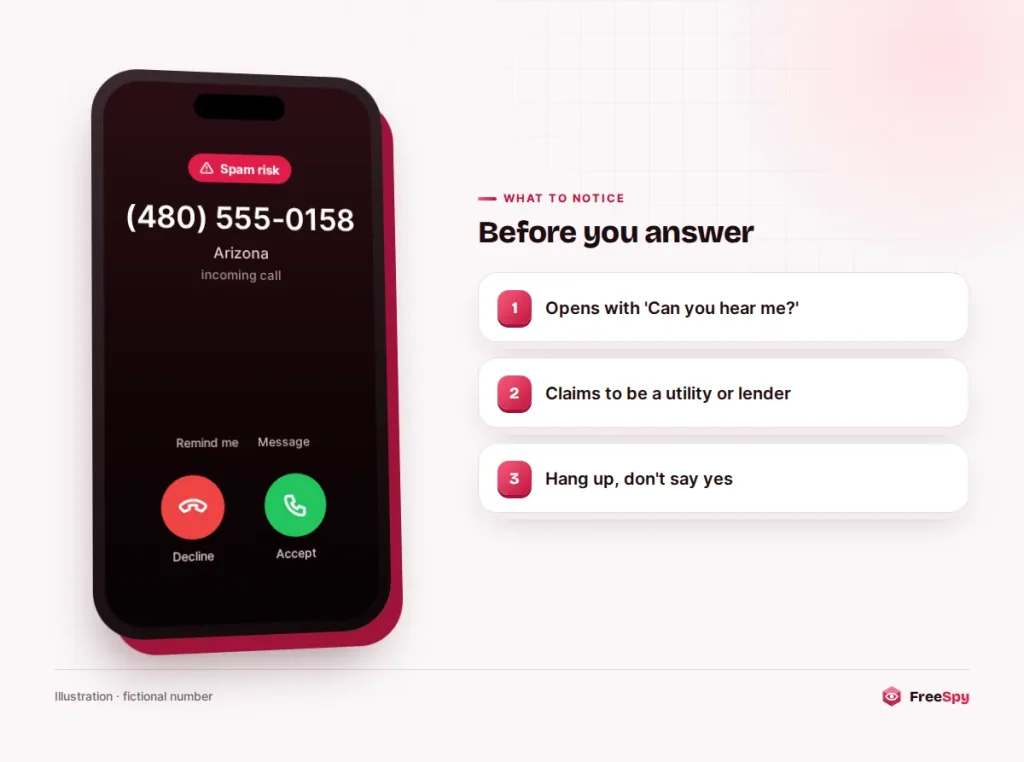
Each one gets you speaking and confirms a detail for the next step of the script. One reply handles all of them: “Who’s calling, and what is this about?” A legitimate caller can answer that in a sentence. A scripted caller usually can’t, and will either push on with the pitch or hang up.
Answer with a question, or don’t answer at all
You don’t need a special phrase. A few habits cover it.
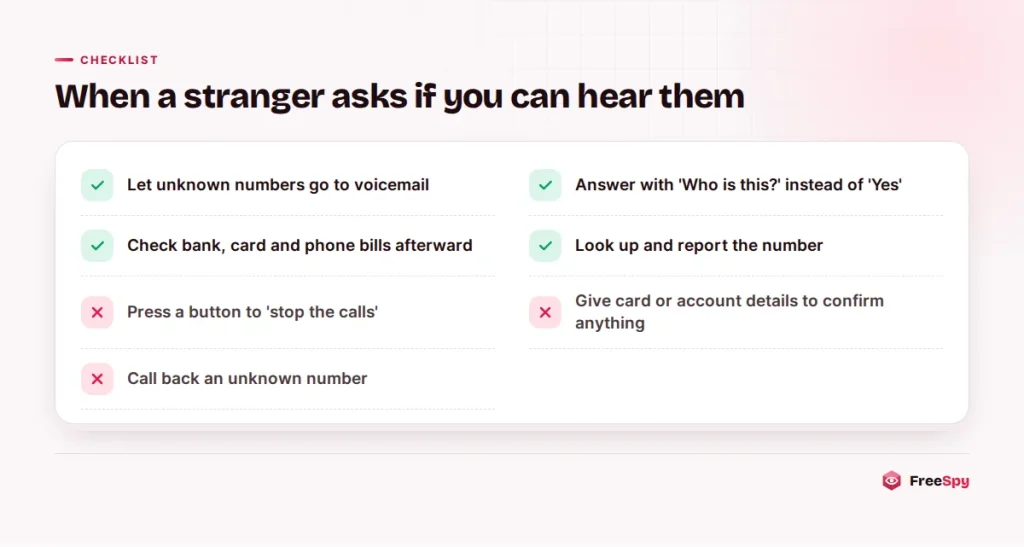
- Let unknown numbers go to voicemail. The FCC suggests this as a general protection. A real caller will leave a message.
- If you do pick up, don’t play along. Say “Who is this?” instead of “Yes,” or say nothing and let the caller speak first.
- Hang up on recordings. The FCC’s advice: if the caller, often a recording, asks you to hit a button to stop receiving calls, just hang up. Pressing a button confirms your number just as a “yes” does.
- Don’t call back a number you don’t recognize until you’ve looked it up.
- Write the number down so you can report it.
And don’t stress about whether you said “yes.” It’s a reflex, and most people have done it. What you do next matters more: hang up, and give no account details to anyone on that call.
Said yes already? Watch your statements for two months
If you answered and then realized what kind of call it was, these steps cover the real risks.
Go through your bank, credit card and phone bills for the next couple of months, as the FCC suggests. Small, unfamiliar charges with vague names are typical of cramming.
Dispute anything you didn’t authorize. For credit cards, the FTC notes that federal law limits your responsibility for unauthorized charges to $50. To use the billing-error process, the CFPB says to send a written notice to the card company within 60 days after the charge appeared on your statement.
Ask your phone carrier about any third-party charges on your phone bill, and whether you can block them altogether.
Crammed charges are easy to miss because they’re small and sound routine. On a phone bill they may sit in a section for third-party or “other” charges, labeled as a service fee, a membership or a subscription you don’t recognize. A few dollars a month adds up over a year, so read the whole bill rather than only the total at the bottom.
If someone calls back claiming you agreed to a purchase and plays a recording, don’t argue. Say you didn’t authorize it, hang up and contact your bank or carrier yourself.
Laws and card agreements vary, and these protections have conditions. For your own situation, check the official source or your card agreement, or talk to a lawyer. In Canada, contact your card issuer or phone provider directly about any charge you didn’t authorize.
Check who rang before you call back
Looking up an unfamiliar number takes a few seconds. A FreeSpy number page shows community reports from other people who got the same call, FTC Do Not Call complaint counts with robocall share and topics, and a 0–100 risk score with every factor listed.
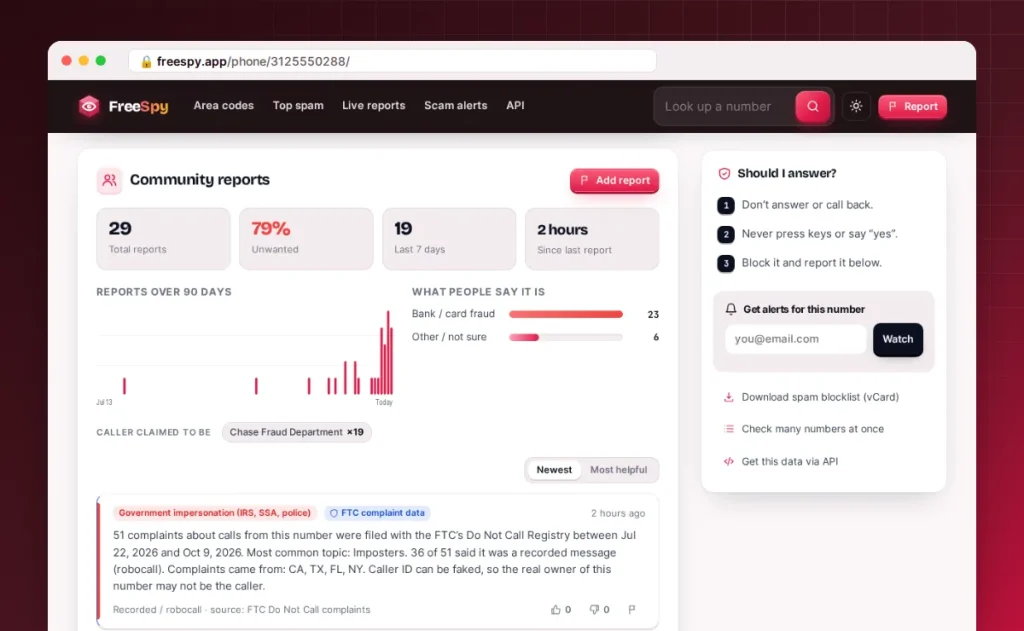
Reports often tell you what the call turned into, a warranty pitch or a fake bank alert, for example, which helps you judge whether to worry. The number shown may not belong to the caller at all, since scammers often spoof caller ID with someone else’s number.
If you got one of these calls, a short report noting the opening line helps the next person who looks that number up.
Fewer calls to begin with
Register on the Do Not Call list. In the US, use donotcall.gov or call 1-888-382-1222; in Canada, use the National DNCL at lnnte-dncl.gc.ca or 1-866-580-3625. Scammers ignore the lists, but legitimate telemarketers follow them, so the calls that still get through are easier to treat as suspect. The FTC notes that callers who don’t respect Do Not Call rules are more likely to be crooks.
Turn on spam filtering through your carrier and on the phone itself. Both iPhone and Android can silence or label unknown callers.
File complaints. In the US, report unwanted calls to the FTC at donotcall.gov or ReportFraud.ftc.gov and to the FCC at fcc.gov/complaints. In Canada, report to the National DNCL, and to the Canadian Anti-Fraud Centre if a scam is involved. The rules for robocalls spell out what callers can and can’t do without your consent.
Questions people ask
Should I stop saying “yes” on the phone?
Not with people you know. With unknown callers, answering with a question is a reasonable habit, mostly because it keeps you out of a sales script.
Could a recording of my voice be used to clone it?
Cloning works from audio samples, and longer, clearer recordings help far more than one word. If cloning worries you, public videos are the bigger exposure, and a family code word is the better defense.
Do these calls still happen?
Yes. The question is an easy way to open any sales or scam call, so it hasn’t gone away. The advice hasn’t changed either: don’t engage, hang up and check your statements.
Sources
- FCC consumer alert, March 27, 2017
- FTC consumer blog, March 2017
- FTC: Why it’s not rude to ignore “hi, how are you?” texts
- FTC: Using credit cards and disputing charges
- CFPB: How do I dispute a charge on my credit card bill?
- National Do Not Call Registry
- Canada’s National Do Not Call List
- FCC Consumer Complaint Center