United States
Alaska AK
American Samoa AS
Arizona AZ
Arkansas AR
California CA
- 209Stockton
- 213Los Angeles
- 279Sacramento
- 310Santa Monica
- 323Los Angeles
- 341Oakland
- 350Stockton
- 357Fresno
- 369Santa Rosa
- 408San Jose
- 415San Francisco
- 424Los Angeles
- 442Oceanside
- 510Oakland
- 530Redding
- 559Fresno
- 562Long Beach
- 619San Diego
- 626Pasadena
- 628San Francisco
- 650San Mateo
- 657Anaheim
- 661Bakersfield
- 669San Jose
- 707Santa Rosa
- 714Anaheim
- 738Los Angeles
- 747Los Angeles
- 760Oceanside
- 805Oxnard
- 818Los Angeles
- 820Oxnard
- 831Salinas
- 840San Bernardino
- 858San Diego
- 909San Bernardino
- 916Sacramento
- 925Concord
- 949Irvine
- 951Riverside
Connecticut CT
Delaware DE
District of Columbia DC
Florida FL
- 239Cape Coral
- 305Miami
- 321Orlando
- 352Gainesville
- 386Daytona Beach
- 407Orlando
- 448Tallahassee
- 561West Palm Beach
- 645Miami
- 656Tampa
- 689Orlando
- 727St. Petersburg
- 728West Palm Beach
- 754Fort Lauderdale
- 772Port St. Lucie
- 786Miami
- 813Tampa
- 850Tallahassee
- 863Lakeland
- 904Jacksonville
- 941Sarasota
- 954Fort Lauderdale
Georgia GA
Guam GU
Hawaii HI
Illinois IL
Indiana IN
Kansas KS
Kentucky KY
Louisiana LA
Maine ME
Maryland MD
Massachusetts MA
Michigan MI
Minnesota MN
Mississippi MS
Missouri MO
Montana MT
Nebraska NE
Nevada NV
New Hampshire NH
New Jersey NJ
New Mexico NM
New York NY
North Carolina NC
North Dakota ND
Northern Mariana Islands MP
Ohio OH
Oklahoma OK
Oregon OR
Pennsylvania PA
Puerto Rico PR
Rhode Island RI
South Carolina SC
South Dakota SD
Tennessee TN
Texas TX
- 210San Antonio
- 214Dallas
- 254Killeen
- 281Houston
- 325Abilene
- 346Houston
- 361Corpus Christi
- 409Beaumont
- 432Midland
- 469Dallas
- 512Austin
- 682Fort Worth
- 713Houston
- 726San Antonio
- 737Austin
- 806Lubbock
- 817Fort Worth
- 830New Braunfels
- 832Houston
- 903Tyler
- 915El Paso
- 936Conroe
- 940Denton
- 945Dallas
- 956Laredo
- 972Dallas
- 979College Station
U.S. Virgin Islands VI
Vermont VT
Virginia VA
Washington WA
West Virginia WV
Wisconsin WI
Wyoming WY
Canada
Alberta AB
British Columbia BC
Manitoba MB
New Brunswick NB
Newfoundland and Labrador NL
Northwest Territories NT
Nova Scotia NS
Ontario ON
Quebec QC
Saskatchewan SK
Special & international codes
Toll-free
Caribbean (billed as international)
- 242Bahamas
- 246Barbados
- 264Anguilla
- 268Antigua and Barbuda
- 284British Virgin Islands
- 345Cayman Islands
- 441Bermuda
- 473Grenada
- 649Turks and Caicos
- 658Jamaica
- 664Montserrat
- 721Sint Maarten
- 758Saint Lucia
- 767Dominica
- 784St. Vincent and the Grenadines
- 809Dominican Republic
- 829Dominican Republic
- 849Dominican Republic
- 868Trinidad and Tobago
- 869St. Kitts and Nevis
- 876Jamaica
Premium rate
Personal communications
- 500Personal communications service
- 521Personal communications service
- 522Personal communications service
- 523Personal communications service
- 524Personal communications service
- 525Personal communications service
- 533Personal communications service
- 544Personal communications service
- 566Personal communications service
- 577Personal communications service
- 588Personal communications service
Every phone number in the United States, Canada and much of the Caribbean starts with a three-digit area code. Those three digits carry a surprising amount of history, a few hard rules and some traps that scammers know very well. This guide explains how area codes work, where they came from, why new ones keep appearing and what an area code can and cannot tell you about the person calling.
Key takeaways
- A North American number has three parts: the area code (NPA), the exchange (NXX) and a four-digit line number, all under country code +1.
- AT&T and the Bell System created the plan in 1947 with 86 area codes; more than 400 are in service today.
- When a region runs out of numbers, it gets a new code, now almost always as an overlay that requires 10-digit dialing.
- Not every +1 number is domestic. Codes like 809, 876 and 473 belong to Caribbean countries and are billed as international calls.
- Because of mobile phones, number porting, internet calling and spoofing, an area code no longer proves where a caller is.
What an area code is, and what the other digits mean
An area code is the first three digits of a 10-digit North American phone number. The official name is a Numbering Plan Area code, or NPA, because each code originally marked one geographic area on a map. Calls inside that area could be dialed with seven digits; calls to another area needed the code in front.
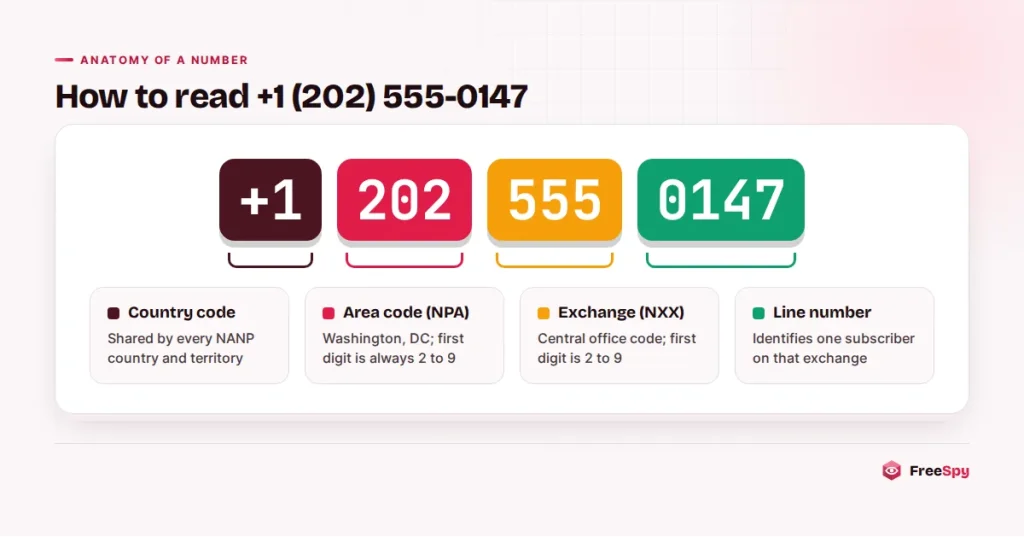
The full format is written +1 NPA-NXX-XXXX. Take the fictional number (202) 555-0147. The +1 is the country code shared by every member of the North American Numbering Plan (NANP). 202 is the area code, in this case Washington, DC. 555 is the central office code, often called the exchange or prefix. 0147 is the line number that identifies one subscriber on that exchange.
The letters in the format are not decoration. An N means any digit from 2 to 9, and an X means any digit from 0 to 9. So neither an area code nor an exchange may start with 0 or 1. That rule dates to the days when a leading 0 reached the operator and a leading 1 told the switch a long-distance number was coming. The 1 still works that way: when you dial 1 before a number, you are dialing the long-distance prefix, not part of the number itself.
The exchange matters more than most people realize. Each NXX was originally assigned to one carrier in one rate center, the small geographic zone used to decide whether a call is local or toll. That is why a lookup can tell you which phone company first received a block of numbers and roughly which town it was meant for. To use numbers more efficiently, carriers now receive them in blocks of 1,000 (NPA-NXX-X) through thousands-block number pooling, rather than a whole exchange of 10,000 at once.
How area codes began: the 1947 plan
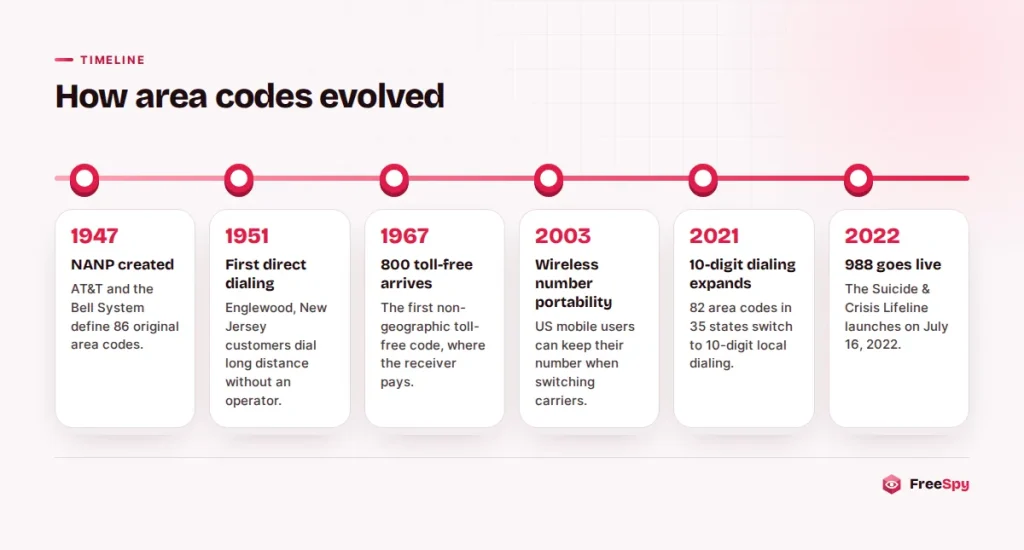
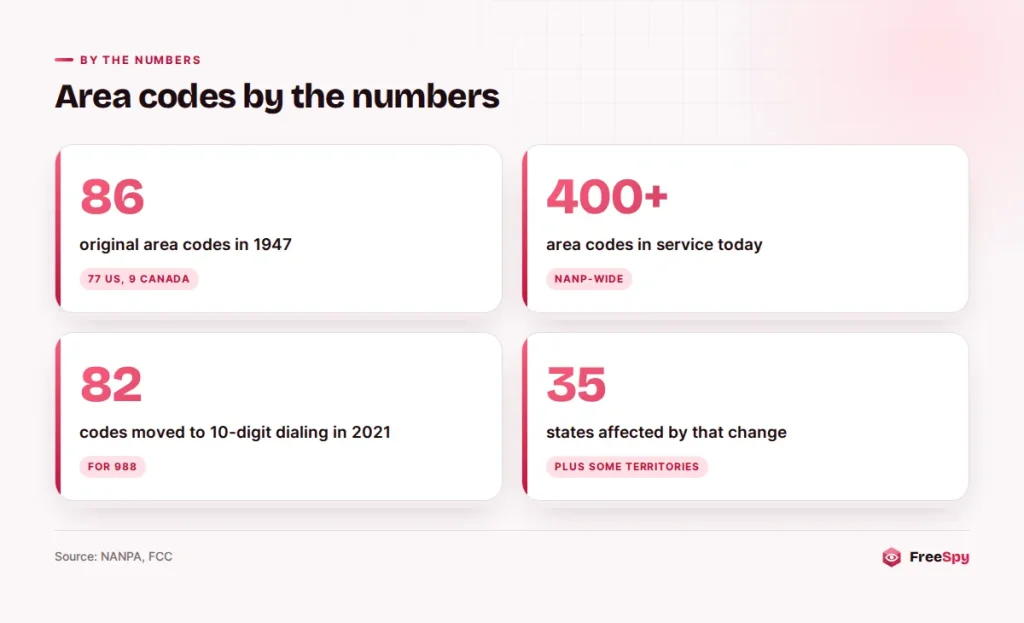
Area codes were invented to let customers, and eventually machines, route long-distance calls without a human operator. In 1947, AT&T and the Bell System drew up the North American Numbering Plan with 86 original numbering plan areas: 77 in the United States and 9 in Canada. Codes 201 (New Jersey) and 212 (New York City) were the first on the list.
The original codes followed a tidy internal logic. Every one of them had a 0 or a 1 as its middle digit. A 0 meant the code covered an entire state or province, as 201 then did for New Jersey. A 1 meant the state was split into more than one area, as with 212 for New York City and 312 for Chicago. Because no exchange code used 0 or 1 in the middle position back then, switching equipment could look at the second digit and know immediately whether it was handling a local seven-digit number or a long-distance call.
There was a physical logic too. On a rotary phone, higher digits take longer to dial (a 0 counts as ten pulses). The busiest cities received the codes that were quickest to dial: 212 for New York, 213 for Los Angeles, 312 for Chicago, 313 for Detroit, 214 for Dallas and 202 for Washington, DC. Rural regions that placed fewer long-distance calls ended up with slower codes containing higher digits.
At first, only operators dialed area codes. The first customer direct distance dialing arrived on November 10, 1951, in Englewood, New Jersey, where subscribers could place certain long-distance calls without asking an operator. Direct dialing spread across the continent over the following decades.
The 0/1 rule eventually became a bottleneck. By the mid-1990s, codes in that format had nearly run out, and new codes began using any middle digit. Since then the middle digit carries no meaning.
Who runs the North American Numbering Plan
No single company owns area codes anymore. Numbering is a shared public resource managed by neutral administrators under government oversight.
- NANPA, the North American Numbering Plan Administrator, handles day-to-day administration of area codes and exchange codes in the United States. It works under the authority of the FCC, the Federal Communications Commission.
- The CNA, the Canadian Numbering Administrator, manages Canadian numbering resources under the CRTC, the Canadian Radio-television and Telecommunications Commission.
- In the US, state public utility commissions usually make the local decisions about when a region needs relief and whether it gets a split or an overlay. In Canada, those decisions run through the CRTC.
- Caribbean members of the plan have their own telecom regulators, who manage the numbers inside their codes.
Carriers apply to these administrators for number blocks, and exhaustion forecasts and relief planning happen at this level. That is why a new area code is announced long before it goes live.
Which countries share +1, and why some +1 calls cost more
The NANP is not just the US and Canada. It covers the United States and its territories, Canada, Bermuda and many Caribbean nations, roughly 20 or more countries and territories in all, every one of them sharing country code +1. Each member has one or more area codes of its own. A few examples:
| Area code | Country or territory | Billed as |
|---|---|---|
| 787 / 939 | Puerto Rico (US territory) | Usually domestic |
| 441 | Bermuda | International |
| 268 | Antigua and Barbuda | International |
| 284 | British Virgin Islands | International |
| 473 | Grenada | International |
| 649 | Turks and Caicos Islands | International |
| 664 | Montserrat | International |
| 767 | Dominica | International |
| 809 / 829 / 849 | Dominican Republic | International |
| 876 | Jamaica | International |
Sharing a numbering plan only means sharing a dialing format. It does not mean sharing a phone network or a price list. Jamaica, the Dominican Republic and Grenada are separate countries with their own carriers, and calls to them cross an international border. Your carrier bills them at international rates, which can be steep on plans that do not include international calling.
That gap between how a number looks and what it costs is the engine behind the one-ring scam. The FCC has warned about calls from codes such as 268, 284, 473, 649, 664, 767, 809, 829, 849 and 876 that ring once and hang up, hoping you will call back and run up international connection fees and per-minute charges. Our guide to the one-ring callback scam covers the pattern in detail. The short version: if you do not know anyone in the Caribbean, do not return a missed call from a Caribbean code.
Why area codes run out
An area code has a fixed number of possible exchanges, and not all of them are usable: service codes, test numbers and reserved blocks take some. For decades, every carrier in every rate center also received a full exchange of 10,000 numbers even if it only needed a few hundred.
Then demand exploded. Households added lines for fax machines and dial-up modems, businesses bought pagers, and mobile phones put a number in almost every pocket. Every new carrier needed its own exchanges in each rate center, and codes that had lasted decades were suddenly forecast to run dry.
Thousands-block pooling was the fix for the waste: instead of locking up 10,000 numbers, a carrier draws 1,000 at a time from a shared pool. It slowed exhaustion considerably, but it could not stop it. When a code’s remaining supply drops below the forecast need, regulators start a relief process.
Area code relief: splits vs. overlays
There are two ways to add numbers to a region. A split divides the old area geographically. One part keeps the existing code; the other part gets a new code, and everyone there has to change their number. A split preserves 7-digit local dialing, but it forces millions of people and businesses to reprint stationery, reprogram devices and tell contacts about the change.
An overlay adds a new code on top of the same geographic area. Nobody’s existing number changes; new lines simply start receiving numbers from the new code. The trade-off is that two neighbors can have different area codes, so everyone in the region must dial all 10 digits, even for a call across the street.
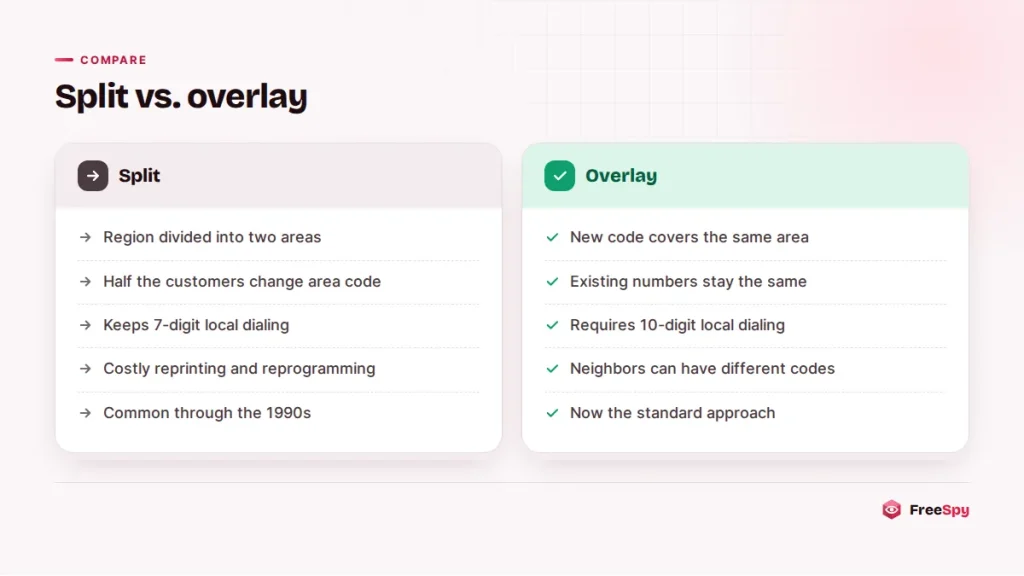
Splits were common through the 1990s. Overlays are now the norm, because changing existing numbers is far more disruptive than dialing three extra digits, and most phones store full numbers in contacts anyway. An overlay can also be repeated as often as needed, which is why some big cities now have four codes stacked on the same map.
The 988 change: 10-digit dialing everywhere it was needed
The biggest recent dialing change had nothing to do with exhaustion. Regulators chose 988 as the three-digit number for the Suicide & Crisis Lifeline in the US. In any area code that also used 988 as a local exchange, a caller dialing those three digits followed by a seven-digit local number would create a conflict for the switch.
The fix: in 2021, 82 area codes in 35 states, plus some territories, moved to mandatory 10-digit local dialing. The 988 Lifeline went live on July 16, 2022. Old alarm systems or speed-dial lists programmed with 7-digit numbers in those areas need updating.
Famous overlay families
Some of the largest cities in North America show how far overlays can stack. These families each cover the same core area, so any of the codes can belong to a neighbor:
| Region | Overlay family |
|---|---|
| Manhattan, New York City | 212, 646, 332, 917 |
| Los Angeles | 213, 323 |
| Toronto | 416, 647, 437 |
| Montreal | 514, 438, 263 |
| Vancouver area | 604, 778, 236, 672 |
Many of these families began with splits. The original 213 covered a large part of Southern California; repeated splits shrank it, and today 213 and 323 overlay the core of Los Angeles. In British Columbia, 604 once covered the whole province. Now it serves the Vancouver area, while 778, 236 and 672 also reach well beyond it.
Special and reserved codes
Not every three-digit combination is a geographic area code. The plan sets aside many codes for services, special billing or future growth. Knowing them helps you read a number at a glance.
N11 service codes
Codes in the form N11 are short dialing codes, not area codes. That is why no area code ends in 11.
- 211: community services and referrals
- 311: non-emergency city services in many cities
- 411: directory assistance
- 511: traffic and travel information
- 611: your carrier’s repair or customer service line
- 711: relay services for people who are deaf, hard of hearing or speech-disabled
- 811: “call before you dig” utility locating in the US; health advice lines in some Canadian provinces
- 911: emergency services
988 is also a three-digit service code, used for the Suicide & Crisis Lifeline in the US. Canada has since launched its own 988 crisis line.
555 numbers
Only 555-0100 through 555-0199 are officially reserved for fictional use, which is why this guide’s examples look like (312) 555-0199. Other 555 numbers have had service uses, such as 555-1212 for directory assistance. If you receive a real call showing a 555-01XX number, treat it as a red flag: no working subscriber should have one.
Non-geographic codes
- Toll-free: 800 (introduced 1967), 888 (1996), 877 (1998), 866 (2000), 855 (2010), 844 (2013) and 833 (2017). The business receiving the call pays, not the caller. See our guide to how toll-free numbers work.
- 900: premium-rate services where the caller pays an extra charge, often per minute.
- 500, 533, 544, 566, 577, 588: personal communications services, such as follow-me numbers that forward to wherever you are.
- 700: carrier-specific services.
- 710: reserved for the US government.
Codes held in reserve
Area codes in the form N9X (such as 292 or 593) are reserved for a future expansion of the plan, should North America ever need longer numbers. The 37X and 96X ranges are also held back. A number using one of these codes cannot be a working geographic number today.
Area codes and time zones
Area codes were drawn around telephone traffic, not around clocks. Most codes sit inside one time zone, but a number of them straddle a boundary, and a few regions handle daylight saving time differently from their neighbors. A sample of the tricky cases:
- 850 (Florida Panhandle): Tallahassee is on Eastern time, while Pensacola, further west, is on Central time.
- 208 (Idaho): the southern part of the state uses Mountain time; the northern panhandle uses Pacific.
- 915 (El Paso, Texas): on Mountain time, while most of Texas is on Central.
- 906 (Michigan’s Upper Peninsula): mostly Eastern, but the counties bordering Wisconsin use Central.
- Arizona codes (602, 480, 520, 623, 928): most of the state does not observe daylight saving time, though the Navajo Nation does.
- 306 and 639 (Saskatchewan): most of the province stays on Central Standard Time all year.
- 867 (Yukon, Northwest Territories, Nunavut): one code spans several time zones across northern Canada.
This matters for more than scheduling. Under the TCPA, telemarketing calls are only allowed between 8 a.m. and 9 p.m. in your local time. A caller who guesses your time zone from your area code can get it wrong, and you might have moved across the country while keeping your number. FreeSpy shows each code’s main time zone and the current local time there; in split codes, treat that as the most likely answer, not a certainty. (This is general information, not legal advice. Check the FCC or a lawyer for your specific situation.)
Why an area code no longer tells you where the caller is
For most of the twentieth century, a 312 number was a phone line physically wired into Chicago. Today the link between code and place is loose at best.
- Mobile phones travel. A 415 number may belong to someone who left San Francisco years ago.
- Numbers can be ported. Wireless number portability has existed in the US since November 24, 2003. You can move a number between carriers, so the carrier that originally received the exchange may not be the one serving it now.
- Internet calling ignores geography. Many VoIP services let you pick a number from almost any area code, wherever you live.
- Caller ID can be faked. Spoofing tools let a caller put almost any number on your screen, including one from your own area code.
An area code tells you where a number was originally assigned. It does not tell you where the caller is now, and says nothing about whether the call is legitimate. For that, you need information about the specific number: line type, community reports and complaint history. Our reverse phone lookup guide explains what each of those signals means.
How scammers exploit local area codes
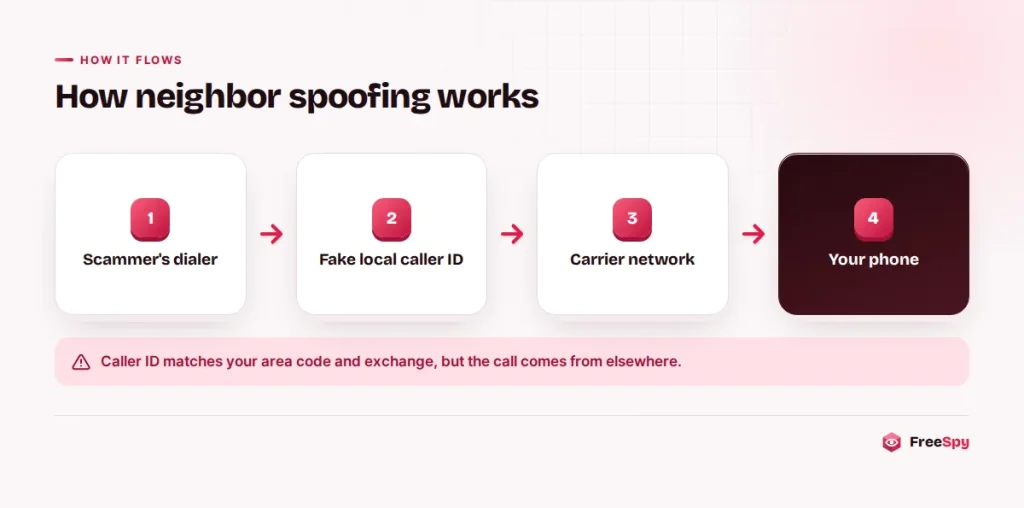
People are more likely to answer a number that looks local. Scammers know this, and they built a technique around it known as neighbor spoofing. The calling software fakes a caller ID that matches your area code, and often your exchange too, so the call looks like it comes from someone a few streets away: a school, a pharmacy, a neighbor.
The spoofed number usually belongs to an unrelated person or to no one at all, which is why people sometimes get angry callbacks from strangers saying “you called me.” If you call a spoofed number back, you either reach an innocent person or a dead line, never the scammer.
Several protections now push back on this. In the US, the Truth in Caller ID Act of 2009 makes it illegal to spoof caller ID with intent to defraud, cause harm or wrongfully obtain anything of value, with FCC fines of up to $10,000 per violation. Not all spoofing is illegal; a doctor’s office showing its main number is legitimate. The TRACED Act required carriers to deploy STIR/SHAKEN caller ID authentication, with the deadline for major US voice providers on IP networks set for June 30, 2021. In Canada, the CRTC has required STIR/SHAKEN for IP-based voice calls since November 30, 2021, and since a 2018 decision has required carriers to block calls with blatantly illegitimate caller ID, such as impossible numbers.
STIR/SHAKEN has limits. It confirms whether the caller has a right to use the number shown, not whether the call is wanted, and it does not work on older non-IP networks. A local-looking number can still reach you with a low attestation level. Our explainer on caller ID spoofing and STIR/SHAKEN goes deeper, including how carriers label and block suspect calls. (Laws change; check the FCC or CRTC for current rules, or consult a lawyer for a specific case.)
Watch for this: a call that matches the first six digits of your own number is not proof of a neighbor. It is one of the most common signs of a spoofed robocall. Let it go to voicemail.
How to use FreeSpy’s area-code directory and pages
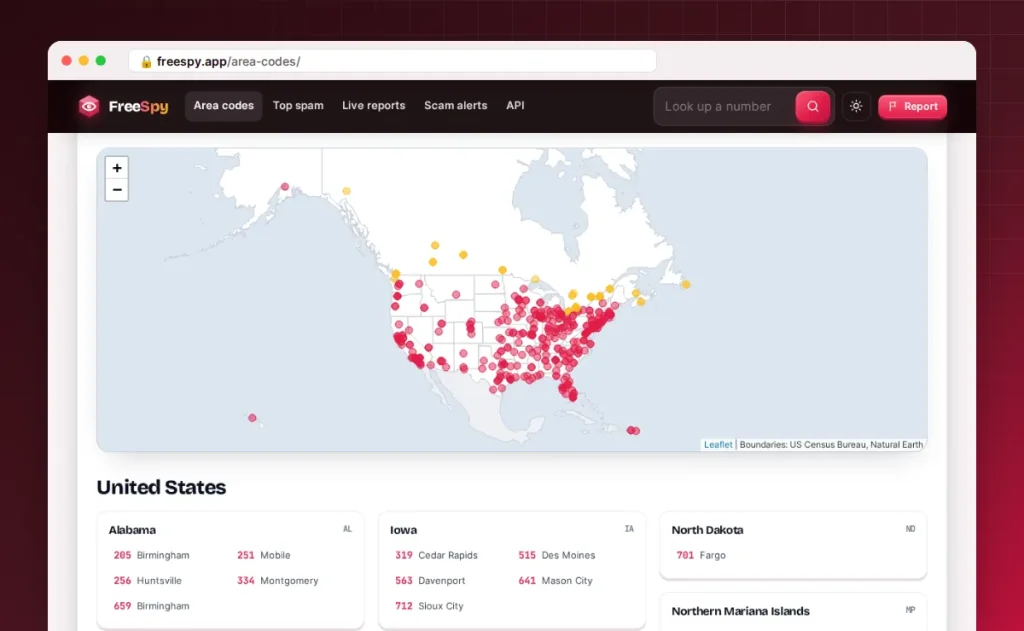
The interactive directory at the top of this page lists more than 400 NANP area codes, including non-geographic ones, on a single map. You can type a code, city, state or province into the filter box, or switch between all codes, United States and Canada. Below the geographic codes is a separate group of special and international codes: toll-free, Caribbean (billed as international), premium rate and personal communications.
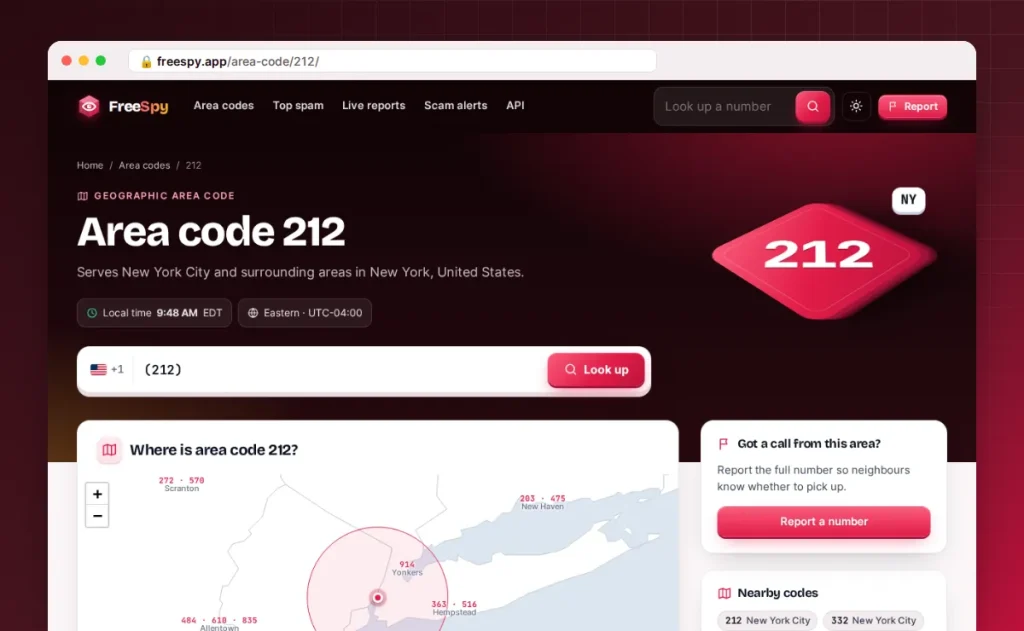
Every code has its own page at an address like /area-code/212/. Each page shows:
- the region, main city and a list of cities and towns the code serves
- the code’s time zone and the current local time there, flagged when it is late at night
- the number type: geographic, toll-free, Caribbean, premium or personal communications
- overlay codes that share the same region, so you know a call from a sibling code is equally “local”
- a map of the area and a list of nearby codes
- the most-reported numbers in that code over the last 30 days, and the latest community reports
- a search box already filled with the area code, so you can finish typing the number you want to check
An area-code page gives you context; a number page gives you an answer. Look up a full number from the FreeSpy home page to see whether it is valid under NANP rules (impossible numbers are flagged as likely spoofed), the original carrier and rate center of its exchange, community reports, FTC Do Not Call complaint counts and a 0 to 100 risk score with every factor listed. The top spam numbers page shows which numbers are trending across all area codes.
Quick reference: major metro area codes
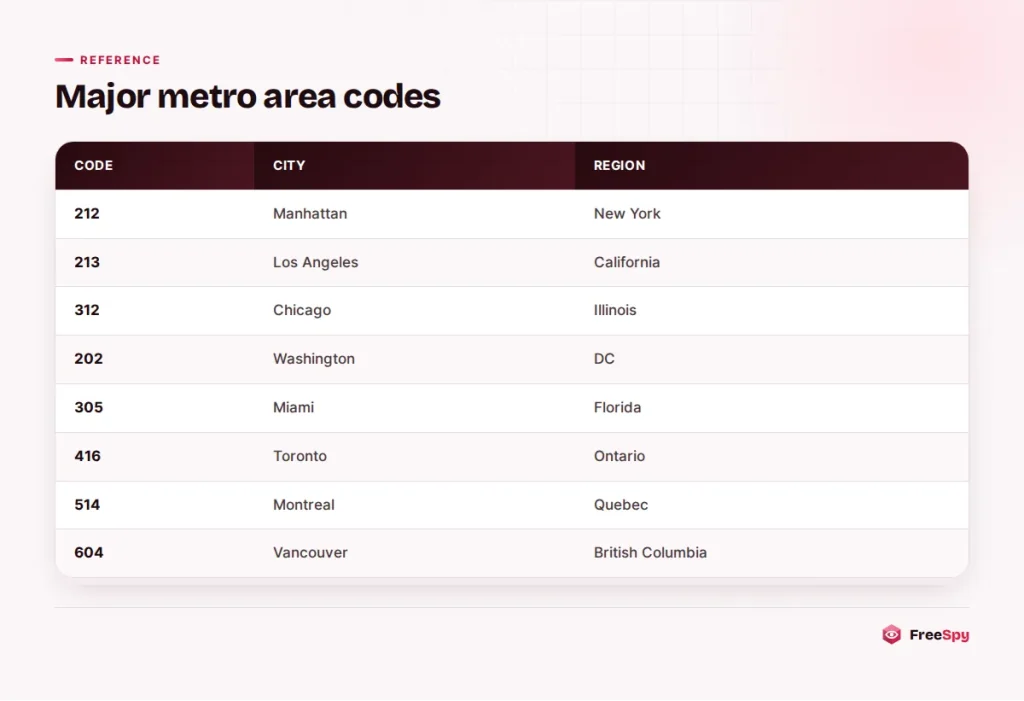
These are the anchor codes for some of the largest cities in the US and Canada. Many now have overlays, so a number from the same city may carry a different code.
| Area code | Main city | State or province |
|---|---|---|
| 212 | Manhattan, New York City | New York |
| 213 | Los Angeles | California |
| 415 | San Francisco | California |
| 312 | Chicago | Illinois |
| 313 | Detroit | Michigan |
| 202 | Washington | District of Columbia |
| 305 | Miami | Florida |
| 617 | Boston | Massachusetts |
| 713 | Houston | Texas |
| 214 | Dallas | Texas |
| 404 | Atlanta | Georgia |
| 206 | Seattle | Washington |
| 416 | Toronto | Ontario |
| 514 | Montreal | Quebec |
| 604 | Vancouver | British Columbia |
| 403 | Calgary | Alberta |
| 613 | Ottawa | Ontario |
Notice that the 1947 big-city codes (212, 213, 312, 313, 214, 202) all have a 1 or 0 in the middle. For any code not listed here, use the directory at the top of the page.
What to do when an unfamiliar area code calls
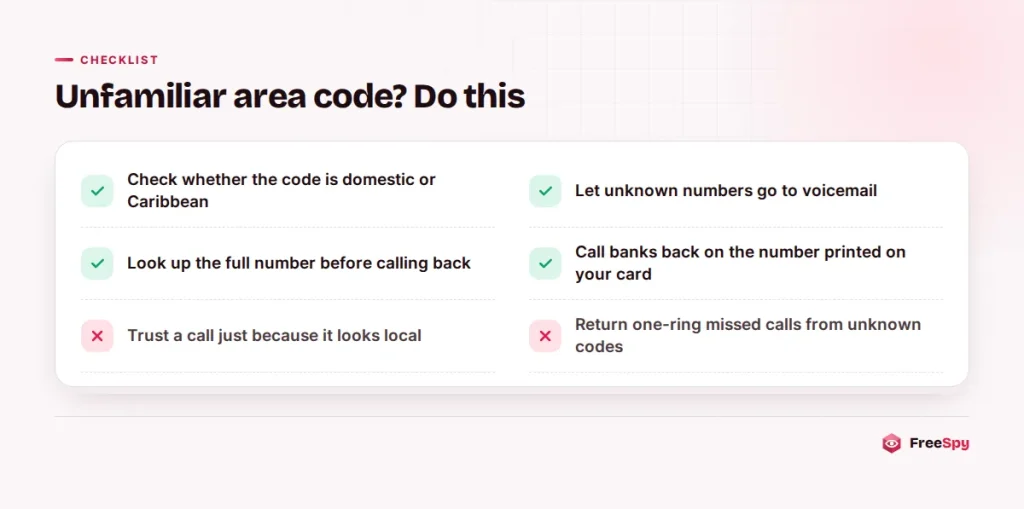
An area code alone cannot tell you whether to answer, but it can tell you how careful to be. A short routine handles most cases:
- Check whether it is domestic. If the code belongs to a Caribbean country and you do not know anyone there, do not call back.
- Be suspicious of near-matches to your own number. A caller ID sharing your area code and exchange is a classic neighbor-spoofing sign.
- Let unknown numbers go to voicemail. Legitimate callers leave messages; most robocalls do not.
- Look up the full number, not just the area code, before calling back.
- If a caller claims to be a bank or agency, hang up and call the number printed on your card, statement or the official website.
- Report the number on FreeSpy’s report page so others in that area code get a warning, and file a complaint with the FTC or, in Canada, the Canadian Anti-Fraud Centre at 1-888-495-8501.
Frequently asked questions
Can I choose my area code?
Usually your carrier assigns a number from the area where you sign up. Many carriers let you request a specific area code if numbers are available in that rate center, and many internet-based phone services let you pick a code from almost anywhere. You can keep your number, and its area code, when you move or switch carriers.
Why do I have to dial 10 digits for a local call?
Either your area has an overlay, so neighbors can have different area codes, or your code was one of those that moved to 10-digit dialing in 2021 to make room for 988. In both cases the switch needs the area code to know which number you mean.
Is a call from my own area code safer than one from far away?
No. Neighbor spoofing deliberately fakes local numbers because people trust them. Judge the call by what the caller asks for, not by the number on the screen, and look up the number if you are unsure.
Is every call from 809 or 876 a scam?
No. Plenty of people in the Dominican Republic and Jamaica call friends, family and businesses in the US and Canada. The risk comes from unexpected calls, especially one-ring missed calls, from Caribbean codes you have no connection to. Calling back is billed as international.
Why doesn’t the location on my caller ID match where the person lives?
Caller ID location usually comes from the rate center where the number was first assigned. If the person moved, ported the number or uses an internet phone service, the displayed city can be hundreds of miles off.