Your phone shows a missed call from a number you don’t recognize, and there’s no voicemail. Was that the dentist’s new office line, or someone you should never talk to? Ten digits don’t look like much, but they carry more public information than most people expect.
This guide covers what that information is, where it comes from, how much of it you can trust, and how to use it to decide what to do with the call. It is written for US and Canadian numbers, which share the same +1 numbering plan.
Starting from the number instead of the name
An old paper phone book went from a name to a number. A reverse lookup runs the other way: you start with the number and work back to whatever is on record about it. For +1 numbers, that record falls into three groups.
The first is numbering-plan data. Every number belongs to an area code and an exchange that were assigned to a region and a carrier, and those assignments are public. They are about as reliable as phone data gets.
The second is network data: which carrier serves the number today, whether it’s a mobile, landline or internet (VoIP) line, and whether it has moved between carriers. This comes from commercial carrier databases.
The third is behaviour: what the number has been doing. Complaints filed with regulators, reports from people who got calls, and sudden bursts of activity all belong here.
Some websites add a fourth group, personal profiles that attach a name, address and relatives to a number. That’s a different product with its own accuracy and privacy problems, and it gets its own section further down.
Questions the lookup can answer
A good lookup settles practical things. Is this a real, possible number, or a combination that can’t exist? Is it in the US or Canada, or is it a Caribbean number that gets billed as an international call? What time is it where the area code is? Have other people reported it, and what did the caller tell them? Did anyone complain about it to the FTC?
Questions it can’t
It can’t prove who placed a particular call. Callers can display a number they don’t own, which is called spoofing, and when that happens every fact about the number describes its real owner rather than the person who rang you. That single limit shapes everything else in this guide.
A lookup also can’t see private details such as a subscriber’s account, call history or physical whereabouts. Carriers don’t publish those. A site that promises the “live GPS location” of any number is making it up.
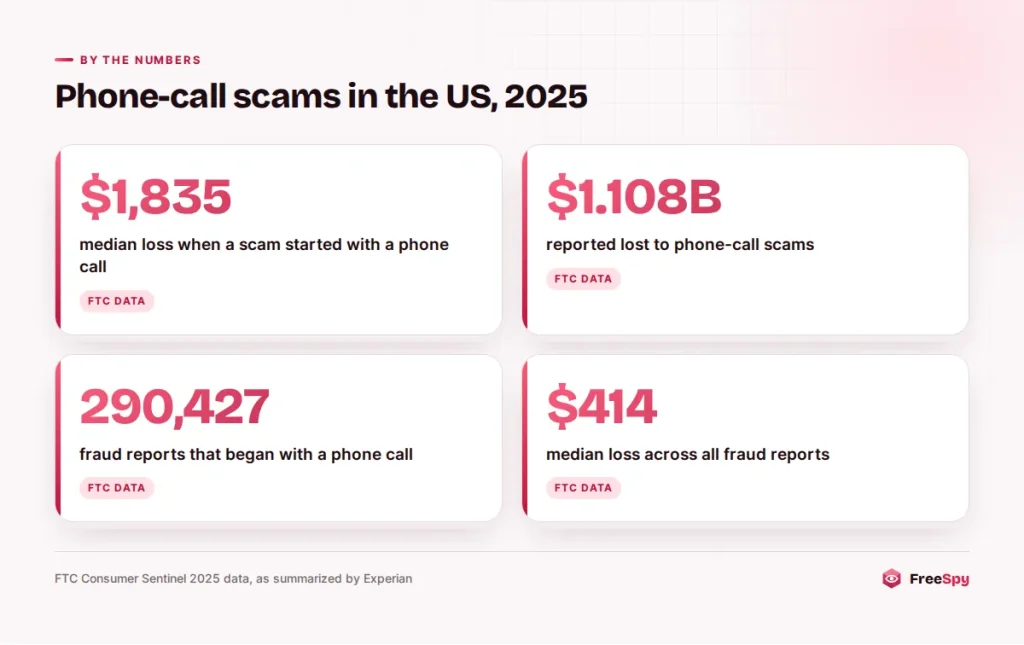
The stakes are real. Phone calls are not the most common way scams begin, but they are among the most costly. According to an Experian summary of the FTC’s 2025 Consumer Sentinel data, people filed 290,427 reports about scams that started with a phone call and reported losing $1.108 billion. The median loss on those calls was $1,835, the highest of the main contact methods and far above the $414 median across all fraud.
Reading the ten digits
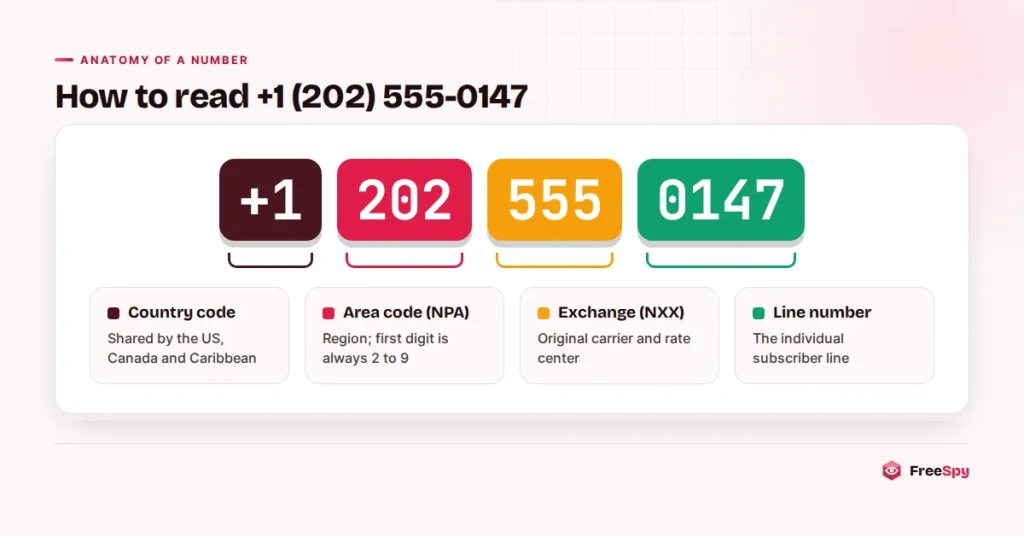
Every number in the North American Numbering Plan (NANP) has the same shape: +1, a three-digit area code (NPA), a three-digit exchange (NXX), and a four-digit line number. Each piece tells you something different.
Area code and exchange
The area code gives you the region: a state or part of one, a Canadian province, a US territory, or a Caribbean country. A few codes aren’t geographic at all. 800, 888, 833 and their relatives are toll-free, and 900 is premium-rate, where the caller pays. There are more than 400 codes in the plan, and the area code directory maps them.
The exchange narrows things down. Each one was assigned to a carrier in a specific “rate center”, usually a town or a district of a city. Carriers often receive numbers in blocks of 1,000, a practice called thousands-block pooling, so the first digit of the line number can matter as well.
Original carrier versus today’s carrier
The exchange tells you who first received the number. Since wireless number portability started in the US on November 24, 2003, people have been able to take their number to a new provider, so the original carrier is often not the one serving it now. Only a live carrier query shows the current provider and whether the number was ported.
Line type
Lines fall into four rough types: mobile, landline, fixed VoIP (tied to a service address, like a cable phone line) and non-fixed VoIP (an app or online service anyone can sign up for). Non-fixed VoIP numbers are cheap and quick to get, which is why they show up in so many scam calls. Plenty of honest people and small businesses use them too, so line type is a clue and nothing more.
The name on your screen
The caller name your phone sometimes displays (CNAM) comes from a database, not from the caller’s handset, and it’s capped at 15 characters. It’s whatever the number’s carrier registered. That might be a company name, a city, or nothing useful at all. Mobile numbers often have no name on file.
Complaints and reports
The FTC publishes Do Not Call complaint data each business day. Each entry includes the number that called, the date, whether it was a robocall, and a topic such as “Imposters” or “Reducing debt”.
Community reports come from people who got the calls. They say who the caller claimed to be, what they wanted, and whether it was a live call, a text or a recorded message. One report is one person’s opinion. Twenty reports describing the same script are evidence.
| Data point | Where it comes from | How far to trust it |
|---|---|---|
| Area code, region, time zone | NANPA (US) and the Canadian Numbering Administrator | Very reliable for the number; says nothing about spoofing |
| Original carrier, rate center | Exchange assignment records | Reliable history, often out of date after porting |
| Current carrier, line type, porting | Commercial carrier databases | Good, refreshed when the lookup runs |
| CNAM caller name | Carrier-registered name databases | Varies; often generic or blank for mobiles |
| FTC complaints | FTC Do Not Call reported-calls data | Real complaints, but numbers may be spoofed |
| Community reports | People who got the calls | Useful in volume; one report is one opinion |
Four kinds of lookup tools, and what each is for
The same phrase covers very different services. Knowing which kind you’re using tells you how much weight its answer deserves.
Tools that judge the call
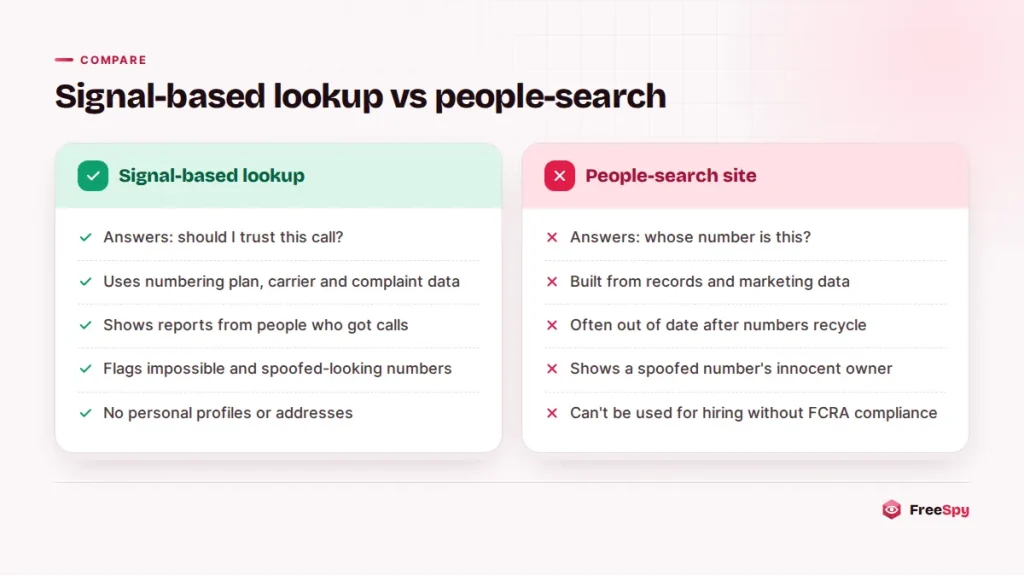
Some tools try to answer “should I trust this call?” rather than “who owns this phone?”. FreeSpy is one of these. It checks the number against numbering-plan rules and flags combinations that can’t exist, shows the area code’s region, cities and local time, the original carrier and rate center, the current carrier and line type when carrier data is available, FTC complaint counts, and community reports.
It then combines those signals into a 0–100 risk score and lists each factor with the points it added, so you can see why a number landed where it did. The full scoring method is published on the how-it-works page. It doesn’t show owners’ names or addresses and doesn’t sell personal data.
Carrier and caller-name services
Other services, often aimed at businesses, return only network data: current carrier, line type, porting status and the registered caller name. They’re accurate for what they cover, but they hold no opinion on whether a call is a scam. A spoofed call that borrows a real landline looks perfectly normal to them.
People-search and background-check sites
These sites assemble public records, marketing lists, old directory listings and social media into profiles, then tie phone numbers to names. They usually show a teaser for free and charge for the full report.
Their weak spots are well known. Numbers get recycled, so a mobile number you got last year may still be listed under its previous holder. Common names and shared family lines produce profiles that merge two different people. The person being looked up never agreed to any of it, and many people spend hours opting out of these sites one at a time.
They are also little help against scams. If a scammer spoofed a real person’s number, a people-search site will confidently show you that innocent person’s name and home address.
Search engines and messaging apps
Typing the number into a search engine in a couple of formats, such as 202-555-0147 and (202) 555-0147, costs nothing and sometimes turns up a business listing, a complaint forum or a scam warning. It works best for businesses that publish their own numbers. For mobiles and new numbers, the results are mostly other lookup sites.
Some messaging and social apps display a profile name or photo when a number is linked to an account. That can help you recognize a real contact. It proves nothing, though, because anyone can set any name and photo, and scammers build accounts specifically to look trustworthy.
Checking an unknown caller in five minutes
You don’t need special tools for this. You need a few minutes and one rule: you won’t act on anything the caller told you until you’ve confirmed it some other way.
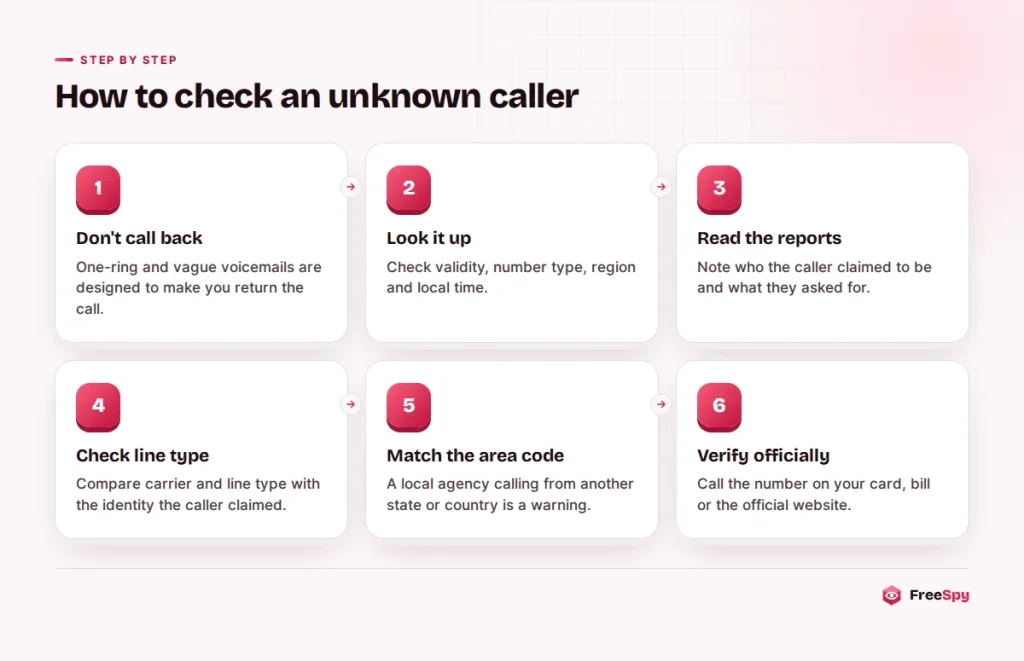
- Hold off on calling back. After a single ring or a vague voicemail, a callback is exactly what a scammer wants. Some numbers bill you; others simply confirm your line is live.
- Look the number up. Check that it’s a valid number, what kind it is, and where the area code sits.
- Read what people wrote. The comments matter more than the score. Ten reports that all mention an “Amazon refund department” tell you more than any single figure.
- Compare line type and carrier with the story. A “bank” on a non-fixed VoIP line, or a “local clinic” whose number is a mobile ported to another provider, doesn’t prove fraud. It does mean the story needs checking.
- Compare the area code with the claimed identity. Your county sheriff’s office calling from an area code three states away, or from a Caribbean code, is a story that doesn’t fit.
- Confirm through a channel you found yourself. That means the number on your card, statement, bill or the organization’s official website. Not a number the caller gave you, and not the number that called you.
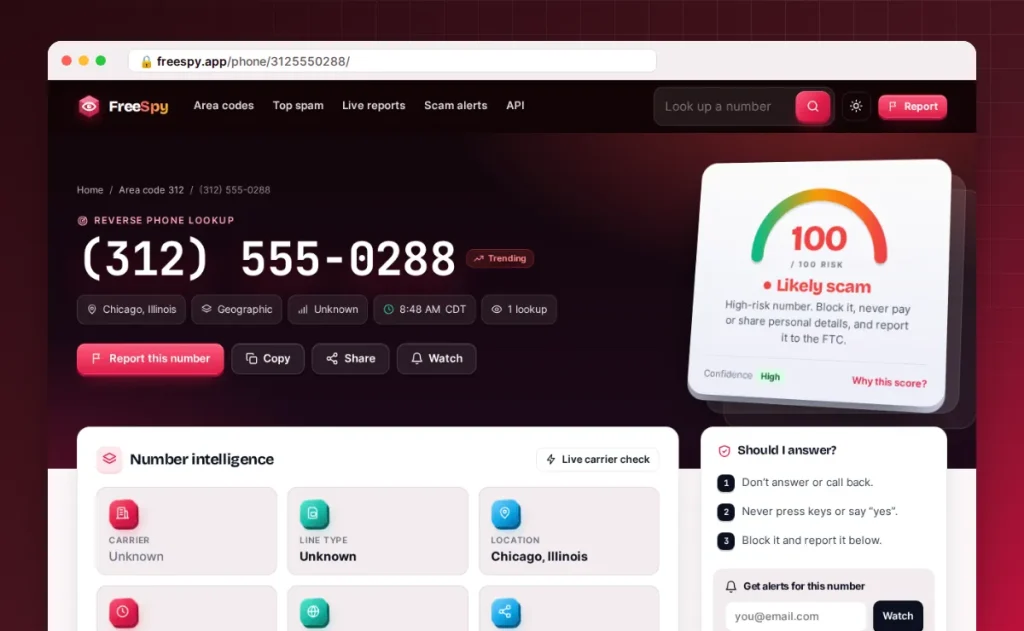
On a number page, start at the top. The verdict and score are the summary, and the factor list under them shows what drove it. Then move down to location, carrier and reports.
A page that says “No reports yet” means only that nobody has reported the number so far. Many fresh scam numbers start that way. Judge the call itself as well.
Tip: If the caller left a voicemail, write down the exact name they used and any callback number they gave, and look that callback number up too. Scammers often call from one number and ask you to ring them back on another.
Three calls, three different answers
The numbers below are fictional. The patterns are not.
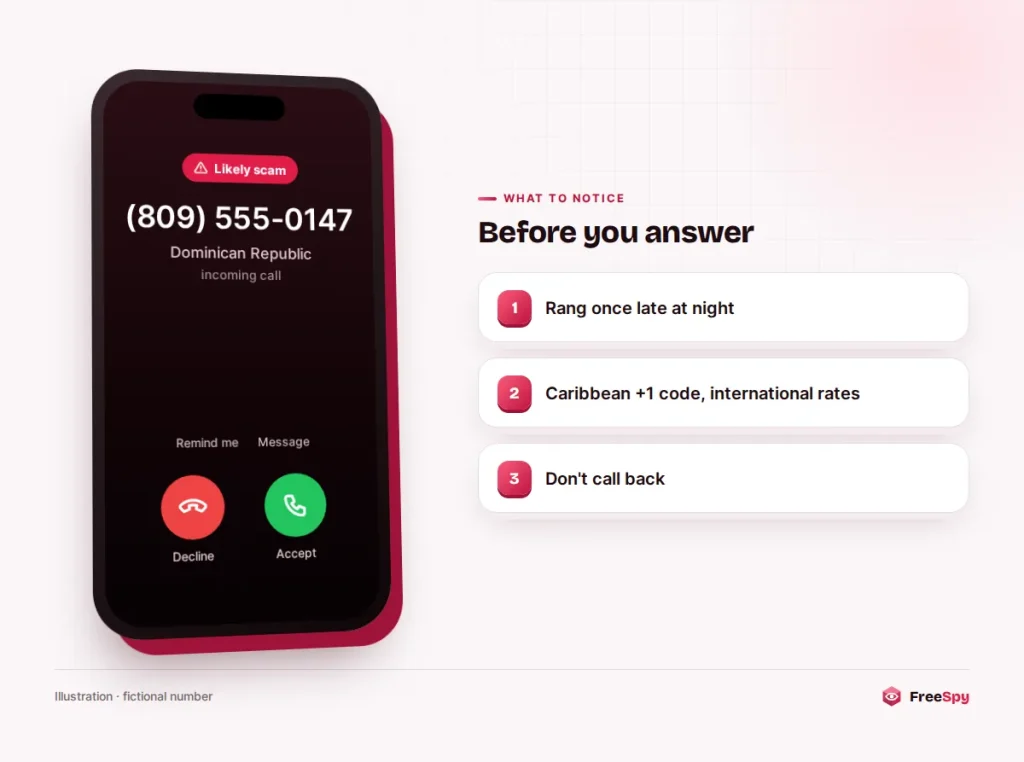
One ring at 11:40 p.m. from (809) 555-0147
Your phone rings once late at night and stops. The missed call shows (809) 555-0147, which looks like any other US number.
The lookup shows that 809 is not a US area code. It belongs to the Dominican Republic, which shares the +1 country code with the US and Canada, and calls to it are billed as international. The page flags it as a Caribbean +1 number, which adds points to the risk score by itself. The reports describe the same thing: one ring, late at night, no voicemail.
This is the “one ring” or Wangiri scam. The FCC has warned about calls from codes that look domestic but are international, including 268 (Antigua and Barbuda), 284 (British Virgin Islands), 473 (Grenada), 649 (Turks and Caicos), 664 (Montserrat), 767 (Dominica), 809, 829 and 849 (Dominican Republic) and 876 (Jamaica). Calling back can trigger an international connection fee plus per-minute charges. Don’t call back, block the number, and look over your next bill. The money side of the one-ring callback trick is worth understanding if these calls keep coming.
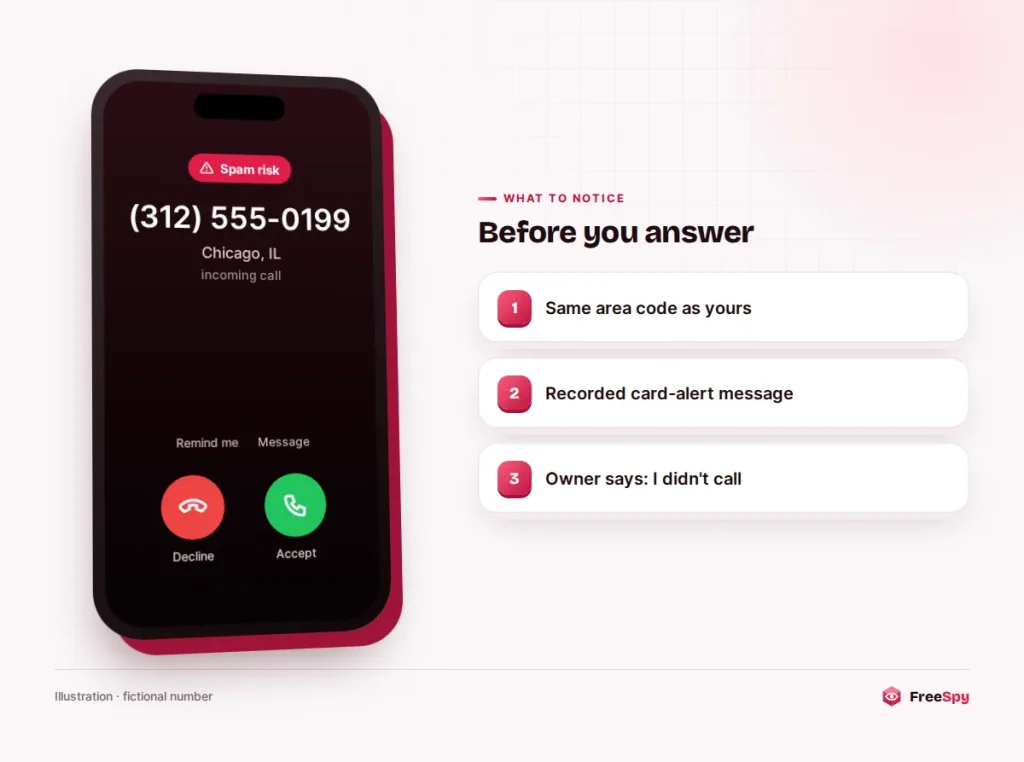
A “neighbour” calling from (312) 555-0199
Your own number is in the 312 area code. The call comes from (312) 555-0199: same area code, almost the same first digits. You answer because it might be someone nearby. A recorded voice says your “credit card account has been flagged” and asks you to press 1.
The lookup shows a valid Chicago number on a landline carrier. Nothing about the number is odd. The reports give it away: a dozen people in the past week describe a recorded message about a card, and several comments read “this is my number, I didn’t call anyone”. That’s neighbour spoofing. The scammer borrowed a real local number, and its owner is now fielding angry callbacks.
The claimed identity is what exposes the call, not the number. Your bank would not ask you to press 1 to “protect” an account. When you report it, describe what the recording said and note that the number looks spoofed, rather than calling the owner a scammer. Carriers have their own system for catching these, explained in the piece on spoofing and STIR/SHAKEN.
A pharmacy reminder from (614) 555-0186
An automated call says a prescription is ready and names the store’s location. It asks for no payment and no personal details.
The lookup shows a landline in the right city, a carrier consistent with a business line, and a few reports marked “Safe” that mention refill reminders. There are no FTC complaints.
Not every robocall is a scam. YouMail’s Robocall Index estimated that in November 2025, 27% of US robocalls were notifications and 16% were payment reminders.
If you want to be sure, call the pharmacy on the number printed on your label or receipt. And if a “pharmacy” ever asks for a card number to “release” a prescription, treat it as a scam however clean the number looks. When a call turns out to be legitimate, a “Safe” report saves the next person the worry.
What gives a scam call away
The strongest warning signs are in the conversation, not the digits. According to the FTC, imposter scams were the most reported fraud category in 2025, with more than a million reports and $3.5 billion lost. Many of the costliest ones open with a fake security alert, often claiming to come from a bank.
The patterns repeat:
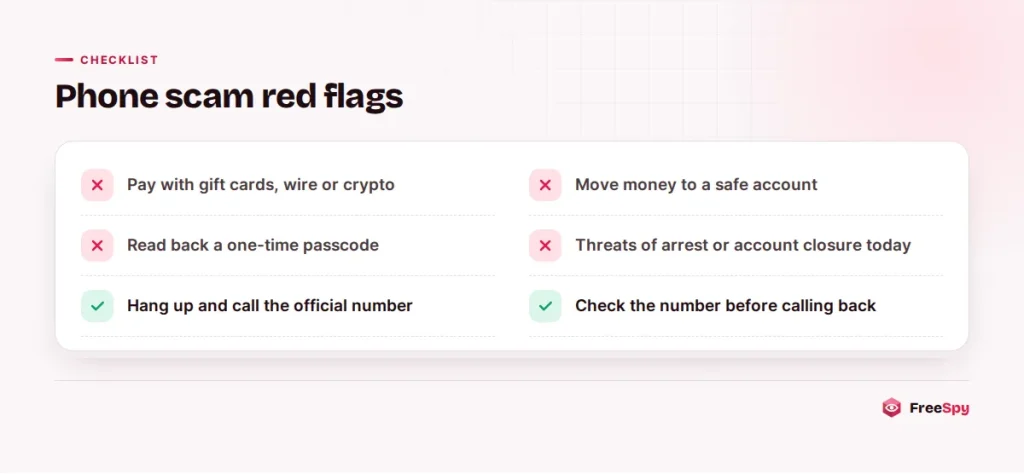
- Urgency and threats: arrest, account closure, a “suspended” Social Security number, a final notice that expires today.
- Odd payment methods, such as gift cards, wire transfers, cryptocurrency, payment apps, or cash handed to a courier. The Social Security Administration and the IRS say they never demand payment this way.
- A request to “move your money to a safe account”. No real bank or agency asks for that.
- A request to read back a one-time passcode. That code is for you alone, and anyone asking for it is trying to get into your account.
- A mismatch between who the caller says they are and the number’s location, line type or carrier.
- Pressure to stay on the line and keep it secret: don’t hang up, don’t call your bank, don’t tell your family.
The scripts don’t stop at the border. The Canadian Anti-Fraud Centre counted 2,167 reports in 2025 of scammers posing as bank or police “fraud investigators”, with $28.3 million in reported losses.
Where the law draws lines
Looking up a number that called you is normal and legal. The limits apply to what you do with the results.
In the US, the Fair Credit Reporting Act (FCRA) governs “consumer reports” used for decisions about employment, housing, credit and insurance. Most people-search sites state in their terms that they are not consumer reporting agencies and that their results can’t be used for those decisions.
So if you’re screening a job applicant or a tenant, you need a background-check provider that follows the FCRA. That includes getting the person’s consent and giving them a way to dispute errors. Using a cheap people-search report instead can expose you to legal trouble.
Other limits apply as well. Using lookup results to harass, stalk or threaten someone is illegal. Spoofing your own caller ID with intent to defraud or cause harm is illegal under the Truth in Caller ID Act, with FCC fines of up to $10,000 per violation. Spoofing for legitimate reasons, such as a clinic showing its main number, is allowed. Canada has its own privacy and consumer protection laws, set federally and by the provinces.
Not legal advice: This section is a general overview. For a specific situation, check the official sources (the FTC and CFPB in the US, the Office of the Privacy Commissioner in Canada) or speak with a lawyer.
The same logic protects your own number. If reports about it are unfair, or came from calls someone else spoofed, you can submit a removal request. After verification, those reports are hidden and the page is taken out of search results.
After the lookup: block, report, file
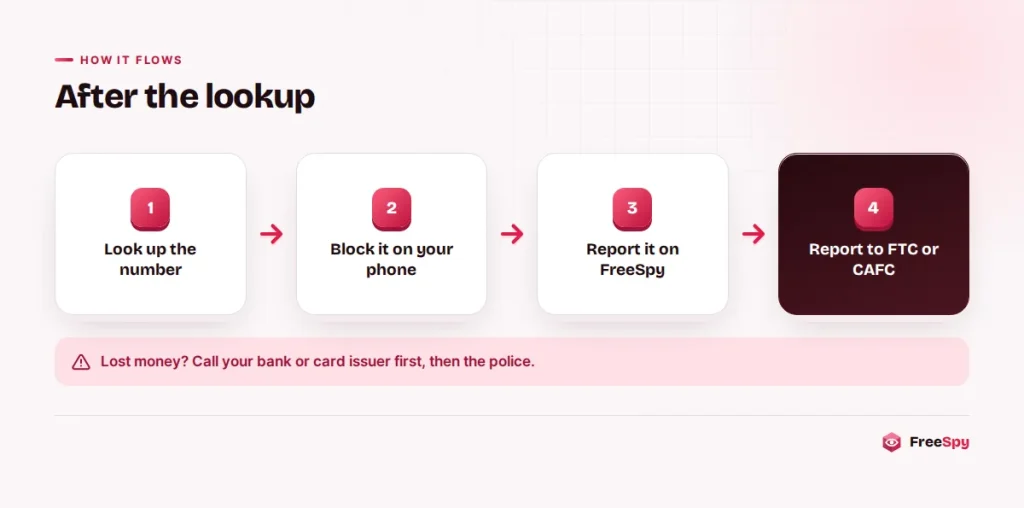
A lookup only earns its keep if it changes what you do next. This order works for most unwanted calls.
- Block the number in your phone’s settings or your carrier’s app. Blocking one spoofed number won’t end the campaign, but it stops that number.
- Add a community report with a rating, a category and a short description of what the caller said. It feeds into the number’s score and warns whoever looks it up next.
- Report fraud to the FTC at ReportFraud.ftc.gov, especially if you lost money or shared personal information.
- File a Do Not Call complaint at donotcall.gov if it was an unwanted sales call and your number has been on the registry for at least 31 days.
- Forward scam texts to 7726 (SPAM) so your carrier can act on them.
- In Canada, report fraud to the Canadian Anti-Fraud Centre at 1-888-495-8501 or through its online system, and file telemarketing complaints with the National DNCL at lnnte-dncl.gc.ca or 1-866-580-3625.
If money already left your account, call your bank or card issuer before anything else, then the police. For spoofed calls and one-ring calls, the FCC also takes complaints at fcc.gov/complaints.
Checking numbers at work
One number at a time is fine for a person. A clinic going through a missed-call log, a support desk vetting callback requests, or a small company cleaning up a contact list needs something faster.
The bulk checker takes up to 50 pasted numbers or a CSV file and returns a table with each number’s location, line type, report count, FTC complaints and risk score, which you can export to CSV. For automated checks there is also a JSON API with keys and rate limits, covering single lookups, bulk checks, reports, trending numbers and area codes. Light use is free, and high-volume plans are listed on the pricing page.
A risk score is not a compliance check, though. If you make sales calls or send marketing texts, you still have to scrub your list against the National Do Not Call Registry (and Canada’s National DNCL) and follow the consent rules of the TCPA and Canada’s telemarketing rules.
Quick answers
Do free lookups work for mobile numbers?
Yes. Mobile numbers have an area code, exchange and carrier history like any other number. Names are harder, because mobiles are rarely listed in public directories and caller-name data for them is often missing.
Can I look up Canadian numbers?
Yes. Canadian numbers use the same +1 format, so you get the province, cities, time zone and any overlay codes. Caribbean +1 codes that are billed as international are flagged separately.
Will the person know I looked up their number?
No. A lookup reads stored records about the number. It doesn’t call or text the number, and its owner isn’t notified.
Sources
- Experian: identity theft and fraud statistics (summary of FTC 2025 data)
- FTC: testimony to the Joint Economic Committee, March 2026
- FTC: people reported losing $3.5 billion to imposter scams in 2025
- FTC: National Do Not Call Registry Data Book, FY2025
- YouMail Robocall Index
- Canadian Anti-Fraud Centre: top frauds of 2025
- FCC consumer complaints
- FTC ReportFraud
- US National Do Not Call Registry
- Canada’s National Do Not Call List