You just hung up on a scam call, or you’ve found a text that is plainly fake. Reporting it takes a few minutes. The hard part is that a dozen agencies have “fraud” or “complaint” somewhere on their websites, and it isn’t obvious which one wants what.
The short version: in the US, scams go to the FTC, unwanted sales calls to donotcall.gov, and robocall or spoofing problems to the FCC. In Canada, fraud goes to the Canadian Anti-Fraud Centre and unwanted telemarketing to the National Do Not Call List. Scam texts get forwarded to 7726 in both countries. The details below make each report count.
Save five things before you block the number
A report is only as useful as its details, so capture them before you delete anything. The FTC asks people reporting unwanted calls to include the number that received the call, the caller ID number, any number you were told to call back, and the date and time if you can. It adds that you should report the caller ID number “even if you think it might be spoofed or faked.”
Canada’s Competition Bureau gives similar advice for fraud: record who contacted you, what they wanted and when, and keep screenshots, receipts, emails and text messages. In practice:
- a screenshot of the call log showing the number, date and time
- the voicemail itself, saved or exported as an audio file, or at least its exact words
- screenshots of texts with the sender’s number visible (without tapping any links)
- a few lines on the script: who they claimed to be, what they asked for, names and amounts
- payment records if money moved: receipts, gift card numbers, transaction IDs, wallet addresses
Which office wants which report
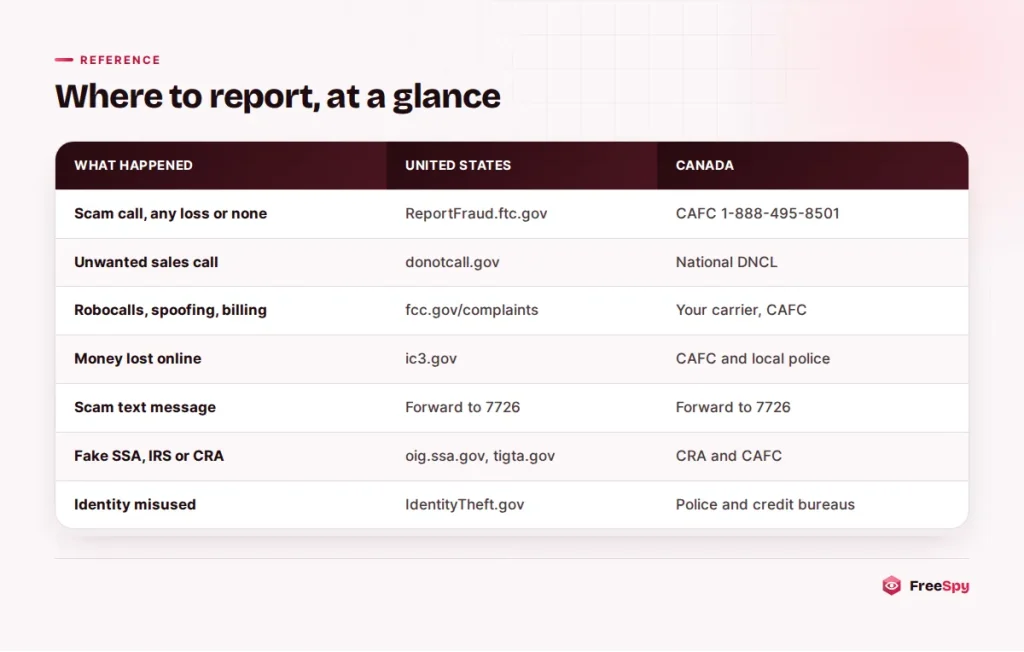
Many people file in one place and assume it reaches everyone. It doesn’t. Each agency collects reports for its own purpose, and some only handle one kind of problem. Filing in more than one place is normal. A fake Social Security call where you lost money on gift cards could reasonably go to the FTC, the SSA Inspector General, the gift card company and your local police, each for a different reason. The table gives the quick map.
In the US: five places, five jobs
The FTC, for any scam
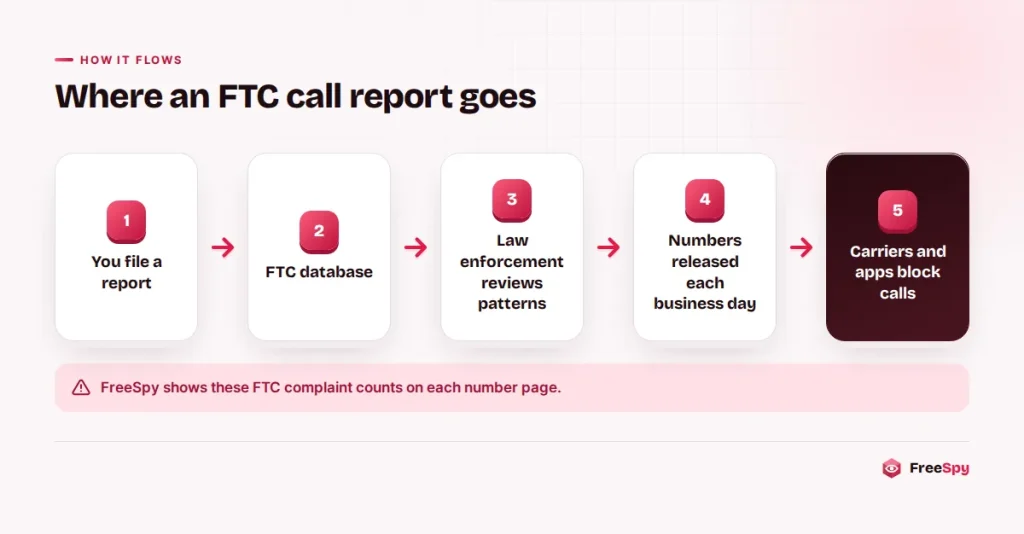
ReportFraud.ftc.gov is the main door, whether or not you lost money. According to the FTC, your report “goes into Consumer Sentinel Network, a secure national database” that is “available to local, state, and federal law enforcement.” FTC staff “review reports to spot patterns and build cases,” and use them to decide which scams to warn the public about.
donotcall.gov, for sales calls and robocalls
For telemarketing and robocalls, especially if your number is on the National Do Not Call Registry, report at donotcall.gov or call 1-888-382-1222. The FTC is frank that it “gets millions of reports each year, so we can’t respond to each one.” The reports don’t sit idle, though: “The FTC also takes the phone numbers that you report calling you and releases them each business day,” so phone companies and partners can build blocking and labeling tools. FreeSpy pulls that same public data each weekday and shows the complaint counts on each number’s page. The rules behind these complaints are covered in the TCPA and Do Not Call explainer.
The FCC, for robocalls, spoofing and phone bills
The FCC takes complaints at fcc.gov/complaints about unwanted calls and texts, caller ID spoofing, and problems such as one-ring scam charges your carrier won’t remove. It regulates phone companies, so it’s the right place when the issue involves how calls are carried or billed.
The FBI’s IC3, for money lost online
If money moved by crypto, wire or a fake website, also file with the Internet Crime Complaint Center at ic3.gov, which calls itself “the FBI’s central repository for the collection of cyber-enabled crime complaints.” Include account information, the transaction date and amount, and who received the money. Expect nothing back: “The IC3 does not conduct investigations,” and “You will not hear from the IC3.” It passes complaints to agencies that do investigate.
Agency watchdogs, for impersonation
If the caller posed as a specific agency, tell its watchdog too. Social Security impersonation goes to the SSA Office of the Inspector General at oig.ssa.gov. IRS impersonation goes to TIGTA at tigta.gov, along with the FTC.
A few other contacts are worth knowing. The FTC lists your state attorney general and local consumer protection office as places to report scams. Your carrier handles billing disputes and blocking features. Local police should hear about threats, losses or anyone who came to your door. And IdentityTheft.gov is the place to go if someone may use your personal information.
In Canada: CAFC for fraud, DNCL for sales calls
The Canadian Anti-Fraud Centre
The CAFC is Canada’s central fraud reporting point. Report through its online reporting system or by phone at 1-888-495-8501. The Government of Canada says “You should report all scams or fraud to the Canadian Anti-Fraud Centre (CAFC), even if you were not a victim.” Those reports are where national figures come from: the CAFC counted more than 112,000 fraud reports and more than $704 million in reported losses in 2025.
The National Do Not Call List
Sales calls that ignore your registration go to the National DNCL at lnnte-dncl.gc.ca or 1-866-580-3625. The CRTC manages the list and enforces the Unsolicited Telecommunications Rules, and notes that “Unwanted calls may violate these rules, even if they offer a legitimate product or service.” Fraudulent calls are a different matter; the CRTC sends people to local law enforcement or the CAFC for those.
Police
Report to local police if you lost money, were threatened or had your identity used. The Competition Bureau suggests keeping a list of every call you make to police and any file number they give you. Ask for that number before the call ends. Banks, card companies and credit bureaus will often want it when you dispute a charge or an account you didn’t open, and getting it later can take days.
Spam messages and tax impersonation
Commercial spam messages can go to the Spam Reporting Centre, and misleading marketing to the Competition Bureau. Fake tax calls have their own process: the CRA asks people to report attempts even when no information was shared, and its options are set out in the guide to checking whether the CRA is really calling.
Forwarding texts to 7726
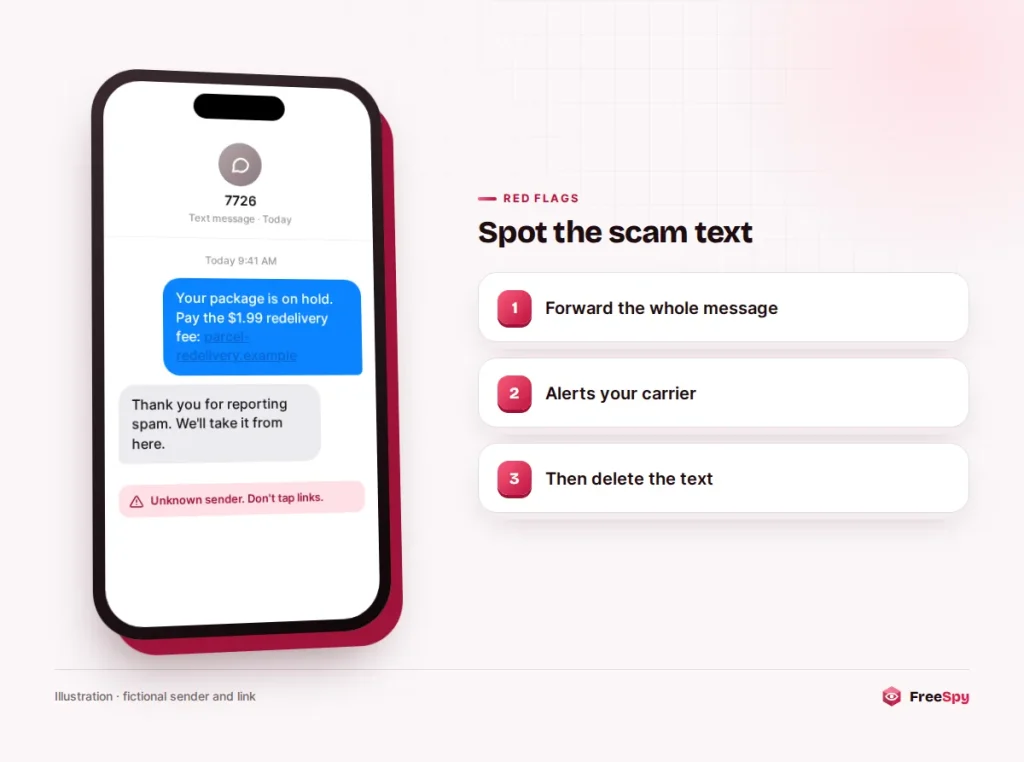
In both countries, forwarding a scam text to 7726 (SPAM) is the fastest way to flag it to your carrier. According to Get Cyber Safe, in Canada this will “alert your cellular provider to open an investigation into the contents of the message,” and reporting is free. In the US, the FTC also recommends the “report junk” option in Apple Messages or Google Messages.
Once it’s forwarded, delete the text so nobody in the house taps it later.
A report an analyst can use
Reports are read by analysts and searched by investigators. Plain, specific facts help most. An example with fictional details:
“On March 4 at 2:15 p.m. ET, I received a call on (614) 555-0110 from caller ID (202) 555-0177. The caller said he was from ‘Social Security’ and that my number was suspended. He asked me to confirm my SSN and buy $500 in gift cards. He gave callback number (202) 555-0198. I hung up and gave no information. No money lost.”
Date, time, both numbers, the callback number, the claimed identity, what was asked for, the outcome. That’s the whole job. Leave out guesses about who is “really” behind it.
Silence afterward is normal
Neither the FTC nor the IC3 replies to individual reports. Police or the CAFC may follow up if you lost money. Your report still does work: it lands in databases used by law enforcement, shapes public warnings, and in the US the reported numbers are released each business day to help carriers and app makers block or label calls.
Reports add up, too. The FTC’s Do Not Call data book for fiscal 2025 showed which states complain most: Arizona led with 1,028 complaints per 100,000 residents, followed by Tennessee, Nevada, Illinois and Florida. Those patterns exist only because people filed.
Warning: If someone calls claiming to be from the FTC, the CAFC or a “fraud recovery” office and offers to get your money back for a fee, it’s another scam. The FTC says it “will never demand money, make threats, tell you to transfer money, or promise you a prize.”
If your personal details went to the scammer, filing reports is only part of the cleanup; the steps for locking down exposed information come next.
Putting a warning where people will see it
Government reports go into databases most people never see. A community report on FreeSpy appears the next time anyone looks up that number. No account is needed: you pick a rating (unwanted, unsure or safe), a category such as “government impersonation,” “smishing” or “one-ring,” the call type, any name the caller gave, and a short comment.
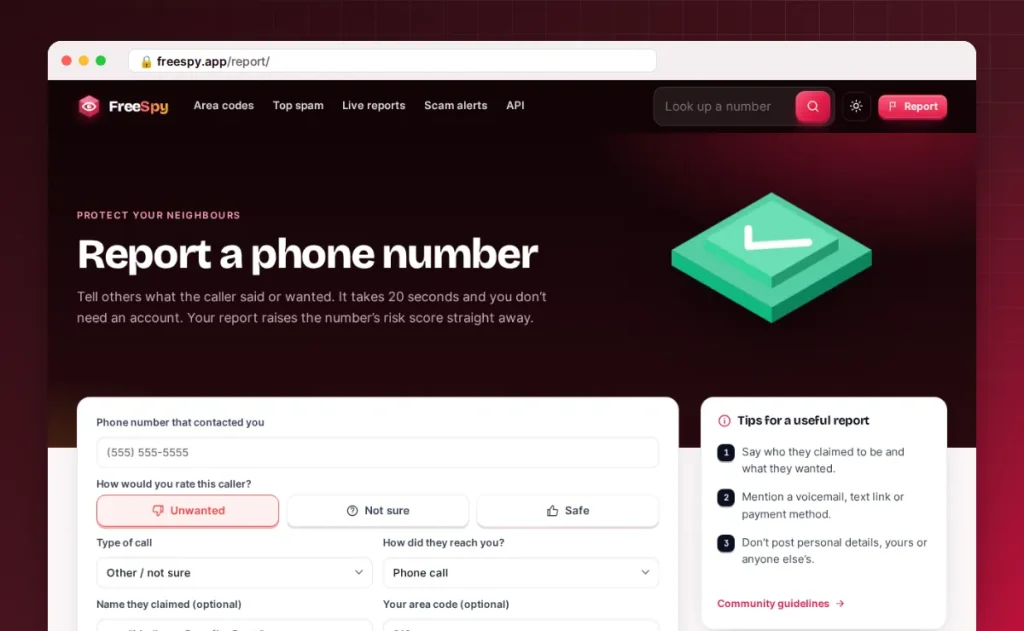
Reports feed the number’s 0–100 risk score, and each report’s weight halves every 60 days, so recent activity counts most. Rate limits and other spam protection keep the reports honest. And if scammers have spoofed your own number and it’s collecting complaints, there’s a removal request form for that.
Quick answers
I live in Canada but the scammer seemed to be in the US. Where do I report?
Report where you live, starting with the CAFC and local police, and say in your report that the caller seemed to be in the US. Include any US phone numbers, websites or payment details, since those are what investigators can follow.
The same number keeps calling. Should I report every call?
Yes, if you have the time. Each report adds a new date and time, and a cluster of fresh reports about one number is a stronger signal than a single old one.
Sources
- FTC: National Do Not Call Registry FAQs
- FTC consumer alert on reporting scams (August 2026)
- FTC: National Do Not Call Registry Data Book FY2025
- FTC Data Spotlight: Top text scams of 2024
- FCC Consumer Complaint Center
- FBI IC3: Frequently Asked Questions
- CRTC: How to protect yourself from scammers
- CRTC: Scam alerts
- Government of Canada: Scams and fraud
- Competition Bureau: How to report fraud and scams in Canada
- Get Cyber Safe: Reporting spam text messages to 7726
- Canadian Anti-Fraud Centre: Top frauds of 2025