You got a new phone number, and within a week it started getting messages for someone named Dana. A pharmacy says her prescription is ready. A dentist wants to confirm her cleaning. A debt collector would like her to call back about “an important business matter.” You’ve never met Dana, but you have her old number.
Phone numbers are a limited resource, so disconnected ones are handed out again after a waiting period, sometimes as short as 45 days. Dana’s friends, her pharmacy and her bank’s security texts haven’t caught up yet. Most of this fades within a few months, and you can speed that up with a few short replies, some caution about codes and links, and a quick check of what the number was used for before you got it.
Forty-five days between owners
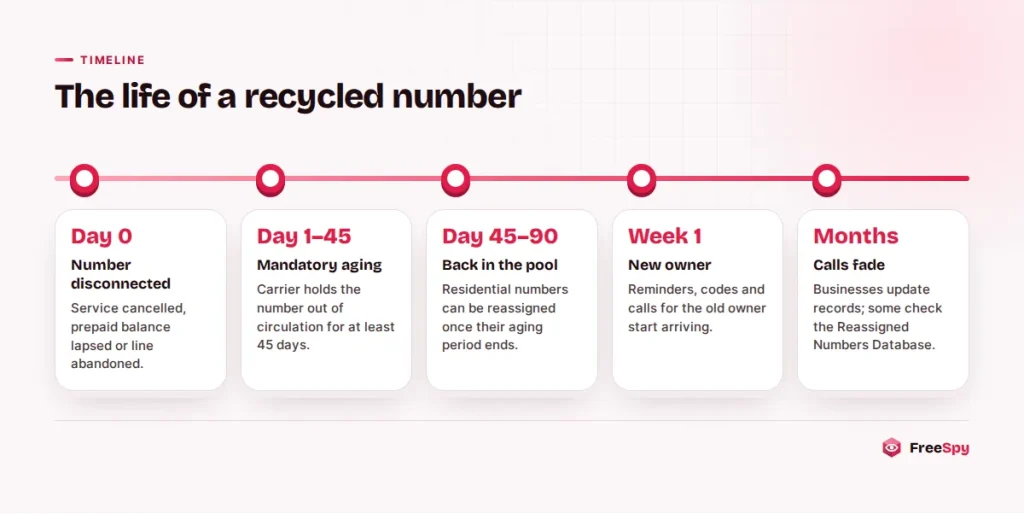
Every area code holds a limited number of seven-digit combinations, and some of them can’t be used at all. Carriers receive numbers in blocks of 1,000 and are expected to use them efficiently, so numbers don’t sit idle. When someone cancels service, lets a prepaid plan lapse or abandons a line, the number goes back into the carrier’s pool.
It doesn’t go straight to a new customer. Under FCC rules a disconnected number has to be “aged” first, held out of circulation so callers have a chance to notice the change. Numbers previously assigned to residential customers may be aged for no less than 45 days and no more than 90. Business numbers may be held from 45 days up to 365. After that, anyone can be given it.
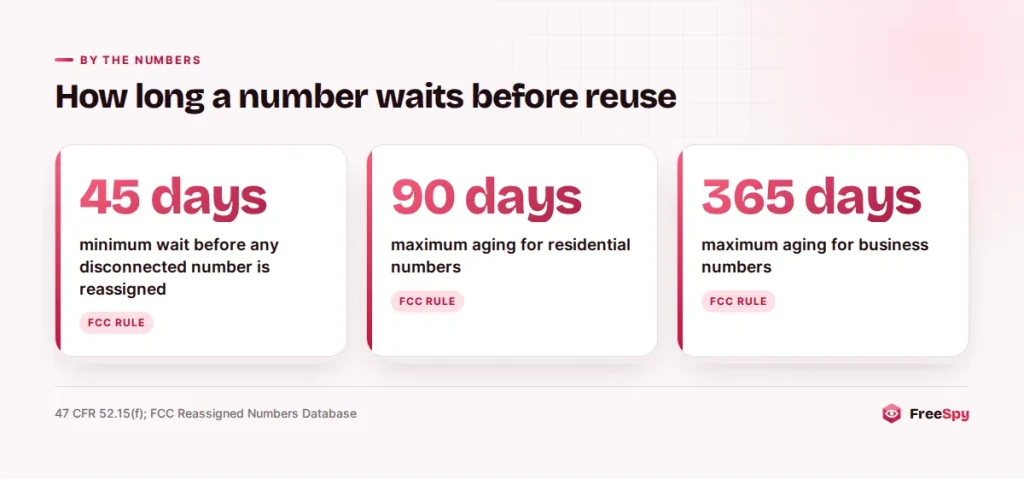
Forty-five days is not long. Few people update their number with every contact and company they deal with, so the previous owner’s life keeps arriving on your phone for weeks or months.
Pharmacies, codes and collectors: who is still trying to reach Dana
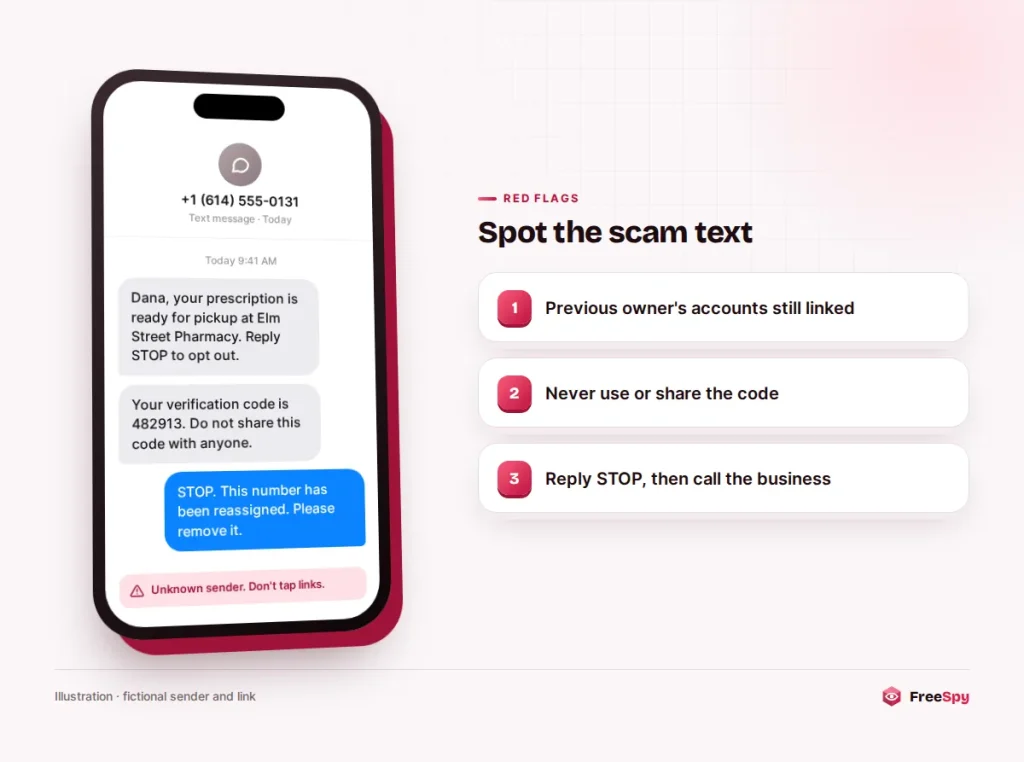
The leftovers come from predictable places. Friends and relatives who never got the new number. Pharmacies, clinics, schools, salons and stores whose systems send reminders automatically. One-time codes, password reset links and login alerts for accounts that still list the old number. Collectors and billing departments chasing an unpaid account. Marketing and political texts the previous owner signed up for years ago.
And spam. A new number that gets a flood of robocalls on day one usually has a history, which says nothing about anything you did. It was on calling lists long before it reached you, for the same reasons numbers end up on spam lists in the first place.
A database meant to stop companies calling the wrong person
For years, businesses had no reliable way to know that a number had changed hands, so they kept calling and texting whoever had it now. The FCC set up the Reassigned Numbers Database to fix that, and it went live on November 1, 2021. Callers can query it to determine whether a number may have been reassigned since the person they meant to reach gave consent to be contacted.
It’s a tool for businesses, not for you, but it matters to you because of the incentive it creates. A caller that checks the database and gets a wrong answer is protected from liability under the Telephone Consumer Protection Act, provided it can show it had consent, checked the database and was told the number hadn’t changed hands. A company that skips the check and keeps calling a reassigned number gets no such protection. This is general information, not legal advice; for a specific dispute, check the FCC’s rules or ask a lawyer.
Plenty of callers never use it, and it does nothing about friends, scammers or a small office calling by hand. That’s where your own replies come in.
One-line replies that usually end it
You don’t owe anyone an explanation, but a clear, short reply stops most of these fastest. Don’t give your own name or details while you do it.
One small change does a lot of the work for you: record a voicemail greeting that says the number is new. Something like “You’ve reached a number that was recently reassigned. If you’re trying to reach the previous owner, they no longer have this number.” People who call Dana hear it without you picking up, and many will update their contacts on the spot. You can switch back to a normal greeting after a couple of months.
Messaging apps that sign people up by phone number can carry leftovers too. If the previous owner never moved their account, contacts may still see an old profile attached to your number. Registering the app on your own phone usually replaces it, and anything still addressed to Dana can be ignored the same way as texts.
Dana’s friends and relatives
“Hi, this is a new number. Dana doesn’t have it anymore, and I don’t have her new one. You may want to delete this one from your contacts.”
Don’t pass along messages or offer to forward anything. You can’t verify who’s asking, and connecting strangers isn’t your job.
Automated reminders
Reply STOP if the message says that’s how to opt out. If reminders keep coming, call the business on the number from its own website and tell them a customer’s number has been reassigned. Pharmacies and clinics have a privacy reason to fix it quickly, since every reminder you receive is a small leak of someone else’s health information. Schools and employers usually fix it within a day once someone tells them.
Debt collectors
“I’m not the person you’re looking for and I don’t know them. This number was recently assigned to me. Please remove it from your records.”
Don’t confirm your name, address or any other detail, even to prove you’re not the person. If a collector keeps calling after you’ve told them, you can file a complaint with the Consumer Financial Protection Bureau in the US. In Canada, provincial consumer protection offices oversee collection agencies.
Codes and reset links you didn’t ask for
Do nothing with them. Don’t tap the link, don’t type the code anywhere and don’t pass it to anyone who asks for it. Using it would mean getting into another person’s account, which can be illegal, and a message asking you to share a code may be a scam aimed at you rather than a leftover of Dana’s. If alerts from one company keep arriving, contact that company through its official site and tell them the number no longer belongs to the account holder.
Warning: Not every misdirected text is a leftover. A friendly opener such as “Hi, is this Emily? We met at the conference” is a common start to romance and investment scams. Messages for a number’s previous owner are usually dull and specific; friendly wrong-number openers are built to start a conversation.
Find out what the number did before it was yours
When your carrier assigns a number, look it up before you give it to everyone. A lookup shows community reports and FTC Do Not Call complaints about the number, the area it belongs to and, when carrier data is available, its current carrier and line type. A long trail of spam reports suggests the number was used for robocalls, or by someone who annoyed a lot of people.
Many carriers will swap a brand-new number if you ask soon after activation. Policies and fees vary, so ask before you’ve updated every account.
If you decide to keep it and old reports about the previous user appear on its FreeSpy page, send a removal request. After verification, reports about the number are hidden and the page is set to noindex. Requests are reviewed within 72 hours.
Then register the number on the Do Not Call list yourself: donotcall.gov or 1-888-382-1222 in the US, lnnte-dncl.gc.ca or 1-866-580-3625 in Canada. While you’re at it, switch on your carrier’s spam filtering and your phone’s screening for unknown callers. The robocall volume usually drops over a few months once nobody answers.
Leaving a number behind without leaving a mess
Most of the trouble above starts with someone who changed numbers in a hurry. If you’re about to switch, a little preparation protects you and whoever comes next.
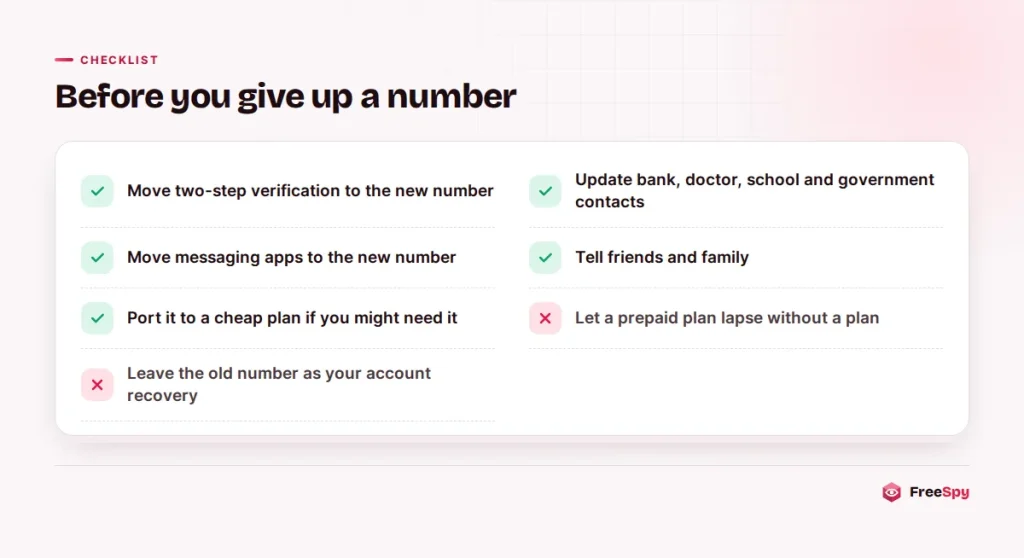
Start with security. Change the phone number on your email, bank, investment, payment and social media accounts while you can still receive codes on the old one. If a number you give up is still your recovery method, whoever gets it next may receive your password reset codes.
Then the people and places that matter: your bank, employer, doctors, pharmacy, your children’s school, insurers and government accounts. Move messaging apps that use your phone number as your identity, so the next owner doesn’t inherit your chats or contact list. A short message to friends saves them, and the next owner, some confusion.
If dozens of accounts depend on the number, porting it to a cheap plan may be easier than updating everything, because once it’s disconnected you can’t count on getting it back. And watch prepaid balances. When one runs out, the number can eventually be disconnected and recycled without you ever deciding to give it up.
Losing a number by neglect is different from having it taken. If your phone suddenly loses service and alerts about account changes start appearing, that points to a SIM swap or unauthorized port, and your carrier needs to hear from you immediately.
Things new owners ask
Does the previous owner’s Do Not Call registration carry over to me?
No. The FTC says the registry removes numbers automatically when they’re disconnected and reassigned, so you need to register again. You can check whether a number is registered at DoNotCall.gov or by calling 1-888-382-1222 from that number.
Can I ask for a number that has never been used?
You can ask, but there’s no guarantee. Numbers are reused routinely and carriers’ pools mix fresh and recycled ones. Looking up a number before you start handing it out is the practical check.
Is it a problem that I keep receiving someone else’s messages?
Receiving them isn’t something you control. Acting on them is different: using someone else’s codes or reset links to get into their accounts can be illegal. Ignore those and ask senders to update their records.
Sources
- FCC: Reassigned Numbers Database
- FCC rules on aging numbers, 47 CFR 52.15
- FTC: National Do Not Call Registry FAQs
- Consumer Financial Protection Bureau: Submit a complaint
- Canada’s National Do Not Call List