The phone rings and a firm voice says your Social Security number has been used in a crime, or that you owe back taxes and officers are on their way. The agency changes from Social Security to the IRS to the Canada Revenue Agency, and the story changes with it, but the moves underneath are the same.
No real agency threatens arrest over the phone or takes payment in gift cards, crypto, wire transfers or cash. If a caller does either, you can hang up without hearing the rest. What follows covers the main scripts in the US and Canada, how real agencies actually contact people, how to check a call in a couple of minutes, and where to report it.
$920 million lost to fake officials in a year
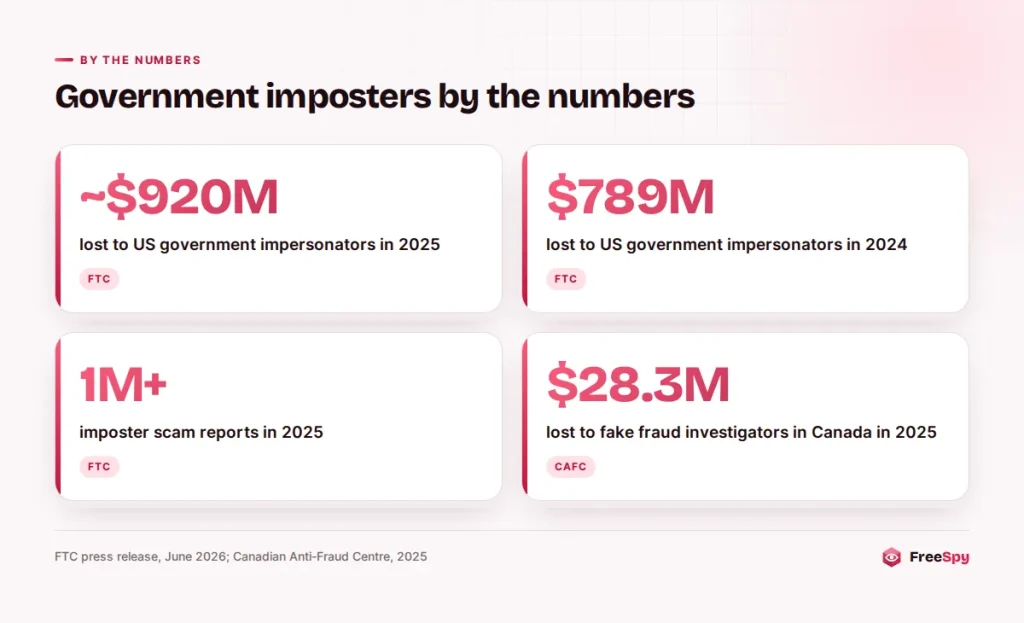
Imposter scams were the most-reported fraud category in the FTC’s 2025 data, with more than 1 million reports and $3.5 billion lost, nearly one in three fraud reports. Within that, losses to government impersonators rose to about $920 million in 2025, from $789 million the year before.
The FTC also says imposter scam losses have nearly tripled since 2020. Imposters are among the top subjects of Do Not Call complaints too, according to the FTC’s Data Book for fiscal 2025.
In Canada, one variation stands out. The Canadian Anti-Fraud Centre’s 2025 top ten includes the “fraud investigator” scam, in which callers pose as bank or police investigators. It drew 2,167 reports from 1,137 victims, with $28.3 million lost.
Five things no agency does on the phone
Whatever badge the caller claims, these moves give the game away:
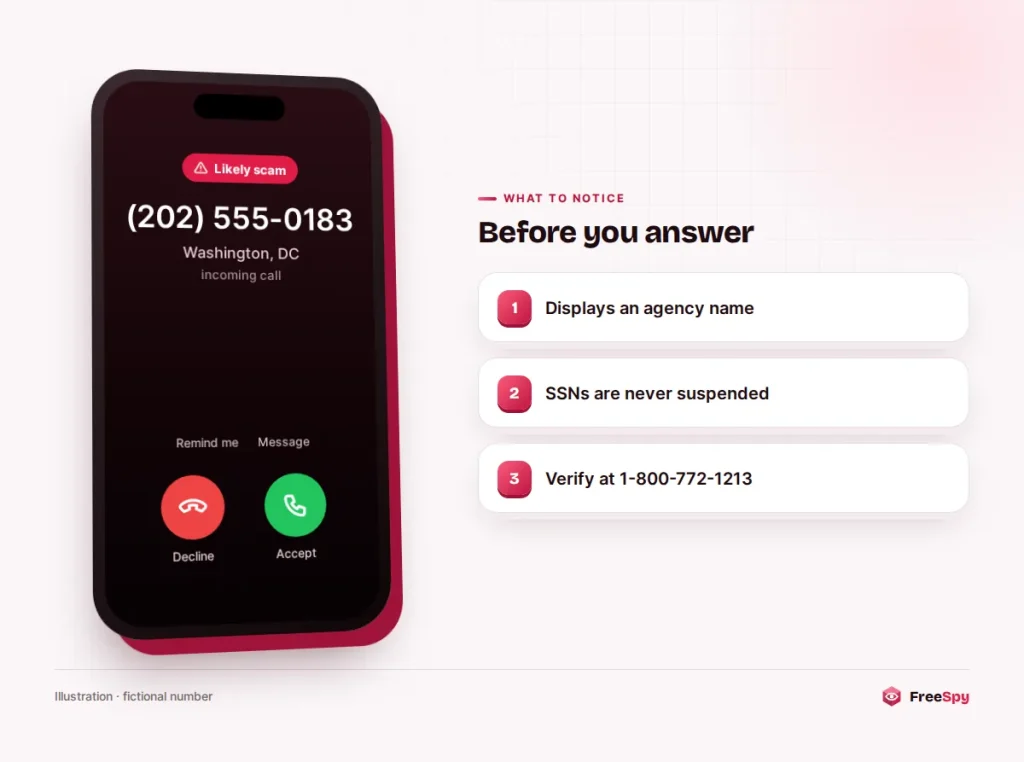
- Telling you your Social Security number has been “suspended”. SSNs are never suspended.
- Threatening arrest, deportation, a suspended licence or frozen benefits unless you act right now.
- Asking for payment by gift card, wire transfer, cryptocurrency, crypto ATM or cash pickup. No government agency collects money this way.
- Telling you to stay on the line, keep the call secret, or distrust your own bank. Real officials have no reason to isolate you.
- Pointing to the caller ID as proof. A real agency’s name and number on your screen proves nothing, because both can be faked with cheap software.
What the caller knows about you doesn’t prove anything either. The last four digits of your SSN, your address and your birth date are widely available after data breaches. Judge the call by what it asks you to do, not by what the caller already knows.
The scripts, agency by agency
Social Security Administration (SSA)
It’s often a robocall: “Your Social Security number has been suspended due to suspicious activity. Press 1 to speak to an officer.” The “officer” says your number was linked to a crime, such as a rental car found with drugs in it. To avoid arrest or “protect” your benefits, you’re told to move your savings to a “secure government account”, buy gift cards, or hand cash to an agent.
Social Security will never threaten arrest, suspend your SSN, or demand payment by gift card, wire, crypto or cash by mail. SSA may call people who already have business with it, but an unexpected call about a “suspended” number is always a scam. To check, call SSA yourself at 1-800-772-1213, or sign in to your online Social Security account.
Internal Revenue Service (IRS)
The caller says you owe back taxes and a warrant will be issued today unless you pay. Some versions threaten to revoke a driver’s licence or business licence, or to report immigrants for deportation. Payment is demanded by gift card, prepaid debit card, wire or crypto, while you stay on the phone.
The IRS usually makes first contact by mail. It won’t demand immediate payment by gift card, wire or crypto, threaten to bring in police to arrest you, or ask for card numbers over the phone. If you’re not sure whether you owe anything, check your IRS online account or call 1-800-829-1040.
Medicare
These calls claim you need a “new Medicare card”, that your benefits are about to lapse, or that you qualify for free equipment or tests. The caller asks you to “confirm” your Medicare number, Social Security number or bank details. The aim is billing fraud in your name, or plain identity theft. Some callers say a “Medicare fraud investigation” has frozen your benefits and ask you to pay to restore them.
Medicare doesn’t cold-call to sell you things, or to verify your number before mailing a card. If you’re worried, call the number printed on your Medicare card.
US Marshals, the sheriff’s office and “missed jury duty”
The caller uses the name of a real local deputy, often copied from the department’s website, and says a warrant was issued because you missed jury duty or ignored a court summons. You can clear it by paying a “bond” right now with gift cards or at a crypto ATM, or by meeting an officer who will take cash. Caller ID may show the sheriff’s real number.
Courts send jury notices by mail, and law enforcement doesn’t phone people to collect fines, let alone in gift cards. The court clerk’s office can tell you whether you were ever summoned, and its number is on the court’s official website. The missed-jury-duty warrant script has a few extra twists worth knowing if someone in your family gets this call.
Immigration officials
Immigrants and visa holders get calls claiming there’s an error in their immigration file and that they’ll be deported unless they pay a “fine” immediately. Callers may know the person’s country of origin and visa type, which makes the call more convincing.
Immigration agencies in the US and Canada handle problems with a case through official letters and your online account. They don’t collect fines by phone or gift card. Check your online account, or contact the agency through its official website.
Canada: the CRA, the RCMP and the “fraud investigator”
The Canada Revenue Agency version mirrors the IRS one: you owe taxes, police are on their way, pay today in gift cards or bitcoin. Some calls claim to come from the RCMP or a local police service and say your Social Insurance Number was used in a crime.
The “fraud investigator” script is more elaborate. A caller says they’re with your bank’s security team or the police, and that someone at your local branch is stealing from customers. They ask you to help catch the thief by withdrawing cash and handing it to a courier, buying crypto, or moving money to an account they control. It works because it flatters you into thinking you’re part of an investigation.
The CRA and police don’t demand payment in gift cards or crypto, and no bank or police force asks customers to withdraw their own money as bait. To check a tax debt, sign in to CRA My Account or call the CRA on the number on its website, and reach your bank through the number on your card. There’s more detail on checking whether the CRA is really calling, including what genuine CRA contact looks like.
Real agencies are slow and write first
The quickest way to spot an imposter is to compare the call with how government offices actually work. Real agencies are slow and paper-based. They write first, give deadlines in weeks, explain your right to appeal, and accept payment through official channels. Scammers do the opposite on each of those points.
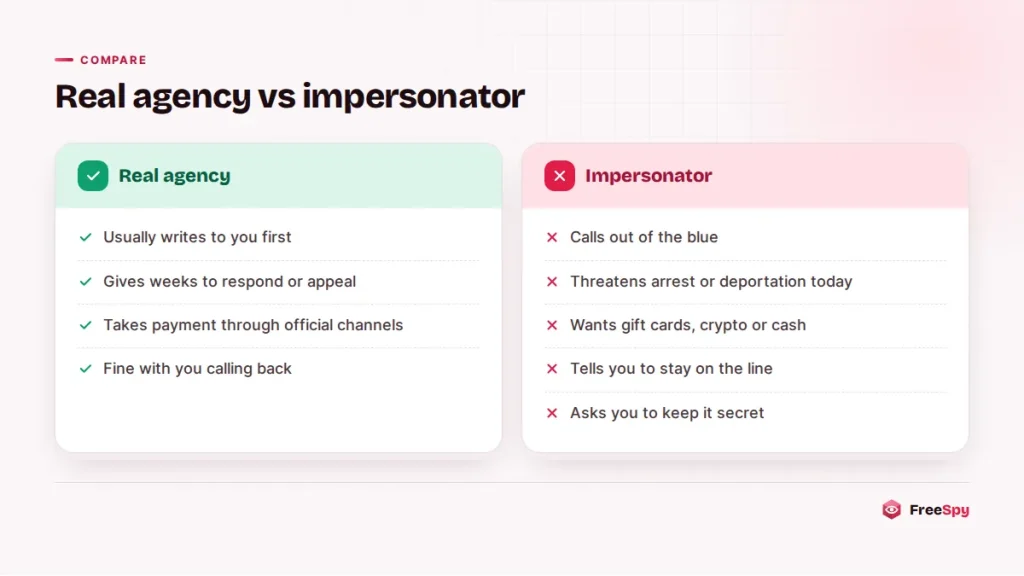
One rule covers almost every case. The FTC says it will never demand money, make threats, tell you to transfer money, or promise you a prize, and the same is true of other real agencies. A call that does any of those things is not from the government.
Checking a call in two minutes
End the call. Say “I’ll call the office back” and hang up. You don’t need the caller’s permission, and you don’t need to argue. A real official will understand, and you can’t get in trouble for calling an agency back through its published number.
Find the number yourself: the agency’s official website (US federal sites end in .gov, Canadian federal sites are on canada.ca), a letter you received, or the card in your wallet. A number the caller gave you doesn’t count.
Sign in to your online account. SSA, the IRS and the CRA all have accounts that show real balances, notices and case status. If there’s no debt and no notice there, the “officer” invented it.
Look up the number that called you. Community reports and FTC complaint data can show that other people got the same script, and a number that breaks numbering-plan rules can only have been spoofed. A clean result doesn’t make the call real, since scammers often borrow genuine agency numbers, but a page full of reports is a strong warning.
Before moving any money, talk to someone you trust. A short conversation with a family member or a bank teller breaks the spell the script depends on.
Fewer of these calls means fewer chances to be caught off guard. Silence Unknown Callers on iPhone or spam filtering on Android sends most of these robocalls to voicemail, where a fake “final notice” is much easier to judge calmly. The filtering settings take a few minutes to turn on.
Report to the agency that was copied
Before you file anything, write down what you can while it’s fresh: the number that called, the date and time, the name and badge number the caller used, any case number, and exactly how they wanted to be paid. Reporting forms ask for these details, and so will your bank if money moved.
Reporting helps investigators connect cases and warns others, even if you didn’t lose money. File with the agency that was impersonated and with a central fraud database:
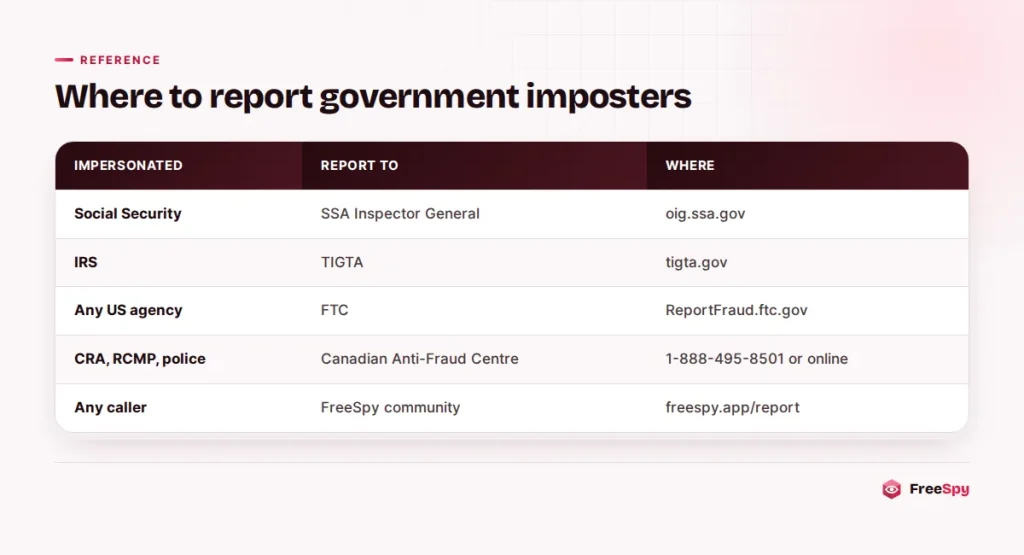
A FreeSpy community report with the category “government impersonation” adds a warning for the next person who looks up the number. If you already paid, call your bank or the gift card company before anything else, because a payment that hasn’t settled can sometimes be stopped. The same scripts also arrive by text, usually with a link to a fake payment page.
Two common questions
Does the Social Security Administration ever call people?
Sometimes, for example when you already have an application or case in progress. But SSA will never threaten you, say your number is suspended, or ask for gift cards, wire transfers, crypto or cash. If you doubt a call, ring 1-800-772-1213 yourself.
How can a scammer show the real agency’s phone number?
By spoofing it. The Truth in Caller ID Act makes spoofing illegal when it’s done to defraud, but criminals do it anyway. Call authentication systems such as STIR/SHAKEN help carriers label suspicious calls, but they can’t stop all of them.
Sources
- FTC: people reported losing $3.5 billion to imposter scams in 2025 (June 2026)
- FTC testimony to the Joint Economic Committee (March 2026)
- FTC National Do Not Call Registry Data Book, FY2025
- Canadian Anti-Fraud Centre: top frauds of 2025
- SSA Office of the Inspector General
- Treasury Inspector General for Tax Administration (TIGTA)
- ReportFraud.ftc.gov