An 800 number used to signal a big, established company. Today anyone can rent one in minutes, including the people running fake support lines and callback scams.
So an 800, 888 or 833 number tells you who pays for the call, and almost nothing about who answers it. Below: how these numbers work, who manages them, how they differ from look-alike numbers that do cost you money, and how to check one before you dial.
The business pays, not you
With an ordinary call, the person dialing is the one who might pay for distance. A toll-free number reverses that. The business or organization that holds the number pays for each incoming call, so customers can reach it without long-distance charges. In the US and Canada, calling a toll-free number from a landline or a mobile phone is typically free.
Toll-free numbers look like regular 10-digit numbers, but their three-digit prefix isn’t tied to a place. A 212 number was assigned to New York City. An 800 number was assigned to nowhere at all. The same 800 number can ring a call centre in Ohio during the day and one in British Columbia overnight. That’s handy for businesses, and it also means the prefix says nothing about where the person answering is sitting.
The numbers are built mainly for incoming calls. Many businesses also show their 800 or 888 line as caller ID when they call you, which is legal and normal. A spoofer can show one just as easily.
Seven prefixes, counting down
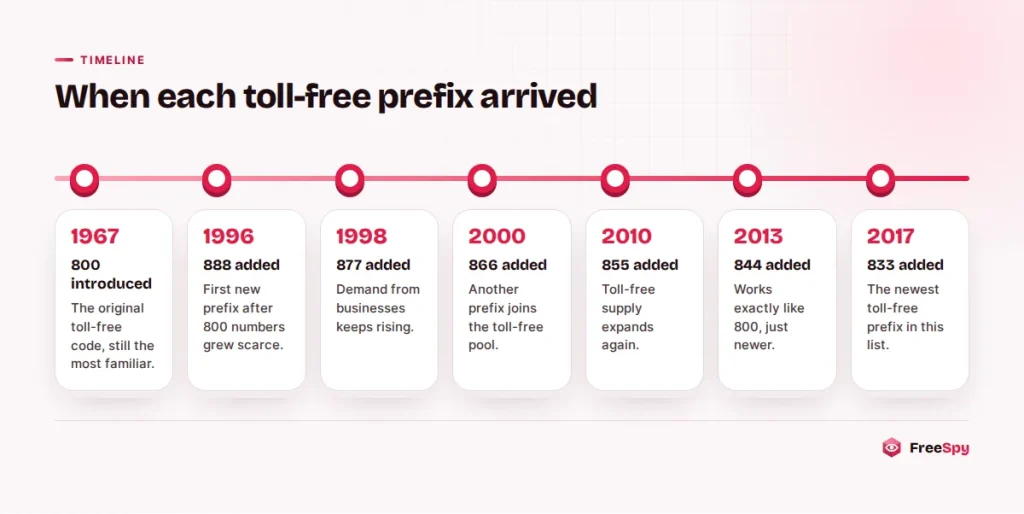
The first toll-free code, 800, arrived in 1967. As demand grew, new prefixes were added, each with a repeated digit:
- 800 in 1967
- 888 in 1996
- 877 in 1998
- 866 in 2000
- 855 in 2010
- 844 in 2013
- 833 in 2017
All seven work the same way. An 833 number is no less legitimate than an 800 number; it’s just newer. Older 800 numbers are in demand because they’re familiar, and because many good vanity combinations were claimed decades ago.
For deciding whether to trust a number, the prefix carries no weight. What matters is whether that specific number belongs to the organization you think you’re calling.
Somos and the RespOrgs
Ordinary area codes are handed out to phone carriers through numbering administrators. These run on a separate system. Somos administers the whole toll-free system, and it runs the central database that records who controls each number and where its calls should go.
Businesses usually don’t deal with Somos directly. They go through a Responsible Organization, or RespOrg: a company authorized to reserve these numbers and manage their routing records. Many phone carriers and calling platforms act as RespOrgs. A business can move its number from one RespOrg to another, much like porting a mobile number, so it can keep the same number for decades while switching providers.
Because the supply is limited, FCC rules forbid “warehousing” (reserving numbers without a real customer for them) and hoarding (a business holding more numbers than it intends to use). Those rules keep numbers available, but they don’t screen who gets one. A small online shop and a scam operation can get a toll-free number through similar channels.
1-800-BAKE-NOW and the vanity trap
A vanity number spells a word on the keypad. Each digit from 2 to 9 carries letters: 2 is ABC, 3 is DEF, 4 is GHI, 5 is JKL, 6 is MNO, 7 is PQRS, 8 is TUV and 9 is WXYZ. A fictional bakery might pick a number that spells BAKE-NOW, which is 2253-669 on the keypad.
Vanity numbers are easy to remember, which is why they’re valuable. They also carry a small risk for callers. The same seven letters on 800, 888 and 833 are three different numbers that may belong to three different companies. Dial the right word with the wrong prefix and you can reach a business you never meant to call. When the number matters, such as your bank’s fraud line, dial it from your card or statement rather than from memory.
A cheap way to look like a big company
An 800 number makes a small operation look like a large company with a customer service department. It’s cheap to set up, easy to route anywhere in the world, and familiar enough that most people don’t question it. Scammers use them in three recurring ways.
“Call us to resolve this”
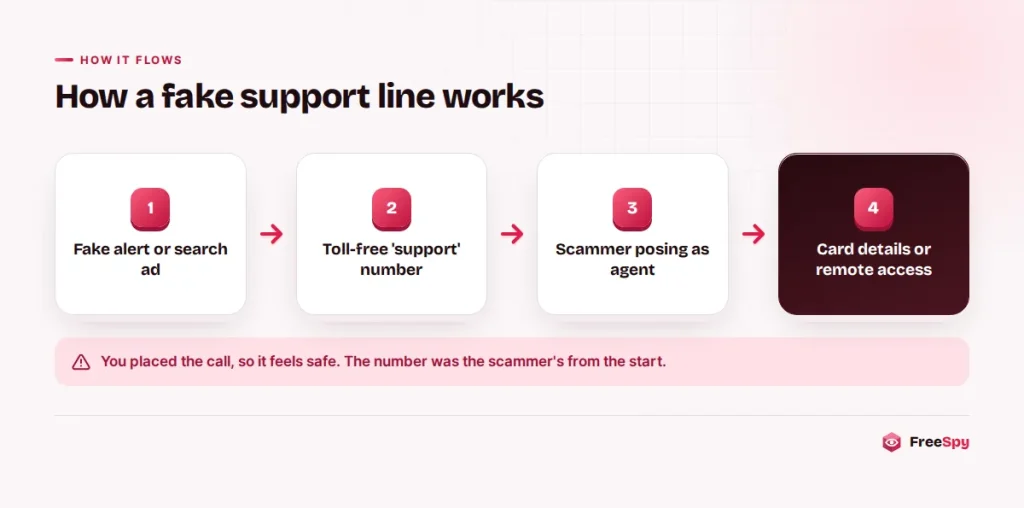
Instead of calling you, the scammer gets you to call them. A text, email or robocall claims there’s a suspicious charge, a locked account, an expired subscription or a delivery problem, and gives an 800 or 888 number to “resolve it”. When you call, you reach someone who sounds like a trained agent and who works to get your card number, one-time passcodes or a payment.
This pattern sits behind some of the costliest fraud. According to the FTC’s June 2026 release on 2025 data, many costly scams start with a fake security alert, often claiming to be from a bank, and bank impersonators caused the highest losses among business impersonators. Imposter scams overall cost people $3.5 billion in 2025, the FTC reported.
Support numbers planted where you search
Scammers place fake support lines where you might look for help: paid search ads, fake listings, forum posts, and pop-up windows that claim your computer is infected. You think you’re calling a well-known software company, airline or bank, but the number goes to the scammer. They may ask for remote access to your computer, sell you a fake “repair”, or talk you into a refund that turns into a payment. These fake Microsoft and Apple agents follow a script that’s easy to recognize once you’ve heard it.
A real company’s number on your screen
An 800 number on your caller ID isn’t proof the call came from that business. Some scammers fake real companies’ support lines precisely because they look trustworthy, and carrier call authentication doesn’t catch every fake.
When these calls work, they’re expensive. According to Experian’s summary of FTC data for 2025, people reported losing $1.108 billion to scams that began with a phone call, with a median loss of $1,835, the highest median of the main contact methods.
Look-alikes that bill you: 900 and Caribbean codes
Three kinds of numbers look similar on a screen but bill very differently. Mixing them up can cost you.
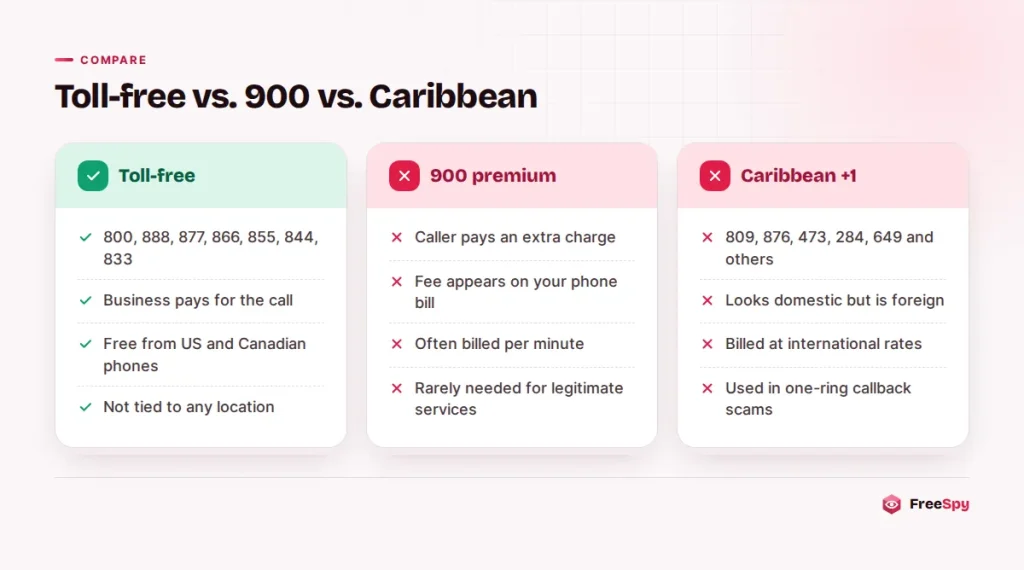
| Type | Examples | Who pays |
|---|---|---|
| Toll-free | 800, 888, 877, 866, 855, 844, 833 | The business receiving the call |
| Premium rate | 900 | You, often an extra per-minute fee |
| Caribbean +1 | 809, 876, 473, 284, 649 | You, at international rates |
900 numbers are premium-rate services: the caller pays an added charge that shows up on the phone bill.
Caribbean numbers use the same +1 country code as the US and Canada, which makes them look domestic. But codes such as 809 (Dominican Republic), 876 (Jamaica), 473 (Grenada), 284 (British Virgin Islands) and 649 (Turks and Caicos) belong to other countries, and calls to them are billed as international. That gap is what the one-ring callback trick exploits.
If you’re not sure where a three-digit code belongs, the area code directory shows the country or region for each one.
Before you dial an 800 number you found somewhere
A few minutes of checking can keep your account details away from a stranger.
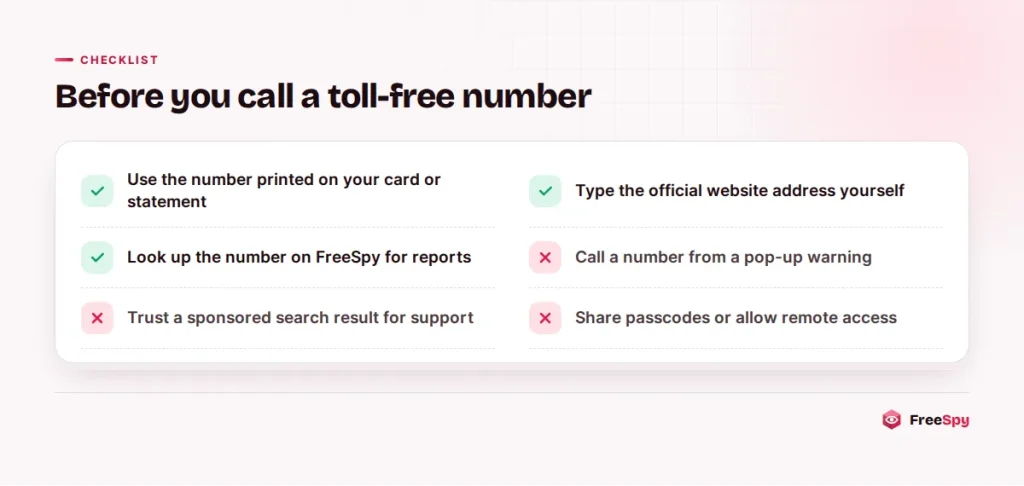
Get the number from a source you already trust: your bank card, a paper statement, the product packaging, or the company’s official website typed straight into your browser. A number from an unexpected text, email, voicemail or pop-up doesn’t qualify.
Be careful with search results. Sponsored results and third-party listings can show fake support numbers, so go to the official site and find its contact page. There are more ways to confirm a company’s real number when the website itself is hard to find.
Look the number up. FreeSpy shows community reports, FTC Do Not Call complaint counts and a risk score with each factor explained, which will often reveal a fake support line that others have already called.
Know the official lines you’re most likely to need. These include the Social Security Administration at 1-800-772-1213, the IRS at 1-800-829-1040, the US Do Not Call Registry at 1-888-382-1222, Canada’s National DNCL at 1-866-580-3625 and the Canadian Anti-Fraud Centre at 1-888-495-8501. Seeing one of these on caller ID still doesn’t prove an incoming call is real, because numbers can be spoofed.
And stop the moment you hear a request for gift cards, wire transfers, crypto, remote access or one-time passcodes. Hang up, whatever number you dialed.
If a number turned out to be a scam, report it to the FTC at ReportFraud.ftc.gov, or in Canada to the Canadian Anti-Fraud Centre, and add a community report so the next caller is warned.
From a cell phone, or from abroad
Within the US and Canada, these calls are typically free from landlines and mobiles. On older or prepaid mobile plans, the call may still use your plan’s minutes even though there’s no toll charge.
Abroad is a different story. Many 800-type numbers can’t be reached from outside North America, and when they can, your mobile carrier may charge international or roaming rates. Toll-free doesn’t mean free from everywhere. If you travel, write down the regular geographic number your bank or airline lists for international callers before you leave.
Tip: Many banks print a separate “call collect from abroad” or international number on the back of the card or on their website. Save it in your contacts before a trip.
Toll-free numbers that text
Many of these numbers can now send and receive texts, and businesses use them for appointment reminders, delivery updates and support chats. To limit abuse, carriers require businesses to register and verify their numbers before texting at volume. Unverified senders can find their messages filtered or blocked.
Verification helps, but it isn’t a safety guarantee for you. A text from an 800 or 833 number can still carry a phishing link, and scammers also text from ordinary 10-digit numbers and email addresses. Treat a toll-free text like any other: don’t tap links in unexpected messages, and forward spam to 7726 (SPAM).
Other questions
Can I find out who owns an 800 number?
The toll-free system tracks which RespOrg manages a number, not which business pays for it. In practice, compare the number with the company’s official website and check it for reports and complaints.
Can a scammer charge me just because I called their 800 number?
The call itself is free to you. The risk is what happens during the call: being talked into a payment, sharing card details or passcodes, or giving someone remote access to your computer.
Sources
- FTC: People reported losing $3.5 billion to imposter scams in 2025 (June 2026)
- Experian: Identity theft and fraud statistics (summary of FTC 2025 data)
- Somos, toll-free number administrator
- FCC Consumer Complaint Center
- Canadian Anti-Fraud Centre