A recorded voice offers to drop your credit card interest rate to zero. A caller says a “federal hardship program” can wipe out most of what you owe. A text announces that your student loans have been approved for forgiveness, as long as you pay a $699 document fee by Friday. They sound like three different offers. They work the same way: you pay for help that is either free or doesn’t exist.
Two rules catch most of them. In the US, a company selling debt relief by phone can’t charge you before it has actually settled or reduced at least one of your debts. And you never have to pay anyone for help with federal student loans.
Debt is one of the most complained-about call topics
In the FTC’s Do Not Call Data Book for fiscal year 2025, reducing debt is one of the top complaint topics, along with imposters and medical and prescriptions. The FCC listed “credit repair and credit card rate reduction calls” among its five most-complained-about categories of unwanted calls in 2020. These calls have been around for years and aren’t going away.
The reason is simple enough. Debt is common and stressful, and the programs for dealing with it are confusing. Federal student loan rules have changed several times in recent years, including a one-time relief program that the Supreme Court blocked in June 2023. Each change hands scammers a new headline. The FTC has warned that they call, text and email to take advantage of confusion about student loan payments.
“Card member services” and the zero percent rate
“This is your card member services calling about your current interest rate. You qualify for a rate as low as zero percent, but this offer expires today. Press 1 to speak with an account specialist.”
Notice what’s missing: the name of your bank. The recording can’t say it, because it doesn’t know it. “Card member services” sounds official and fits any card in anyone’s wallet.
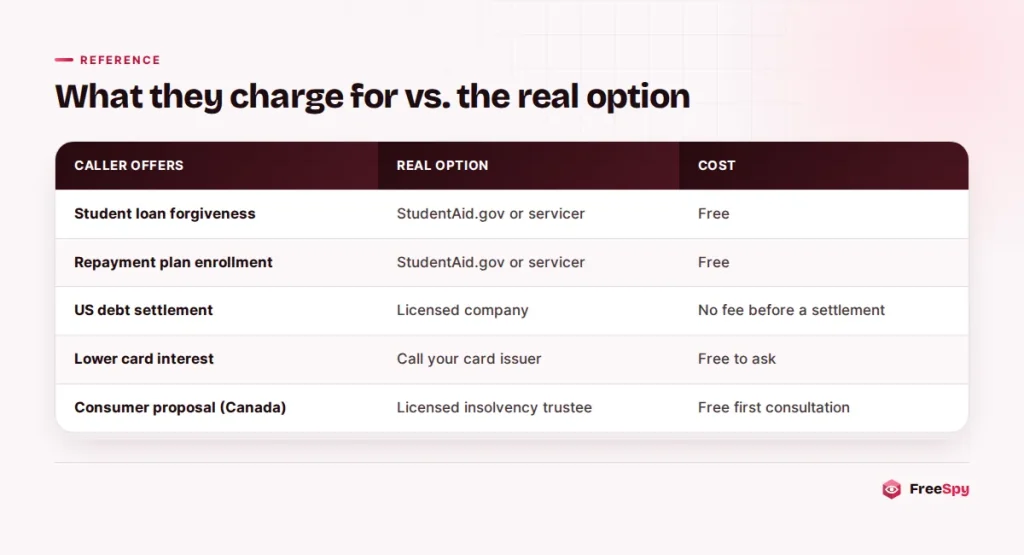
Press 1 and a live salesperson asks for your card number, your balance and often your Social Security number, “to check eligibility.” Your actual card issuer already has all of that. If you want a lower rate, call the number on the back of your card and ask. It costs nothing.
The “federal hardship program” that forgives 75%
“Due to a new federal hardship program, consumers with over ten thousand dollars in credit card debt can have up to seventy-five percent forgiven. There’s a one-time enrollment fee, and we’ll tell your creditors to stop calling you.”
No federal program forgives credit card debt in exchange for a fee.
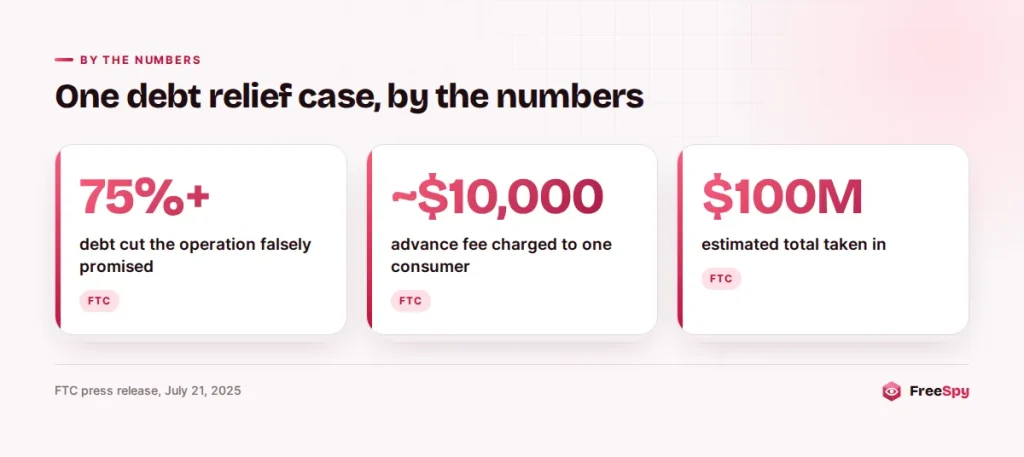
A real case shows where this script leads. In July 2025 the FTC sued a debt relief operation that, according to the agency, impersonated consumers’ banks or card issuers, the federal government or a consumer reporting agency, and falsely claimed it could cut debts by as much as 75% or more. The FTC said it collected illegal advance fees, including nearly $10,000 from one consumer, and took in an estimated $100 million. People were told to stop paying their credit cards. Their debts grew and their credit scores fell.
Student loan “final notices”
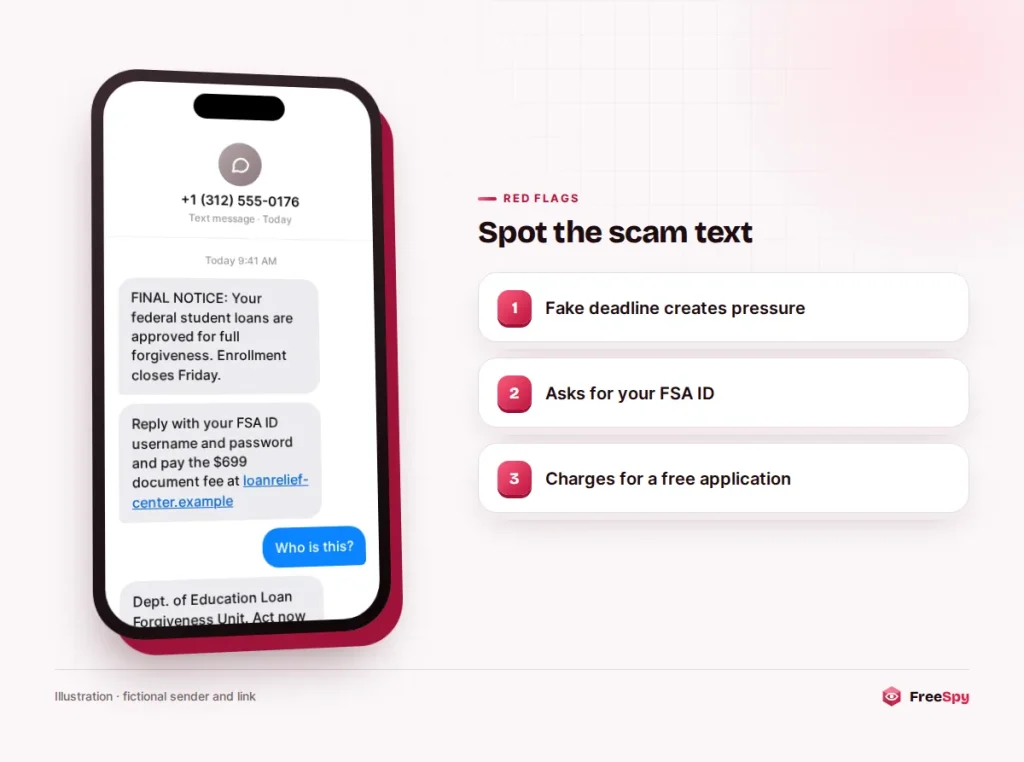
“This is a final notice about your federal student loans. Your account is eligible for full forgiveness under the new program, but the enrollment window closes Friday. To process your forgiveness, we’ll need your FSA ID login and a one-time document fee of $699.”
Almost every phrase in that message is a giveaway. The FTC says scammers use fake seals and logos and promise special access to repayment plans or forgiveness. Real federal programs don’t close on a Friday for people who haven’t paid a fee, and nobody legitimate needs your FSA ID. According to the FTC, scammers use that login to get into your account and redirect your payments.
More and more of these pitches arrive as texts, often linking to a page dressed up as a government site. Don’t tap, don’t reply and don’t call the number in the message; forwarding it to 7726 is the standard way to report a scam text to your carrier.
The no-upfront-fee rule, and what it means for you
Since October 27, 2010, the FTC’s Telemarketing Sales Rule has banned companies that sell debt relief over the phone from charging fees before they settle or reduce your credit card or other unsecured debt. A company can collect only after three things have happened: it has actually settled or changed the terms of at least one of your debts, there is an agreement such as a settlement or debt management plan, and you have made at least one payment to the creditor under that agreement.
In practice, that makes a phone pitch easy to test. A caller who wants an “enrollment fee,” a “setup fee” or your first monthly payment before anything has been settled is either breaking the rule or running a scam.
The FTC says the same for student loans, in fewer words: never pay an upfront fee, because it’s illegal for companies to charge you before they help you.
Help with federal student loans costs nothing
You never have to pay for help from the Department of Education. Repayment plans, consolidation and forgiveness applications are handled at StudentAid.gov or through your loan servicer. A private company can offer to fill in the same forms for a fee, but it can’t get you anything you couldn’t get yourself for free. The FTC also advises against anyone promising quick forgiveness.
Your FSA ID stays with you
The FTC’s advice is direct: never give out your Federal Student Aid ID or your Social Security number. If a caller says they need either to “process” something, end the call and contact your servicer.
“Stop paying your creditors” should end the conversation
Some debt settlement companies tell you to stop paying your cards and send the money to them instead, to build up a settlement fund. Your creditors don’t have to agree to any deal. Meanwhile, late fees pile up, accounts go to collections and your credit score drops. That is exactly the harm described in the FTC’s 2025 case.
Not every debt company is a scam. Some debt settlement firms and many nonprofit credit counseling agencies operate legally. But a company that wants money first, or wants you to stop paying your creditors, deserves a very hard look.
The Canadian version: “government debt programs”
Canadians hear the same calls, usually framed as a government debt program. The Financial Consumer Agency of Canada warns that some companies misrepresent their services as part of a government program, and suggests checking with the department responsible. It also notes that with a debt settlement company, you may still owe fees even if your creditors refuse to make a deal.
Only a licensed insolvency trustee can help you with a consumer proposal or bankruptcy. Trustees are licensed by the federal Office of the Superintendent of Bankruptcy, their advice on those two options is typically free, and they generally offer free consultations with no upfront fees.
Innovation, Science and Economic Development Canada lists two more warning signs: firms that want payment before meeting you or delivering anything, and fees dressed up as “referral fees” or “administration fees.”
For student loans, Canadians deal with the National Student Loans Service Centre. Reach it through the Government of Canada website, not through a number from a call or a text.
Fraud of this kind can be reported to the Canadian Anti-Fraud Centre at 1-888-495-8501, and unwanted sales calls to the National Do Not Call List.
Three questions for anyone who calls about your debt
Hang up on any recording, and don’t press a key to “opt out.” It just confirms your number works.
If a live person is on the line, ask:
- What is your company’s legal name?
- What do you charge, and when do you charge it?
- Will you send me the full agreement in writing before I pay anything?
A dodge on any of them is your cue to hang up. Then go to the source yourself: your card issuer through the number on the back of your card, or your student loan servicer through StudentAid.gov. If you’re not sure which number is real, there are reliable ways to check a number before you dial it.
For independent advice, look for a nonprofit credit counselor in the US, or an accredited credit counsellor or licensed insolvency trustee in Canada.
A reverse lookup on FreeSpy will show you the line type and region of the number that called, plus community reports and FTC Do Not Call complaints filed about it.
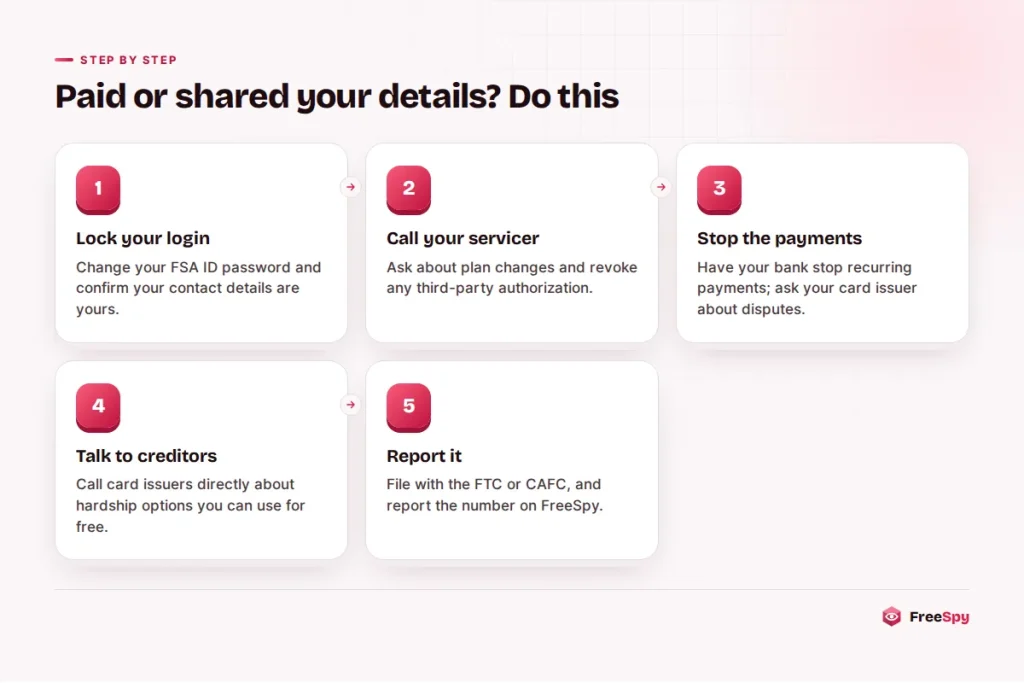
Shared your FSA ID or paid a fee? Lock things down today
If you gave out your FSA ID, change the password at StudentAid.gov and make sure the email, phone and address on the account are still yours. Then call your servicer. Ask whether anyone changed your repayment plan or payment details, and ask them to remove any third-party authorization you signed for the company.
If you set up automatic payments to a debt company, ask your bank to stop them. If you paid by card, ask your card issuer about a dispute.
If a company told you to stop paying your creditors, call those creditors yourself. Many card issuers have hardship options they offer directly, at no charge.
A Social Security or bank account number in the wrong hands needs more: a credit freeze with the three credit bureaus, fraud alerts at your bank, and close watch on your accounts for the next several months.
Report what happened at ReportFraud.ftc.gov. Unwanted sales calls can also go to DoNotCall.gov or 1-888-382-1222, and you can post the number on FreeSpy so the next person who looks it up sees the warning.
These robocalls usually break several rules at once. Most are prerecorded sales calls placed without consent, and they ignore the Do Not Call Registry. That gives you options under the TCPA and Do Not Call rules, including, in some cases, the right to sue. This is general information, not legal advice. For your own situation, check the official sources or talk to a lawyer or a legal aid office.
Why these calls borrow your bank’s name
Debt relief scams work best in someone else’s voice: your bank, a credit bureau, the Department of Education. Those names do the persuading, so the caller doesn’t have to. It’s the same trick behind fake bank fraud alerts and government imposter calls.
A caller who knows your servicer or your balance isn’t proof of anything either. Details like that leak through data breaches and get passed around. A real servicer still won’t ask for your FSA ID, or charge you to apply for a federal plan.
Reporting a number won’t stop these calls overnight, because the operations rotate numbers constantly. But reports to the FTC and FCC feed the kind of enforcement that shut down the operation in the 2025 case.
Sources
- FTC: Student loan scam calls
- FTC: Advance fee ban for debt relief (2010)
- FTC: Debt relief case (July 2025)
- FTC: Do Not Call Data Book FY2025
- FCC: Top five unwanted call complaints
- FCAC: Getting help with debt or credit repair
- ISED: Beware of debt-relief scams