Leaderboard
- 1 (561) 780-6092West Palm Beach, FL Harassment 1 reports 21
- 2 (984) 206-2682Raleigh, NC Medicare / health insurance 1 reports 25
- 3 (508) 419-4661Worcester, MA Other / not sure 1 reports 57
- 4 (970) 303-2486Fort Collins, CO Bank / card fraud 1 reports 64
- 5 (888) 382-1222 Robocall / recorded message 72 FTC complaints 43
- 6 (877) 297-4711 Telemarketer / sales 90 FTC complaints 43
- 7 (325) 949-3333Abilene, TX Robocall / recorded message 40 FTC complaints 43
- 8 (866) 666-1049 Debt relief / lower interest offer 94 FTC complaints 43
- 9 (855) 883-0462 Debt relief / lower interest offer 118 FTC complaints 43
- 10 (833) 662-5734 Debt relief / lower interest offer 110 FTC complaints 43
- 11 (866) 923-1419 Auto warranty 178 FTC complaints 57
- 12 (866) 771-6356 Robocall / recorded message 20 FTC complaints 43
- 13 (669) 200-0116San Jose, CA Robocall / recorded message 22 FTC complaints 38
- 14 (888) 912-0212 Debt relief / lower interest offer 22 FTC complaints 43
- 15 (855) 446-0858 Debt relief / lower interest offer 26 FTC complaints 43
- 16 (706) 395-8731Augusta, GA Robocall / recorded message 30 FTC complaints 38
- 17 (877) 372-1087 Debt relief / lower interest offer 82 FTC complaints 43
- 18 (888) 310-1459 Debt relief / lower interest offer 72 FTC complaints 43
- 19 (877) 578-3258 Debt relief / lower interest offer 54 FTC complaints 43
- 20 (877) 578-4294 Debt relief / lower interest offer 112 FTC complaints 43
- 21 (866) 386-5614 Debt relief / lower interest offer 102 FTC complaints 43
- 22 (866) 666-1172 Debt relief / lower interest offer 128 FTC complaints 43
- 23 (870) 985-6856Jonesboro, AR Robocall / recorded message 122 FTC complaints 43
- 24 (877) 957-2865 Debt relief / lower interest offer 106 FTC complaints 43
- 25 (866) 771-6919 Debt relief / lower interest offer 82 FTC complaints 43
National heat map
Report mix (30 days)
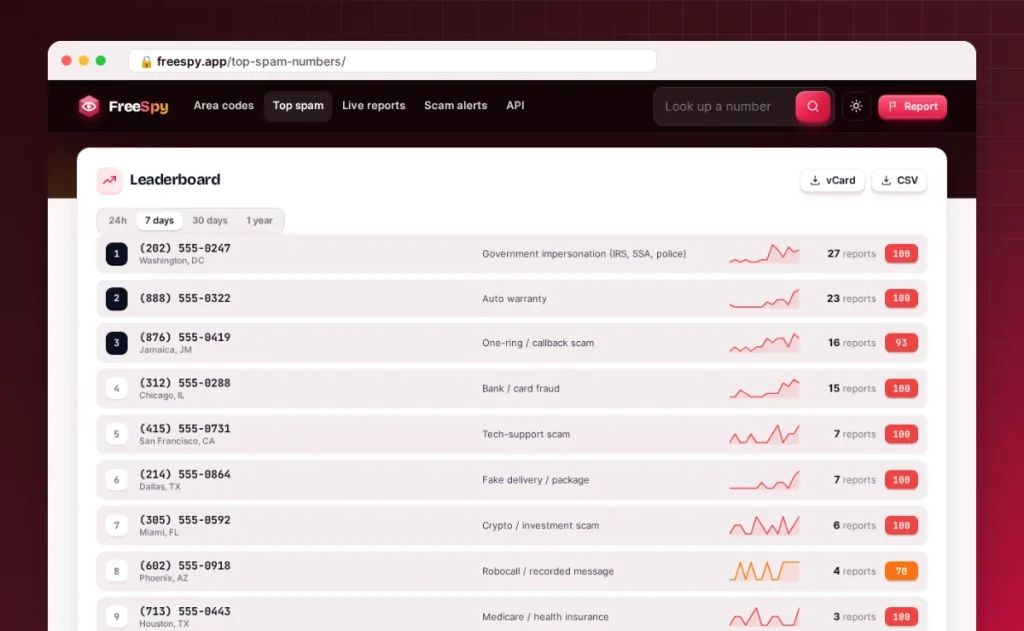
The leaderboard above lists the numbers people have reported most often as unwanted, for the window you pick. It’s a quick way to see what’s ringing phones right now, and to check whether the missed call you’re about to return is on it. This page explains how the list is built, why it changes so fast, and how to use it without blocking the wrong people.
Key takeaways
- Numbers are ranked by how many “unwanted” community reports they got in the chosen window: 24 hours, 7 days, 30 days or 1 year.
- The colored score next to each number is its full risk score, which also counts FTC complaints, report severity and line type.
- Many listed numbers are spoofed. They rise fast and drop off within days, and the real owner may have done nothing wrong.
- If a number from the list called you, don’t call back, don’t press any keys, and report what happened.
- Imposters, debt relief offers and Medicare or health pitches dominate lists like this, matching the FTC’s top Do Not Call complaint topics.
The four time windows
The tabs above the list change how far back it looks. Each window answers a different question.
- 24 hours shows what’s happening today. A new campaign can reach the top within hours if enough people report it. This view changes the most, and it’s the best one to check when you’ve just had a strange call.
- 7 days is the default. It smooths out the hour-to-hour noise and still catches campaigns that run for a few days before switching numbers.
- 30 days favors numbers that keep calling. A spoofed number used for one afternoon rarely survives here, but a dialer that reuses the same lines for weeks does.
- 1 year shows long-running callers. These are more often real lines than spoofed ones: aggressive telemarketers, collection agencies, and Caribbean numbers tied to callback scams.
The live feed of individual reports is on the recent reports page. The leaderboard is the summary; the feed is the raw material.
How numbers are ranked
The ranking is simple on purpose. FreeSpy counts the approved community reports rated “unwanted” that each number received inside the window, and sorts from most to fewest. If two numbers are tied, the one reported most recently goes first.
Some things don’t count toward the rank. Reports rated “safe” or “unsure” are left out. Reports hidden by moderators, or waiting for review after being flagged, are left out. Numbers whose owners had reports removed through the remove my number process don’t appear. Each visitor can report a given number only once per 24 hours, so one angry person can’t push a number up the list alone.
Each row shows:
- The number and its area code’s location. This is where the number was issued, not where the caller is.
- The category people chose most often for that number, such as “Government impersonation” or “Telemarketer / sales”.
- A 14-day sparkline of daily reports. A sharp spike at the right edge means a fresh campaign. A flat, steady line means a caller that’s been at it a while.
- The report count for the chosen window.
- The risk score, colored by verdict band.
Rank and score measure different things. Rank is volume in one window. Score weighs all the evidence: every report, discounted by age, plus how serious the calls were, FTC complaints, sudden spikes and line type. So a debt collector reported 20 times this week can rank above a bank-fraud number reported 8 times, while the bank-fraud number carries the higher score. When in doubt, trust the score and the reports over the rank. The How it works page shows the full scoring method.
What the FTC complaint data means
When you open a number from the list, you may see a section headed “FTC Do-Not-Call complaints” with an official-data label. Those figures come from the Federal Trade Commission, which publishes basic details of Do Not Call complaints each business day: the number that called, the date, whether it was a robocall, and the subject the consumer picked. FreeSpy imports the feed every weekday and totals it per number.
FTC complaints add up to 30 points to a number’s score, plus 5 more if most complainants said it was a recorded message. They don’t change the rank, which is based only on community reports. A number can therefore sit low on the leaderboard while carrying a high score, because hundreds of people complained to the FTC instead of reporting it here.
Two cautions apply. The complaints aren’t verified, and they’re filed against whatever number showed on the caller ID screen. If that number was spoofed, the complaints describe the scammer’s calls but sit on someone else’s line.
Why spoofed numbers appear and vanish so quickly
Caller ID is information the caller supplies, and the network often passes it along unchecked. Robocall operations exploit that. They display a different number on every few thousand calls, often one that shares your area code and exchange so it looks local. That trick is known as neighbor spoofing. When people report those calls, the reports land on numbers that belong to unrelated people or businesses, or to no one at all.
Spoofed numbers follow a pattern on the list. They appear suddenly, collect a burst of reports in a day or two, and then disappear as the operation moves on to new numbers. If you look at the sparkline, you’ll see a single spike and nothing before it. That’s also why FreeSpy’s scoring lets a report lose half its weight every 60 days. A number that was borrowed for one campaign shouldn’t carry the label forever.
STIR/SHAKEN caller ID authentication, required for major US providers on IP networks since June 30, 2021 and in Canada since November 30, 2021, has made some spoofing easier to trace. It doesn’t stop it, especially for calls that enter from overseas or pass through older networks. The spoofing guide explains the attestation levels and their limits.
Tip: Look for several listed numbers with the same first six digits. That usually means a dialer is spoofing numbers in one exchange. The “Campaign radar” panel on each number page shows other reported numbers in the same block.
What usually tops lists like this
The categories that fill the leaderboard track what consumers report to the government. According to the FTC’s National Do Not Call Registry Data Book for fiscal 2025, robocalls make up most Do Not Call complaints, and the top complaint topics are reducing debt, imposters, and medical and prescriptions. Expect the same three themes here.
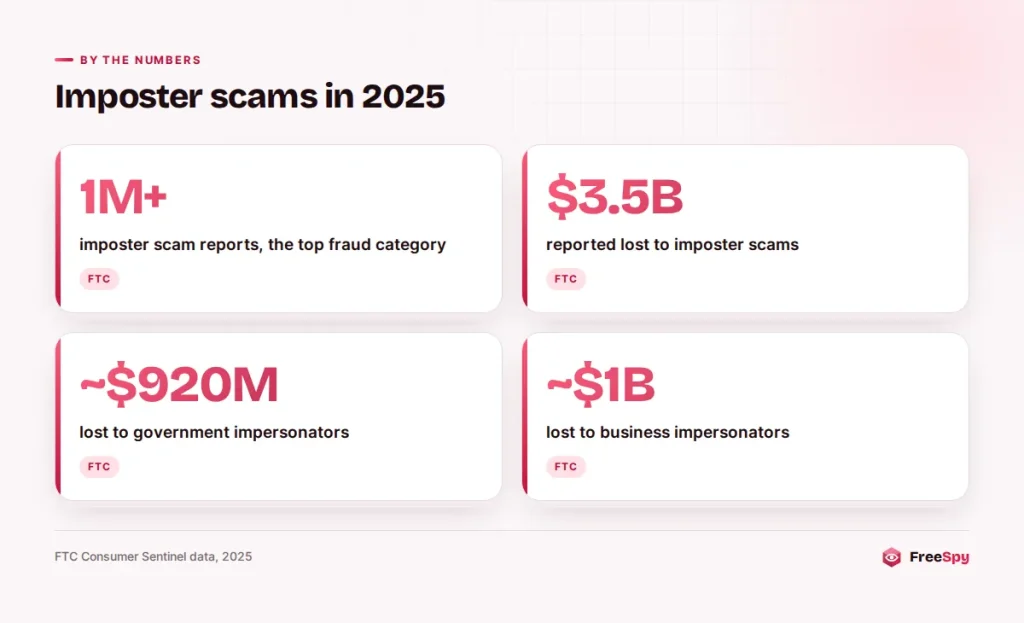
- Imposters. Callers posing as the IRS, Social Security, police, your bank, Amazon or a utility. The FTC’s 2025 data shows imposter scams were the most-reported fraud category, with more than 1 million reports and $3.5 billion lost. Government impersonators alone accounted for about $920 million. Our guide to government impersonation calls covers the scripts.
- Debt relief. Recorded offers to lower your credit card interest or settle your debt, usually for an upfront fee.
- Medicare and health insurance. Calls about “new Medicare cards”, free braces or test kits, or health plans, often fishing for a Medicare number.
- One-ring calls. A single ring from an area code like 809, 876 or 473 that looks domestic but is billed at international rates if you call back.
- Auto warranty and fake deliveries. Long-running robocall themes, joined by text-based delivery and toll scams.
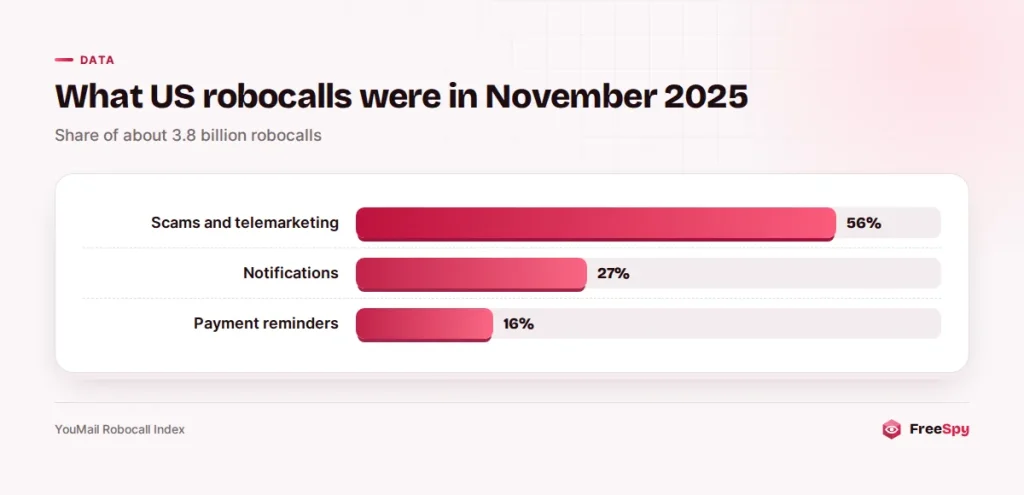
Not every robocall is a scam. YouMail’s Robocall Index estimated 3.8 billion robocalls in November 2025, of which 56% were scams and telemarketing combined. The rest were notifications and payment reminders, the kind of automated calls pharmacies, schools and lenders make. That’s one more reason to read the reports before you block a number.
If a number from the list called you
Being on the list doesn’t mean every call from that number is a scam, but it’s a strong reason for caution.
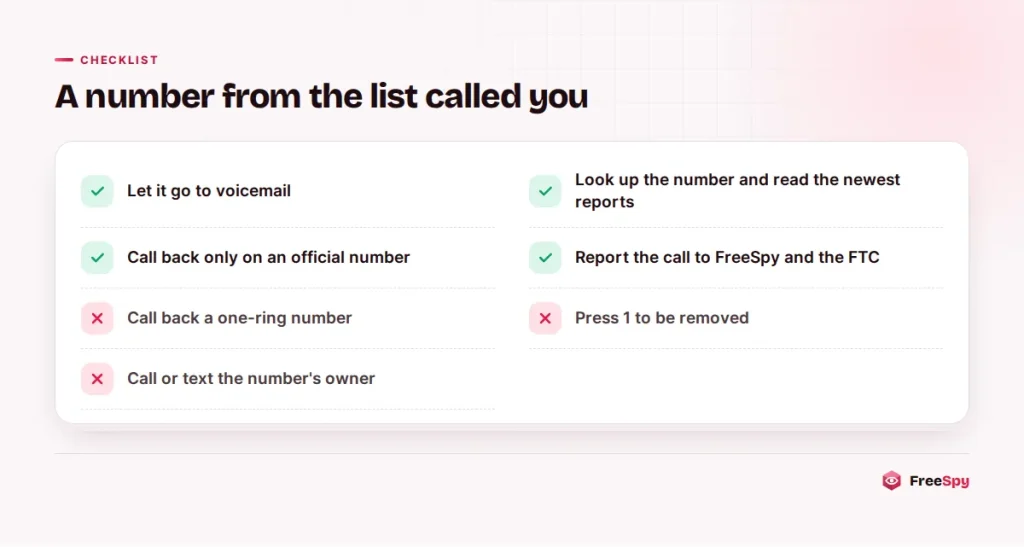
- Don’t call back. Returning a one-ring call to a Caribbean code can cost you, and returning any scam call confirms your number is live.
- Don’t press keys or say “yes”. “Press 1 to be removed” usually just marks you as someone who answers.
- Check the number page. Read the newest reports and see whether they match what you heard.
- Verify through an official number. If the caller claimed to be your bank, a government agency or a company you deal with, call the number on your card, statement or the official website.
- Report it. Add your report on the report page. In the US, you can also report to the FTC at ReportFraud.ftc.gov. In Canada, contact the Canadian Anti-Fraud Centre at 1-888-495-8501.
- Block it if you like. The blocking guide covers iPhone and Android settings and carrier tools.
If you already paid or shared personal details, call your bank right away and see the phone scams guide for next steps.
Using the list well
Check before you call back. The most useful habit is simple: before returning a missed call from an unknown number, look it up. If it’s on the 24-hour or 7-day list, wait for a voicemail instead.
Use the downloads with care. The CSV and vCard buttons export numbers reported in the last 30 days that score 50 or higher, so “Suspicious” or “Likely scam”. The vCard file is a single contact called “Spam” holding all the numbers, which you can import and then block in one step. Because spoofed numbers rotate, a blocklist catches repeat callers better than fresh campaigns. Refresh it every few weeks, and remove a number if a real contact turns out to own it.
Read the map and the mix. The heat map shows where reported numbers are issued, not where victims live. The report mix chart shows which categories people chose in the last 30 days, and it often shifts when a new script takes off.
Don’t target the owner. A listed number may belong to someone whose number was spoofed. Never call, text or confront the owner of a listed number. Report the call and move on.
Frequently asked questions
How often is the list updated?
It’s built from approved reports when the page loads, so new reports show up as soon as they’re approved. The 24-hour view changes the fastest.
My number is on the list, but I never made those calls. What can I do?
Your number was probably spoofed. Use the remove my number form. Requests are reviewed within 72 hours, and approved ones hide the reports and take the number off the list. Also let your carrier know.
Why is a number with a low score ranked high?
Rank counts reports in the window. Score weighs how serious they are, how old they are and other evidence. Many reports about low-severity calls, like surveys or sales, give a high rank with a moderate score.