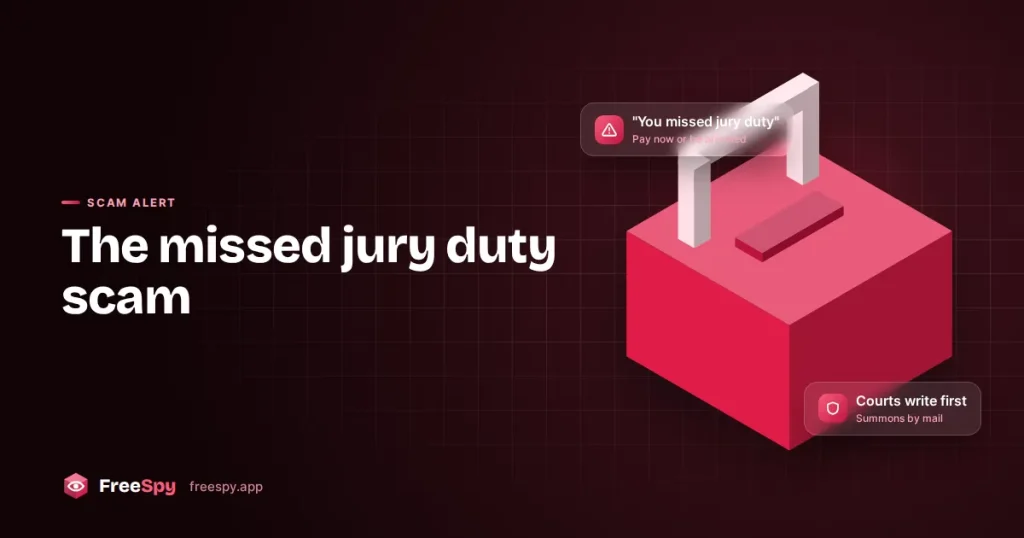
The caller gives a rank, a badge number and your full name. You were summoned for jury service, he says, you didn’t show up, and a judge has signed a warrant for your arrest. You can clear it today by paying a fine, as long as you stay on the line.
No court works this way. Jurors are summoned by mail, missed dates are followed up by mail, and courts never take payment over the phone. Everything below is about recognizing the call quickly and checking with the real court in a way the caller can’t interfere with.
The call often starts with your own address
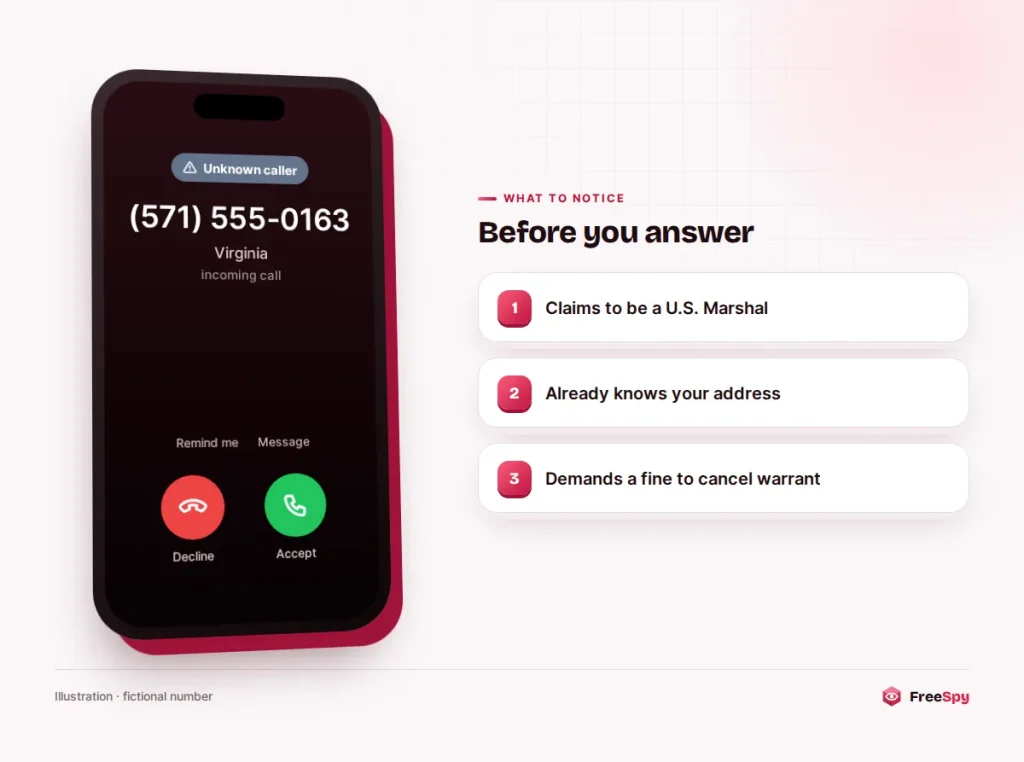
According to the FTC, most of these calls start with an “urgent” call from someone claiming to be a U.S. Marshal or a local police officer, and “the caller might already know things about you, like your full name or address.” A typical opening:
“This is the warrants division of the county sheriff’s office, badge number 4471. I’m calling about a failure to appear. You were summoned for jury service on the 14th and did not report. The judge has issued a bench warrant. Before we send deputies to your address, you have the option of posting a bond to resolve it today.”
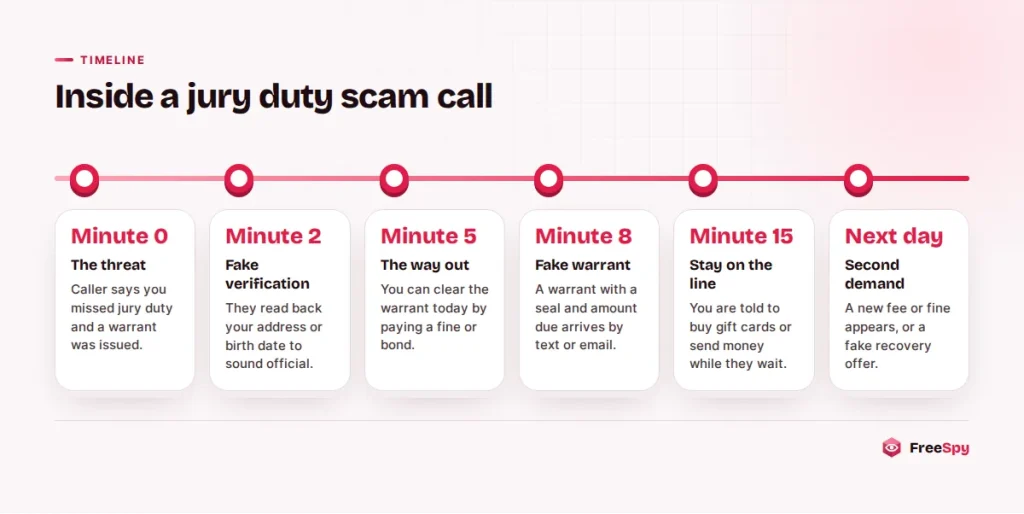
The pressure builds in stages. First the caller “verifies” you by reading back your address or date of birth. Then comes the way out: the warrant can be recalled if you pay a fine or bond right now. Some send a fake arrest warrant by text or email, complete with a seal, a case number and the amount you supposedly owe. The FTC’s verdict on those documents: “While this might make the scam look more convincing, it’s all fake.”
Then the payment. The FTC lists what these callers ask for: payment apps, cryptocurrency, gift cards, and wire transfer services such as Western Union or MoneyGram. A federal court in Montana describes callers telling people to buy prepaid debit cards, such as a Green Dot card or gift card, and read the card numbers over the phone. Older versions recorded by the federal judiciary had victims bring cash or prepaid cards to the courthouse.
Callers often keep you on the phone throughout, even while you drive to a store, so there’s never a quiet minute to call someone and check. Some may come back the next day with a “processing fee” or a second fine.
Fear, a badge number and a plausible story
Careful people get caught by this, and it’s easy to see why. Jury summonses are common. Most adults have had one, and anyone can imagine a letter going to an old address or getting lost.
The caller also knows things. Names, addresses and birth dates leak from data breaches and sit in public records, and hearing them read back feels like proof of authority.
The phone display can look official as well, showing a sheriff’s office or courthouse name and a local area code. That display can be spoofed, and the FTC notes that officers won’t call to threaten arrest even when the caller ID looks official.
Then there’s embarrassment. Nobody wants deputies at their front door or their office, and paying quietly to make it disappear is tempting. The vocabulary helps the caller too. Bench warrant, failure to appear, contempt, bond: legal language makes questions feel out of place.
Jury calls are one script among many. Fake Social Security, IRS and police calls run on the same fear, and the other agency impersonation scripts are worth recognizing too.
What a real court does when you miss a date
The real process contradicts the call at nearly every step. Details differ between federal and state courts, but the outline holds.
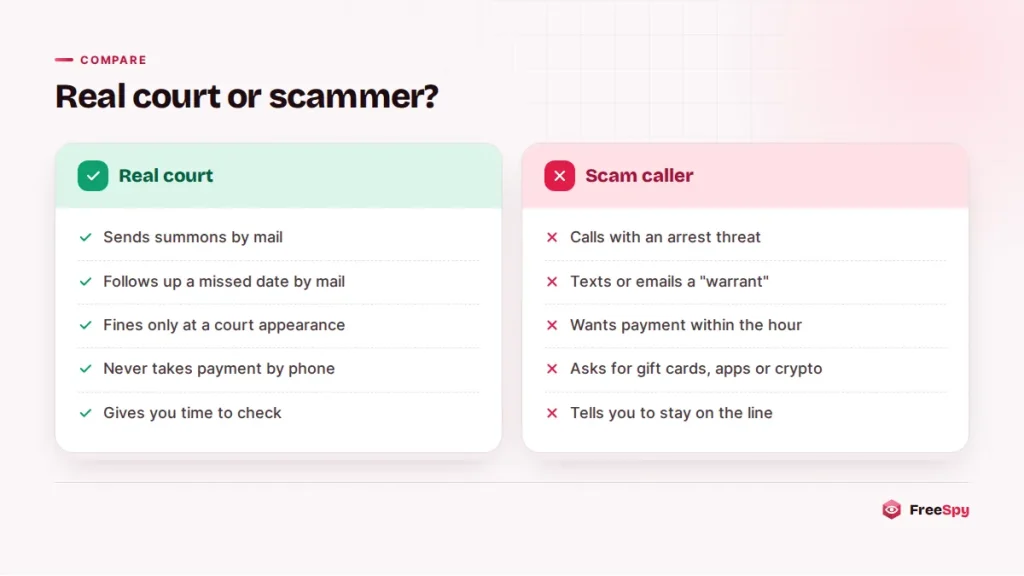
The summons comes by mail. The federal judiciary says “A court will always send a jury summons by U.S. mail,” and state courts work the same way. Some courts let you fill in a juror questionnaire online, but you reach it through the address printed on your summons, not through a link someone texts you.
A missed date leads to a letter. The U.S. District Court for Arizona states that “if a juror fails to appear for jury duty, the court will make contact with the juror by mail.”
Any penalty goes through a judge. According to the federal judiciary, “A fine may be imposed but not until the court appearance.”
And nobody collects money or sensitive data by phone. Federal courts say they “will never demand payment or sensitive information over the telephone,” and Arizona’s federal court adds that its staff will never call or email asking for personal information such as Social Security numbers. The U.S. Marshals Service has said it “will never call anyone to arrange payment of fines over the phone.”
The FTC puts it in two sentences: “Courts never demand payment over the phone. In fact, no government agency will.” Procedures vary by state and county, so for a real question about a summons, check your court’s official website or call its jury office. This is general information, not legal advice.
Canada: provincial jury offices and fake investigators
In Canada, the provinces and territories run jury selection, so the paperwork depends on where you live. Ontario, for example, mails a Mandatory Jury Eligibility Form to over 800,000 residents each year, and people who qualify may later receive a summons in the mail. Ontario’s jury page also says that if you haven’t signed up for digital notifications, court staff may call or send a letter with updates. A scheduling call about a date you already know is a long way from a stranger demanding money to cancel a warrant.
Canadian versions tend to cast a police officer or a “fraud investigator” instead of a marshal. In its 2025 figures, the Canadian Anti-Fraud Centre counted 2,167 reports of fraud investigator scams, where criminals pose as bank or police investigators, with $28.3 million in reported losses. If you get a call like this in Canada, hang up, reach your provincial court office or local police through a number on an official website, and report it to the CAFC at 1-888-495-8501.
A warrant that arrives by text is fake
A document can be more convincing than a voice. Scammers send PDFs or images that look like court orders, with a state seal, a case number, a judge’s signature and a total due. Some arrive as a text with a link to “view your warrant,” which doubles as a way to collect more personal details.
There’s no need to examine the seal. The FTC states: “Real law enforcement will never text or email you an arrest warrant.” A warrant that comes with a payment amount and a number to call is a scam document, however official it looks. If it came by text, forward it to 7726 (SPAM) and delete it; phones also have built-in options for reporting scam texts.
One sentence, then hang up
You don’t have to argue or prove anything. Say this and end the call:
“I’ll contact the court clerk directly. Goodbye.”
After that, a few rules:
- If they read out your address or birth date, don’t say whether it’s right. Confirmations help them fill in their records.
- Don’t call back the number on caller ID or any number the caller gave you.
- Don’t open links in follow-up texts or emails.
- If anyone tells you to go to a store, a Bitcoin machine or a money transfer counter, you already know what this is.
A voicemail version gets the same treatment: note the details, don’t call the number in the message.
Asking the clerk’s office directly
If the call leaves you uneasy, settle it with the court itself.
Start with the court’s official website. For federal courts, uscourts.gov links to every federal court’s site. For state and county courts, use your state judicial branch site, which usually ends in .gov or .us. Avoid phone numbers from search ads, which are not always run by the court.
Call the jury office or the clerk of court and give your name. They can tell you whether you were ever summoned and whether anything is outstanding. Check your mail for a real summons too, and note the date and court printed on it.
Federal courts advise people who get these calls to contact the clerk of court’s office of their local U.S. district court and local law enforcement. Courts post scam warnings on their websites when a wave of calls hits an area, so the clerk may already have heard your caller’s script.
It can also help to look up the number that called. A FreeSpy lookup shows the number’s type and region along with community reports and FTC complaint data, and other people may have reported the same “marshal.”
Paid with a gift card? Call the card company first
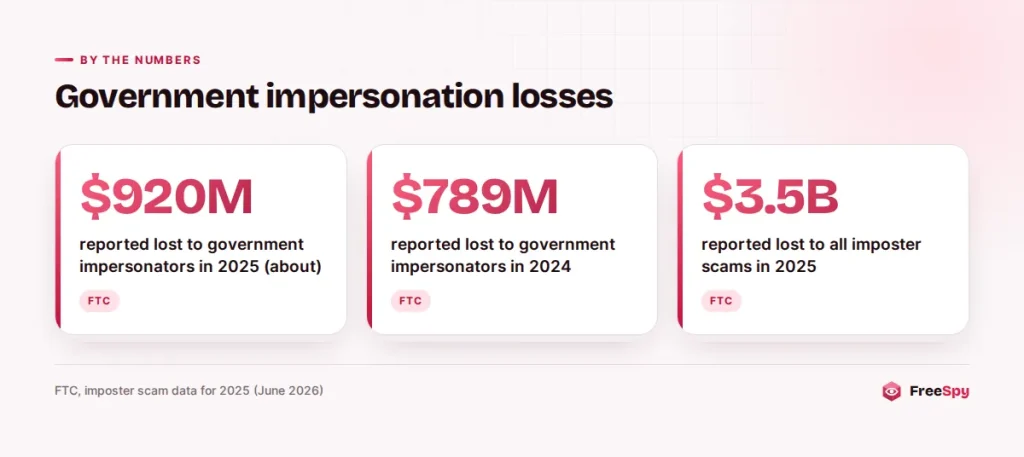
Move quickly, and don’t let embarrassment slow you down. You’re far from alone: according to the FTC, people reported losing about $920 million to government impersonators in 2025, up from $789 million in 2024.
- Contact the payment provider right away. For gift cards, call the card company on the number printed on the back of the card and say it was used in a scam. For a payment app, bank transfer or wire, call your bank or the service and ask them to stop or reverse it. Money is hard to recover, but speed helps.
- Report it. In the US, to the FTC at ReportFraud.ftc.gov and to local police. Tell the court clerk as well, since courts track these calls. In Canada, report to the CAFC and local police.
- Protect your identity if you gave out your Social Security number, SIN, birth date or bank details. There’s a fuller checklist for after you’ve shared personal details.
- Expect a second approach. Victims are often called again by “investigators” offering to recover the money for a fee. That is a second scam.
- Warn others. A report on the number, filed under government impersonation with a line about what the caller said, shows up for the next person who checks it.
Questions people ask
Can you actually be arrested for missing jury duty?
Courts can act against people who ignore a summons, but the process runs through letters and an appearance in front of a judge. It does not start with a phone call demanding payment, and no court accepts gift cards or crypto.
The caller used a real officer’s name. Does that change anything?
No. Names of real officers, judges and court staff are often public. Call the court or police department back on a number from its official website.
What if I really did miss my date?
Call your court’s jury office using the number on its website or your summons and explain what happened. They will tell you how to reschedule and whether anything else is needed.
Sources
- FTC: Calls threatening arrest for missing jury duty
- U.S. Courts: False jury service claims
- U.S. District Court, District of Arizona: Juror scams
- U.S. District Court, District of Montana: Jury scam alert
- Government of Ontario: Jury duty in Ontario
- FTC: Imposter scam losses in 2025
- Canadian Anti-Fraud Centre: Top frauds of 2025