You never gave your number to a car warranty company, a debt relief outfit or a “Medicare benefits hotline.” They call anyway, some mornings before breakfast. A brand-new number can start getting the same calls within weeks.
The plain answer is that spam calls find you by several routes at once. Some callers guessed your number. Some bought it from a website you used. Some found it in a breach or a public listing, and some learned it was worth calling because you once picked up. A few of those routes can still be narrowed.
52.5 billion robocalls in one year
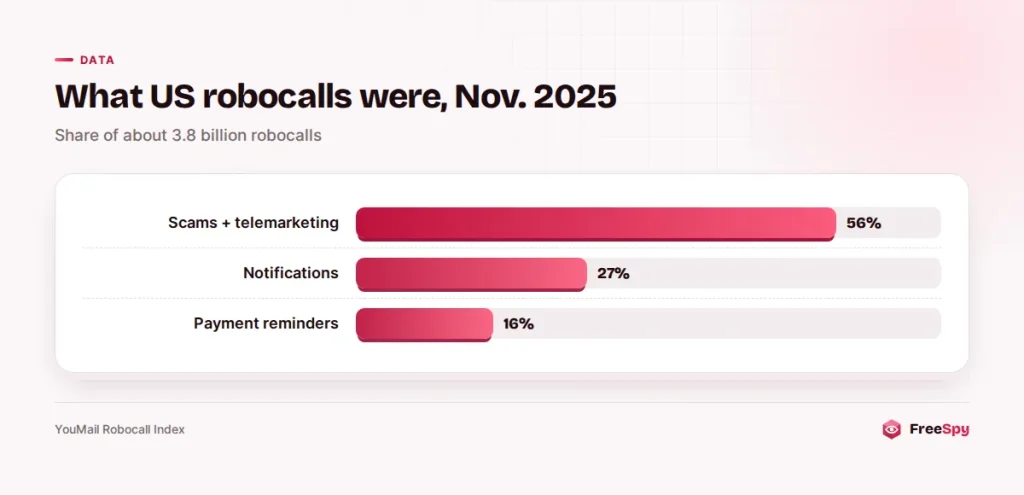
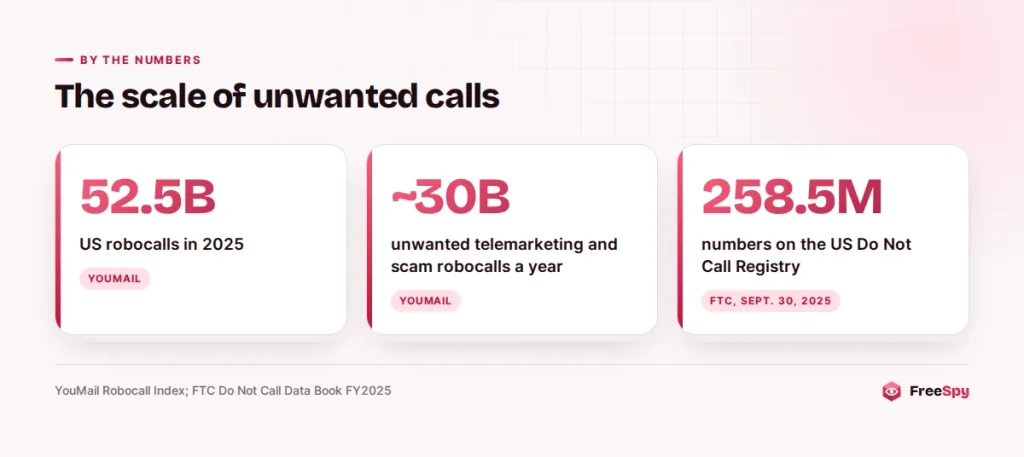
If the calls feel endless, the numbers agree. According to the YouMail Robocall Index, there were about 52.5 billion robocalls in the US in 2025, barely down from 52.8 billion in 2024. YouMail estimates that roughly 30 billion a year are unwanted telemarketing and scam calls.
Not all of it is junk. In YouMail’s November 2025 breakdown, scams and telemarketing made up 56% of robocalls, while notifications such as pharmacy and appointment reminders were 27% and payment reminders 16%. The first group is the problem, and the interesting question is how it found you.
Nobody had to leak a number that can be guessed
A phone number isn’t a secret. Every number in North America follows the same pattern of area code, exchange and line number. Carriers receive numbers in blocks, and which area codes and exchanges are in use is public information. An autodialer can generate every possible number in an exchange and call them all.
That’s why a new number can ring with junk almost immediately. Nobody sold it. The dialer reached it the same way it reached the numbers on either side. Internet calling makes each attempt nearly free, so a tiny success rate still pays.
Guesswork also explains the “neighbor” effect. Robocallers often display a number that matches your area code and exchange, because people answer local-looking calls more often. Faking a caller ID like that, known as spoofing, costs them next to nothing.
A quote form you filled in got sold
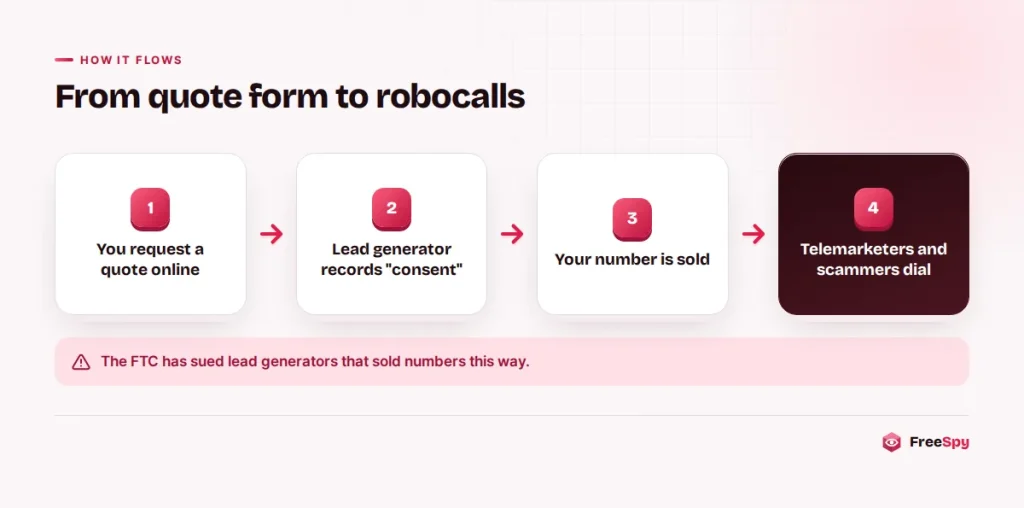
This is the route most people underestimate. Plenty of sites offering quotes for insurance, mortgages, solar panels, home repairs, jobs or prizes are lead generators. Their product is your name and number, sold to companies that make calls.
The FTC has been blunt about it. In a January 2024 consumer alert, it described a lead generator called Response Tree that collected names and numbers from people shopping for mortgage refinancing and sold them to telemarketers. Those telemarketers made illegal robocalls about auto warranties, solar panels, hearing aids and Social Security disability services. Nobody on the list had asked about any of those.
In July 2023, the FTC and more than 100 federal and state law enforcement partners announced Operation Stop Scam Calls, a sweep of more than 180 actions. Part of it went after lead generators that, according to the FTC, collected numbers deceptively and then falsely claimed those people had agreed to be called. The FTC called some of them “consent farms”: sites where a single click on a button or checkbox is treated as permission for many companies to call you.
It tends to look like this. You search for cheaper car insurance and land on a comparison site. You type your ZIP code, your car and your phone number, then click “See my rates.” Under the button, in small gray type, a line says that by clicking you agree to be contacted by “marketing partners,” with a link to a list of hundreds of company names. The calls start a week later.
Tip: The FTC suggests searching a site’s name along with “complaint,” “review” or “scam” before you type personal details, and reading the small print near any button or checkbox. Under FTC rules, a robocall trying to sell you something is illegal unless the company has your written permission to call you that way.
Breaches and data brokers fill in the details
Your number sits in a long list of databases: your bank, pharmacy and airline, retailers, apps, loyalty programs, and every account that asked for a phone number “for security.” When one of those companies is breached, phone numbers are usually part of the haul, along with names and email addresses.
Breach data is valuable to scammers because it comes with context. A caller who knows your name and which bank you use sounds far more convincing than a random recording, which is one reason fake fraud alerts can feel so personal.
Data brokers add another layer. They compile records from public sources, marketing lists and purchased data and sell them on. Some of it reaches telemarketers, and some of it eventually reaches scammers.
If you get a breach notice, follow its instructions, and use the FTC’s IdentityTheft.gov to see which steps fit what was exposed.
Your number is printed somewhere public
Numbers posted online are easy to scrape. The usual places are business listings and websites (including side businesses run from home), marketplace and classified ads, social media profiles that show contact details, resumes on job sites, domain registrations, and club, church or school directories.
You don’t need to scrub all of these. If your personal mobile appears in many of them, a second number for listings and ads keeps the main one quieter.
The number came with someone else’s baggage
Carriers reuse numbers. If yours belonged to someone else first, you may inherit their debt collectors, their pharmacy reminders and every marketing list they landed on. Calls asking for a person you’ve never heard of are the giveaway, and there are specific fixes for a recycled number.
Something similar happens when robocallers borrow your number as their fake caller ID. Strangers call back angry, and some of them report you.
Picking up taught the dialer something
Many calls are tests. When a person answers, or a key gets pressed, the system learns that the number works and reaches a human. That number is now worth more.
The FTC warns that pressing a number to reach an operator or to be taken off a list might only lead to more robocalls. The FCC gives the same advice about callers who ask you to press a button to stop the calls, noting that scammers often use the trick to identify potential targets. Returning missed calls from unknown numbers sends the same signal, and some of those callbacks are billed at international rates.
Why registering didn’t make it stop
Putting your number on the National Do Not Call Registry (donotcall.gov, 1-888-382-1222) is still worth doing. Registration never expires, and law-abiding telemarketers get up to 31 days to stop calling once you sign up. According to the FTC’s data book for fiscal 2025, about 258.5 million numbers were actively registered as of September 30, 2025.
The FTC is also frank that being on the Registry won’t stop calls from scammers making illegal calls. Someone already breaking the law by robocalling you isn’t deterred by one more rule. The Registry has legal exemptions too, among them political calls, charities, surveys, debt collectors and companies you’ve recently done business with. The full set of Do Not Call rules and exemptions is longer than most people expect. This isn’t legal advice; check the official source or a lawyer for a specific case.
Canada’s version is the National Do Not Call List (lnnte-dncl.gc.ca, 1-866-580-3625). Registration is permanent, telemarketers have 31 days to stop, and it has the same blind spot: it works on legitimate telemarketers, not fraudsters.
Five changes that cut the volume
You can’t pull your number off every list. You can make it less useful to the people dialing it, and stop most of their calls from reaching you.
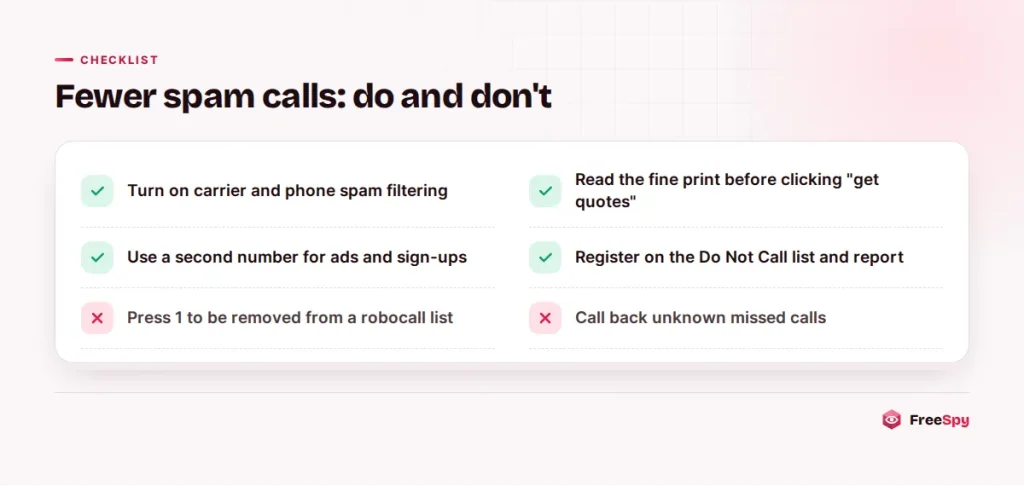
- Turn on filtering. Your carrier’s free spam blocking and your phone’s unknown-caller settings, such as Silence or Screen Unknown Callers on iPhone and spam filtering in Android’s Phone app, catch a large share before you hear a ring. The settings for each phone take a few minutes to find.
- Stop confirming the number. Let unknown calls go to voicemail, never press keys on a robocall, and don’t return missed calls you can’t explain.
- Protect it at the source. Read the small print before clicking “get quotes,” and use a secondary number for sign-ups, ads and listings where you can.
- Register, then report. Join the US Registry or Canada’s DNCL, and report violations at DoNotCall.gov or through the DNCL. The FTC releases the numbers people report to the public each business day, which helps phone companies working on call blocking and labeling.
- Check before calling anyone back. A lookup shows community reports and FTC complaint counts for the number, and adding your own report warns the next person.
Patterns in who calls you
Looking up the numbers that call you most often can reveal a pattern. If the same topic keeps appearing across different numbers, “reducing debt” or “imposters” for example, you’re probably on a list sold for that purpose. The FTC complaint data shown on each FreeSpy number page includes complaint topics and dates, so the theme is easy to spot.
Timing gives clues too. A burst of insurance calls right after you requested a quote online points fairly directly at the site that sold your details.
Questions people ask
Will changing my number stop the calls?
Usually only for a while. Dialers that call whole ranges will find a new number too, and the new number may be recycled with its own history. Filtering and better habits last longer.
Does replying “STOP” to junk texts help?
For texts from a real business you signed up with, “STOP” is the standard way to opt out. For texts from unknown senders, replying confirms the number is active. Report those and delete them instead.
Can I find out which company sold my number?
Not easily. If a caller claims you gave consent, ask which company and which website they got your information from. A legitimate telemarketer should be able to say. Then ask to be added to their internal do-not-call list.
Sources
- FTC: How are robocallers getting your phone number?
- FTC: Operation Stop Scam Calls (July 2023)
- FTC: Do Not Call Registry FAQs
- FTC: Phone scams
- FTC: Robocalls
- FCC: Caller ID spoofing
- FTC: Do Not Call Registry Data Book FY2025
- YouMail Robocall Index
- IdentityTheft.gov