
You picked up without looking, and it was a recording about your car warranty, or a stranger reading a script about your “account.” Now you’re wondering whether that one tap did any damage.
Usually it didn’t. Answering a spam call, by itself, can’t take money from you or put anything on your phone. What the caller gains is information: that your number works and a person answers it. The real risk depends on what happened after you said hello, so this walks through each stage and what to do about it.
The first few seconds, from the dialer’s side
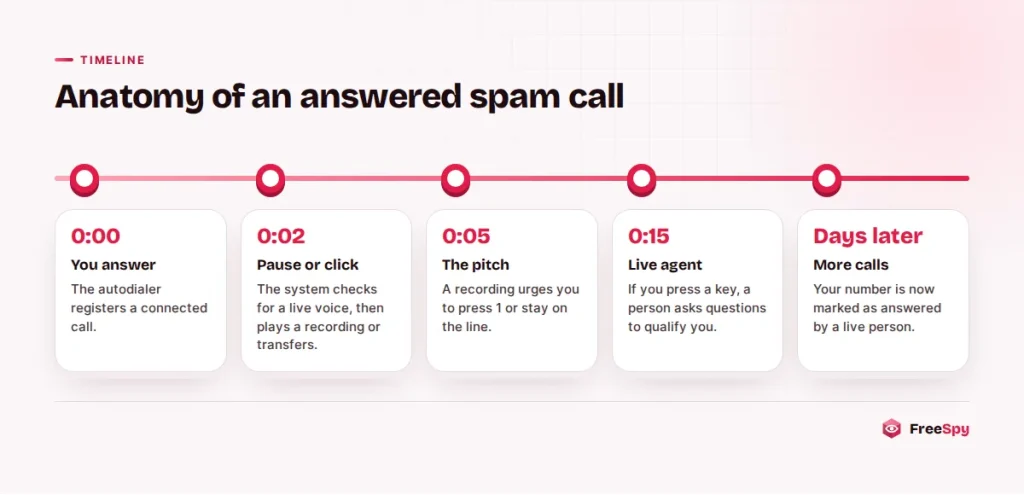
Most junk calls come from autodialers placing calls to huge lists at once. When you answer, the system registers a connected call and often listens for a moment to tell a live voice from a voicemail greeting. Then it plays a recording, hands you to a live agent after a short pause or click, or simply drops the call.
From that point your number carries a new tag on the caller’s list: answered by a person. That can’t be undone, which is why the quickest response is also the safest one. Hang up.
Three fears that don’t hold up
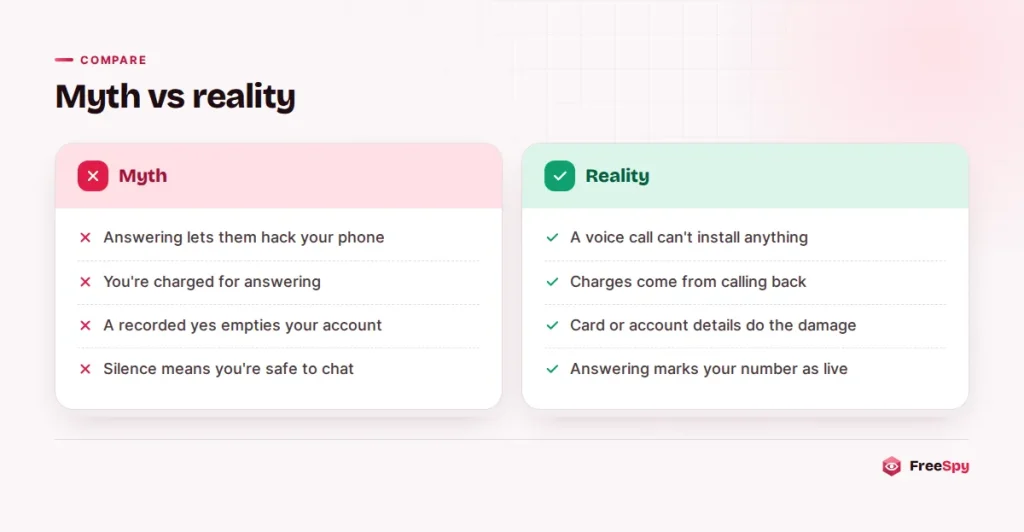
Answering doesn’t let anyone into your phone
A regular call carries audio, not software. Picking up gives the caller no access to your files, photos or apps. Phones get compromised when a caller talks someone into installing a “security” app, opening a link, or reading out a code, and that takes your cooperation.
You aren’t billed for answering
Taking an incoming call on a US or Canadian plan at home doesn’t charge you for the caller’s number. Phone-bill scams make their money when you dial out, which is why the one-ring scam wants a callback. Roaming abroad works differently, so check your plan if you travel.
A recorded “yes” isn’t a key to your bank
The FCC does advise against answering questions that can be answered with “yes” or “no,” and saying as little as possible is a sensible habit. But a clip of you saying “yes” doesn’t hand anyone your card number or bank login. The worry behind “Can you hear me?” calls is mostly bigger than the actual risk.
How the risk climbs with each step
You answered and hung up
Your number may now be marked as active, and you might get a few more calls for a while. That’s the whole impact.
You pressed a key
Robocalls love “Press 1 to speak to an agent” and “Press 9 to be removed from our list.” For the caller, both buttons do the same job: they prove someone is listening and willing to act. The FTC says pressing numbers to reach someone or to come off the list might lead to more robocalls. The FCC adds that scammers often use the trick to identify potential targets.
You talked to someone
A live agent’s job is to keep you on the line and move you toward a decision. Small details you let slip, such as your name, your bank, your age or the fact that you’re on Medicare, help them shape the pitch or sell your profile to the next caller.
A short recording of your voice can be enough for voice-cloning tools. Since February 2024, the FCC has treated AI-generated voices in robocalls as “artificial” under the TCPA, so the same consent rules apply to them. Criminals don’t care much about consent rules, which is one more reason to say little to unknown callers and to agree on a family code word for emergency calls.
You shared personal or account information
This is where real harm begins. Callers usually want card numbers with expiry dates and security codes, bank logins or the one-time code your bank just texted you, a Social Security or Social Insurance Number, a date of birth or Medicare number, or your carrier account PIN, which can help someone move your number onto their own SIM.
You paid, or let someone into your computer
Gift cards, wire transfers, payment apps and cryptocurrency are hard to reverse, which is exactly why scammers insist on them. The FTC puts it bluntly: anyone who insists that you can only pay that way is a scammer. Remote access software installed during a “tech support” or “refund” call gives the caller control of your screen, and possibly your online banking.
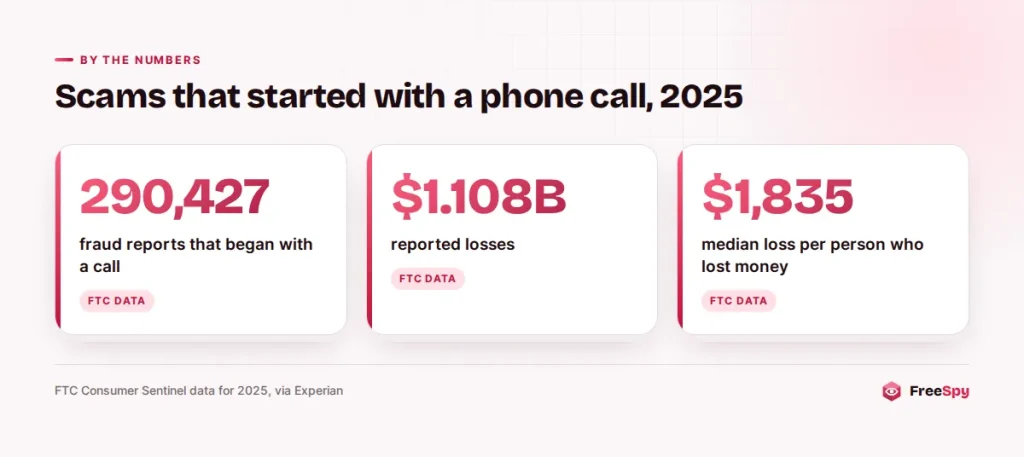
The money involved is large. According to FTC data for 2025, people filed 290,427 fraud reports about scams that began with a phone call, with $1.108 billion lost. The median loss was $1,835, higher than for any other main contact method.
Match the call to the cleanup
Answered, or pressed a key, and that’s all
Don’t call the number back. Turn on your carrier’s spam filtering and your phone’s unknown-caller settings. Then report the number, in the US at DoNotCall.gov and in Canada through the National Do Not Call List, which handles complaints about unwanted telemarketing.
Talked, but gave nothing sensitive
Write down who the caller claimed to be, the number they used, any callback number they gave, and what they asked for. Expect follow-ups that lean on what you said; a call later “about your earlier conversation” deserves suspicion. If they claimed to be your bank, a government office or a company you use, check with that organization through its official number.
Shared account, card or identity details
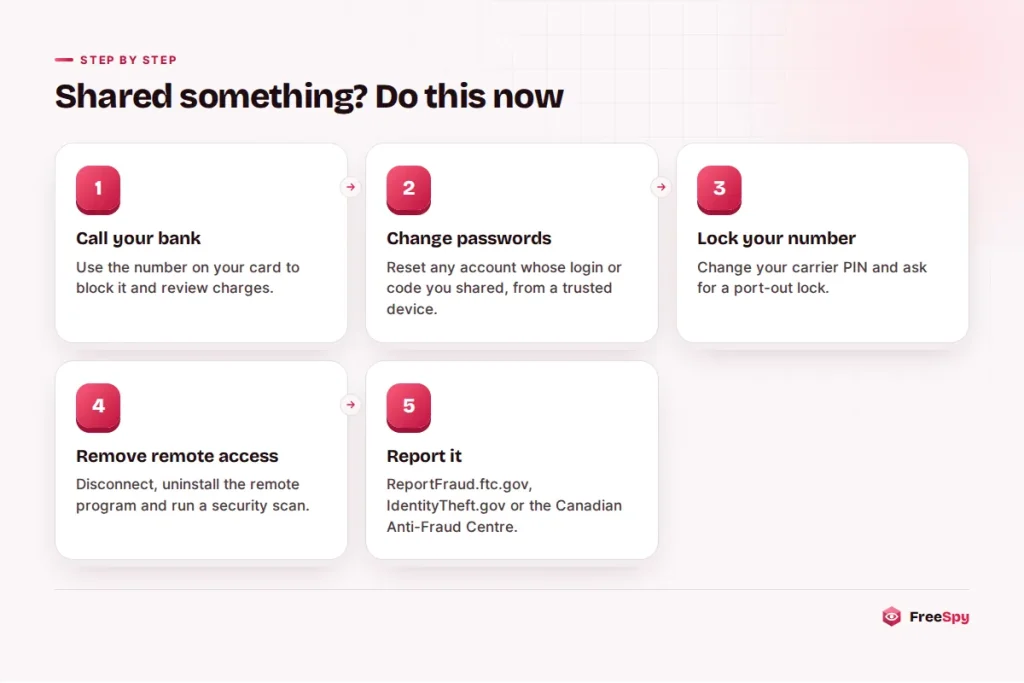
- Card or bank details: call the number on the back of your card right away, ask to block the card, and go through recent transactions with them.
- A login or one-time code: change that account’s password from a device you trust, sign out other sessions, and check the security settings.
- Social Security or SIN: in the US, IdentityTheft.gov builds a recovery plan, and a credit freeze is worth considering. In Canada, contact the Canadian Anti-Fraud Centre at 1-888-495-8501 and the credit bureaus.
- Carrier PIN: call your carrier, change the PIN, and ask for a port-out lock.
Each of these has more steps than fit here, and there is a full walk-through for what to do after giving a scammer your details.
Paid, or allowed remote access
Contact the company you paid through immediately: bank, card issuer, payment app, wire service or gift card company. The FTC notes that depending on how you paid, you might be able to get your money back, and that it’s worth asking regardless.
If someone got into your computer, disconnect it from the internet, uninstall the remote access program, run a security scan, and change passwords from a different device. Report what happened at ReportFraud.ftc.gov, or to the Canadian Anti-Fraud Centre in Canada.
The follow-up calls won’t come from the same number
Blocking the number that called you feels like the natural next step, and it does no harm. It also won’t do much. Operations that place millions of calls rotate through numbers constantly, so the next attempt usually arrives from a different number, often one with your own area code.
Recognize the follow-ups by what they say rather than where they come from. The same product, the same “final notice,” the same agency name or the same callback number in a voicemail means the same operation. A second caller who already knows what you told the first one is a strong sign your answers were passed along.
Carrier filters do learn from reports over time, so reporting the numbers that reach you helps the warnings catch up.
When it was Mom who picked up
Often the person who answered isn’t you. A parent mentions, days later, that “a nice man from Medicare” called, or a teenager pressed 1 to claim a prize. People are often embarrassed to say how far a call went, so the way you ask matters.
Ask what happened rather than why. “What did they ask you for?” gets a clearer answer than “Why did you talk to them?” Then go through the list above together: a card number, a bank name, a Medicare or Social Security number, a code from a text, anything installed. Each answer points to a section.
Look at the call log for the number and time, and look it up to see whether others have reported it. Turn on unknown-caller silencing or screening on their phone, which stops most repeat calls.
A simple house rule helps more than a list of warning signs: if anyone calls about money, a prize or an account problem, hang up and call me first.
Expect the same people to try again. A number that engaged once tends to get called repeatedly, sometimes by a “recovery” service promising to get the lost money back for a fee, which is another scam.
Short lines for next time
You don’t owe a stranger a conversation, and four responses cover almost everything.
For a robocall or recording, say nothing and hang up. For “Can you hear me?” or “Is this the homeowner?”, hang up without answering.
For a caller claiming to be your bank or a government office: “I’ll call you back on the number I have.” Then use the number on your card, statement or the official website. That one habit stops most impostors, whatever the caller ID shows.
For a pushy sales call from a real company: “Please put my number on your internal do-not-call list.” Note the date and the company name.
Screening before you answer
The easiest way to avoid all of this is to let unknown numbers go to voicemail and check them first. A FreeSpy lookup shows the area code and region, whether the number is even valid, FTC Do Not Call complaint counts and community reports, along with a 0 to 100 risk score that lists each factor behind it. A carrier warning like “Spam Risk” on the screen deserves the same treatment: let it ring, then check.
Still wondering
Can a spam caller get my location by calling me?
No. Connecting a call doesn’t send your location to the caller. They may know your area code, which only shows where the number was assigned.
What if it was a spam text I answered, not a call?
Replying confirms the number is active, much like answering. Don’t tap any links or reply again. Forward the text to 7726 (SPAM) and delete it.
Sources
- FTC: Phone scams
- FCC: Caller ID spoofing
- Experian summary of FTC 2025 fraud data
- IdentityTheft.gov
- ReportFraud.ftc.gov
- Canadian Anti-Fraud Centre