
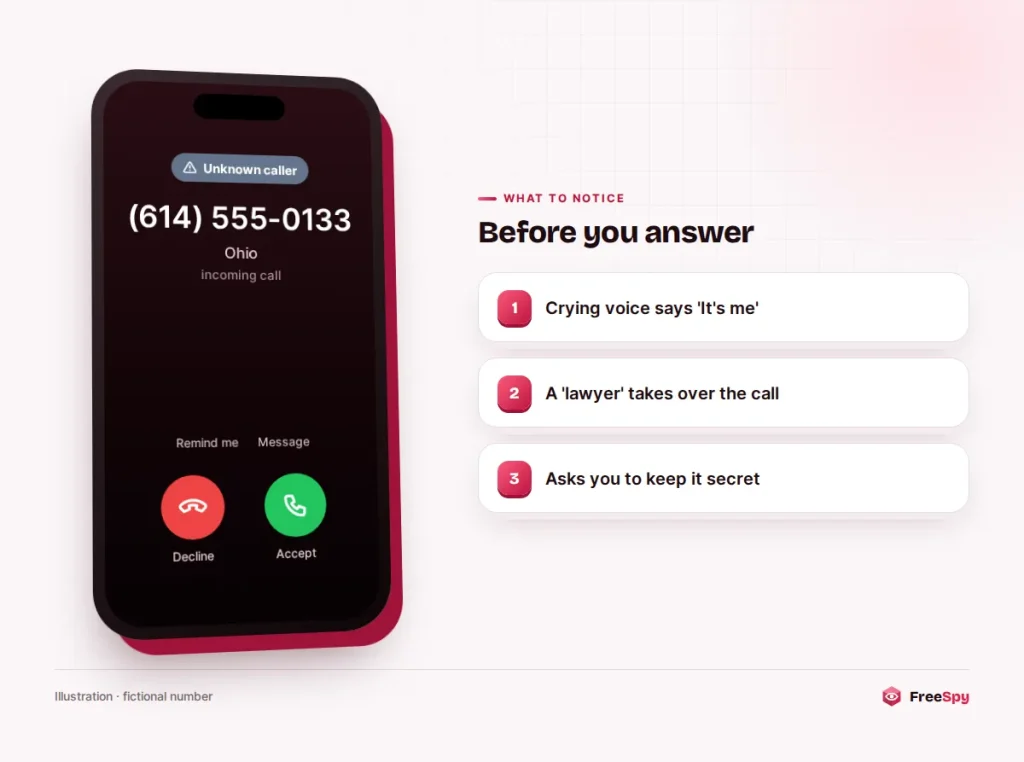
The phone rings late in the evening. A young voice, crying, says “Grandma, it’s me. I’m in trouble. Please don’t tell Mom.” Then a calm man takes the phone, says he’s a lawyer, and explains that bail money is needed tonight.
The grandparent scam is old. What’s new is the voice. With a short clip pulled from a video posted online, a scammer can now make that crying sound like your actual grandchild, so “it didn’t sound like him” no longer protects anyone.
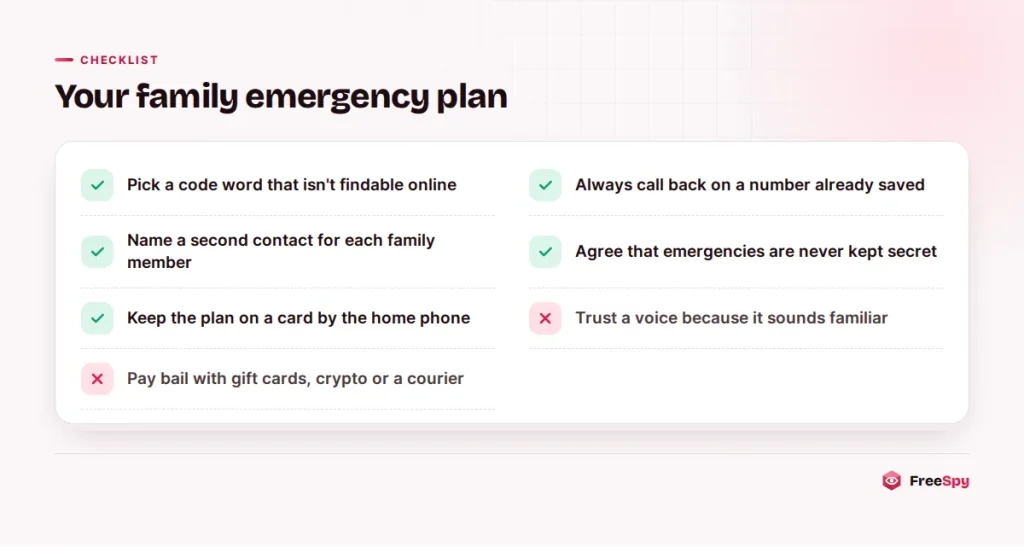
What still works is a family plan made in advance: a code word, a rule about calling back, and an agreement that emergencies are never kept secret. The FBI recommends exactly that kind of secret word. Setting it up takes one conversation.
Crying, a lawyer, then a request for secrecy
The FTC describes the basic pattern: someone calls saying they’re a family member or close friend, says it’s urgent and that you’re the only one who can help. The details change from call to call. The order of events hardly ever does.
It opens with emotion. A young-sounding voice, upset and hard to hear, says “It’s me.” Many people fill in the name themselves (“Jake, is that you?”), and now the caller has a name to use.
Then the emergency: a car accident, an arrest, a hospital bill, being stuck abroad. The Canadian Anti-Fraud Centre lists needing bail money after an arrest as a common version.
Next comes the handoff. A second person takes the phone, playing a lawyer, a police officer, a bail bondsman or a doctor. The FTC notes that scammers may pose as authority figures like these. The calm professional voice makes the story feel real and explains how to pay.
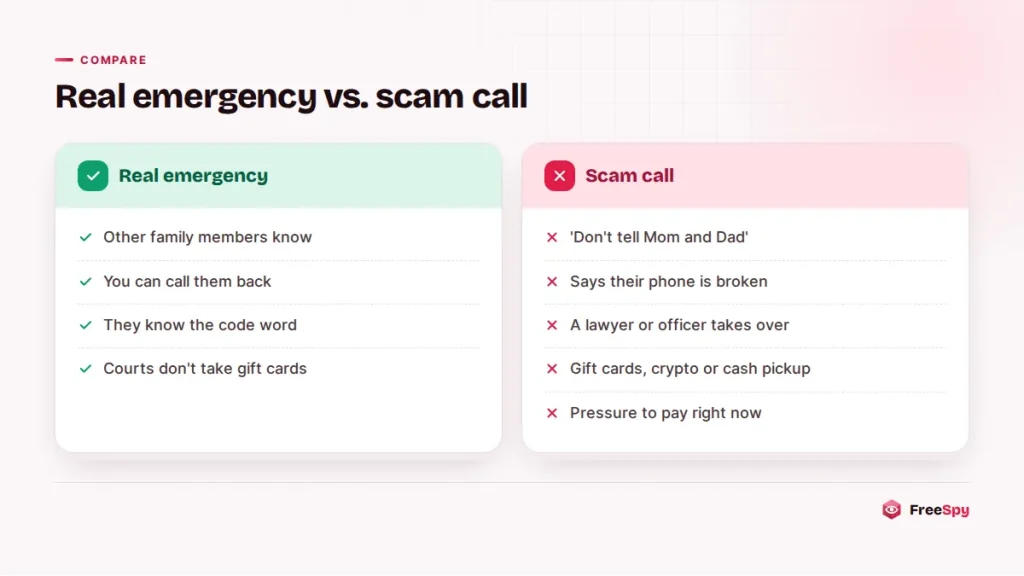
Then secrecy. “Please don’t tell Mom and Dad.” Some scammers claim a court “gag order” bars you from discussing the case, a tactic the CAFC specifically warns about. The point of secrecy is to stop you from checking the story with anyone.
Finally, payment: a wire transfer, cryptocurrency, a payment app, gift card numbers read over the phone, or cash. The CAFC says that if you agree to pay, fraudsters may arrange to pick up the money in person.
A second call often follows. A scammer who got paid once has every reason to return with a new problem. The charges got worse, or the other driver is pressing a claim. A request for more money is a strong sign the first payment went to a scammer too.
A short clip is enough to copy a voice
For years the main defense was “that didn’t sound like him.” Scammers leaned on bad connections and crying to hide a voice that was wrong. Voice cloning takes that defense away.
According to the FTC, a scammer needs a short audio clip of your family member’s voice, which could come from content posted online, plus a voice-cloning program. The result can sound just like your loved one. The FBI’s December 2024 public service announcement on generative AI says criminals generate short audio clips containing a loved one’s voice to impersonate a close relative in a crisis.
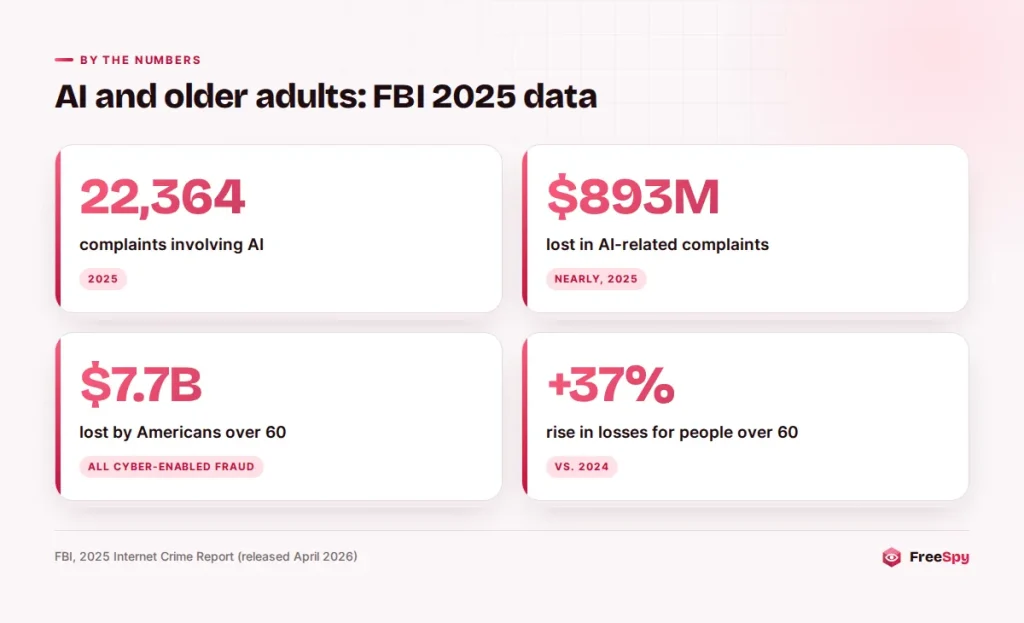
The FBI’s 2025 Internet Crime Report counted 22,364 complaints involving artificial intelligence, with losses of nearly $893 million. That covers every kind of AI-assisted fraud, not only family emergency calls, but voice clones are one of the tactics the FBI names. The same report found that people over 60 lost about $7.7 billion to cyber-enabled fraud in 2025, up 37% from 2024.
In the US, the FCC ruled in February 2024 that AI-generated voices in robocalls count as “artificial” voices under the Telephone Consumer Protection Act, which gives regulators another tool against illegal robocalls that use cloned voices. For a specific case, check the official source or talk to a lawyer.
Warning: A familiar voice no longer proves who is calling. Neither does caller ID: the CAFC notes that a caller ID showing a familiar name or number can be faked. Check the story, not the voice.
Your family’s posts supply the script
A convincing call needs more than a voice. Scammers want names, schools, travel plans and who is related to whom. The FTC says they may take details from social media or a hacked email account, or simply guess.
Public videos are the obvious source, since a short clip of a grandchild talking can be enough audio to work with. Tagged photos and comments like “Love you, Grandma” connect the grandchild to the grandparent. A “spring break in Cancun” post sets up the arrested-abroad story. Obituaries and announcements often list family members by name and town.
You can’t scrub all of this, and nobody should have to stop sharing their life. Making accounts private, limiting who can see family videos and skipping “we’re away right now” posts all shrink what a scammer can use. The CAFC advises care about what you share on social media for this reason.
A 15-minute family plan
The plan works because everyone agrees to it before an emergency, real or fake.
Pick a code word nobody could look up
The FBI recommends creating a secret word or phrase with your family to verify identity. Make it easy to remember and impossible to find online, so not a pet’s name, a street or a school. “Blue pancakes” works. So does an inside joke. Anyone calling in trouble should be able to say it, and a scammer with a perfect cloned voice won’t know it.
Agree that every money call gets a call back
This is the rule that matters most. If anyone calls asking for emergency money, the person who answered hangs up and calls back on the number already saved in their phone, not one the caller provides. No exceptions, even if the caller says their phone is broken or the police took it. The CAFC warns specifically about “new phone number” messages from relatives who claim their phone is broken.
Name a backup contact
If you can’t reach the person, the FTC advises trying them through another family member or their friends. Decide now who that is. For a grandchild at college, it might be a parent, a roommate or a sibling.
Say out loud that emergencies aren’t secret
“If anyone tells you to keep an emergency from the family, that’s the scam.” A real grandchild in real trouble would rather have their parents know than have Grandpa lose his savings.
Put it on paper by the phone
Write the code word reminder and the call-back numbers on a card next to the home phone. The CAFC notes these calls typically come to a home phone or landline, where an older relative may be alone when they answer.
Lines that slow the caller down
You don’t need to accuse anyone. You only need time. Try:
- “What’s our family word?”
- “I’m going to hang up and call you right back on your cell.”
- “Let me call your mother first. If it’s real, she’ll want to help.”
- To the “lawyer” or “officer”: “Give me your name and office. I’ll find the number myself and call you back.”
- A question only the real person could answer, as the FTC suggests, like the name of the family dog that died years ago.
Expect resistance. The caller may cry harder, say there’s no time, or get angry. That pressure is part of the script. The FTC’s advice is to resist the pressure to react and send money immediately.
Bail doesn’t get paid in gift cards
Real courts and hospitals don’t work the way these calls describe. The CAFC states that the Canadian justice system does not allow someone to be bailed out of jail with cash or cryptocurrency. The FBI’s IC3 says US government and law enforcement will never ask you to send money by wire to foreign accounts, by cryptocurrency, by gift cards or in cash shipments.
So if the request involves any of these, you can stop wondering:
- Gift cards, with the numbers read over the phone
- Cryptocurrency or a crypto ATM
- Cash in an envelope, handed to a “courier,” “bail agent” or driver at your door
- Cash mailed or shipped in a package
- A wire transfer to a person rather than a court
The FTC lists wiring money, cryptocurrency and gift cards as warning signs in family emergency calls. If someone is on the way to your home to collect cash, treat it as a crime in progress. Don’t hand anything over, and call your local police.
Money already sent? Call the payment company before anyone else
People who lose money this way are often smart and careful. The scam targets love and fear, not intelligence. The FTC’s advice is that the sooner you act, the better.
- Call the wire service, bank, gift card company or crypto platform you used. Say it was fraud and ask them to stop or reverse the transfer.
- If a courier came to your home, call the police. They may want to know if the scammer arranges a second pickup.
- Report it. In the US, use ReportFraud.ftc.gov and the FBI’s ic3.gov; the FTC also suggests your state attorney general. In Canada, report to local police and the Canadian Anti-Fraud Centre at 1-888-495-8501.
- Don’t answer follow-up requests for money, and be wary of anyone offering to recover your losses for a fee.
- Tell the family. It’s embarrassing, but scammers often try other relatives next.
If you also gave out bank or personal details during the call, a separate checklist for exposed information covers locking down accounts and credit.
Phone settings that buy you time
Settings won’t stop a determined scammer, but they help. Spam filtering and silencing unknown callers send many of these calls to voicemail, where there’s room to think. A voicemail from a “relative in trouble” gets the same call-back rule, and fake emergency voicemails follow patterns you can learn to hear.
You can also look up the number that called. FreeSpy shows the area code’s region, community reports and FTC complaints for any US or Canadian number. A number with reports of family-emergency calls settles the question, but a clean result proves nothing because scammers change numbers often. The call-back rule still comes first.
After a call like this, a report on the number warns the next family that gets it.
Sources
- FTC: Scammers use fake emergencies to steal your money
- FTC: Scammers use AI to enhance their family emergency schemes
- FTC: Fighting back against harmful voice cloning
- FBI IC3: Public service announcement I-120324-PSA
- FBI: Cryptocurrency and AI scams bilk Americans of billions
- FBI IC3: Government impersonation guidance
- Canadian Anti-Fraud Centre: Emergency scams