“Congratulations, you’ve been selected as our second-place winner.” The caller sounds cheerful and official, and the amount is large enough to change your year. There is only one small thing to take care of first: a fee, a tax or a delivery charge.
That small thing is the whole scam. Most phone fraud runs on fear. Prize calls run on hope, and people lower their guard when they hear good news. A real prize never costs money to collect, and once you hold onto that rule the rest of the script stops working.
The one question that ends the call
The FTC boils it down to three signs, and any one of them is enough:
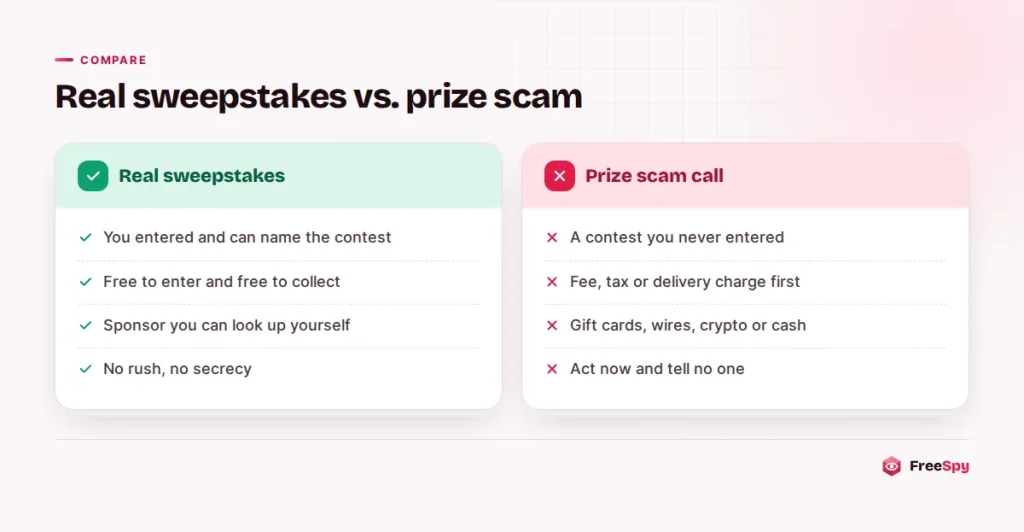
- “If you have to pay to get your prize, it’s a scam.”
- “If you have to pay to increase your odds of winning, it’s a scam.”
- “If you have to give your financial or personal information, it’s a scam.”
The agency also puts the rule the other way round: “Real sweepstakes are free and by chance,” and “It’s illegal to ask you to pay or buy something to enter or to increase your odds of winning.” In a warning about callers impersonating a well-known sweepstakes company, it adds that “no real sweepstakes company will demand money for a prize.”
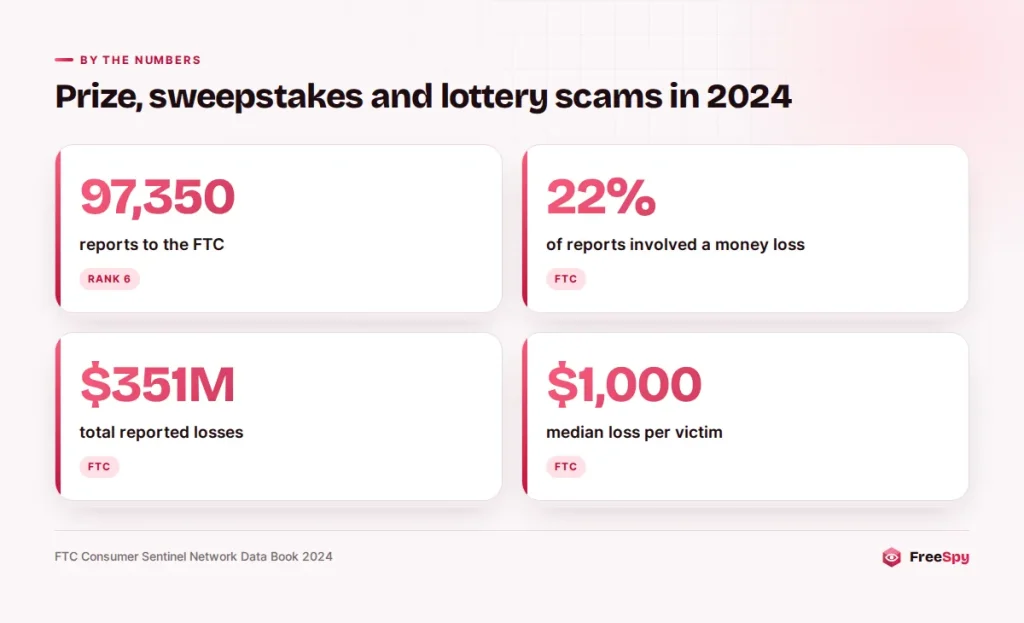
Before any of that, ask yourself whether you entered. Callers will say you were entered automatically through a store purchase, a magazine subscription or a “customer appreciation” draw. Real promotions have published rules and a sponsor you can find on your own.
A surprise win from a contest you can’t remember is the opening line, not a lucky break.
Four beats of a typical call
The details change, but the order rarely does. Recognizing the stage you’ve walked into helps you leave it.
The hook
A robocall, voicemail or live caller announces a win: cash, a car, a “sweepstakes check.” The FTC describes impersonators of one well-known sweepstakes brand who “tell you to call a number and press 1 to learn more,” and warn that if you don’t, you supposedly won’t get the money.
The proof
Then come official-sounding details. In the FTC’s example, callers claim “the winnings are at the Federal Reserve Bank of New York (they’re not).” Others quote a claim number, a “prize verification officer” or a government department said to be supervising the payout.
The fee
Before the prize can be released, you must cover taxes, insurance, customs, legal fees or delivery. The Canadian Anti-Fraud Centre (CAFC) says callers in this variation often claim to represent well-known publishers or prize companies and ask winners to pay for taxes, legal fees or delivery. A real sponsor doesn’t collect “tax” from winners by gift card, wire or crypto before handing over a prize.
The clock
The FTC notes callers insist you “act NOW” because “it’s a limited offer.” You’re told not to tell family, because “sharing your win” voids the prize or relatives will want a cut.
Strung together, it sounds like this:
“This is the compliance officer at the National Prize Office. Your number was selected in this year’s consumer sweepstakes for $2.5 million and a new car. Under federal rules we’re required to collect a 1% processing tax before release. That’s $2,500, and you can pay it today with gift cards from any pharmacy. Please don’t discuss this with anyone until delivery, for security reasons.”
The office in that script is invented, as is everything else in it. The “tax” is tiny next to the prize, which makes paying it feel sensible. That ratio is deliberate.
$351 million in a single year
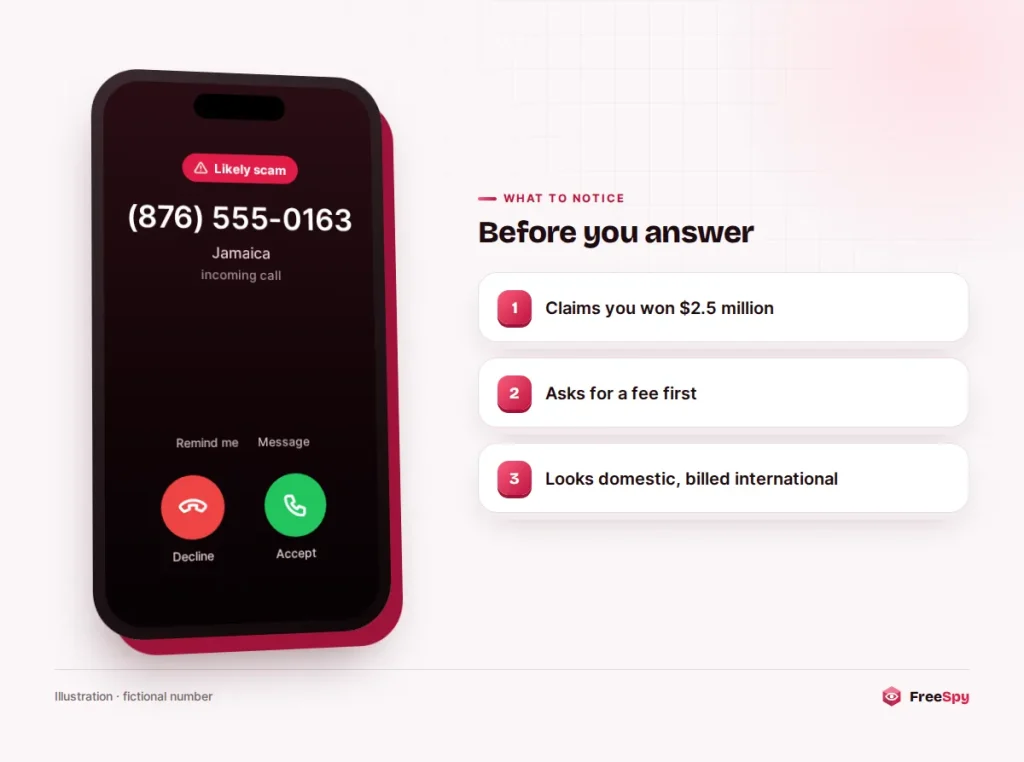
In the FTC’s Consumer Sentinel Data Book for 2024, “Prizes, Sweepstakes and Lotteries” ranked sixth among fraud categories, with 97,350 reports. Of those, 22% reported losing money, for a total of $351 million and a median loss of $1,000.
Phone contact makes it worse. According to the FTC’s 2025 data, as summarized by Experian, scams that started with a phone call had a median loss of $1,835, the highest of the main contact methods. A live caller can answer objections, build rapport and keep someone on the line for an hour. Prize scams depend on all three.
Gift cards, wires and couriers
Watch how the caller wants to be paid. The CAFC says these scammers often ask for money transfer services or prepaid gift cards. Others want cryptocurrency, a bank wire, or cash handed to a courier or mailed in a package.
Sometimes the request comes dressed up: “buy the cards at two different stores so the bank doesn’t flag it,” or “the courier will pick up the tax in cash so it’s processed today.” Those instructions exist to stop a cashier or a bank teller from asking you what’s going on.
Each of those is hard to reverse once the money moves, which is exactly why they’re chosen. A sponsor paying out a real prize has no use for any of them. If a “prize office” wants gift card numbers read over the phone, the conversation is finished.
Warning: Some scammers mail a real-looking check first and ask you to deposit it and send part back for “fees.” The check can bounce days later, after your money is gone. Never return money from a check a stranger sent you.
Why so many come from 876
A call about winning a lottery in another country is a scam on its face. The FTC notes that “it’s illegal for U.S. citizens to play a foreign lottery.” The CAFC lists the foreign lottery as a common variation, pointing out that you “did not travel to purchase tickets.”
The FBI has described how many lottery scammers carry out their crimes from Jamaica, using internet tools to mask their calls, with US associates, known as money mules, who help launder the money. It also notes that scammers “buy lead lists that are widely available online” to find older targets.
Jamaica’s area code is 876, and like other Caribbean codes it uses the same +1 format as US and Canadian numbers. A call from (876) 555-0163 looks domestic. It isn’t, and calling back is billed as an international call, the same trap used in the one-ring callback scam.
The reverse is also true: scammers can fake a local number, so a familiar area code proves nothing.
Paying once brings more calls
A person who has paid has shown that the script works on them. The fees grow: a second tax, a currency conversion charge, a penalty for late paperwork. The prize always stays one payment away.
Later calls may come from someone posing as a lawyer, a government investigator or a “recovery” service that will get the money back for an upfront fee. Same scam, new costume. The FTC itself “will never demand money, make threats, tell you to transfer money, or promise you a prize.”
Older adults are frequent targets, though anyone hopeful, lonely or short of money can be drawn in. If you’re worried about a parent, a calm conversation beats a lecture:
“I read that people are getting calls saying they won a big prize but need to pay a fee first. Real prizes never charge a fee. If anyone ever calls you about winning something, would you call me before you pay anything? I promise I won’t be upset.”
When they call back, and they usually do, you don’t owe them an explanation or an argument. “I’m not interested. Don’t call this number again,” then hang up. Trying to waste a scammer’s time or catch them out feels satisfying, but every minute on the line tells them the number is answered by a real person who engages, and that is the kind of number that gets sold on to the next crew.
The promise is the important part, because embarrassment keeps people paying in silence. A family code word, the kind suggested for fake-grandchild emergency calls, gives them a simple next step too.
A two-minute check before you do anything
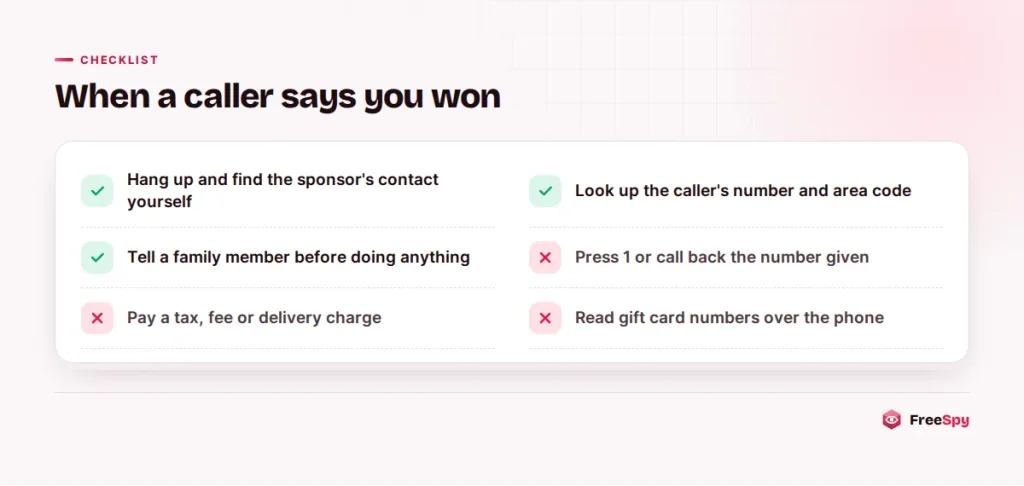
- Don’t press 1, and don’t call back the number you were given. Hang up.
- Ask whether you entered. If you can’t name the contest and roughly when, you didn’t.
- Find the sponsor yourself. The FTC advises contacting the real company with contact details you look up independently, not the ones the caller supplied.
- Look up the caller’s number for its region, number type and reports from other people.
- Apply the fee rule. If any payment is required, stop; there’s nothing left to verify.
On FreeSpy, a Caribbean number is labeled “Caribbean +1 international” instead of a US state, and its 0–100 risk score adds 15 points for that alone. Community reports, FTC Do Not Call complaints and sudden spikes add more, and each factor is listed on the number’s page.
Money already sent? Start with whoever moved it
The FTC’s advice is that “the sooner you act, the better.” Call the company that carried the payment: the gift card issuer, the money transfer service, your bank or the crypto exchange. Ask whether it can be stopped or reversed. For gift cards, the FTC says to contact the issuer immediately and keep the card and receipt; once the balance is spent, recovery is unlikely.
In the US, report the scam at ReportFraud.ftc.gov and to your state attorney general. If the offer came by mail, the FTC also points to the US Postal Inspection Service. In Canada, report to the CAFC online or at 1-888-495-8501. Which agency handles what is laid out in this US and Canada reporting walkthrough.
If you gave out a bank account, card, Social Security or Social Insurance Number, treat that as its own problem: call your bank, and look at a credit freeze or fraud alert.
Then expect follow-up calls. Say nothing, hang up, block. To warn others, add the number under “scam” and put the prize amount and the fee in your comment.
Questions people ask
Do real sweepstakes ever call winners?
Some legitimate promotions do contact winners, but they never ask you to pay to receive the prize. If you’re unsure, end the call and contact the sponsor through details you find yourself.
I only gave my name and address. Is that a problem?
It’s not a crisis, but expect more calls and mail, since your details may be passed to other scammers. Don’t engage, and be wary of anyone who mentions your “file.”
Sources
- FTC: Fake Prize, Sweepstakes, and Lottery Scams
- FTC consumer alert: Hang up on sweepstakes impersonators
- FTC Consumer Sentinel Network Data Book 2024
- FTC: Imposter scam losses in 2025
- FBI: Scammers Target the Elderly in Lottery Fraud
- Canadian Anti-Fraud Centre: Prize scams
- FTC: What To Do if You Were Scammed
- Experian summary of FTC 2025 fraud data