The voice says it’s the Canada Revenue Agency. You owe back taxes, a warrant has been issued, and an officer will be at your door this afternoon unless you settle the balance now. The caller ID even shows an Ottawa number.
It’s almost certainly a scam. But the CRA does sometimes phone people, so ignoring every call that uses its name isn’t a complete answer. The better answer is to check, using the process the CRA itself publishes, and to know the handful of things a real agent will never say.
The real CRA does call, which is the problem
Most impersonation scams borrow the name of an organization that rarely calls. The CRA is different. By its own account, there are times it needs to contact you “to ask for additional or missing information, to discuss an amount you owe, or notify about an upcoming review.” It may also call or write to begin an audit.
So the useful question isn’t whether the CRA ever calls. It’s whether this particular call came from the CRA. That has a reliable answer if you take ten minutes to check, and the people on the other end are counting on you not taking them.
The money involved is large. The Canadian Anti-Fraud Centre (CAFC) received more than 112,000 fraud reports in 2025, with more than $704 million in reported losses. “Personal information” fraud alone accounted for 3,016 reports, and scammers posing as bank or police investigators for 2,167 reports and $28.3 million in losses. Fake tax collectors belong to the same family of borrowed-authority fraud.
Three scripts you’re likely to hear
The warrant
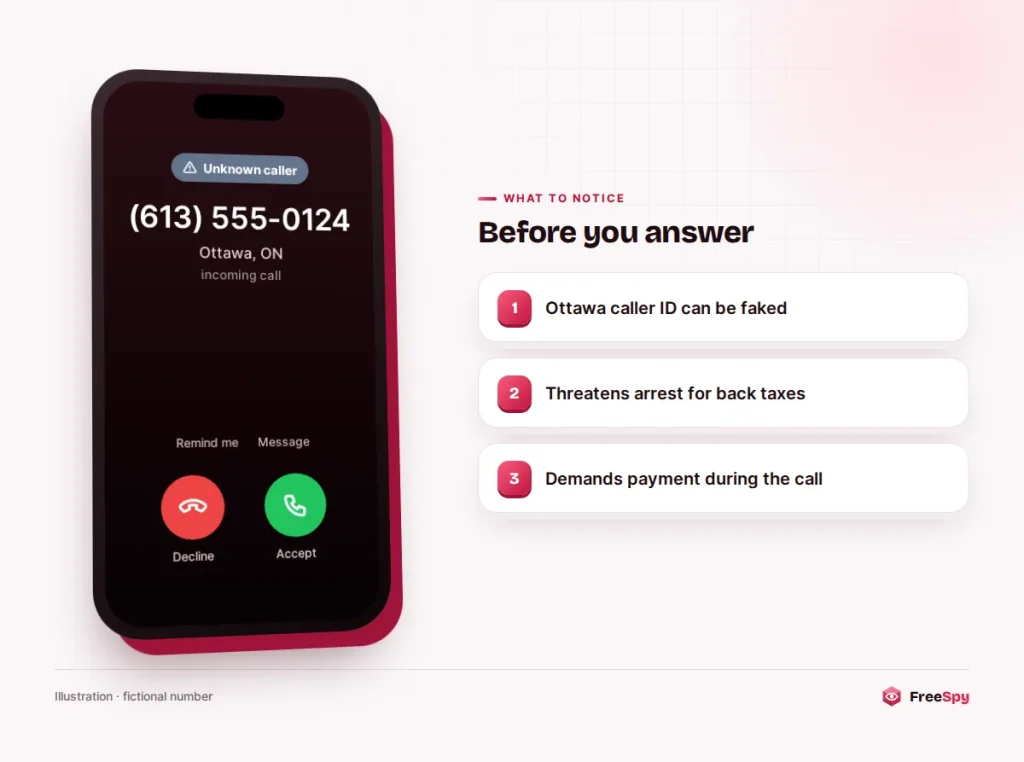
“This is an officer with the Canada Revenue Agency. We’ve found discrepancies in your returns for the last four years, and a warrant has been issued in your name. To avoid arrest today, you need to make a payment while I stay on the line.”
The robocall
“This message is for the person whose SIN ends in 4417. Your file has been suspended due to suspicious activity. Press 1 to speak with a CRA agent, or legal action will begin.”
The refund
“You’re eligible for a tax refund of $812.40 that was never deposited. I just need to confirm your banking information and your social insurance number to send it.”
The warrant version wants money today. The refund version wants the details needed to steal your identity. Both lean on urgency and a vague, alarming claim that falls apart the moment you check it.
Don’t be thrown if the caller already knows your address or part of your SIN. Personal details leak through data breaches and earlier scams, and quoting them back is how a fake call is made to feel official.
What the CRA says it may and won’t do
The CRA publishes clear limits on its own behaviour, and knowing them ends most fake calls in the first minute.
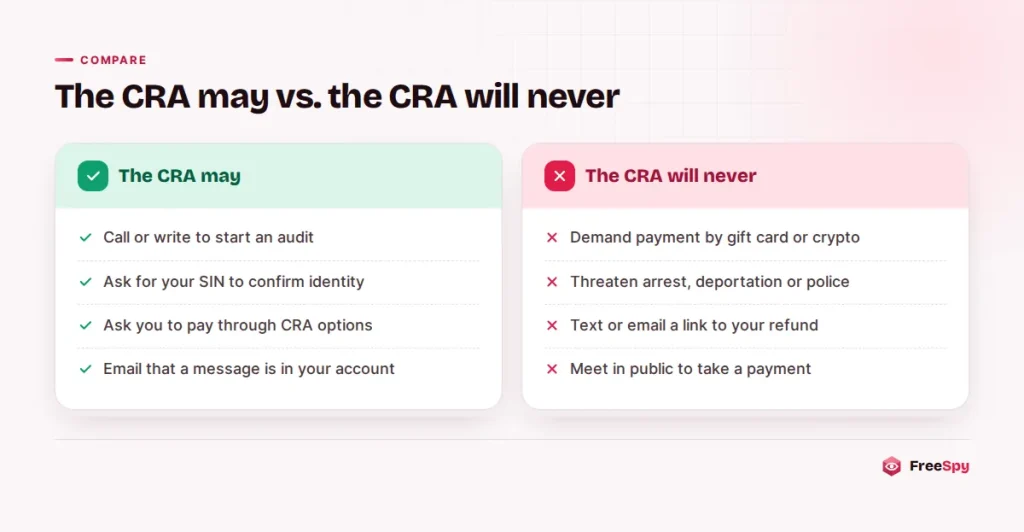
According to the CRA, it may:
- call or write to begin an audit, or to discuss missing information or an amount you owe
- ask for personal information such as your name, date of birth and social insurance number to confirm your identity
- ask you to pay an amount you owe through one of the CRA’s own payment options
- email you that a message or document is waiting in your CRA account
- take legal action to recover money you owe if you refuse to pay, through formal notices and processes
And it says it will never:
- “Demand immediate payment by e-transfer, cryptocurrency, prepaid credit cards or gift cards.”
- threaten you; in the CRA’s words, “Our call centre agents won’t threaten you with arrest, deportation or sending the police.”
- leave voicemails that are threatening or that include personal or financial information
- “Email or text you a link to your refund.”
- ask about your passport, health card or driver’s licence
- set up a meeting in a public place to take a payment
There’s an awkward overlap. A real agent may ask for your SIN to confirm who you are, so “never give your SIN to anyone who says CRA” isn’t quite right. Give it only after you’ve confirmed, through a number you looked up yourself, that you’re really talking to the CRA. And the legal action on that “may” list is real, but it arrives as formal notices, not as a phone demand for gift cards within the hour.
Real CRA contact leaves a trail
A genuine tax problem rarely appears out of nowhere in a single phone call. The CRA lists the ways it may reach you: it may send a notice of assessment or reassessment, call or write to begin an audit, or email to say a message is waiting in your CRA account. If a caller describes years of “discrepancies” and you have never received a single letter or account message about them, that gap is telling.
The same goes for payment. A real balance is paid through the CRA’s own payment options, which are listed on canada.ca. An Interac e-transfer to someone’s personal email address, a crypto ATM in a convenience store or a stack of gift cards isn’t one of them, whatever name the caller gives it.
If you do owe money, the debt doesn’t vanish because a scammer used it as bait. Call the CRA on a number from canada.ca and ask what is on your file. You’ll get a real answer, with real options, and nobody will ask you to stay on the line while you drive to a store.
Checking a call against the CRA’s own process
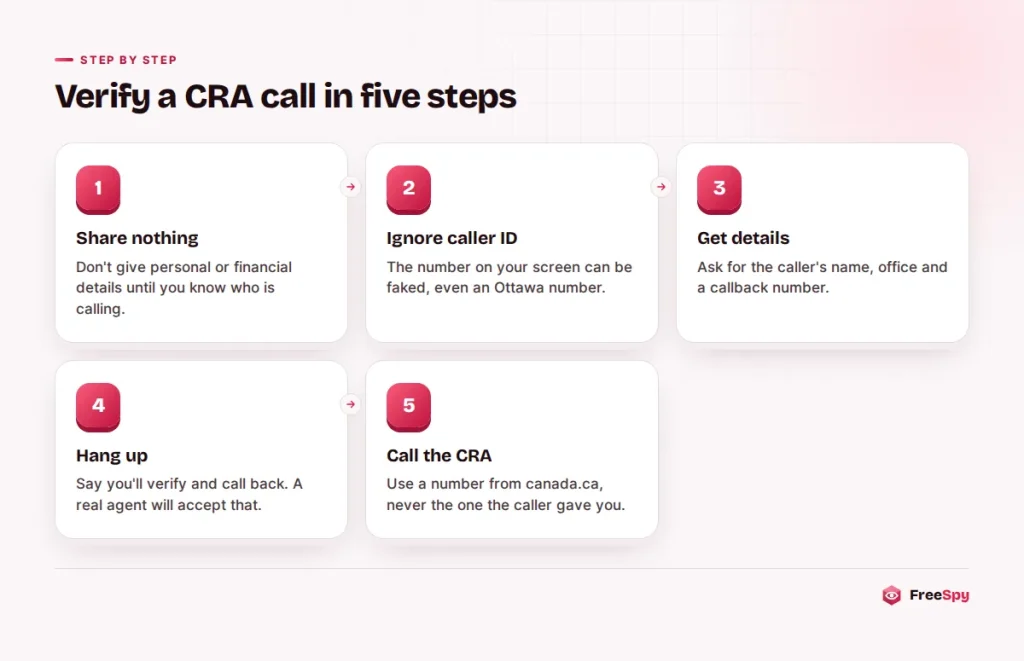
The CRA’s page “Verify it’s the CRA calling” sets out the steps. In practical form:
- Share nothing yet. The CRA’s advice: “Since you do not know if it’s really the CRA calling you, do not provide any personal information to the caller.”
- Disregard the number on your screen. The CRA warns: “Do not trust the phone number displayed on your caller ID.” An Ottawa number, a government-looking number or a blocked one tells you nothing either way, because caller ID spoofing can put almost anything there.
- Ask for details. Get the caller’s name, office or location, and a callback number. Real CRA employees identify themselves and give you a name and a number to call back.
- End the call politely. Say you’ll verify and call back. A real agent will accept that. A scammer will push.
- Check the callback number. The verify page has a tool where you enter the number you were given. Don’t do it while still on the call. As the CRA puts it: “Never call the phone number that was given to you unless you have verified it yourself with the CRA.”
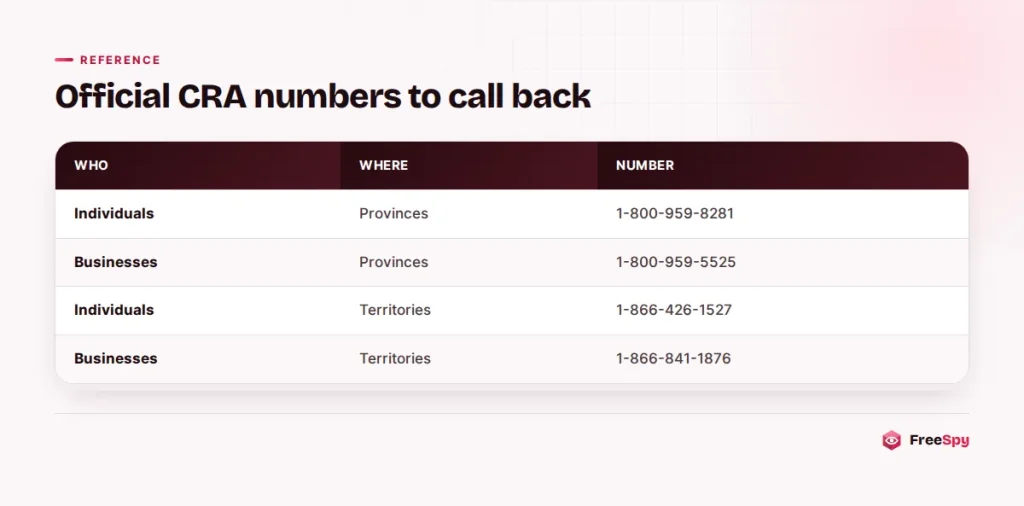
- Call the CRA directly. From canada.ca: 1-800-959-8281 for individuals and 1-800-959-5525 for businesses in the provinces; 1-866-426-1527 for individuals and 1-866-841-1876 for businesses in the territories. Expect a wait in busy periods.
- Look at your CRA account. If you use one, sign in through canada.ca rather than a link, and see whether any message, notice or balance matches what the caller said.
You can close the call with one sentence:
“Thanks. I don’t give out information on calls I didn’t make. Please give me your name, your office and a callback number, and I’ll contact the CRA through the number on canada.ca.”
A scammer will usually escalate here, with arrest threats or a warning that the “offer” expires in minutes. That reaction is your answer.
Refund texts and “legal case” voicemails
The rules carry over to writing. The CRA says it “will never email or text you a link to your refund.” When it has something for you, it emails to say a message or document is waiting in your CRA account, and you sign in on your own to read it. A text with a link to “claim your refund” or “update your direct deposit” is phishing. Forward it to 7726 (SPAM), which is free in Canada, then delete it.
Voicemails follow the call pattern. The CRA doesn’t leave threatening voicemails or ones containing personal or financial information, so a message demanding an urgent callback about a “legal case” isn’t from the CRA. The scripts behind these recordings are much the same across agencies and banks, and the fake voicemail patterns are worth knowing.
Tip: Before returning any unknown call, look the number up on FreeSpy. You’ll see the area code’s region, whether the number is valid, and any community reports or FTC complaints. A clean result doesn’t prove it’s the CRA, but a page of “government impersonation” reports settles it quickly.
Shared your SIN or paid? Who to call first
Don’t let embarrassment slow you down. These scripts are written by professionals, and speed limits the damage.
Start with your bank if you paid or gave banking details, and ask about stopping transfers and watching the account.
Then the CRA. Contact it if you think your CRA sign-in was compromised, if you see changes you didn’t make to your banking, address or personal information in your CRA account, or if a benefit application was filed without your knowledge. Its “Report a scam or identity theft” page explains reporting by phone, by fax or through an online form; after an online report, a CRA officer contacts you within 14 business days.
After that:
- the credit bureaus, Equifax and TransUnion, to ask about a fraud alert
- Service Canada at 1-866-274-6627 for SIN misuse, as the CRA advises
- your local police, keeping the file number
- the CAFC, online or at 1-888-495-8501
Report to the CAFC even if you hung up straight away and lost nothing. The CRA says that if someone attempted to scam you but you gave no information, “you should still report it.” Those reports show which scripts and numbers are active. Credit freezes, fraud alerts and the rest of the cleanup are covered in more depth in the guide on what to do after sharing personal details.
Same playbook, US names
South of the border the script swaps in the IRS or Social Security. The IRS usually makes first contact by mail and won’t demand immediate payment by gift card, wire or crypto, or threaten arrest. Social Security and other agencies set similar limits, summarized in our overview of fake government calls.
Sources
- CRA: Verify it’s the CRA calling
- CRA: How to recognize fraud, scams and tax schemes
- CRA: The CRA may / The CRA will never (infographic)
- CRA: Report a scam or identity theft
- Get Cyber Safe: Reporting spam text messages to 7726
- Canadian Anti-Fraud Centre: Top frauds of 2025