Most phone scams are not clever. They are fast. The caller hands you a problem you didn’t know you had, such as a frozen bank account, a warrant or a grandchild in jail, and then offers one way out that has to happen right now, on the phone, with money that can’t be pulled back.
What follows covers the scams that reach phones in the US and Canada most often: how each one opens, what the caller says, where the story gives itself away, and what to do instead. Near the end there’s a short test you can run during any call, and a plan for the worst case, when the money is already gone.
A $15.9 billion year
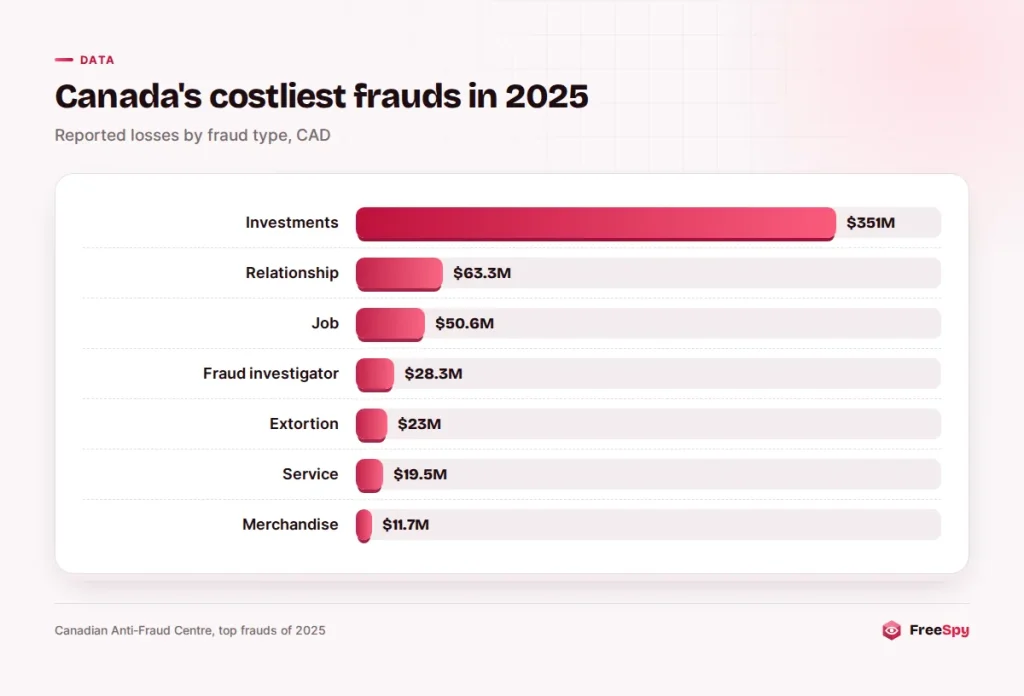
According to the FTC’s Consumer Sentinel data for 2025, people filed about 3 million fraud reports and reported losing $15.9 billion. That’s a record, and roughly 25% more than the $12.5 billion reported for 2024. Imposter scams were the most-reported category, with more than 1 million reports and $3.5 billion lost, nearly one in three fraud reports. Investment scams caused the largest losses, at $7.9 billion.
Calls are not the most common way a scam starts, but they’re among the most expensive. Experian’s summary of the FTC’s 2025 data counts 290,427 reports of scams that began with a phone call, with $1.108 billion lost and a median loss of $1,835, the highest of the main contact methods.
Texts produced more reports (411,424) but less money lost ($639 million) and a lower median ($1,000). The difference makes sense. A live voice can answer objections, sound worried or official, and keep you on the line while you drive to the bank. A text can’t.
Robocalls carry a lot of this traffic. The YouMail Robocall Index estimates 52.5 billion robocalls reached US phones in 2025, barely changed from 52.8 billion in 2024. In November 2025 alone, YouMail counted 3.8 billion, and scams plus telemarketing made up 56% of them.
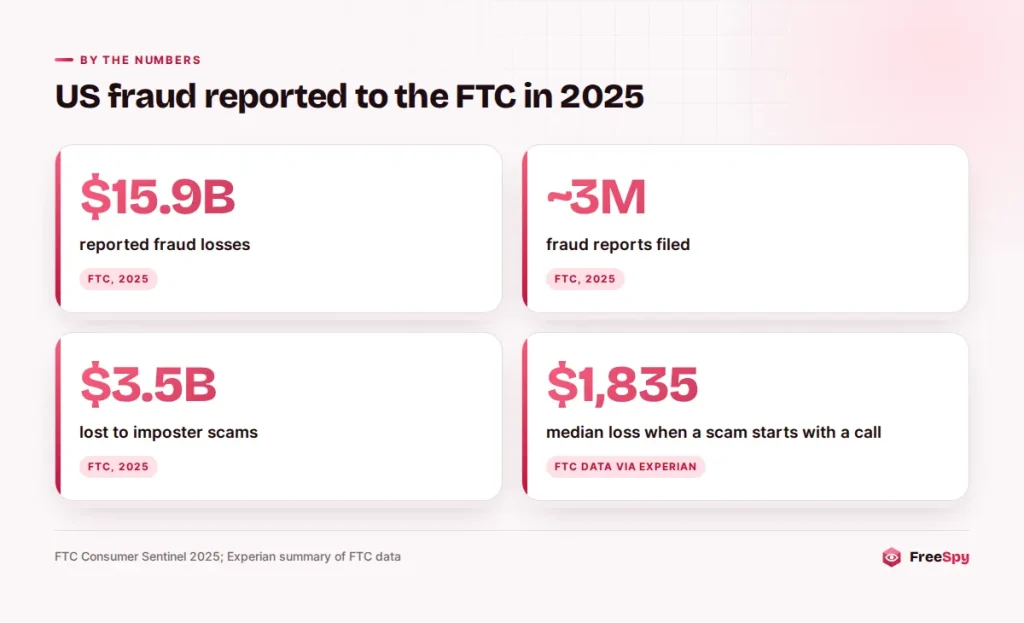
Canada sees the same patterns. The Canadian Anti-Fraud Centre (CAFC) received more than 112,000 fraud reports in 2025, with over $704 million (CAD) in reported losses. Investment fraud led by a wide margin at $351 million.
One Canadian category is almost entirely phone-based: the “fraud investigator” scam, where callers pose as bank or police investigators. It produced 2,167 reports and $28.3 million in losses.
Treat all of these figures as a floor. They count only people who reported, and the FTC notes it didn’t collect reports during the 2025 government shutdown. Many victims never tell anyone, often because they’re embarrassed.
The script is built to stop you thinking
Phone scammers don’t need you to be gullible. They need you to be in a hurry and a little frightened, because a person under threat stops checking details. Every script is written to put you in that state and keep you there.
A clock that’s always running
The account will be drained “in the next hour”. The officers are “on their way”. The power goes off “at 3 p.m.” A deadline takes away the one thing that defeats almost every scam: time to hang up and check.
Borrowed authority
The caller is a federal agent, a bank’s fraud department, Microsoft support or a police sergeant. They quote badge numbers and case numbers, read out the last four digits of your card, and may already know your address. None of that proves anything. Personal details are cheap to buy after data breaches.
Fear, or sometimes hope
Most scripts threaten something: arrest, deportation, losing your savings, a relative hurt. Prize, investment and romance scams run on hope instead. The effect is the same, because strong feelings crowd out careful thinking.
Secrecy
“Don’t tell the bank teller, they may be part of the investigation.” “Don’t tell Mom, she’ll be furious.” Isolation is a deliberate step, because a five-minute conversation with a family member or a bank employee ends most scams.
Money that can’t come back
The last step is always a payment that is hard to trace and close to impossible to reverse.
With gift cards, you buy cards at a store and read the numbers off the back, and the balance can be drained within minutes. Wire transfers and payment apps behave like cash once the money is sent and accepted. Cryptocurrency often goes out from an exchange account the scammer walks you through opening.
Crypto ATMs are a newer favourite. You feed cash into a kiosk at a gas station or convenience store and scan a QR code the caller sends you, and that code is the scammer’s wallet. Then there are cash couriers: someone comes to your door to collect cash or gold, or you’re told to mail cash hidden inside a package.
Credit cards come with dispute rights. These methods mostly don’t, which is exactly why scammers insist on them. The FTC says plainly that it will never demand money, make threats, tell you to transfer money, or promise you a prize. Neither will any real government agency or bank.
The scams you’re most likely to meet
Scripts change every few months, but the bones of each scam stay the same. Once you know the bones, the new versions are easy to spot.
Government imposters: SSA, IRS, CRA and “police”
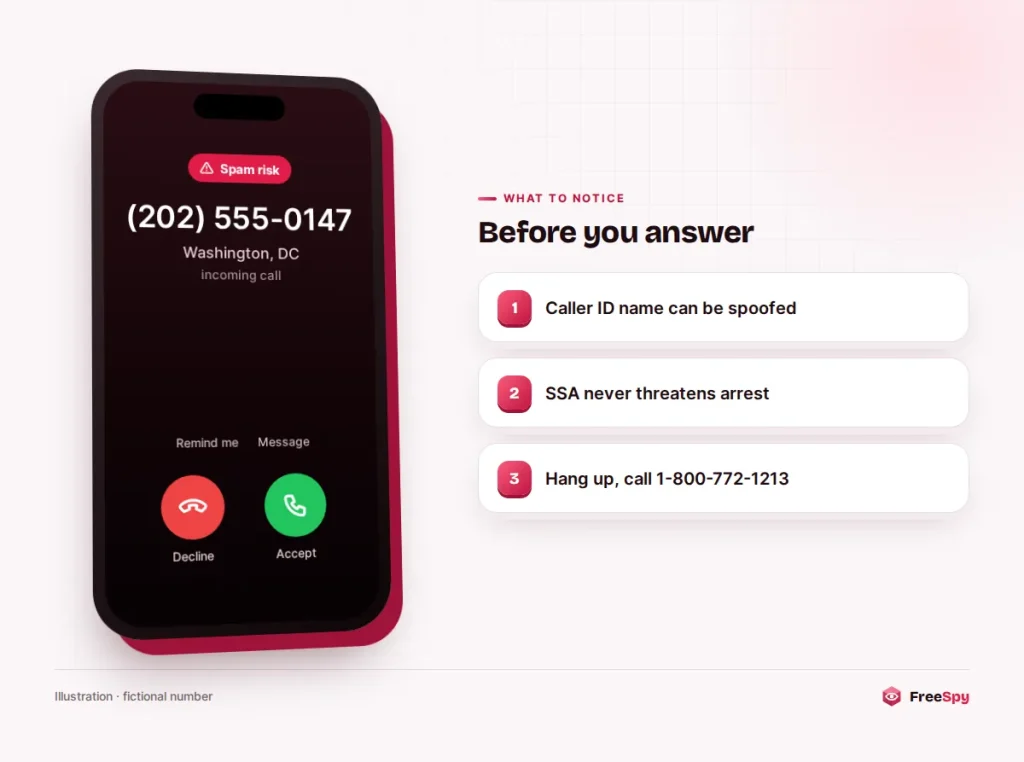
The call, often a robocall that hands off to a live person, says your Social Security number has been “suspended” or linked to a crime, or that you owe back taxes to the IRS or, in Canada, the Canada Revenue Agency (CRA). Sometimes it’s a warrant for your arrest. Caller ID may show a real agency’s name or number.
The “agent” or “officer” reads a case number, explains that your assets must be “protected” or the debt settled today, and warns that local police will come if you hang up. In Canada the caller often claims to be from the RCMP, a local police service or a bank’s “fraud investigator”.
The giveaways are threats of arrest or deportation, payment by gift card or crypto, and instructions to stay on the line while you go to a store. Social Security numbers are not suspended. The IRS usually makes first contact by mail and does not demand immediate payment by gift card, wire or crypto.
To check, call the agency on a number from its official website, such as SSA at 1-800-772-1213 or the IRS at 1-800-829-1040. Each agency’s version of the script is broken down in the piece on calls from fake agencies.
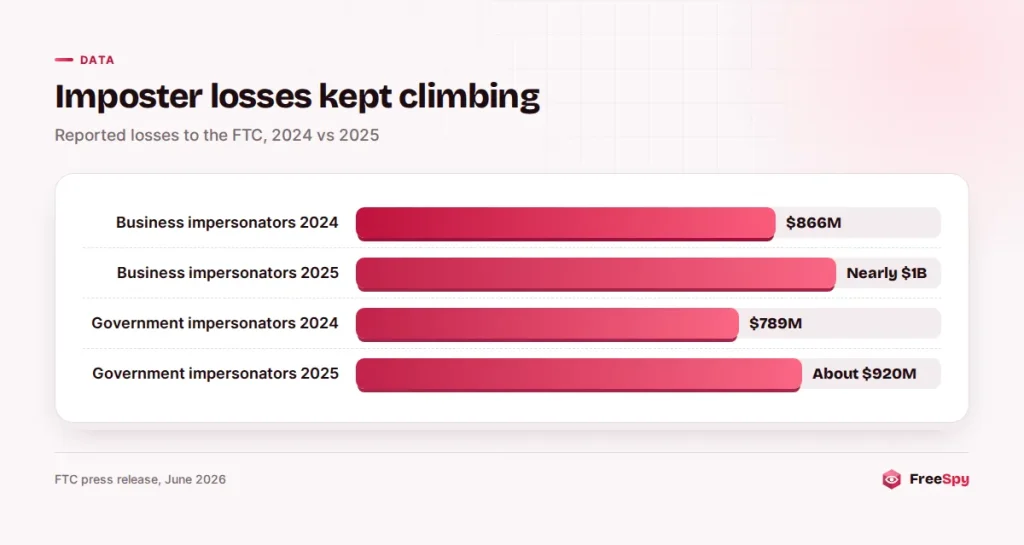
This category keeps getting more expensive. FTC data shows losses to government impersonators rose from $789 million in 2024 to about $920 million in 2025, while business impersonators climbed from $866 million to nearly $1 billion.
“Your account is at risk, move it to a safe account”
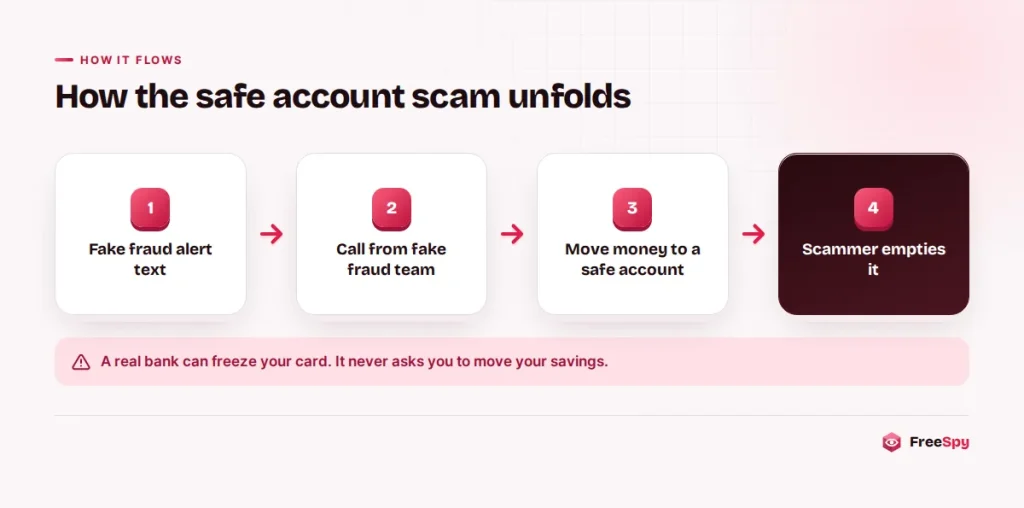
This one often begins with a text dressed up as a fraud alert: “Did you attempt a purchase of $1,249 at an electronics store? Reply YES or NO.” Reply either way and someone from the “fraud department” calls within minutes. Caller ID may show your bank’s real number.
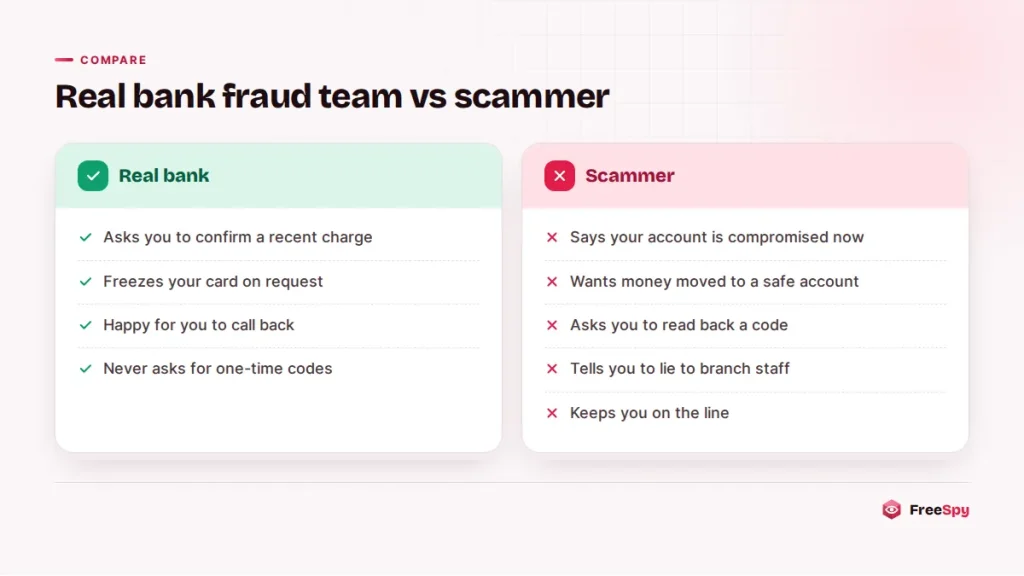
The caller says criminals, sometimes “someone inside the branch”, have access to your account. To protect your money you have to move it to a new “safe account”, withdraw cash for a courier, or read back the one-time code the bank just texted you. That code is usually what lets the scammer log in or approve a payment.
No real bank asks you to move money to protect it, read out a passcode, or lie to branch staff about why you’re withdrawing cash. According to the FTC, bank impersonators caused the highest losses among business impersonators in 2025, and many of the costliest scams began with a fake security alert.
The fix takes one phone call: hang up and dial the number on the back of your card. A real fraud team can freeze the card on that call. It will never ask you to move your savings. The differences between a real alert and a fake one are covered in more depth in this look at bank fraud calls.
Tech support
A browser pop-up freezes the screen and tells you to call a number, or “Microsoft”, “Apple” or your internet provider calls out of nowhere about a virus on your computer.
The “technician” asks you to install a remote-access app, shows you harmless system logs as proof of infection, then charges for a fix. A common twist is the refund trick. They say you’re owed a refund, “accidentally” add too much to your bank balance on screen, and beg you to send the difference back.
Real tech companies don’t phone you about viruses. Close the browser, force-quitting it if you must, and never call a number shown in a pop-up. If you already gave someone access, disconnect from the internet, run a security scan, change passwords from a different device and call your bank.
Utility shut-off threats
The caller says your electricity, gas or water will be cut off within the hour over an unpaid bill, and that a “disconnection crew is already on the way” unless you pay now by prepaid card, payment app or crypto ATM. Restaurants and other small businesses are frequent targets, usually right before their busiest hours.
Utilities send written notices before disconnecting anyone and accept ordinary payment channels. Call the number on your latest bill or the utility’s website.
The grandchild in trouble, now with a cloned voice
“Grandma, it’s me. I’ve been in a car accident and they arrested me. Please don’t tell Mom.” The voice is crying or muffled, which covers small differences.
Then a “lawyer” or “police officer” takes over and explains that bail must be paid today, in cash. A courier will pick it up, or you’re told to mail it. A second call often follows asking for “court fees”.
The voice itself is no longer proof. Scammers can clone a voice from short clips posted online. In February 2024 the FCC ruled that AI-generated voices in robocalls count as “artificial” voices under the Telephone Consumer Protection Act, which makes those calls illegal without prior consent.
Hang up and call your relative, or their parent, on the number you already have. Better still, agree on a family safe word now that anyone in real trouble would use.
One ring and gone
Your phone rings once and stops. The missed call shows an area code that looks domestic, such as 876, 809 or 473, but belongs to a Caribbean country.
If you call back, you may pay an international connection fee plus per-minute charges, and part of that money goes to the scammer. There’s no script here. Curiosity does the work. Don’t return missed calls from numbers you don’t recognize until you’ve looked them up. If they keep coming, it helps to understand how the one-ring billing trick pays the people behind it.
Packages that can’t be delivered, tolls you didn’t skip
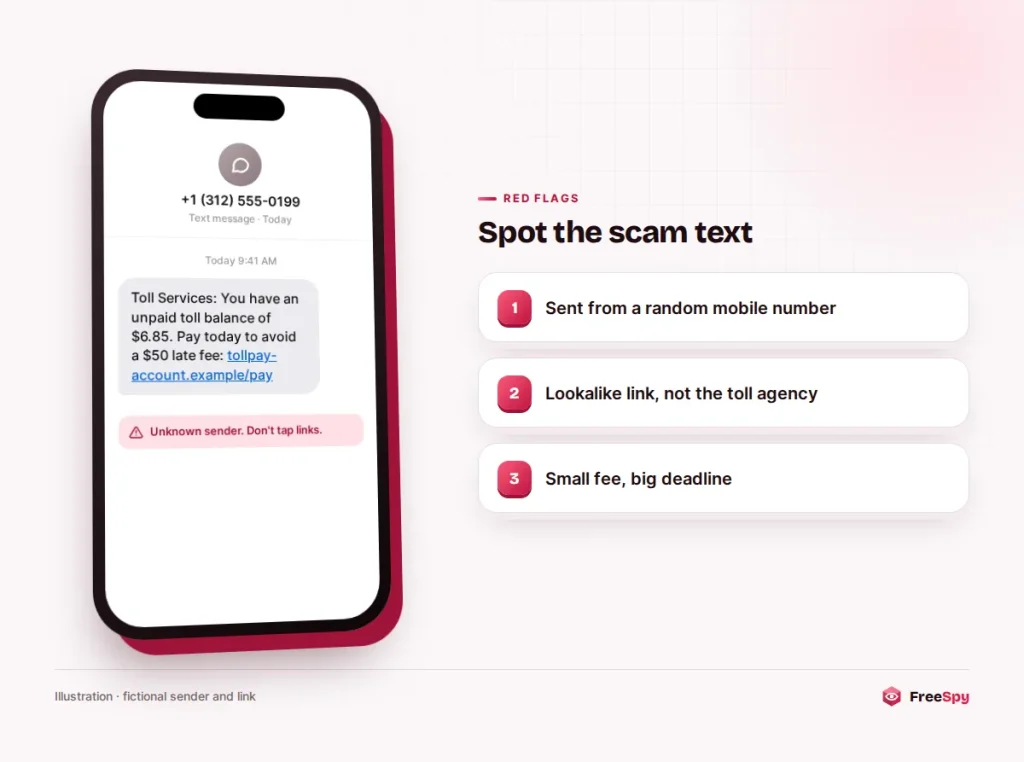
A text says a package couldn’t be delivered, often “from USPS”, or that you owe an unpaid toll plus a late fee. According to the FTC, fake package delivery problems were the most-reported text scam of 2024, and bogus toll notices ranked fourth.
The link leads to a convincing copy of the real site that asks for a small fee and your card details. The fee is a pretext. The card number is the goal.
Don’t tap the link. Check the tracking number or toll account by typing the official website into your browser yourself, and forward the text to 7726 (SPAM). Reading a link before you trust it is a skill worth ten minutes, and the guide to scam texts shows how.
Jobs you never applied for
A “recruiter” texts or messages you about remote work with flexible hours. The FTC ranked phony job offers as the second most-reported text scam of 2024, and the CAFC logged 2,148 job-fraud reports and $50.6 million in losses in 2025.
In a task scam you “rate products” or “boost apps” on an online dashboard that shows growing earnings. Then a “combination task” pushes your balance negative, and you have to deposit crypto to keep going or to withdraw.
No interview, a job you didn’t apply for, and any payment from you to start or to get paid: that combination is the scam. Stop paying. No legitimate employer charges you to receive your wages.
The “wrong number” that turns into an investment pitch
A text meant for “someone else” arrives: “Hi Amy, are we still on for golf Saturday?” When you politely say it’s the wrong number, the sender apologizes and strikes up a friendly conversation that can run for weeks.
Eventually the new friend mentions success in crypto or gold trading and offers to show you how. A slick platform shows big gains on small deposits. When you try to withdraw, you’re told to pay “taxes” or “release fees” first.
FTC data puts investment scam losses at $7.9 billion for 2025, the most of any category. In Canada, the CAFC recorded $351 million in investment losses and $63.3 million in relationship-fraud losses. Don’t reply to wrong-number texts, and never send money to someone you’ve only met online.
Debt relief robocalls
A prerecorded message offers to lower your credit card interest rate or wipe out your debt. “Reducing debt” was a top topic in Do Not Call complaints, according to the FTC’s Data Book for fiscal 2025. Press 1 and a “specialist” asks for an upfront fee and your account details.
Hang up. If you need help with debt, contact your lender directly or a nonprofit credit counseling agency you research yourself.
Medicare and health coverage
The offer is a “new Medicare card”, a free back brace or genetic test, or cheaper health coverage. Medical and prescription topics are also among the top Do Not Call complaint subjects. The caller needs your Medicare or insurance number to “verify eligibility”, then bills for services or equipment you never receive.
Treat your Medicare number like a credit card number. Medicare doesn’t cold-call people to sell anything. In Canada, the same pitch shows up around provincial health cards, and provinces don’t phone to renew them.
The car warranty “final notice”
A robocall warns that your vehicle’s warranty is about to expire. Press 1 to “reactivate” coverage and you get a high-pressure pitch for an overpriced service contract, or a request for card details.
Don’t press any key, since that only confirms your number reaches a person. If anything about your warranty actually changes, the manufacturer or dealer will write to you.
Prizes that cost money
“Congratulations, you’ve won a car and a cash prize.” Before the prize can be released, you have to pay taxes, insurance or a “processing fee”, usually by gift card or wire. Once you pay, a new fee appears.
If you have to pay to collect a prize, there is no prize. You also can’t win a contest you never entered.
The 10-second test
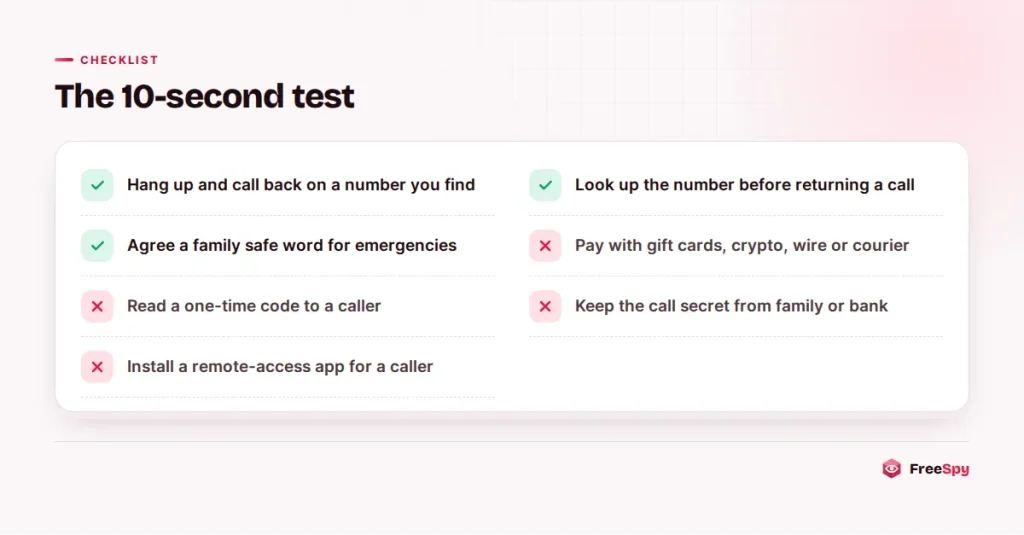
You don’t need to work out which scam you’re hearing. You only need to notice one of these signs, and that takes seconds:
- Did they contact me, and are they asking for money or information?
- Is there a deadline measured in minutes or hours?
- Do they want gift cards, a wire, crypto, a crypto ATM, a payment app or cash handed to a courier?
- Are they asking me to keep this secret, or to lie to my bank?
- Do they want a one-time code, a password, a PIN, or my full SSN or SIN?
- Do they want me to install an app or give them remote access?
One “yes” is enough. Say “I’ll call you back”, hang up, and contact the organization on a number from its official website, your bill or the back of your card. Caller ID can be faked, so the number that rang you doesn’t count. A real bank, agency or relative will still be there in ten minutes. A scammer will try to keep you from hanging up, and that pressure is your answer.
Before you call back any unfamiliar number, run it through a free lookup. FreeSpy checks the number against numbering-plan rules (impossible numbers are flagged as likely spoofed), shows the area code’s region and number type, and lists community reports and FTC complaints with a 0–100 risk score.
The money’s gone: the first hour
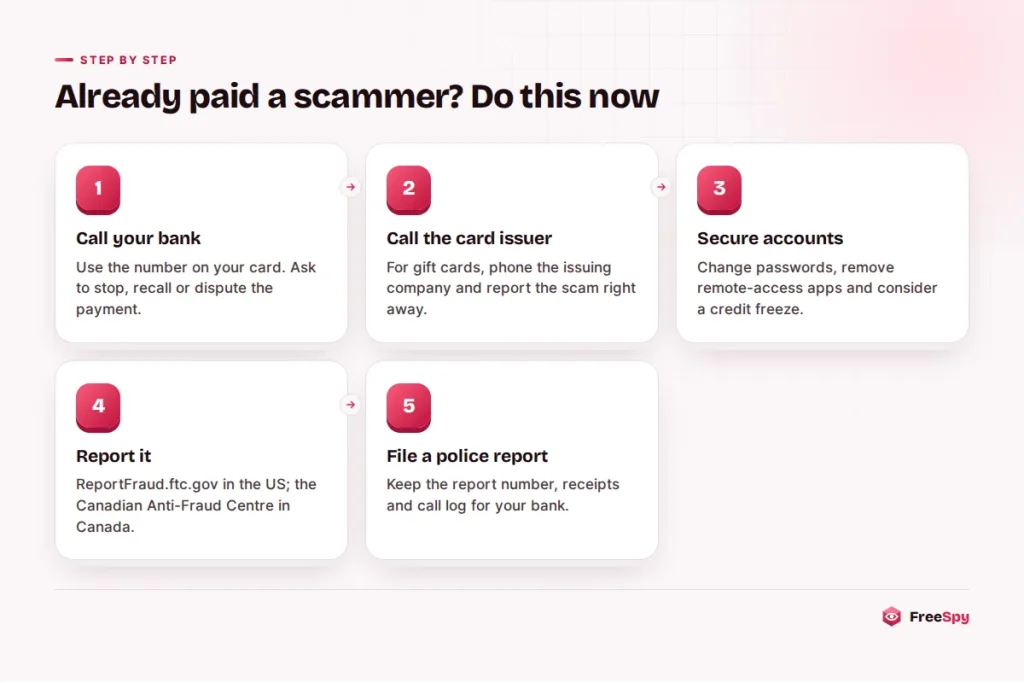
Don’t wait until you’re sure. Recovery chances drop fast, and banks and card issuers can sometimes stop a payment that hasn’t settled. Who to call depends on how you paid.
- Bank transfer, wire or payment app: call your bank’s fraud line on the number on your card. Ask them to recall or reverse the transfer and to flag the receiving account.
- Credit or debit card: dispute the charge and ask for a new card number.
- Gift cards: call the company that issued the card, using the number on the back or its official website. Tell them the card was used in a scam and ask for a refund. Keep the cards and the store receipts.
- Crypto or a crypto ATM: contact the exchange or the ATM operator right away and report the wallet address you sent to. Keep the transaction receipts.
- Cash handed to a courier or mailed: call your local police. In the US, also contact the shipping company to try to intercept the package.
- Remote access: disconnect the device from the internet, remove the app, run a security scan and change passwords from another device.
If you gave out your Social Security number, a bank login or other identity details, IdentityTheft.gov builds a personal recovery plan for US residents, and a credit freeze is worth considering. In Canada, contact your bank and the two national credit bureaus, Equifax and TransUnion. The full sequence for leaked personal details is laid out in what to do after giving a scammer your information.
Then report it. In the US, file at ReportFraud.ftc.gov, and report government imposters to the SSA Office of the Inspector General (oig.ssa.gov), or to TIGTA (tigta.gov) for IRS scams. In Canada, report to the Canadian Anti-Fraud Centre online or at 1-888-495-8501. File a police report too, because banks and card issuers often ask for the report number. A community report on the number itself warns the next person who looks it up.
Watch for the second scam: victims are often contacted later by “recovery agents”, “lawyers” or even fake FTC staff who promise to get the money back for an upfront fee. Nobody legitimate charges you to recover money stolen in a scam.
Looking out for older relatives
Older adults aren’t the only targets, but the grandparent call and the Medicare pitch are aimed squarely at them, and the losses often come out of savings that can’t be replaced. A few habits make a large difference.
Talk through the scripts before they arrive. Someone who has already heard “your grandson is in jail and needs bail” described is far more likely to recognize it on the phone. Set a family safe word for real emergencies, and agree that nobody moves money because of a call without first checking with a family member.
Turn on call filtering. Silence Unknown Callers on iPhone, or spam filtering on Android, sends strangers to voicemail, and the settings for both are in the walkthrough on blocking spam calls.
Register on the Do Not Call lists: the US National Do Not Call Registry (1-888-382-1222) or Canada’s National DNCL (1-866-580-3625). Scammers ignore these lists, but cutting down legal telemarketing makes the calls that remain easier to treat with suspicion.
Ask the bank about extra protections, such as alerts on large withdrawals or adding a trusted contact to the account.
And keep shame out of it. Scammers tell victims to stay quiet because embarrassment is what stops people from getting help in time.
Questions people ask
Can a scammer make my phone show a real bank or government number?
Yes. Spoofing is easy, and the Truth in Caller ID Act makes it illegal only when it’s done to defraud or cause harm, which doesn’t stop criminals. STIR/SHAKEN call authentication helps carriers flag spoofed calls but doesn’t catch them all.
Is it risky just to answer a scam call?
Answering alone usually costs nothing. The risk comes from talking, pressing keys or calling back, which confirms that a real person uses the number and can lead to more calls.
Will the Do Not Call Registry stop scam calls?
No. It cuts calls from legitimate telemarketers who follow the law, and scammers ignore it. Call filtering and not engaging with unknown callers do more against scams. For a specific legal question, check the official source or consult a lawyer.
Sources
- FTC testimony to the Joint Economic Committee (March 2026)
- FTC: people reported losing $3.5 billion to imposter scams in 2025 (June 2026)
- Experian: identity theft and fraud statistics (FTC 2025 data)
- FTC Data Spotlight: top text scams of 2024
- FTC National Do Not Call Registry Data Book, FY2025
- YouMail Robocall Index
- Canadian Anti-Fraud Centre: top frauds of 2025
- ReportFraud.ftc.gov and IdentityTheft.gov
- SSA Office of the Inspector General and TIGTA