You answer, say hello, and hear nothing. Maybe a faint hiss, maybe a click or a second of office noise, then the line goes dead. The next day it happens again from a different number.
Almost always, the explanation is a piece of call center software that dialed more people than it had agents to talk to. That’s annoying, and in some cases against the rules, but it isn’t sinister. A smaller share of these calls come from robocallers testing numbers, from network faults or from pockets. And now and then a pattern of hang-ups is personal, which is worth being able to recognize.
The software that dials more people than it can talk to
Large call centers don’t dial one number at a time. They use predictive dialers, which call many numbers at once and estimate how many people will pick up. The goal is to keep every agent busy with no idle seconds between conversations.
The estimate is never perfect. When more people answer than there are free agents, the software either holds the extra calls in silence until someone frees up, or drops them. You’re the person who answered and heard nothing. The industry name for this is an abandoned call.
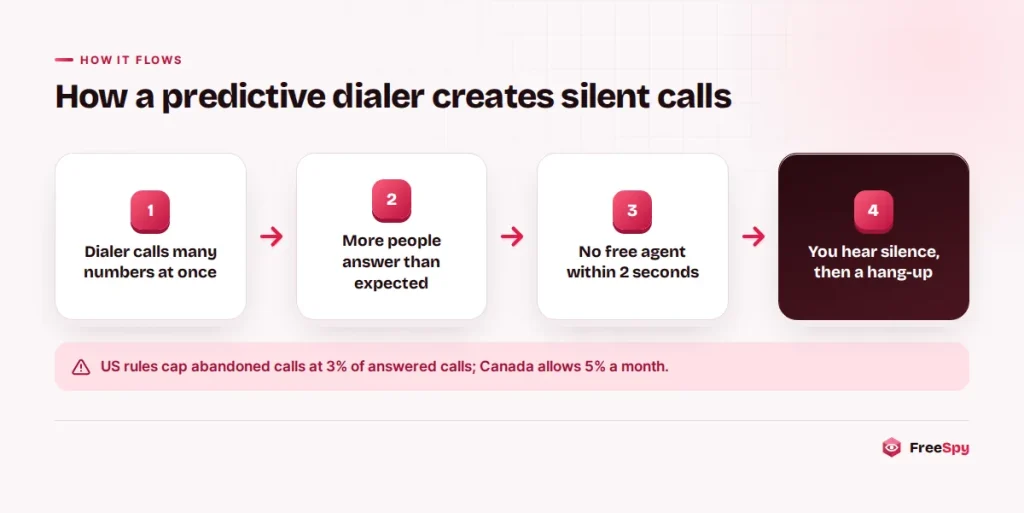
If an agent does come free, you’ll often hear a click or a short beep and then a voice that starts slightly too abruptly. The click is the dialer handing your call over. If nobody frees up, the line just drops.
Two seconds, 3% and 5%: the limits on abandoned calls
Regulators accepted long ago that a few abandoned calls are unavoidable and decided to cap them.
In the US, the FTC’s Telemarketing Sales Rule counts a call as abandoned if a person answers and the telemarketer doesn’t connect them to a sales representative within two seconds of their completed greeting. A telemarketer is shielded from liability only if it abandons no more than 3% of calls answered by a person, measured per campaign or per 30-day period; lets each call ring for at least 15 seconds or four rings before giving up; plays a recorded message with the seller’s name and phone number whenever no representative is available within those two seconds; and keeps records proving all of this.
The ringing rule is easy to overlook, and it explains a second kind of hang-up. A sales call that rings twice and stops before you can reach the phone falls short of the 15-second, four-ring minimum. One such call means little. A company that does it to you repeatedly is cutting corners, and that is worth mentioning if you file a complaint.
The FCC’s rules under the Telephone Consumer Protection Act set the same 3% ceiling and the same two-second definition for telemarketing calls answered live.
Canada’s version, in the CRTC’s Unsolicited Telecommunications Rules, defines an abandoned call as one placed by a predictive dialing device where no live telemarketer is available within two seconds of you answering. Telemarketers may not exceed a 5% abandonment rate in any calendar month and must keep monthly records for three years.
In practice, an occasional dead-air call from a legitimate Canadian telemarketer can be within the rules. In the US, a lawful abandoned call should play a short recorded message instead of leaving you in silence. Repeated silent calls from the same company suggest it isn’t following them. That’s a plain-language reading, not legal advice; the official texts are listed at the end.
Other reasons the line is quiet
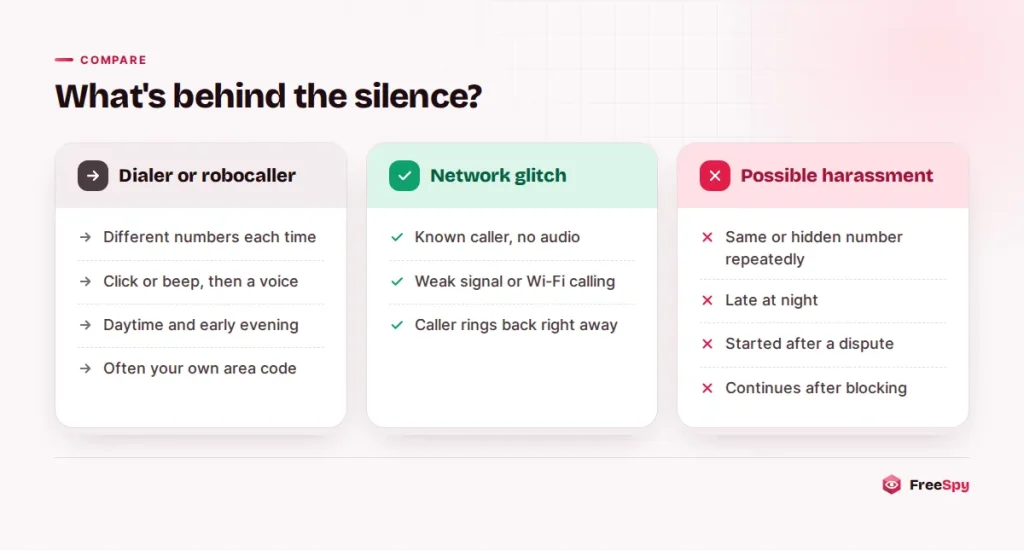
Dialers aren’t the only cause, just the most common one.
Robocall and scam operations clean their lists by calling numbers and noting which ones get answered. A human picking up tells them the number is live and worth calling again.
Some dialing systems listen to the first moment after pickup to decide whether a person or a voicemail greeting answered, and you hear nothing while they decide. A short “Hello?” usually registers as a person. A long, formal greeting can be mistaken for an answering machine.
Networks fail too. Weak signal, a handoff between Wi-Fi calling and the cell network, or a fault in an internet calling system can produce one-way audio: the caller is talking and you can’t hear them. Usually they ring straight back.
Then there are pocket dials and people who misdialed and hung up when they realized.
A related nuisance is the call that hangs up before you can even answer. Those one-ring calls are designed to make you call back an expensive international number, which is a different scheme altogether.
Finally, and rarely, the silence is aimed at you: someone checking whether you’re home, or trying to unsettle you. More on that below.
Most of it is decided before you finish saying hello
An automated system has a very short window to connect you. If it can’t, it gives up. The usual sequence looks something like this:
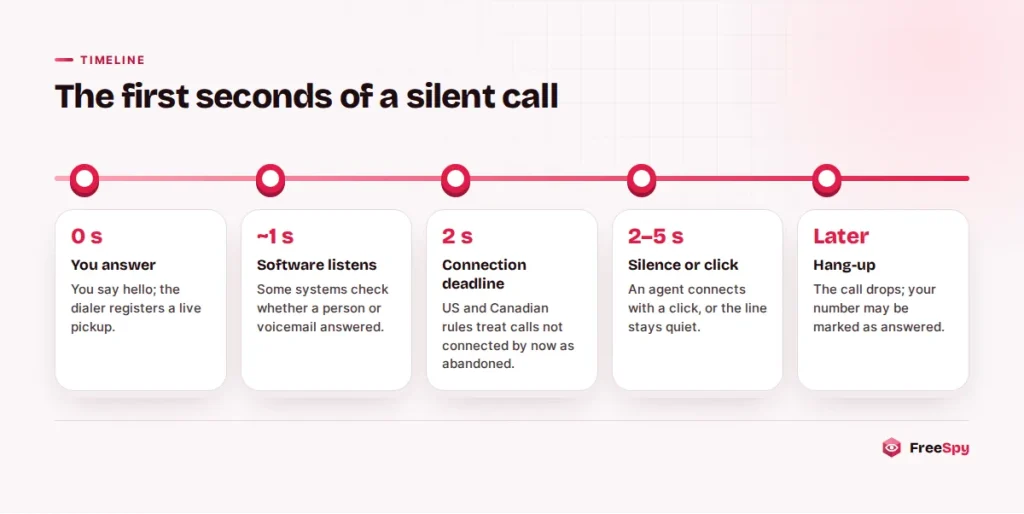
That’s why staying on the line to “see who it is” rarely achieves anything. If nobody was available at the two-second mark, waiting longer seldom changes the outcome, and it can teach the dialer that your number is answered by a patient human.
Picking up isn’t dangerous, but it isn’t free either
Answering doesn’t hand over your money or your data. What it does is confirm that the number works and that a person answers it, which tends to bring more calls.
You may have heard that silent callers are recording your voice so they can reuse a “yes” against you. That story spreads far faster than the evidence for it, and the facts behind the “yes” recording warning are narrower than the warnings suggest. One habit covers every version: don’t answer questions from unknown callers, and don’t press buttons on automated calls. The FTC’s own warning is that pressing numbers to speak to someone or remove you from a list “will probably only lead to more robocalls.”
Hello, two seconds, hang up
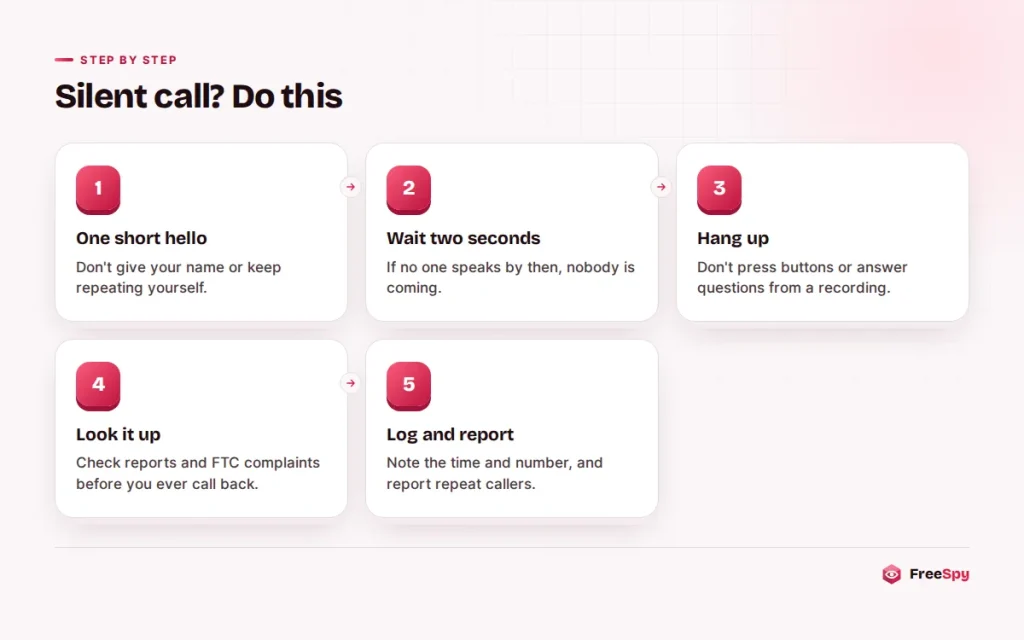
When it happens, keep it short. Say one “Hello?” and nothing else; don’t give your name, and don’t keep repeating yourself. Wait two or three seconds. If a person was going to be connected, it would usually have happened by then. Hang up.
Don’t call the number back unless you recognize it. If you’re curious, look it up first, especially when the area code is unfamiliar, and see whether other people have reported dead air from it or filed FTC complaints.
If the calls keep coming, start noting the date, time and number. It takes ten seconds and turns a vague irritation into something you can act on.
If someone does start talking after a pause, the usual rules apply. Don’t confirm personal details or agree to anything, and if they say they’re from a company or agency, end the call and contact that organization through a number you look up yourself.
Fewer dead-air calls in a week
You won’t stop all of them, but four changes cut the numbers a lot.
- Screen or silence callers who aren’t in your contacts. On iPhone and Android it takes a minute, and the screening settings are similar on most phones.
- Turn on your carrier’s spam filtering. Most carriers offer free tools that block or label suspected robocalls.
- Register with the Do Not Call lists: donotcall.gov or 1-888-382-1222 in the US, and lnnte-dncl.gc.ca or 1-866-580-3625 for Canada’s National DNCL. Legitimate telemarketers then have 31 days to stop calling. Scammers ignore the lists, but registering removes the law-abiding share of the problem and gives you grounds to complain.
- Let unknown numbers go to voicemail. Dialers that reach voicemail usually hang up without leaving anything, which costs you nothing.
When the silence seems aimed at you
A handful of dead-air calls spread over weeks, each from a different number, is a dialer. A different pattern deserves attention: the same number or a hidden one again and again, calls late at night or right after you get home or leave, calls that began after a breakup or a dispute with a neighbor or coworker, breathing or background sounds you recognize, or calls that continue after you’ve blocked a number.
If that sounds familiar, keep a log of every call with the date, time and number, save any voicemails and screenshot your call history. Contact your carrier and ask for the team that handles harassing calls, because carriers can trace calls you can’t. If you feel unsafe or there are threats, go to your local police and bring the log.
Many of these calls arrive with the number withheld, and there are specific settings and steps for hidden-number calls that make them much easier to shut out.
Reporting the number helps the next person
On FreeSpy you can report a number without creating an account. Choose the category “silent/hang-up,” the call type “call,” and add a short, factual comment such as “Silent for three seconds then hung up, third time this week.”
When several people report the same number in a short time, it shows. The site’s risk score adds 8 points for a spike, meaning three or more reports in seven days and at least double the week before, and each number page also lists the FTC Do Not Call complaints filed about it.
In the US, unwanted telemarketing calls, abandoned ones included, can also be reported to the FTC at donotcall.gov. In Canada, file a complaint with the National DNCL.
Short answers
Why do these calls so often show my own area code?
Callers choose, or fake, local-looking numbers because people are more likely to answer them. The number on your screen may not belong to whoever placed the call, so an angry callback can land on an innocent person.
Will blocking the number stop it?
It stops that one number. Dialing operations work through many numbers, so screening unknown callers and turning on carrier spam filtering usually does far more than a block list.
What should I write in a complaint about an abandoned call?
The date and time, the number shown, how long the silence lasted, whether a recorded message played and whether the company has done it before. If a person eventually came on the line, note the company name they gave.
Sources
- FTC Telemarketing Sales Rule, 16 CFR 310.4
- FCC telemarketing rules, 47 CFR 64.1200
- CRTC Unsolicited Telecommunications Rules
- FTC: Robocalls
- National Do Not Call Registry
- Canada’s National Do Not Call List